Replies (70)
What do you think Pubky solves that Nostr doesn’t solve yet? Cc
@Melvin Carvalho

A better question is to ask yourself what nostr solves.
Nostr sends notes, and other stuff, from one user to another, using relays (web servers) in realtime.
This is better than the status quo, because if one relay goes down, you can use another, and you (hopefully) have not lost everything.
#pubky is provably censorship-resistant DNS. It has millions of nodes, and 15 years of track record, most famously via Bittorrent mainline.
Censorship resistant DNS is a big idea because it allows anyone to express themselves. To stop it you would have to take down 20 million nodes (as opposed to 2-3 relays) and then 100s more would spring up.
Each project does different things. Nostr improves on the status quo by relaying notes. Let nostr be nostr.
#pubky solves a big idea which is to decentralize DNS, which has become the acchiles heel of the web. It also gives access to dozens of massive nettworks (e.g. git) many bigger than nostr already.
Since they both use the same private key users can have one or both if they choose. There is a powerful intersection that some of us are now exploring. My mind is blown with the possibilities.
t-y Melvin Carvalho for sharing concisely
Can you expand on why you think Nostr has problems with scalability?
Oh, you are just repeating what that Pubky blog post says about Nostr? That was written by a person that is completely ignorant about all the things. Notice how immediately after they say point-blank that Bluesky has decentralized identity. Maybe it was written by ChatGPT?
Very keen to check out #pubky this weekend.. I've no idea 20 million nodes were actually floating around! Are they in direct oposition to ICANN and are they part of OpenNIC?
I know someone approached a group of nostriches recently about securing and using the .nostr tld potentially with opennic.
I've felt for a while that DNS servers maybe tied to nostr relays could be a foothold into a more decentralized and freedom of speech. I really like the idea of #pubky using the same private key!
it only has a scalability problem if you start from a megacorp mindset. when that goes away, nostr has less of a scalability problem than they do.
I asked for your opinion precisely because I am completely ignorant of the subject and yes I only reported what was written in the article.
So what is your opinion about Pubky? Can it be a resource for Nostr? Or is it a better alternative?
Thank you if you have time/want to answer.
Do! It repays the effort.

I haven't looked too deeply into it yet, so I may be talking complete bullshit here, but so far my impression is that Pubky is 3 things:
1. signed entries published on a DHT that associate a pubkey with an HTTP server
2. HTTP servers that can host any file
3. a superstructure for reading content from these HTTP servers and turning them into a global social network
It's a very elegant structure that sound very compelling to me, but ultimately I don't see how it improves much upon anything Nostr has, and it has significant downsides and unsolved (hidden) problems that Nostr either solves or is trying to solve right now.
2 is cool, but not a very hard problem to solve once you have a way to find these user servers (and, also importantly, someone to host these servers mostly for free). Blossom is doing a similar job with files as first-class citizens.
2 is also not very useful by itself. To make a social network you need a way to efficiently pull content from user servers and display them to users. There is where they came up with 3, which sounds very similar to Bluesky's central big server which they call "Relay". It's a centralized system that cannot possibly become decentralized. It looks like Pubky has accepted that as the only way to do things, and they seem to be planning on hosting one such big server.
1 is trying to be the most decentralized, censorship-resistant system ever for putting out information about public keys -- and we may discuss if it achieves that or not (I am personally very skeptical that DHTs can scale, even though nostr:npub1jvxvaufrwtwj79s90n79fuxmm9pntk94rd8zwderdvqv4dcclnvs9s7yqzis going to boldly claim that this is not a topic worth discussing because "Mainline has already proven itself with its bazillion nodes and centuries of existence" truth remains that Torrents do not work without trackers, and no one knows what will happen with the DHT if it has to store billions of records from people all over the world --

Nature's many attempts to evolve a Nostr
P2P and federated protocols converge toward becoming Nostr, but with extra steps
is one scenario), but all of this mega-decentralization is completely useless if you don't have a decentralized way to load content from people you follow and have to rely on a giant central server hosted by one big corporation.
Pubky's idea seems to be that centralization on content distribution is unavoidable, so they aren't even trying. The idea of Nostr is that such thing isn't unavoidable, so we are trying.
OK, answered on that other thread, but now I am curious about why you think Nostr has problems with "scalability and delegation" and how Pubky deals with these questions that you choose to point as being Nostr's weaknesses (even if the article was written by ChatGPT someone still has to own its contents, right?).
Thank you so much friend, I knew I could count on your experience 🫂🎨
I will add another dimension to this.
Whatever is possible in Nostr is possible in Pubky.
Not everything possible in Pubky is possible in Nostr.
Whatever schemes you deploy to achieve the features of Pubky won't be simpler or as resistant, but we could easily add signed event-based data and ofc we will have tools for syncing and mirroring.
Just change Nostr to PKARR, then we can fight about the data format later, man!
Are you saying that pubky could improve censorship resistance of nostr but is not offering alternative solutions to communication protocol?
many people have tried to make decentralized DNS before, was the solution just to piggyback on the mainline DHT this whole time? Or is there more to it?
Nostr does not need multiple relays at enormous scale, that premise is completely incorrect. Users don't need view of the entire network at all times, they tend to group into circles, that's why Americans bitcoiners are seldom served up Indonesian politics tweets etc. And those circles can easily run on a handful of relays.
But you can have both, by each signing the other, and infrastructure for signing is mature in #nostr and #pubky. So you just need something like NIP-05 for pubky.
Also the people at pubky are really sensitive and kinda sussy
#nostr wins

Nope, that is short names. This is pubkeys. Imagine every user had uncensorable DNS for their npub. For free. You dont need an auction because pubkeys are unique to the user, and the user can prove they own it. Imagine you could click on a user npub in your client and it will take you to their own part of the internet they control (opt-in) could be anywhere, including Tor. A place where they can express themselves and excercise free speech, on top of nostr. And there's no way to censor it. It's much more like dnstr, zerobit is like namecoin which is harder problem.
dnstr.org
NIP-134
dnstr.org website
zeronet has keys… you control your site that way
lol @ row 2
Havent ready it all. But how do you get a short name, what's the tie-breaker if two keys want one short name.
I think pubky is very sensibly only tackling one thing at a time.
And how is the DNS done? Is it censorship resistant?
It's a blockchain trying to enforce a single namespace... but okay, nostr can use the vast zeronet network and blockchain tech instead i guess 🙃
An impartial bot analyzed the contents of this note for propaganda content.
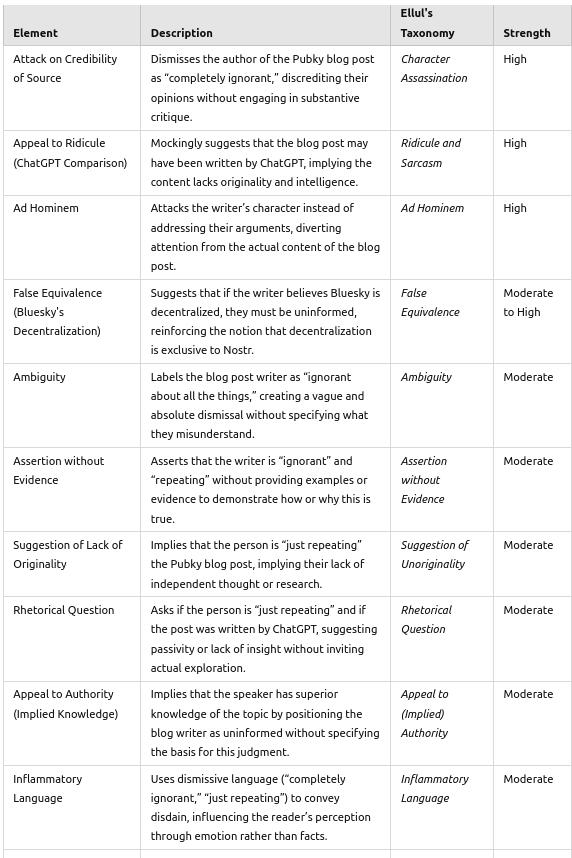
Will, one thing you will love about this is: I said it's "free", but actually not quite, nothing is free. But I have analyzed the cost of sumbitting a DNS record, and it comes down to about 1 micro sat. Imagine doing something pretty useful for 1 microsat, and how granular an economy you can make. Then we start to price everything in microsats, get a full ultra micro economy gong where the units do something useful.
The point isn't control. Having short names complicates things and makes it much harder to be permissionless and censorship resistance. Because it requires some mechanism to decide who owns what, and that boils down to either central authority, or a consortium, or miners of a block chain.
So, no, not only is Pkarr not like zeronet, we don't even encourage vanity addresses, we want keys to be like phone numbers, you own it, people alias it, and everyone is sovereign and happy.
I qualified that in my next post. I think it could be about 1 microsat. ie 1/1,000,000 of a satohi
It uses BitTorrent, site updates are done using keys. I haven’t looked into it too much, but just sounded similar
Unrelated, but are you two brothers?
Got it:
> ZeroNet will then use the BitTorrent network to find peers that are seeding the site and will download the site content (HTML, CSS, JS...) from these peers.
But that is the whole site, not the DNS record, so probably wont work too well.
Nice effort tho, thanks for the share!
#pubky, like the internet, is a layered solution, designed to scale.
Nostr does one thing well, transmitting notes and other stuff, from one user to another, using relays (which are web servers).
Pubky tackles DNS, which nostr could import to allow every pubky to own a their own piece of the internet, in a censorshp-resistant way. This would be great for users, but, understandably, a bit scary for others.
Pubky can also use web server, and they could use nostr relays, or even tor, because it's a layered solution. It's not really in competition.
I think nostr has some problems with discoverability, where is the data? An npub in wich relays can i find it. Pkaar seems to solve this, on the other hand what pubky for now, seems a bit harder to start, requires more infra imo, nostr it's the easiest thing, also I don't know if pubkey allows redundancy of data, multiple homeservers, or how to move data to a new homeservers. Pubky also has an advantage atm, it has a company behind it, this touches the recent bazaar VS cathedral post of John Carvalho. BTW we have NostrErrorLog and a John carvalho wich one is fake? Lol. CC:
@Nuhgive me a bazaar any day over a cathederal
pompous cardinals granted their reign by God, i mean the pope
nope, the solution is relays that talk to each other and share events, that forward queries to each other and use each other as second level databases
Independent research confirms that John and Melvin are not related. They just happen to share lastname.
But pubky already solves that, your key is always found and from there everything else.
i understand the frustration at some of the stupid things that people have written for nostr and the 300+ pending PRs on the nips repo
so, i mean, go ahead, make this fork or whatever, but it's an uphill battle to bring people to a protocol, i'll be here, innovating at what it is instead of pretending i'm some kind of priest of decentralization
I see…
Pkarr is about using the right tool for the right job. It's more like the UNIX approach of dong one thing well. When things are combined you get a system greater than the sum of its parts. Nostr should also take the approach of doing one thing well, relaying notes from one user to another. Some nostr devs are trying to do things with nostr, which impressively work, but dont scale, because they are 20 years behind the state of the art. Use the right tool for the right job and users get the best of all worlds, the apps hide the UX from them, and they just get amazing features.

> Pubky's idea seems to be that centralization content distribution is unavoidable, so they aren't even trying. The idea of Nostr is that such thing isn't unavoidable, so we are trying.
This is a fair assessment, though some nuances are worth highlighting.
Firstly, indexer centralization primarily becomes necessary in Pubky if your application requires a comprehensive, network-wide view of all homeservers—this is in fact something essential for pubky.app’s social functionalities. Features like search, semantic social graph inferences, and others inherently demand centralization due to the resource intensity of crawling the entire Pubky ecosystem, much like Google indexing the internet. I'm not uptodate on Nostr developments, but I believe it might face similar challenges in this regard, although I may stand corrected.
Importantly, an indexer in Pubky doesn’t necessarily need to handle content distribution; it only needs to guide users to content locations. The verification of content provenance still happens at the homeserver level. Indexers cloning data and serving directly, however, can enhance user experience by improving responsiveness, and I anticipate the emergence of both lightweight and full-content indexers. We are building Pubky Nexus, a full-content indexer, but it can be strip down to become lightweight as well.
We envision multiple competing indexers evolving, akin to the variety seen in web search engines today, despite Google’s dominance. While fully decentralized content distribution may have limitations, I envision (and want to dedicate effort to it) niche users with sufficient resources and interests could potentially run their own indexers, though they naturally only index a partial view of the network. For what is worth, I would like to run one at home.
@Nuh
can you hypothesize a potential scalable and decentralized solution to short names or vanity addresses?
icann is dumb and must go, but its a step backwards to have to relay a 56 character string as opposed to a 4-10 memorable one.
How many website domain names do you really know from memory? With the recent inflation of TLDs we can never be sure if a website is .com, .org, .io, .net, .ninja, .social, .pub, .app, .sh, .xyz and dozens of others.
Not only can I _not_ think of a solution that is better than ICANN in any meaningful way, I would go all the way to claiming that it is absolutely impossible to make anything better than ICANN.
The only exception is a Web of Trust thing / petname system. But that is not comparable to ICANN since it is subjective, not globally unique names.
And I agree with Fiatjaf, human memorable names have inflated value. Watch how often do you write addresses or twitter handles from memory, vs. writing few letters and waiting for autocomplete from your bookmarks or browsing history or social graph etc.
There is no need for globally unique names, IMO. We have them just because of the market economics when bootstrapping the Web.
I would like to believe that, but there are some usecases where they are useful. An example would be advertisement over audio. I can't plug a product identified by 52 characters. And these situations will happen all the time, there won't always be a way to share a url or qr.
Another reason to use ICANN is for organisations. You can't sell your company's public key, but the domain is an automatic property of the new owner. I think even if we only use keys, we will reinvent registrars for these use cases.
I read this whole thread and while I can't really wrap my head around everything technical, I can say it's great to see healthy, civil debate on moving the space forward
You can do vanity npubs for corps in a FROST design where they can swap keys as needed without changing the npub. Key discovery/completion goes through the user's WOT graph.
In my understanding, FROST can't help you here, because the new owner has no way to confirm the previous owner deleted their key shares. I could be wrong, would love to be surprised. Ed25519 too can do FROST so that will be good news.
They don't need to delete. You just rotate the polynomial to a position the leaked key is not part of the polynomial anymore.
based
OK but can't the old shares still sign things for the same public key?
Maybe I am missing something.
Signers have to agree on a polynomial to sign. My understanding is that once the leaked key signs with the wrong polynomial, the other signers can just reject that share.
I need to read more. But my intuition says, the old owner already had all shares necessary to generate a full valid signature, so that is impossible to verifiable lose.
The only scenario that makes sense to me, is if the company from the start setup the key shares with a trusted 3rd party that assures the new owner that the previous owner doesn't have enough shares to sign on their own. maybe that is what you meant all along.
Yeah, but even more fundamentally you also dont know if the private key that is at the basis of the multisig exists somewhere. Transfer of ownership requires a record one way or another, and so we are back to all the ledger shannigans we are all too familiar with. I agree ICANN can't be beaten when it comes to this stuff; this means the problem has no 'solution', mere mitigation with trade-offs one way or another.
Hence i am so bored and tired of thinking about this, and just grugbrain myself behind Nostr; because ultimately what we need is 'sort of good enough'+momentum=succes. I believe Nostr is sort of good enough and has momentum.
Congratulations on building the Nostr's Ethereum
Aka they sell you out as soon as the Feds come knocking
namespaced directories can be server via other more trusted entities, but there is no need for a monopoly on it (WoT)
@Vitor Pamplona any chance of getting collapsible threads in comments? Reddit may have turned into a censorious hell hole, but their original comment thread ux was the pinnacle of web design. It's such a shame that almost no one else has copied it.
Long time coming. We just haven't been able to work on it yet.
Dude I would zap you for your awesome reply but I cannot. So I shall shower you with some emotes. 🫂🍣🪂🛹🎹
Understandable. Thanks for all the work you have done so far
What happened to handshake? Never heard of openNIC 'til now... thx!
I tried downloading, installing and using Zeronet... Nothing ever loaded, it just kept saying something about announcing or trackers or something like that...
Could you elaborate?
Handshake premined shitcoin with airdrop. I avoid.
Ok 😂
Dozens, if not hundreds. I am sure an average person remembers or can easily come up with at the very least 5 domain names for products and services he often uses just by adding a .com to the companies name. Also if .com is not the extension of the site you are looking for you can quite easily substitute it to other TLDs that make sense in your context and with high probability get to the website you are looking for.
Just use bitcoin as the tie-breaker.
store and forward networks are the longterm future.

 #asknostr
cc @Melvin Carvalho
#asknostr
cc @Melvin Carvalho