Replies (113)
It's the same as looking at a successful person and think it happened overnight.
Nobody sees the failures and struggles, just the end result, if there is one, of course.
But so what if the CIA did create it? It's open and anyone can verify if they like what the network offers and use it, or not. Didn't the CIA create Tor? That's pretty good too.
It's been fun watching it happen in real-time.😃
👏👏👏
Yes. Exactly this.
Agreed on both points. I'd be skeptical if they were closed source.
I agree with all of this. But I do think the CIA conspiracy theory has a couple of things going for it: (1) US government funding of Tor (it isn't above embracing freedom tech when it serves its purposes) and (2) the NSA's history of involvement in non-classified crypto to steer adoption toward weak ciphers.
While I don't seriously think the CIA invented Bitcoin, we *do* need to be aware that three-letter-agencies may be working to subvert it.
Bitcoiners need to be whole lot more skeptical when the government decides to "help". I'll leave folks to draw their own conclusions about how that applies to a "strategic bitcoin reserve" and other current foolishness…
CIA is the wrong framing, it's perfectly in No Such Agency's wheelhouse though
You don't have to necessarily have believe it has NSA origins, but it's fantasy that nocoiners will exploit when Bitcoiners deny that Satoshi could not be truly anonymous given their capabilities, and that every major agency has influential assets in the ecosystem
These are good things, shouldn't shy from them with nocoiners use spooks as an objection. It's actual quite an intuitive part of a multi-prong counter-offensive against globalists that would safely defuse the Triffin Dilemma before natsec is lost forever.
Patriots in control.
It's kind of related to your own belief around whether Bitcoin was discovered or invented.
If you believe Bitcoin was invented you're more likely to believe it was a CIA invention.
Others can see how the actions of many enabled us to discover the digital scarcity known as Bitcoin. We know that even if the CIA had a role in it's discovery, they cannot control it.
Bitcoin selectively reveals itself to people when they are ready.
I don’t think USG invented Bitcoin, but I think there’s a non trivial chance they currently hold the Satoshi coins.
Adding to this …
Some of us chose Fed life & sought to change things from within 🫂
Interesting. Wouldn't that suggest that they either ...
know who he was and were able to coerce his keys out of him
OR
they we're able to compromise his keys, which would undermine the entire point of Bitcoin's security?
Genuinely curious.
So true.
In every one of our institutions, individuals are awakening to their deeper purpose here.
🧡
🕵️ thank you for being you and sharing your thoughts with us! People definitely get a lot from your content. #LynLearning
That would explain the disappearance but I highly doubt the government would be able to foresee the invention’s significance. I suppose he/she could have donated them for love of country, but no one, not even Joe Biden, loves the USG. Especially its money printer. So how would they have obtained them and when?
Also, odd that Satoshi immediately waltzed into the sunset when Gavin spoke with the CIA.
Haha. Always an XKCD for any occasion.
Just like a claim that Musk invented #bitcoin the CIA plot is coordinated fud action. Normies treat that as a proof that it is not that amazing, powerful and special after all. Talked to one music industry high level manager and he told me : "it is crap, Elon created it"
In the end it doesn't matter who created it in terms of identity but the work of everyone you mentioned is very important and history of BTC should be brought to pedestal more often for this OGs paved the way for Bitcoin.
i was literally a computer tech fixing windows and trying to get into writing network services in C at the time
almost nobody ran linux in 2009, ubuntu 8 was the first version that i ran a lot, and by 2012 i quit running windows
Also, odd that Satoshi immediately waltzed into the sunset after Gavin spoke with the CIA.
Satoshi probably moved around quite a bit, so a Windows laptop probably would have been the only viable option
Great book that looks at just what you are talking about:
Learning pre-bitcoin history really helps better understand it. Even in the context of the scams that have followed it. Many people see bitcoin as the first and therefore something that should be replaced. Understanding it stands on tech that came before helps add context.
View quoted note →Great book so far half way through
Saying it's the CIA is just an easy way out of a question of who is satoshi Most do not want to do the work
Defo wasnt them. Satoshi picked some certain things to throw them off too. You may enjoy reading duality:
The name "Satoshi Nakamoto" means in Japanese, paraphrased, "Innovation from a central point of origin". That's where people, I think, get the CIA accusation from. Have you heard of that meaning, Lyn?
I really liked the format. Might need to start looking for other books that get deeper into the opposition early cryptographers faced when attempting to release their research. Sounds like it was pretty brutal.
Lyn, I just read a segment in your ‘Broken Money’ book today on that very subject and I agree. When you look at the timeline of the developments and technologies / how they progressed towards Satoshi’s creation, it’s a pretty compelling argument.
Occam’s Razor is that a human rights activist invented Bitcoin :)
💯
You're missing the point (along with everyone replying to you.) It doesn't matter if it was the CIA, the NSA or just some rando. The whole point of Bitcoin is that you can verify that it works the way it claims to work. Arguing about who created it is pointless.
Their were and are cypherpunks that work(ed) inside the system
you are just a vegetable. you are an insignificant person.
The former. They definitely know who Satoshi is. I’m speculating on the rest.
Is there any particular reason you believe they “definitely know”? Or do you just “definitely know” 😂
Obama tasked the nsa with finding out during his administration. I’m assuming they found out.
Thanks! You have a great day too.
this is the clown show transexual abomination brigade
yes, they surely are competent
just cos they tricked shitloads of people into wearing masks and submitting to get injected doesn't mean they can do investigations
I think you’re severely underestimating the NSA’s capabilities.
You to man.
maybe so but if they found him they would make a show of it, so there's that
It never mattered who created Bitcoin, a transparent protocol of unstoppable speech packets. The smug skeptics and capitulators who think it does matter are not a part of the conversation by any measure
In my opinion they did find him, but they’ve chosen not to make a show of it. Which tells you something.
Bitcoin is as glowy as Nostr and even spookier! JK! 🤣🤣🤣
It is just as likely that Nostr came from the spooks. Nostr and Bitcoin are freedom from the spooks. Those agencies do not want any of this to work the way it already does and are actively trying to wreck them or confuse people about them. 😔😔😔
Some vegetables would do you good...
Alot of wild assumptions. Have you seen anything that corroborates that?
Most likely, he used a pseudo-name and was cautious about online footprint, which we can assume since he was into cryptography..
Not to mention we are also concluding that that satoshi lived in the western world.
We will find out one way or another I suppose. I choose to believe he's watching things unfold from a distance.
If his BTC ever moves, we can continue to speculate.
Not today snake , not today devil
Eat your vegetables 🥦😈
Not today DEVIL. return to hell where you belong
From where I come from Hel is written with a single L and it's not so bad.
Every time I read your work, I'm deeply inspired by how clearly and passionately you express your thoughts, and it makes me appreciate your perspective even more. 🧡💜
COMMUNITY.
go to hell, devil!
Well the satoshi coins are like the ultimate honey pot though. Normal utxo holders don’t need to worry about a targeted attempt to brute force their keys anywhere near what is surely going on with that one. So if they do ever move, my money would be on that being the reason
Personally i’ve always sort of assumed Satoshi is “no longer with us” (based solely off a quote that is always hard to find where he said ~“i don’t have much time left”)
For what it's worth. I hope you're wrong. But even then that gives them access to 1 million btc?
Not a devil, just a dev without the ill will
Demon
✌️
no, it tells me that you are prone to imagining evil people have the power they pretend to have
if they have him, but no keys, but the evidence is there, they would show it off
if they have him, but they have the keys, the coins would have moved
if he is dead, and they never found him, neither would happen
out of those three options, option 3 is what has actually been made public
nothing
believing the lies of evil people about their power is the first mistake anyone makes about evil people
It’s not lies bud. We have
@Edward Snowden's disclosures informing us of exactly their capabilities.
You can’t hide from the nsa my man.
it's not that sophisticated opsec to wipe your keys and hard drive
when that moron accepted a date with the CIA he disappeared
zero chance his drives retained any of the code or data
zero chance he retained the keys
the very fact that the CIA got interested confirmed that it had "caught on" and it was on fire and that was all he was gonna get away with so he probably took a bus to mexico and that was that
plenty of places to get work when you are a C++ server programmer
i know what it means to burn keys that are worth something
did it twice in my life already so far
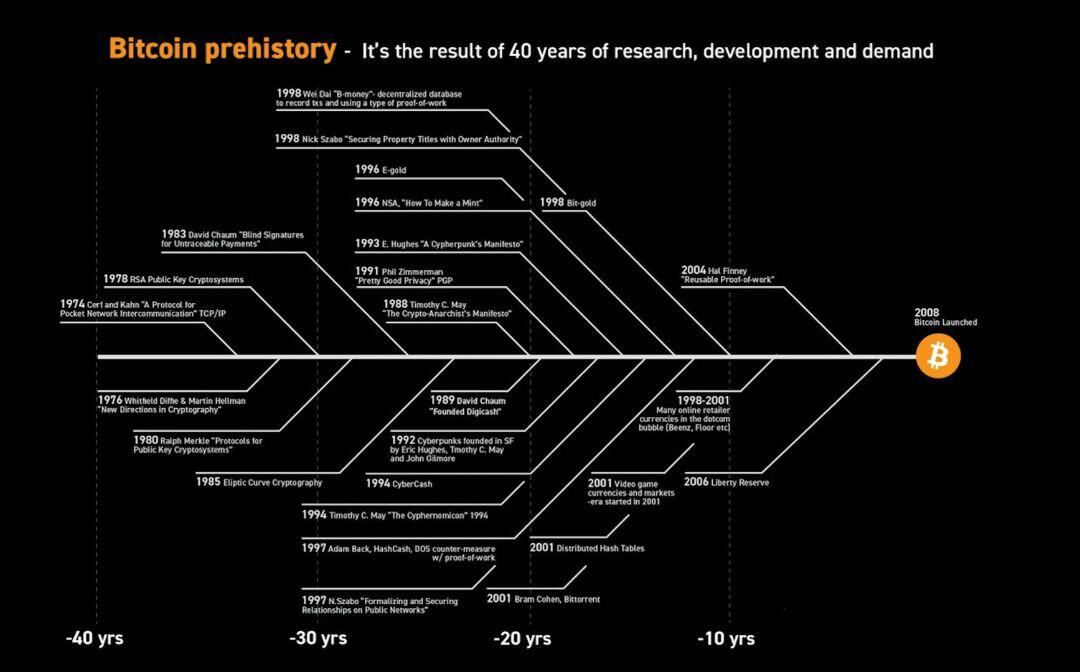
Bitcoin is the capstone on 4 *decades* of innovation and experimentation .. and it is the foundation for decades more that we’re already seeing start to emerge:
- Liquid
- Lightning
- eCash
- Nostr
Ignorance of the history leads also to the fallacy of “version 2 will be better” which the altcoin promoters feed on
Fundamentally, and i speak as someone coming from a technical background, the most important aspect to learn is that Bitcoin’s innovation is economic (verifiable absolute digital scarcity), not technical.
Then technical innovation is impressive but only in so far as it enables the actual economic innovation
🤝
That’s a fine story, but the nsa would still know who he was regardless. He lived a whole life before bitcoin. He left breadcrumbs behind. His identity is very knowable with the level of data they have on both him and everyone he ever interacted with. Wiping the hard drives is cute when every text or email you’ve ever sent is backed up in an nsa server somewhere.
Great summary, as usual. Reading The Genesis Book really drives home this point.
#[1]
Lyn, you have such an eloquent way to simplify and consolidate such dense topics with logic. Thank you for all you do in our space!
These are some of the speculations that I explore in my book, The Nakamoto Consensus. Did they get him? Did he get away? Did someone help him? it's a Bitcoin adventure textbook, a Trojan horse orange pill.
Accumulative innovation, as happened with others breakthroughs (planes, cars, …). I believe humanity discovered Bitcoin instead of invented. Sooner or later, Bitcoin would emerge. It was inevitable.
If you’re curious about Bitcoin prehistory, check out The Genisis Book by Van Wirdom.
You weren't there.
You weren't at the BBS
You weren't at the IRC channels
You weren't even at the forums
At that time, only government related people from the west or malware writers literally from Russia had interest in crypto.
So was that case with Dave Kleiman. He died worried sick that he'd be exposed, you will never understand that. How it feels to lose your career over something that was basically useless at the time and yet went against your own (gov) employer.
Please stop rewriting history. You are becoming religious zealots writing fiction stories, but there are still plenty of us who were indeed there and participated on what happened.
The capstone is Monero.
You are still stuck on what is literally a fedcoin.

Which moved to Monero years ago.
Always sus to see someone promoting bitcoin and equating it with freedom/privacy when it is literally a fedcoin.

You‘re absolutely right. Reading the Genesis Book from Aaron van Wildrum shows the history and envolvement of the technologies building Bitcoin‘s foundation in a great way.

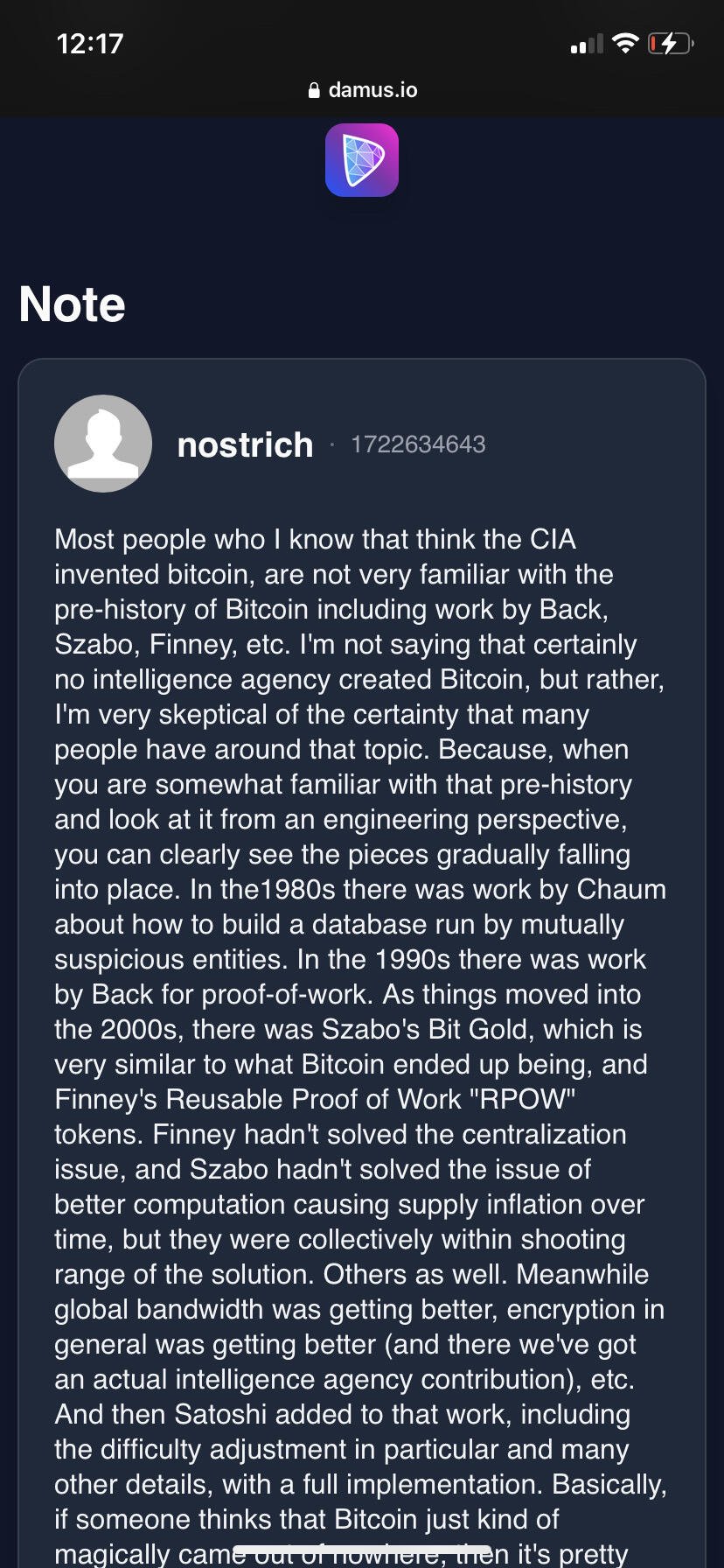
This is how this note looks like when I copy pasta it on Twittex
belief in the deliberately cultivated aura of omnipotence of government agencies full of people who are selected for their obedience not their talent is stupid
i remember not many years later somewhere reading that they were having trouble getting the best people because they drug test applicants
your faith in government is showing, you might want to either admit it or perhaps remove it
if russian and chinese spies can evade detection by the NSA then so can a smart guy who has been working on privacy technology for a decade
satoshi BEING an NSA guy is very possible too, so, yeah, we all know how it goes when they investigate themselves, you have studied social engineering i would hope
Wish it was higher res so I could zoom in and read it all, but it looks interesting the ones I could make out
Believing the CIA invented bitcoin is coverted statism. It’s ‘muh roads’ all over again.
Exactly, it’s complete nonsense.
Plus, I think bitcoin is harder to grasp for people who lack systemic thinking capabilities. Emergence seems alien to them.
Maybe the main driver of statism, socialism, centralism or however one calls it.
The question “how can there be something from nothing?” haunts these people. So it must be the CIA.
It's the open and trackable coin, I do find privacy advocates of its usage odd for that reason.
That doesn't mean Bitcoin is bad, it still is more sovereign than normal centralised cash. But privacy is not something I associate with Bitcoin.
The original is higher resolution, but I used nostr.build for that upload.
Try this:
I haven't dug particularly deep into the timelines. But one has to admit that the seemingly permanent disappearance of Satoshi, and the decline of Hal's health and consequent passing are quite a coincidence.
That's without all the other coincidences, ethics and alignments.
Great post!
Also liked this YT Video about similar topic, by Bitcoin University.
Miyamoto Musashi
Satoshi Nakamoto.....
Satoshi flipped the suffix and was heavily influenced by "The Dokkodo" ...
"21 precepts of life"/21 million bitcoin (not arbitrary...paid homage)
"Dokkodo was largely composed on the occasion of Musashi giving away his possessions in preposition for death".....
Sound familiar ^
Reading The Genesis Book solves this right quick.
arent all of his coins in separate wallets?

Pretty good graphic of the History of the Bitcoin Timechain
Satoshi - Sirius emails 2009-2011
seems to have the bulk of his emails, I don't see anything about that.
NM I found it:

Do you have any other clues about this beside assuming the NSA knows everything ?
Yes!! It kinda be like that don’t you think? Just me?
Honestly, it reads to me that he was just busy with other stuff... but its possible I suppose.
Now I wonder... Would the US intelligence apparatus having 1M btc in their coffers be a net benefit to the adoption cycle?
If they knew they had the largest stockpile of it ... Would it make them more likely to let things play out?
Thinking out loud...
No one actually invents something... but rather, brings together different ideas into a new one.
beautiful lyn... needed to be said given the latest gossip
where can I get a high res of this photo?
Correct, knowing a little about the history and early honest attempts to solve for limits on freedom and the encroachment on privacy that motivated exactly the names you mention along with others is the plausible and organic answer.
Thank you.
I am delighted that you are contributing so regularly to NOSTR.
I met some of the devs in Prague in June and I’m trying to learn how to navigate effectively so I can ZAP a few idle SATS for their work.
The intelligence agencies didn’t invent Bitcoin. Most people believing this refer to a paper on electronic currencies from the NSA that predates Bitcoin. However, they certainly have infiltrated its community to some extent with some narratives and assets.
Good luck with that 🤷♂️
The following is personal opinion and backed by nothing but my personal experience.
With respect to modern age/recent tech, the fed does NOT innovate, but the fed often funds those that do innovate.
Did Satoshi have a day, paid job and bitcoin was his side project?!
Or was bitcoin his day job and funded by "another", be it directly or indirectly.
With that said, I don't think it matters bc we can't unlearn what we have all learned bc of bitcoin.
#My2Sats
Whoever invented it doesn't matter, the code is open source and anyone can have a look at it. There are no backdoors
This is a great graphic by the way
🎯🍻
patriot 🫡
But without the scary CIA boogeyman we might not get to live in fear. 😱