Replies (146)
On one side we have core which has been corrupted. On the other side we have wall street trying to turn Bitcoin into an inter-broker settlements asset.
I feel like I've wasted over a decade of my life.
Dude haven’t you been in bitcoin for awhile? This post makes it sound like you never understood the value prop that was still very clearly explained when I started paying attention to the space. Bitcoin’s value comes from the fact that (1) it can’t be diluted. 21M. And (2) I can easily run a node to verify bitcoin sent to me and broadcast bitcoin I want to spend without any intermediary. Nothing you’ve just complained about has to do with that. And I’m not sure if you are misunderstanding op_return or what but can you explain how the recent change affects bandwidth, ram, or storage for noderunners? I know for a fact the block size limit prevents storage concerns but open to your opinion on bandwidth and ram, though I’m fairly confident the impact there is trivial.
But what would be the point? The miner wastes 500k on adding a bunch of, as you say, low value nodes to the network? What would they relay? Blocks with large op_returns?
Assuming BIP110 nodes are 10% of the network and the miner has added 10% to the total of relay nodes, the added nodes are basically doing what 90% of nodes were doing before. The added nodes would be even more pointless than the BIP110 nodes.
I would really like to understand your angle here and if this could be a threat to Bitcoin in some way.
Yes, shitcoiners together with certain VCs and coretards are attacking Bitcoin.
True, and many more like him - Rod Palmer, Vlad, Rizzo, Tone etc.
Speaking of bad actor influencers like Rizzo ...
 BitcoinIsFuture
The new propaganda from the shitcoiners targets Bitcoin Maximalism.
OP-NET is the new shitcoin attack against Bitcoin.
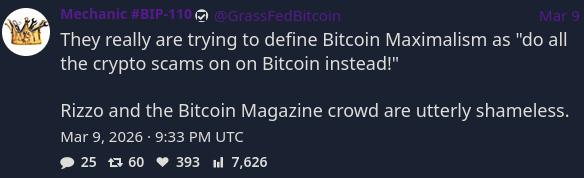
Notice "Ethereum", "programmable money" - Jameson SLopp's shitcoin narrative, "DeFI", "stablecoins" aka slavery CBDCs.
The scammers are out there!
Very well said. I’ve come to believe that #Bitcoin is no longer fighting a technical battle… that’s settled; it works. It’s also not fighting a financial battle. As much as everyone hates it, the fact that the suits are here proves that battle is won too.
The only important war still raging, and I believe it’s eternal, is over Bitcoin’s philosophy, its soul. That this war is currently fought so viciously is not a bug but a feature. It shows Bitcoin is still alive and well.
No actor in the space, no miner, no BIP, no other authority, will lead the way here. Every node on the network is responsible for what they want Bitcoin to be. Act accordingly, whatever that means for you. The results will punish or reward our actions.
Please explain how I am “corrupt”
View quoted note →Solid points. Thank you for the rational thinking!
Thank you for putting the whole clown show into words this well.
You have much to learn.
1) The supply of Bitcoin can easily be diluted with wrappers and paper claims off chain. Past cycle is evident for this.
2) The spam issue raises the bar for new participants bc it’s more difficult to do an IDB (4GB of RAM HW no longer works), you need 8-12 at minimum. The same problem is here for old participants who need to make a fresh sync of the blockchain due to critical errors, or changing hardware.
3) the Blocksize limit doesn’t prevent storage concerns, see below image for details.

I feel the same anger.
Economic incentives can become mal-incentives. Once a mal-incentive exists long enough, entire industries start depending on it. At that point fixing the problem threatens the people profiting from the distortion. The incentive system becomes self-defending. I hope you can see the irony. If you don’t, I can give you some real live examples to prove incentive can be co-opted just as easily and then be turned on its head. See Goodheart’s Law for reference. And substitute “the measures” for “miner revenue”, “security budget” or whatever made up metric you like to justify miners mining spam.
> IMO we should convince people / nodes to change their relay policy back to 80 cap on op_return and to solo mine with ocean defining their own block
We tried this for 3 years.
phrases, keywords
> BIP 110 which is actually changing OTHER people's experience of Bitcoin
Yes, if you’re using Bitcoin as money it will actually *improve* your experience.
If you’re using it for something else, it will degrade your experience. Simple as that.
The question we need to answer is do we want other uses for Bitcoin besides money. My answer is a clear NO and my node reflects this answer.
1) isn’t related to OP but agree paper bitcoin = bad
2 & 3) again, blocksize limit. Are you suggesting that blocks should be smaller?
You are right ; we should continue. 20% of knots and 20% core 30 so 80 pct network running 80 capped op_return.
I would have preferred consensus to have capped op_return but the conservativeness in changing consensus is very important too (and, less so but also, the simplicity of consensus rules)
I disagree with changes implemented in relay policy by core. I believe it is reckless and arrogant. core has too much influence on the network through this type of changes I agree. But I am also happy that core can’t change consensus rules too easily.
I also want home solo mining to increase and I believe it will and we should aim for as much as possible designing own blocks through ocean
Then for BIP-110 itself I understand the motivation, the frustration etc, I am hesitating but it might be (at this stage at least) a bad precedent if it were to succeed and if does not reinforce core
All facts. Nodes must run the show. BIP-110 brings that back into alignment.
You’re missing the point. Models suggest that even if 99.9% of nodes run restricted policy, a toxic op_return and a motivated attacker will still find a way to embed a large file on the network. Core 30 changed everything. Prior to it was possible to limit this attack vector with stricter policy. Consensus change is the only mitigation right now. That’s why it’s more important than ever to realise the risk associated with compromised dev team. We should stop pretending consensus is effective defence against human governance. It’s good enough, but not a painkiller.
No one said incentives could be, at times, wrong.
Voluntary, bottom-up incentives are ALWAYS better than top-down authoritarian incentives.
What spam?
I don’t understand why core 30 changed that. Even before core 30 a motivated attacker could (one of the arguments of core for changing) and it was indeed a situation where 99.9 pct of nodes were a running restrictive relay policy. And if you believe that most nodes having a restrictive or relax relay policy does not matter you can’t be mad at core 30 for changing that.
So my position is : “I wish consensus rules were different but they are the way they are and changing them is not not-costly and should be done carefully” and “I wish core did not change relay policy rule let’s continue to try to gather consensus first on this”
You suddenly think you were neutral?
Let me refresh your short memory.
How did spreading misinformation feel? BIP 110 is a soft fork.
But you gladly amplified the false hitpeace propaganda.
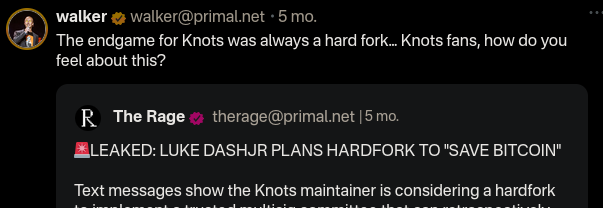
So while you are saying "you are free to run anything" which is true and people can't be stopped to have their free choice and run anything,
you are actively being against Knots. That is not neutral.
I never stated I was “neutral.” I asked you to explain how I am “corrupt.” Still waiting.
Also, when I posted about the hard fork potential that was a looooong time before BIP110 was even proposed. At the time, everyone said there would be no fork whatsoever, because knots filters would solve spam. Looks like that was false.
And Bitcoin Knots itself has nothing to do with a hard fork.
Corruption can have different direct and also indirect effects. Whether you choose not to say a word against David Bailey spammer because of his conferences to which you would like to be invited, whether you choose the side of the comrpomised Core because some of them are your friends, whether you choose not to speak about Citrea because of the investors like Jameson Lopp or Peter Thiel or others ...
There is a reason of each action and there is a root cause.
"ive got friends on all sides" is the manipulative political mantra of a fiat banker.
a man who has "friends" on all sides has ZERO, and is hardly a man at all.
You position yourself where you are with your own choice, voice and actions. Everyone positions themselves where they are.
Bitcoiners have their own opinions and their own points of view. Bitcoiners felt something was not right with Core and started asking themselves Why are Core doing this? Why are Core censoring Bitcoin contributers for mentioning Citrea? Why do Core's arguments make no sense?
That is why they did it and because of that 23% of the Bitcoin nodes are running Knots.
So what I am saying it is that I am not making you anything. I just get the information coming from you which reveals to me your position.
Maybe introspection is good for everyone to do.
overheads...
"shut up and send my tx."
"but spam..."
"that's a you problem. here's your fee."
"thanks..."
💀
These aren’t serious people, Walker. I muted all the BIP110 Knotzis weeks ago and haven’t looked back — not worth the time.
Running core 29.2 until this whole thing blows over 🤷♂️
BIP 110 and Bitcoin Knots filters up 🤙
because
Thnx for this. Finally muted the person you were responding too. Have seen too many lame attempts to stir trouble.
I'm not worried at all. If you don't want to see what's happening, that's okay.
indeed, forming consensus is profound.
so just do that. run your node, explain why it serves your interests, and persuade others.
all other behavior rightfully belongs to the category “kardashian drama”
It must be very uncomfortable to have a fence that far up your ass.
That includes illuminating bad actors like VCs and corrupt influencers. As they confuse people. Calling that “kardashian drama” is disingenuous. Where do you stand, young Neal?
Still waiting for you to explain how I am “corrupt.”
View quoted note →I don’t think you’re making the point you think you are making…

I am once again asking you to explain how I am “corrupt” and a “bad actor.”
what abouth the lightning channel worrys?
Looks like this note must have been posted in the BIP110 group chat. Welcome back to Nostr!
Likewise.
I don’t think you’re making the point you think you are making…
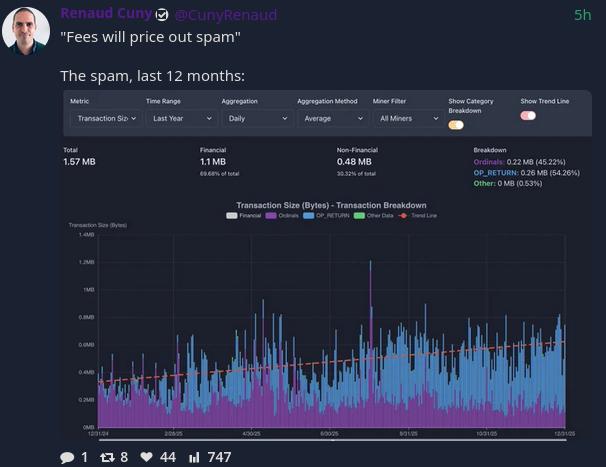
Spam forms currently more than 40% of Bitcoin's transactions.

Shouldn’t knots filters be stopping this?? And why aren’t more people using bitcoin as money??
Bitcoin Knots is stopping spam to enter my mempool. I don't relay spam.
Many people use Bitcoin as money. And their number will grow.

Filters are a quicker and more dynamic way for the nodes, including miners, to stop unwanted data. it's a tool of the whole network. If a fewminers disregard and decide that they will just mine those txs, then 1-the spammers incur in a cost, they loose the censorship resistance of the p2p network, it centralized service and pay a premium to the miners. 2-if this is considered harmful by a majority of the network, and miners are not following the gentlemans agreement, then the only choice is to force them by consensus, it's not by making their choices more widespread.
I use bitcoin as money every single day. You, on the other hand, don’t even have your zaps turned on.
And wrt relaying spam, you just said a bunch of spam had been mined… does your node not relay valid blocks anymore?
My node does not relay spam transactions.
My zaps are turned on. I receive zaps and I zap people. Not sure why you need to lie about this?
Just trying to help you out. I'm not the one with platform to lose. No one gives a fuck what I think. This is not going to end well for you and other core apologists.
Because we’ve seen you at your best. A few years ago. When you had fire in your belly. Because you’re smarter than that. Because you know better than being silent. Than actively trying to mute the debate. Than giving weasel answers. Than gaslighting maxis.
You know what Core did was dangerous, an attack on #bitcoin. The old walker would have defended Bitcoin. That’s why.
You are doing great @walker! I have no idea exactly what things I agree or disagree with you about but I consider you a fully honest broker. All these idiots calling you corrupt don’t even know that you’d be the first one to help them start their own bitcoin podcast so they can say whatever they believe. They would rather come at you and try to leech off all the work you have done to build your audience. Eyes ahead and keep on keeping on sir, we’re thankful you’re in the arena doing the work!

As a philosopher and leader, I focus on promoting principles for individuals to apply to their particular lives.
That’s why I will alway say, in general, bitcoin works by soverign agents acting in their self-interest, so think about what your interests are, and then act accordingly.
Since you ask about my particular interests, here is how I apply that principle to myself.
I have no need for arbitrary data. I have never had need for arbitrary data. I don’t care how effecient nodes propogate meme pool data to give me an accurate estimate for fees. I just want my transactions to be secure and decentralized, and am not willing to trade that off for anything.
So I run software that serves my interests.
I can do that, and stand next to someone who puts monkey pics in arbitrary data, because I believe that Satoshi’s network consensus decentralizes arbitration on contentious matters, and produces a better answer than any individual could.
I’m fighting against tribalism, becuse it is antithetical to the individual sovereign
You can’t outsource your sovereignty.
So I won’t tell you what particular thing to do, just emphasize the principles that make bitcoin bitcoin, and encourage you to be a sovereign.
but Im fucking sick of childish name calling and useless drama.
Advocate for your interests, make the affirmative case for why X serves an individual better than Y, but i’m done with the overselling of “bitcoin is dead if you don’t agree with me”
make the case
believe in bitcoin
believe in its consensus mechanism
participate
if consensus allows monkey pics on chain or csam, hate it as much as i do, im not going to leave bitcoin becuase of it.
this is how the sausage is made, so let’s just make the sausage
the tension is good, but the drama doesn’t serve anyone
it just makes a lot of gay retarded noise
I will also say, the entire “censorship” argument is a category error
and the “who is to say what is non-monetary” line of thought is non-rational, absurd, retarded.
Well put man.
Who calls themselves a philosopher and leader? The hubris.
Sound as a self custody sat
🤣
one who philosophizes and leads?
🤷♂️
it’s not hubris for the man building a house to say he is a carpenter.
I’ve devoted my life to philosophy and leading soldiers.
Now i’m in the bitcoin space.
if you want to go back to clucking, knock yourself out
imma do what i do. 🫡
What I didn't see in your philosophy is the part of the truth and the part of taking informed decisions. Many Coretards do not have good understanding of Bitcoin and just trust the compromised Core devs or some influencers who spread misinformation. Their decisions are not in their own interest. They are tricked to act in the shitcoiners VCs interests. Other than that I agree.
Stop shilling for the core pedophiles.
You know they were funded by Epstein.
When you openly defend pedophiles and then say you're doing it as a bitcoiner, all that does is make normies think all bitcoiners must be pedophiles.
That's all you're doing
Yep.
Can't believe this scumbag walker is openly defending pedophiles again.
I think bitcoin is very anti-fragile.
Satoshi knew bad actors would attack it. I think his consensus mechanism is up to the task of sorting through all the conflicts of self interest.
The principles of consensus make sense to me, so I’m good with participating in forming the consensus by contributing my vector of action to it, and let the chips fall where they will.
lol, my friend you need to do your own research before making a comment like that.
He has a degree in philosophy, and practices the methodology
He was an officer in the military, and lead troops.
Therefore he is in fact both a philosopher and a leader..
He’s also a published author.
Outlining this in his response helps frame his response
Its up to you to consider the effect of the propaganda in the consensus formation. I do consider it.
He's a war monger that supports Israel against American citizens
"people who don't believe in allowing child porn on the chain are attempting to stir trouble"
Lol because somehow stirring trouble is worse than supporting pedophilia
But... You are most : man, richs, withes, obsessed by money, sexists, and do "crypto sectarism" and "techno sectarism" and spam Nostr with that, it's not just a river under gain, it's a cyclone of dirty content
(And you Know what ? There are no spam on the fediverse and they donc claim monaie, don't exclude poeple when they can't pays)
Young Neal: “I just want my transactions to be secure and decentralized, and am not willing to trade that off for anything.”
But
@walker is actively weakening #bitcoin
Then you lose me, and I’m just a humble pleb mind you…you feel like one can’t speak up because of why?
lol. Like i said, the Hubris. Fiat thinking.
couldn’t be further from the truth.
speak up, advocate for your self interest, make the affirmative case
let the principles informing your action stand on their own.
be a beacon for others to reflect upon.
promoting sovereignty, helping others stand, that’s how bitcoin actualizes itself as the unstoppable force it can be.
spending your time and energy speculating about the interior motives of others, trying to tear others down doesn’t help those ends.
some people tear down themselves via their actions and their misinformation or illogical arguments, for example the compromised Core
So segwit should have been an HF.
Apathy is a dangerous game.

Don’t worry, you’re not the only one who doesn’t see what actually changed.
Before that release, about 99.9% of the network - both Bitcoin Core and Knots - were running policy that effectively capped OP_RETURN at around 83 bytes or less. Data storage was not considered a supported use case. Technically possible, but clearly outside the intended design. Anyone determined to do it had to hack their way in through non-standard transactions.
That mattered, because when something is possible but non-standard, the network is implicitly signaling: this isn’t what Bitcoin is for. The legal and moral hazard for node operators stayed minimal, basically zero, because these transactions were extremely rare and the ecosystem broadly agreed that Bitcoin wasn’t meant to host arbitrary data.
Then the default implementation used by 95%+ of the network changed the policy. That flipped the script. Bitcoin went from being a monetary network that merely tolerated rare data embeddings to a system that is effectively agnostic about what data gets stored in transactions. Suddenly you could insert arbitrary data in a standard, non-contiguous way through the official channel. No hacks required. Just follow the default settings. That’s a profound shift.
For sixteen years the norm was: Bitcoin was for monetary transactions, and anything else lived on the margins. With this change, the default stance quietly moved toward content neutrality. Bitcoin becomes not just money infrastructure, but a general-purpose data carrier.
That philosophical pivot has consequences far beyond technical policy. It introduces legal exposure, moral questions for node operators, and a very different set of incentives around blockspace.
Once the default policy changes at the reference client level, you can’t realistically mitigate the effect with local node policy alone. The coordination gravity of the default implementation is too strong. If the network wants to close that gap, the only durable path is tightening the rules at the consensus layer, because that’s where the highest level of network coordination actually happens.
The only “top-down authoritarian incentives” in Bitcoin are the ones created by Core maintainers (5 people) who can apparently make arbitrary code changes to the default implementation without network wide agreement. You’re asking what spam? Are you unable to define what is spam (therefore you’re retarded) or are simply new to this topic?
2 & 3) blocks don’t need to be full for Bitcoin to function as intended. So any additional storage used for non-monetary purposes is simply a burden on the network. Storage optimization should be the obvious default.
UTXO bloat is different, and it impacts the network in two concrete ways. First, it increases the amount of RAM a fully validating node must keep available, since the UTXO set has to live in memory for efficient validation. Second, it lengthens the time required to complete an IBD, because every historical transaction must still be validated against that expanding state.
Personally, I think blocks should be smaller, but that’s beside the point here. Block size is a physical constraint, not an optimization mechanism. It limits throughput, it doesn’t decide what should occupy that space.
Even with smaller blocks, you can still end up with blocks packed full of spam. That pushes monetary transactions into the backlog and raises the cost of getting them confirmed. The constraint alone doesn’t guarantee the space is used for the purpose Bitcoin was built for. It only guarantees that competition for that space becomes more expensive. As we’ve seen, fees don’t outprice spam.

Segwit was a multi year battle and included a hard fork (bch). It eventually aligned the technical and the pleb against miners and became consensus. Bip110 is the technical and the miners against the most retarded of the plebs. It does not have broad consensus or alignment of the users vs the miner and therefore a hard fork is the appropriate course. On top of all this Segwit didn’t need replay protection. Bip 110 does because its activation threshold is so retardly low.
Just like knots was wrong about filters being effective they are wrong about the need for replay protection. This is a bad bip and the people who are bringing it should be socially punished to prevent more retarded behavior in the future.
1. 5 is better than 1
2. I didn't appreciate the change in v30 either and haven't upgraded. Doesn't make Knotzis any better or a suitable alternative.
3. Spam isn't a problem. I know this because I am not new and seen when there was issues.
1. Actually it’s marginally better and it’s not 1.
2. Not upgrading solves nothing. The rest is your opinion.
3. Then you are quite retarded in fact.
Okay Knotzi.
Not upgrading your core node solves nothing.
Filters would have solved spam eventually if Core didn’t release v30. That’s when and why a soft fork was drafted. You’re a complete imbecile not worth replying to, but here we are because you have a lot of readers/listeners.
This ain’t gonna blow over friend. Having said that you’re free to block me too.
Do you remember the slogan “fix the filters”? The wording wasn’t random. It was a direct appeal to the maintainers to repair the broken filters that used to block most of the spam. Instead, the broken filters were left untouched and some of the ones that actually worked were removed (OP_Return).
At the moment, the only filters that behave the way they were originally intended are the Knots filters, and they’re running on roughly 22% of the network. That’s the backdrop for why BIP-110 was drafted.
If that basic chain of cause and effect is still unclear to you, the problem isn’t the argument. It’s your ability to follow it. Your homeschooling apparently skipped the part about adversarial thinking. Right now it’s just hot air under pressure.
🎯
"Your homeschooling apparently skipped the part about adversarial thinking. Right now it’s just hot air under pressure." Hahahabahaahha brilliant.
Ah. You’re coming around. It’s ulterior motives btw. And an attack on #bitcoin involves plenty of them. Somehow you seem afraid to defend #bitcoin ?
might have been wrong bruh... been digging - not that core is correct at all - but that the issue is more nuanced to parse ... mostly due to knowing who and what to trust... currently trying to grok bitcoin-assets and satoshi's positions on nodes v miners as primary...
Popescu seems to have taken miner sovereignty as the final decider...
but this was based, as i can see it, on his notion that nodes were more easily corruptible (BUT I am currently trying to understand if this was a reaction to core initially iterating the software all the way up to v20 and now 30 when the assets guys were trying to "polish the turd" way back at 0.5.3)
now this "miner sovereignty" vs node runner proneness to corruption seems to have been reversed during the blocksize wars where the nodes rejected the fork initiated by the miners...
and AI is now doing nothing but hallucinating so I will get back to it later...
can you add any clarity to this groping of mine?
View quoted note →This isn’t going to blow over.
The bigger picture is that Core v30 demonstrated #bitcoin s only weakness, the CoreDevs. They touch the code. They are zero degrees removed. We can’t have the hardest money be touched by the softest people.
As for saving Bitcoin, the nodes decide. #bip110 makes #Bitcoin a pure monetary network, corrects some of the mistakes of the past and sends a signal that the decentralized immune system works. To move reliance away from Core DevsPretty powerful.
This is the nirvana falacy that is so often repeated by core worshiping sycophants. You are stuck on this idea that if something isn't 100% perfect then it's completely worthless.
Ok now try to follow along here, this is an analogy that you seem incapable of understanding but I'll try anyway: if you have a lock on your door but a burglar breaks in through the window, this doesn't mean the lock is useless.
btw if you have an issue with being called a core worshiping sycophant you should re listen to your episodes with Lopp and Michael Tidwell from last September for two particularly egregious examples.
Great news is I don’t have to upgrade anytime soon and neither does anyone else.
Knots isn’t convincing to me from a SDLC opsec/governance perspective, but I’m open to running another node implementation in the future if it’s up to snuff.
Not here to convince you of anything. Your v29.2 isn’t helping because since v25 the policy heuristics have been manually and quietly altered to justify the drift toward turning Bitcoin into a data dumpster like Ethereum. Your node is signaling to the network that, as far it’s concerned, this is the sanctioned, acceptable state of affairs.
The only real point of division now is the OP_RETURN rate limit, which is merely the final nail in the coffin on the road to Bitcoin turning into Bithereum.
the point is, just bc it's a consensus change it doesn't have to be a HF, even though imo HFs are technically cleaner, but there are other reasons to go SF way. It's not Knots being wrong on filters, filters are in previous versions of Core and they have a reason to exist and they do the job they are supposed to do.
Mempool policy was never consensus. That's the feature, not the bug. Individual nodes can run whatever filter they want. The panic starts when people want that baked into consensus rules. That's the real "Bithereum" move. Paying transactions earning block space isn't drift. It's Bitcoin working as designed.
My point was that bitcoin should still function as intended even if blocks are full. If it doesn’t, we need smaller blocks. Look I see your point that spam is a strain on the network and I agree, but this is in an environment where fees are less than 1 sat/vbyte. It’s not surprising fees aren’t outpricing spam. Censorship of the network is a short sighted solution to a problem that was already solved in the design of the protocol with fee market & blocksize limit. If bitcoin becomes a valuable monetary network the market will solve the spam problem naturally.
Chess not checkers. To many people home school to protect their kids. This is great but you also must give them artificial hardship and teach them strategy through physical and
Mental challenges.
Framing what you disagree with, or is not important to you, as "drama" poisons the well and basically ends any hope for an honest debate. This has been a key part of the core playbook from the start.
i read your post, then re-read my post, and i have no idea what you are responding to.
Can you clarify what you meant when you said: all other behavior rightfully belongs to the category “kardashian drama”? In particular what are some examples of the "other behavior" you mentioned?
Add @odell to that list of corrupt influencers
> Censorship of the network is a short sighted solution to a problem that was already solved in the design of the protocol with fee market & blocksize limit.
- it’s not censorship, filters enforce rate limits, not content moderation. they have always worked like that and never been called censorship until core propagandists and spam apologists started spinning that narrative
- fees and Blocksize limit were only part of the spam solution, the rest was handled by policy and thanks to core, policy is now serving the opposite purpose that was originally created for
What rate limit are we really talking about when fees are less than 1 sat/vbyte?
Again, fee market is the only effective rate limit
Data rate limits care not about how cheap is transacting on chain. It only cares about conserving network resources.
Again, that would be in fact not true. And I personally consider myself an anarcho-capitalist. So I’m sympathetic to your sentiment.
View quoted note →hey just FYI there are a lot of us running BIP-110 who aren't picking fights with everyone. It can still be the logical move forward even if you don't wanna run knots or associate with knots.
Appreciate the civility. It’s rare. However, personally I don’t think BIP110 is “the logical move forward.”
cutting someone down doesn’t help anyone stand up.
name calling, speculating on the unknowable interiority of another, and chicken little “the sky is falling” type of hyperbole belongs in tabloids.
When discourse resembles the dialog of “real housewives of miami” it’s apt to call it kardashian drama.
no matter how wrong anyone else is, makes no difference in whether or not you are right.
so just persuade people why your actions are right for others.
“i like my money being money, so i do X for Y, and Z. I have no use for B and C, and I think they hurt my interest with D and E risk.”
that’s how people make affirmative cases for their actions and negative cases against the opposite.
speak to the principles not the people
not sure if that helps
Doesn’t this prove the point you’re a corrupt influencer? (Rhetorical question, no need to reply)
Only if you’re retarded.
Ad hominem now. You know what that means?
I get why that lands. But what's the actual disagreement here—the tech or the tone?

It’s about the survival of #bitcoin
I had lunch with someone in an Agency whose job it is to kill Bitcoin around 2020.
He said, the single weakest link of Bitcoin are the Developers. They can change the code (granted, we were talking about scarcity). I laughed and said, luckily the nodes decide. They decide what they want to update and download and what not….turns out, the nodes are very passive, complacent, naive and also susceptible to a Sybil attack.
He may have been right, the CoreDevs and half of the key influencers are easy marks.
IMHO, it’s not about the severity of the change, it’s that the development process is the preferred perimeter to attack (and I’m repeating someone else’s thoughts here):
- Cheaper than legislation: Defaults and "safety" framing do the enforcement work.
- Plausible deniability: "We're just improving performance".
- Asymmetric impact: hits sovereign users hardest; institutional wrappers unaffected.
Development-Process Capture = Perimeter Control
You don't have to "hack" Bitcoin's consensus rules to influence how the network behaves.
You can steer what gets relayed, mined, or socially accepted by quietly shaping the development process — who gets funded, who reviews changes, which features become defaults, how releases are timed, and how communication is framed.
If you expect for governments to come out and try to ban Bitcoin, don't because that's not how the system works.
Systems don't rely on bans; they use knobs — adjustable defaults, standards, and processes that subtly guide behavior.
The Bitcoin development process is a dense cluster of such knobs.
Open source ≠ immune
Control flows through funding, maintainers, policy defaults, and release cadence.
There are probably less than a 100 people in the world who have game theory studied:
- the development process control surfaces — where steering actually happens
- what capture looks like
- how capture changes outcomes
- why the development process is the preferred perimeter to attack
…it’s the only thing that can kill Bitcoin.
And
@walker is such an influencer. Slightly misleading, gaslighting, labeling…
You do realize that spammers can circumvent rate limits by broadcasting multiple transactions, right?

Sorry forgot to reply. Basically the original argument was that Core fundamentally changed Bitcoin when they changed the op return limit. As in, they had changed the way Bitcoin worked at a network level. That also means not just for nodes running that software, but for everyone on the network.
But when BIP110 was first introduced, it was framed as 'Core have changed Bitcoin, we want to change it back.' That message may have changed now, but that was certainly the original framing.
Then as time went on the community level of understanding about the difference between relay policy and consensus policy deepened. I had no idea about any of this before this whole drama, and neither did most people.
But now it's quite apparent that Core didn't change the consensus rules, they just changed the default policy to match consensus.
And quite the opposite, it's BIP110 which is actually a change to Bitcoin, and not just for the people running it, but for everyone else too.
That's the only sometimes dishonest feeling thing about the framing, just that it keeps shifting
“Can” and “will” are two different things. I do realise a motivated enough spammer can’t be stopped with rate limits, just like a motivated enough burglar can’t be stopped with a fence and an alarm system. Still, the effects of prevention are there, even if not immediately seen.
bastiat.org/en/twisatwins.html
Ahhh cool. I understand what you mean now. Still running BIP110 though - Core can go fuck themselves because despite what you point out, they don't care for Bircoin or sound money or anything Bitcoiners actually care about.
And what is so prohibitive of using multiple transactions to spam when the fee market is non-existent?
Fees were never the solution for the current type of gamified spam.
I never understood the argument that because there are other loopholes for bad actors, let’s just break the whole thing.
Bitcoin breaks with the removal of the default op_return limit on the reference client, is that what you are saying?
Maybe #bip110 will save #bitcoin , maybe not. But the Core v30 attack by the core devs and supported by corrupt influencers has stripped Bitcoin of its panacea status. Adoption has completely stalled. For Bitcoin to succeed, it needed to solve for two things in the absolute: Scarcity and immutability. The fact that some weakling core devs can just change the code has killed its immutability. The fact that, this day and age, there are only thousands of nodes, not millions, and they are very passive, has demonstrated a weakness in Bitcoin’s immune system. Bitcoin is in a bad way. Maybe Bip110 will save Bitcoin….but until then, yes.
Do you know what immutability means? v30 did absolutely nothing to the scarcity or immutability of bitcoin
I'm not following the bitcoin tech deep enough to weigh in on v30, but the scarcity/immutability thing seems like separate concerns? what made those two the bar for you?
Yes, do you? Immutability is the state or quality of being unchangeable, unalterable, or fixed, representing something that never changes over time.
Core Devs changed to code which changed the properties of #bitcoin away from being money. Increased the attack surface. Decreased decentralization etc etc … and of course, if they can change that, why not other things.
Which brings me back my original question, I never understood why people make this logic error to say, some bad actors are using a workaround to hurt #bitcoin , let’s break the whole thing.
Spot on! 👌
Des, that’s a bot don’t sweat it. Literally everything you’re saying is spot on
lol. Thanks!
Right, but immutability is referring to transaction finality. Meaning you can confidently transact peer to peer without intermediaries and without fear of the transaction being reversed or changed. v30 did nothing to this feature of bitcoin.
Don’t tell me you can’t get simple definitions right either 🤦♂️
Sure it was. If fees were higher people wouldn’t want to bear the cost of spamming on chain. They would use cheaper alternatives
Why are all you AI reply guys/bots so obsessed with me?
This is cope. Core removed the OP_RETURN limit knowing full well it would open the floodgates for spam. Calling it 'just policy' doesn't change the real-world effect. BIP-110 isn't 'changing Bitcoin' — it's defending what Bitcoin was. The framing isn't shifting, yours is.
We ran the filters. Core removed them. We’re now fixing it at consensus because relay policy clearly wasn’t enough — you just proved that. BIP-110 is temporary, surgical, and automatically expires. Every sat you own works exactly the same after activation. The people trying to normalize data storage on the base layer are the ones who need social accountability.

You just called people protecting Bitcoin as money a ‘tyrannical minority.’ The inscription crowd embedding JPEGs on the base layer are the tyranny. We’re the ones running nodes, self-custodying, and refusing to let Bitcoin become a data landfill. Low economic value? Our nodes don’t sell out for VC money. Can you say the same about Core?
Not if they win more or expect to win more eventually. Most gamblers lose money in the casino yet they keep returning.

GM
The “miners will do it anyway” argument has a ratchet built into it that nobody wants to talk about. Every time you use it to justify loosening relay policy, you’ve made it harder to draw any future line — because the same logic applies to the next thing miners find profitable. And the next. And the next.
What’s actually happening is that miner economics is quietly becoming the policy-setting mechanism for the network. Relay policy used to function as an independent layer of network hygiene. Now it’s being subordinated to “well, they’re going to mine it regardless.” That’s a real shift, and it deserves to be named plainly.
The resource cost angle gets chronically underweighted in these debates too. Every relaxation of what gets relayed and stored is a cost imposed on the entire full node set — forever. Each individual change looks modest. They compound.
And the asymmetry is stark: every node operator bears the cost, while miners and specific use-case promoters capture the benefit.
This isn’t really (only) about OP_RETURN. It’s about whether Bitcoin’s governance culture is developing a pattern where the path of least resistance always wins and where that path is increasingly defined by whoever generates the most short-term fee revenue for miners.
That’s an incentive alignment problem, and it doesn’t have a technical fix because it’s fundamentally about values and willingness to bear costs for principles.
Relay policy was never the strongest wall. But the cultural posture behind tearing it down matters.
The cumulative direction of these changes deserves way more scrutiny than any single change receives. The risk isn’t one catastrophic capitulation.
It’s slow drift; where every step looks reasonable on its own, but the destination is one nobody would have chosen if they’d seen the full path upfront.
View quoted note →So you are saying that these spammers will NOT be deterred by increased monetary costs but WILL be deterred by the inconvenience of splitting their spam into multiple transactions. That’s just a strange position to take.
But now you're doing it. You said BIP110 isn't changing Bitcoin, but that is literally what it's doing, changing the consensus rules.
The thing that comes closest to the statement of defending what Bitcoin was is running Knots.
Isn't that an argument to have a new/different/replacement for the reference client though, as opposed to a consensus policy change?
Like wouldn't we be better off with a new Core, rather than a new Bitcoin?
SegWit was a consensus change. Taproot was a consensus change. Nobody called those ‘changing Bitcoin’ because they moved Bitcoin forward. BIP-110 is a consensus change that moves Bitcoin BACK to its purpose. The framing of ‘change’ only cuts one way if you’ve already decided inscriptions belong here.
Very good point about Segwit and Taproot being consensus changes. And they're all soft forks, so in that sense it's also the same.
But, and this is a big but, nobody lost anything (as far as I know) from Segwit and Taproot, e.g. they restricted previously unused functionality in such a way to make the unused functions usable, i.e. giving them structure to actually create new monetary use cases.
It just so happened that by enabling new monetary use cases, they also enabled new non-monetary use cases as a side effect.
As you pointed out, that is different to BIP110 which is a minority of users trying to add restrictions to functionality that other people are actually using right now, not to enable any new use cases, but to take them away.
I'm not sure how I feel about that myself, I'm really on the fence still. But it is important to acknowledge that BIP110 will limit potential monetary use cases on Bitcoin (which would be the sorts of things that would improve scaling and privacy) purely to stop JPEGs on chain.
And in all honesty, as someone who's all in on Bitcoin and who runs a node, I'm not sure I care at all about JPEGs on chain. I can't see how it's affected me. I mean, I already had a 2TB SSD for my node, if I have to increase to 4TB on day then fine. And I don't care about JPEGs that I can't see, they're not bothering me.
What I'm waaaay more worried about is that nobody is really using Bitcoin! All this energy would've been way better spent figuring out how to get actual adoption, because blocks are mostly empty, the chain is just dead, I don't see any merchants trying to adopt it. It's just crickets out there. Suit Coiners everywhere, and everyone else has just moved onto AI.
And then people go on about how "agents are going to transact in sats because they can't get a credit card", and I just think HA, watch how fast the powers that be figure how to get regulatory permission and capture to give AI agents credit cards (or access to their human's cards), and how mindlessly most people will just use whatever walled gardens they're placed in.
So at this stage I feel like Bitcoin is in a massive fight to stay relevant and actually build a network effect, and we're here arguing about JPEGs on chain, and I've never seen one of these JPEGs or had any awareness of any downsides as my node sits there running. But I do worry about messing things up, especially if there are monetary use cases to Segwit/Taproot in their current form. And I worry far more about Bitcoin just stalling out from lack of adoption.
You're on the fence because you don't care if Bitcoin fails as money. You're on the fence and posting with such detailed shit sandwiches because you're being paid to do so or will profit from new use cases on Bitcoin that belong on Etherium. Go play in Eth and stop meddling with sound money.