Replies (75)
We lost the battle a decade ago my friend. This is just the aftermath/ ripple effects of its spiritual blow off top.
Bitcoin momentum topped in 2013.
Look at the gold chart.
Bitcoin value topped in 2017.
Bitcoin is a nightmare for privacy activists. In the last 5 years it attracted literally all the wrong people. None of them will ever use it as money. Everybody trying to make it in the fiat casino, defining winning as doing better than their neighbours.
I hate to be the messenger.
truth nvke.
In this since 2010. Almost seen it all. Some realisations take time.
There are next steps, but I see none of it getting accomplished by Bitcoin.
We need open source hardware
We need alternative ways to enter the internet (mesh)
We need anonymisaton of traffic (i2p)
We need private communication (SimpleX)
We need private transction networks (Monero)
We need decentralise public communication (Nostr)
Bitcoin with its KYC demands is not helping.
99/100 new Bitcoiners enter via KYC.
80/100 use custodians.
Meaning with ongoung Bitcoin adoption current visible problems only will get worse.
One can not ruin Bitcoin. If one can, Bitcoin couldn't work in the first place.
We're still very early, give it a time
That's not true.
Everything has a different life cycle and a life span.
Everything.
Bitcoin worked fantastically until around 2016.
Source: I was there.
Wrong. Bitcoin is developed and maintained by humans that can make mistakes or bad decisions and ruin it.
Hey look, another Monero guy jumping on a "bitcoin has failed" bus and driving through town.
Bitcoin has failed me.
I am just your random Monero guy that coincidentally happened to be in Bitcoin when it all began.
I don't care if BlackRock sees value in it to keep or expand their reign.
Lol
That's exactly why Satoshi chose to build Bitcoin like it's been build (in a decentralized fashion), so no one person can ruin it.
In Bitcoin, one person can make their mistakes and bad decisions without affecting others.
To ruin Bitcoin, super majority of the users has to make same mistakes and bad decisions at the same time, and that's very unlikely.
Bitcoin works now very much better that it was working in 2016 😂
There you have another early Bitcoiner, not shy of speaking the truth.
 DarthCoin ₿⚡️
>extend a credit line against your BTC
In other words: give me your BTC and I will give you fake money that I can create from thin air...
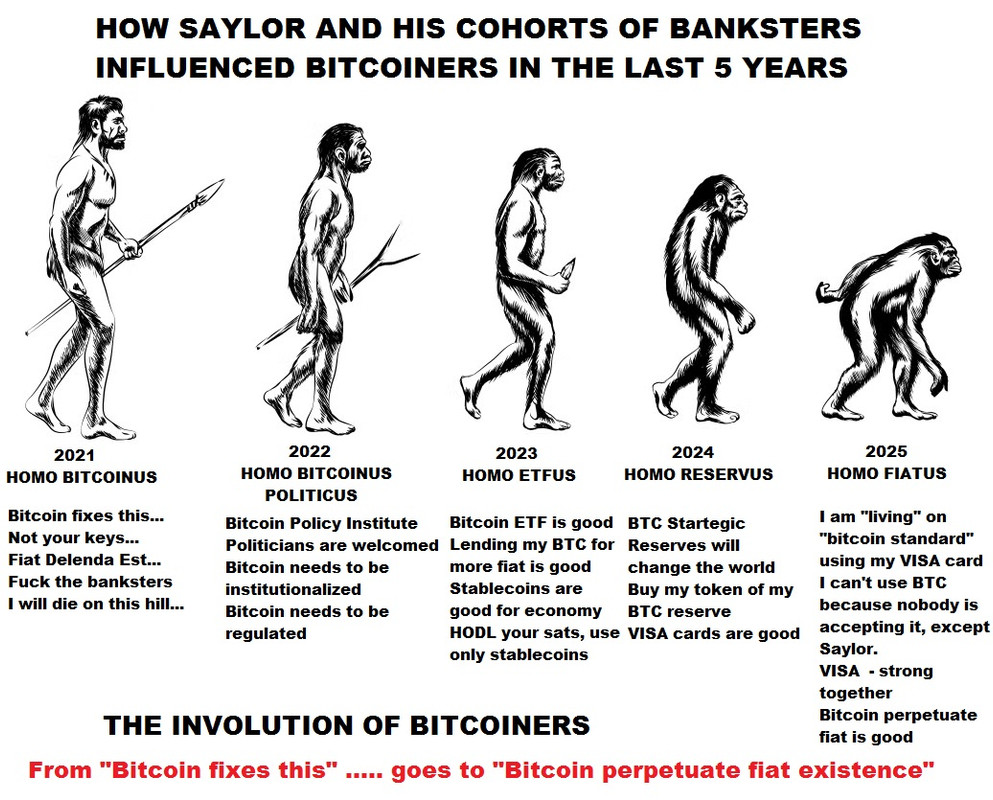
I believe that only way to ruin Bitcoin is by making fiat better money. That would mean that central banks and governments needs to stop printing money. That's very unlikely if looking at the last 4600 years of the history of money.
You're arguing with a Monero guy. They seem reasonable, and they prey on your desire to have a civilized discussion. They'll eventually (usually quickly) appeal to your fears around Bitcoin, and eventually (usually quickly) suggest that Monero is the answer. Don't waste too much time on @verbiricha, I'm sure he's a nice guy, but he's not interested in Bitcoin being the money that the world needs.
I love your enthusiasm, but lol.
If the Bitcoin cruiser is guided by people like you that have not the tiniest bit of understanding how to navigate in an adversarial environment, Bitcoin is indeed already lost.
Luckily there are still a few people in Bitcoin that can make sense of what is happening. But their voices are rarely heard between the cacophony.
yeah, that's almost impossible. there are no incentives to be responsible.
Glad you are addressing me as a Monero supporter so you can tell others to discard what I have to say.
Intellectual laziness breeds complacency.
100%. A lot of people don't understand this. For example arguing too much about nonsense and moving way WAY too slow on post quantum, then one sunny day an unexpected quantum breakthrough and goodbye pretty much all of Bitcoin.
Intellectual laziness? Or smelling a rat? You know how many of these conversations I've attempted to engage in that have ended in Monero? All of them. What's your white flag again? Oh, you got into Bitcoin when it started so you know it died a decade ago. Cool.
What? What makes you so worried?
I was worried too but the more I study, the more I'm convinced that Bitcoin is here to stay.
So maybe you just need to study the subject more. When you realize that there's nothing that can offer stronger assurances, you'll be close there.
PQC is a must. hard forking to fix the block number bug too, i know we've got >80 years still but we should fix it asap.
We might have 8 years. The nature of unexpected breakthroughs is that they are unexpected. Ten years ago nobody expected us to be where we are with AI now.
Going too slow on post quantum is a great way to ruin Bitcoin. We already have the exact quantum algo that can destroy Bitcoin, it's just a matter of functional q-bits, and there are enough teams trying enough different approaches that a breakthrough in the next few years, while still shocking, would not be unimaginable. All the arguing is not helping, in my mind it's a 50/50 whether Bitcoin wins the race against quantum or not.
On the plus side, what a dramatic way to go.
We really don't need to and shouldn't make any changes before we need to. There's really nothing to worry about quantum attacks.
In fact, if looking at the Bitcoin code, we can see that Satoshi have already made multiple ways to mitigate such worries.
Are you kidding? The attack is mathematically proven. There is literally nothing Bitcoin can do in it's current form. It's just a matter of computational resources, that's it.
And no, Satoshi didn't envision anything about quantum computing, Shor's algo (which he could not have know about) and AI assisted error correction (which he also could not have known about).
This for Satoshi is a complete black sawn.
What's your story bro? You seem to be angry? Not yet made it in the fiat hamster wheel?
Still need to show up for a job that you hate?
Or have you had the guts to live fully on your Bitcoin already by creating a circular economy around you. Because that's what I did for both Bitcoin and Monero.
I'm angry yeah for sure. But my observation is right isn't it? That monero is the answer and Bitcoin has failed? I just want to get that clear before I go on.
What I trust less is the big institutional players intentions and wall street, they are no doubt a double edged sword or even trojan horse waiting to undermine everything gained since the genesis block
We won’t fix this with pleas. Gotta kick the shitcoiners out like in the early days (and I’m not talking just about Bitcoin Core).
We're are still at least tens of years away when there even could be enough cubits to brake SHA-256 and way before we'll just update the algorithm.
Bitcoin's design already has features which mitigates the quantum threat:
- standard addresses which don't leak your pub key
- possibility to not re-use addresses
- ~10min network confirmation time that provides buffer
> We're are still at least tens of years away when there even could be enough cubits to brake SHA-256 and way before we'll just update the algorithm
You have no idea. We could be 5 years away. Nobody can know what quantum breakthroughs will or will not happen. (That's true for AI also, which can support the error-correction side). The nature of unexpected research breakthroughs is that they are *unexpected*, and "It'll never happen in such and such a time" is not a very strong argument.
Also to have any upgrade propagate widely enough to save bitcoin from a massive and potentially life-ending system shock we need at least 10 years of propagation, give how human nature impedes propagation. Maybe by 2035 the network will be hardened enough to survive the shock.
None of those "features" you mentioned help avoid catastrophe by the way. A machine with enough q-bits will bulldoze in with ease.
This is a real thing.
Sure, if you trust the physicists and the assumptions without proof of verification.
But the physics of bitcoin disprove their models…specifically the modern definition of Superpostion, which breaks the theory of all CQC models.
Bitcoin (and its physics) stand in direct defiance of this belief. The goal has always been to convince you otherwise. Your castle of cryptography is not safe anon!
Proof or verification**
Lol, please. This is mathematically proven, you just have to trust math, not people. Which, for bitcoin people, trusting math is supposed to be everything. We can literarily estimate how many stable logic qbits we need for short-range and long-range attacks, the equations are all there. And the fact that processors can reliably harness quantum mechanics in the way needed for this is also experimentally proven, has been over and over again.
You can see this as scare tactics by the illuminati if you want. But it'd be hilarious if bitcoin went down because bitcoiners one day decided they didn't need to trust math and physics anymore.

You’re saying “trust math,” but math only binds when its primitives are well-posed. The modern definition of superposition smuggles in simultaneity without a defined clock. “At once” with respect to what unit of time?
If one can break the modern definition of superposition, you break the entire math and theory behind CQC models.
1. Superposition without a time quantum is semantics, not physics.
Superposition isn’t just spatial spread; it’s temporal and it asserts coexistence of incompatible states between measurements. If the smallest tick of change isn’t operationally defined or measured , “simultaneous” is an undefined primitive. Planck time is a theoretical bound, not a measured clock, it has never been measured or observed because of technological limitations, and the fact we exist within the ledger we’re trying to measure. Until you can compute time at that granularity, you’re describing probability distributions, not realized process. The modern definition of Superposition is assumed and has not been proven due to the lack of a measured quantum of time.
2. Bitcoin computes time; physics only infers it. Every block is a discrete, auditable quantum of time and memory created by irreducible work. Proof-of-work collapses entropy into a single conserved outcome at each tick. That is an operational definition of time: energy → structure, recorded forever. Within this substrate, “multiple states at once” reduces to “unresolved proposals in the mempool.” Measurement (mining + consensus) eliminates simultaneity, every step has one verifiable result.
3. “We can just scale to X logical qubits” rests on reversible-computation dogma. Resource estimates presume:
- a stable clock for coherent evolution,
- fault-tolerant logical qubits with nontrivial overhead,
- error models that stay stationary as scale rises,
- a readout that doesn’t reintroduce irreversibility costs you hand-wave away.
- assumes centralization in measurement and observation.
CQC is math on an assumed substrate. Bitcoin is math on a measured substrate: every tick priced in joules and conserved as memory. If your definition of superposition lacks a measured tick, your “proof” is an extrapolation from symbols, not from measurable physics.
You don’t defeat a thermodynamic clock (Bitcoin) with a semantic clock. Until “at once” is anchored to a measured quantum of time, superposition-based certainty is metaphysics with equations. Bitcoin’s ledger gives the thing you’re missing: a verifiable tick where entropy becomes memory. Go verify, the proof is in the work.
There is no second best, there has never been a threat. You just believe a story and deny the physics of the operational system in front of you.
Don’t trust, verify they say.
Fren, we run Bitcoin Knots to protect it.
Majority of Core devs are compromised.
This is tinfoil hat woo-woo nonsense. I don't know where you're reading this stuff, it sounds like some Deepak Chopra of bitcoin physics, but I'd not go back to that source.
All you really need to know is this. The Grover algo quadratic speedup (Order of sqrt(N) compared to the classical Order of N for an unsorted search space of size N) has been proven. First you've got the geometric proof of quadratic speedup, and if you don't believe in geometric proofs you don't believe in anything, since geometric proofs are as final as it gets in math. Next the principle of this same quadratic speedup has been successfully demoed and validated on the current quantum chips, even with the noise they have. As in without quantum chips enabling quadratic speedup what happened could not have happened.
That's it. There is no Deepak Chopra rhinestone-powered magic going on here. And this is why people who are serious about bitcoin are rightly concerned.
1. Enemy has all the Joules they can dream up
2. Playing that card makes all other digital assets and cryptography worthless too
3. Bitcoin is useful until that card is played
Lol. Ok man.
You can append your physics to a fiat model if you’d like, I’m not here to stop you. If you want to believe that particles can exist in “multiple states at once”, go for it. You’re double spending your beliefs.
Grover algo is literally built upon physics and theory that Bitcoin disproves. I don’t care what it proves, it requires non-observable physics to work.
I’m reading from my own mind, my thoughts and my work.
Sorry man. Both geometric proof and real-world experimental proof. Your somewhat wild theory has already been killed off by proof. Done deal.
Lol, the modern definition of superposition is not proven as Planck Time has not been measured. Full stop.
But sure, believe that particles exist in multiple states at once. You need to, the story you have appended your physical belief to doesn’t work without it.
No double spends, except quantum physics 😂.
If you don't believe in either mathematical geometric proofs or real-world experimental evidence then you don't believe in anything, I'm sorry. Bitcoin might as well be powered by Thor's hammer for you.
What does this even mean? You can’t mathematically prove superposition unless you are measuring at Planck Time.
Show me a device that can measure Planck time and process the information between ticks in a logical sequence.
How does one converse with someone for whom nothing is real there's no such thing as proof?
Shrug. Whatever you want to be true, you do you.
You are the one defending a model of physics that claims temporal simultaneity and I’m asking you to prove it at the smallest unit of time, Planck Time.
Where is your proof that the modern definition of superposition exists at the smallest unit of possible time.
You can’t as it has not been measured. Therefore you are operating a model of physics on a convenient assumption and trust.
You're just one of those people that always goes one level down says "prove this exists", and then if someone can you just go one more level down, on to infinity. Gotta stop somewhere or no conversation has meaning.
You used the name Jack but prove the letter J exists. Prove this computer exists. Prove bitcoin exists. Prove the Dodgers are in the world series... Can you prove any of that? I'll wait.
I admire your patience. Some people can not be taken seriously.
This sounds like you are trying to say something, but have been gagged from saying it.
I noticed that you mentioned I2P and not Tor. Personally I believe that Tor has fundamental advantages over I2P. I believe that one of the greatest advantages of Tor is how much choice it gives to the people who participate in the network. Someone can use Tor without relaying other people's traffic, and node operators can opt in or out of being an exit node, even picking and choosing what kind of traffic and clearnet destinations one will allow the user to visit through you.
Not every user has the same values or OpSec. Some people live in countries where running a Tor node is illegal, even if they can't know what encrypted traffic they are relaying. I believe that I2P's choice to have everyone relay other people's traffic is a big problem.
Also, the small number of relays that allow for browsing the clearnet is a problem.
What do you think?
@BitcoinIsFuture, what do you mean?
Bitcoin Knots filters out spam and so protects the network.
Inscriptions spam is fixed in Bitcoin Knots only.
OP_RETURN defaults in Bitcoin Knots are 42 Bytes.
Sad but true
Bitcoin is still a once-in-history opportunity if we Bitcoiners keep it as MONEY not data storage
I think it depends on your usecase. Tor is normie tech. My whole family runs it in the background.
It's good. But if you are not using onion addresses it is compromised. You need to exclude spy nodes from Germany and Netherlands that make up >50% of the network and unfortunately they provide the highest speed.
Use it as much as you can. Ask people to provide you with onion addresses!
Then people in opppresive regimes should look into v2ray.
And in general I'd recommend a VPN on your router to separate ISP from your Tor usage patterns.
Finally you could even use i2p on top of Tor. It has less shortcomings and it's only issue are low speeds because usage is still low, but it's preferable if you want higher degrees of anonymity.
Everybody I know that worked in the field of so called AI 8 years ago expected exactly that. Outsiders maybe not.
That's why I expected BTC to reach at least 10k in 2010. New developments are only reallyvver new for outsiders.
>Everybody I know that worked in the field of so called AI 8 years ago expected exactly that
Find me any paper or blog from 10 years ago (or anytime before "All you need is attention" dropped) that predicted we'd be where we are with AI now and (critically) the specific means of how we'd get here. All there are are general "Neural nets will get better and better" wishy washy predictions of the type anyone can blurt out. Everything that happened with transformer architectures and their scale properties and their application to large language models, that was as out of the blue as it gets, even for those on the inside of the general neural net field.
Your family sounds based.
Even if 50% of Tor nodes were run by the same organization, and even if that organization attempted to deanonymize them, that would still result in only 13% of 3 hop Tor circuits allowing users to be deanonymized. If you are really worried then your push should be to increase the number of hops in Tor circuits. Trying to identify and exclude nodes you think might be malicious is completely misunderstanding how Tor provides anonymity to its users. What grows faster? 2^x or x^2?
But I have yet to see convincing evidence that ANYONE is capable of tracing Tor circuits, especially with the most up to date version of the software. I would like to hear where you are getting your information from, if you don't kind sharing.
I don't have time to say more.
We need more toxicity to shitcoin scammers like core.
You are right in general in regards to (not) exclude certain nodes, but because there is ? a speed component to the circuits, one often ends up with servers from Germany and Netherlands only.
Onion links have 6 hops by default. Timing attacks are a thing. That's why it is good to have a router VPN between you and Tor.

This is metaphysical poetry, not science.
Definitions could help:
Quantum Superposition: a principle that states that linear combinations of solutions to the Schrödinger equation are also solutions to the Schrödinger equation.
The wave equation is a probabilistic function. If you assign a physical "simultaneous" nature, you are making a leap of assumptions into something like the multi-universe interpretation of quantum theory. You are also assuming that time is quantized in the first place, which has been proposed before but is unproven. Loop Quantum Gravity (LQG) comes to mind.
Let me try to unpack some of your assumptions regarding bitcoin in this context...let me know where i may have mis-characterized...
Assumption: Bitcoin timestamps reflect absolute, physical time
Bitcoin enforces causal order, not chronological truth.
Example: A miner could timestamp a block 1 hour into the future, valid under protocol... Bitcoin does not measure time, it measures sequence with loose clock with bounds.
Assumption: Bitcoin’s 10-minute block interval is a universal time quantum
Block time is probabilistic, not deterministic.
Inter-block intervals follow an exponential distribution (average ~10 min, but can be 1 sec or 40 min or more).
Reality: 10 minutes is a statistical average, not a measurement of time.
While Bitcoin does impose a discrete, irreversible ordering on events (via blocks and difficulty-adjusted timestamps), this is not a measurement of physical time, let alone quantized Planck-scale time.
Assumption: Bitcoin’s 10-minute block interval is a universal time quantum
Violation of Protocol: Block time is probabilistic, not deterministic.
Inter-block intervals follow an exponential distribution (mean ~10 min, but can be 1 sec or 40 min).
Difficulty retargeting every 2016 blocks (~2 weeks) adjusts hash rate to target 10 minutes — but never guarantees it.
During hash rate spikes/drops, block times fluctuate wildly.
Reality: 10 minutes is a statistical average, not a quantum of time.
Assumption: Bitcoin’s chain is a universal, objective clock
Time is local, nodes in different regions see different "now" due to propagation delays (~12.6 sec median).
Orphan blocks, reorgs, and chain splits mean history is provisional.
51% attacks could rewrite this time
Reality: Bitcoin achieves eventual consistency, not absolute temporal truth.
Assumption: Bitcoin’s difficulty adjustment measures physical entropy
Difficulty adjusts based on wall-clock time using node system clocks, not physics.
It assumes about 2 weeks of real time, but if clocks drift or are manipulated (within bounds), difficulty can miscalibrate.
No link to physical constants.
Assumption: Bitcoin’s proof-of-work creates irreversible time
Irreversibility comes from game-theoretic incentives, not spacetime structure.
A quantum computer or state actor could still reverse it, no law of physics prevents it.
Hope this helps.
The Schrödinger equation describes probability amplitudes, not physical states. Superposition, as you defined it (the linear combination of solutions) is a mathematical statement of uncertainty, not a physical statement of simultaneity. To treat those linear combinations as physically coexistent states requires an additional ontological commitment, that the equation describes reality rather than our knowledge of it. This is philosophical, not mathematical, and Bitcoin falsifies it by making measurement endogenous to the system (proof-of-work).
You’re right, Bitcoin’s timestamps are not chronometric. Bitcoin isn’t trying to measure seconds; it measures sequence with irreversible cost. That’s the physical and thermodynamic definition of time: the ordering of causally irreversible events. The Planck time analogy is not about duration; it’s about resolution. A block is locally equivalent to Planck, not universally. Bitcoin gives a finite lower bound on temporal resolution within its local universe: a block cannot occur until entropy is expended and consensus is reached. That is a quantum of causality, not a measure of seconds.
Block intervals are stochastic, but discrete. Each block is an indivisible thermodynamic event: a crystallization of entropy into structure. Quantum mechanics itself is built on the same statistical substrate, discrete but probabilistic transitions. In both systems, events are quantized even when timing is probabilistic. That’s the whole point. Bitcoin computes it as a chain of irreversible outcomes, time is not approximated.
Bitcoin is not a universal clock, it is a universal clock architecture. Every node participates in the same irreversible sequence of measured events, locally resolved but globally consistent. This is relativity in computation form: local perception differs, global conservation holds.
Difficulty is not a measure of wall-clock entropy, it’s a measure of computational entropy resistance, the energy required to collapse one valid state from an exponentially large field of possibilities. That’s as physical a definition of entropy as exists in any system, including statistical mechanics.
Every hash computed is a thermodynamic event and energy spent irreversibly, increasing entropy in the environment. You cannot “reverse” the chain without redoing that work. This is Second Law.
Bitcoin doesn’t measure time like a stopwatch. It measures becoming. Each block is a discrete thermodynamic transition; the only kind of time that actually exists in physics. If you can’t measure the smallest tick of irreversible change, you can’t define simultaneity. Bitcoin g computes that tick locally to its network. Physics has only assumed it universally.
I think you may have skipped over this part of my post:
The wave equation is a probabilistic function. If you assign a physical "simultaneous" nature, you are making a leap of assumptions into something like the multi-universe interpretation of quantum theory. You are also assuming that time is quantized in the first place, which has been proposed before but is unproven. Loop Quantum Gravity (LQG) comes to mind.
Your argument is a strawman fallacy, combined with a Red herring.
That isn’t a strawman; it’s a boundary condition. You’re treating the wave equation as a physical engine rather than what it is: a statistical model that assumes, but never defines, the temporal substrate it evolves on. The Schrödinger equation is not wrong; it’s incomplete. It tells you how probabilities change if time flows continuously, but it cannot tell you what time is, or why measurement resolves.
If you assign no physical simultaneity, then superposition has no physical meaning; it’s purely epistemic and a mathematical description of uncertainty, not a statement about reality. The moment you treat the equation as ontological truth, you implicitly assume that its continuous variable t corresponds to something physically measurable, and that is precisely the leap of faith you’re accusing me of.
The issue isn’t the math; it’s the missing physical definition of time in that math. LQG and similar frameworks recognize this gap but still fail to make it operational. They quantize geometry but not measurement itself. Bitcoin does.
So no, pointing to the wave equation isn’t a rebuttal, it’s a redirection back into abstraction. The math works because it’s detached from physical irreversibility. Bitcoin closes that loop: it defines time as work, measurement as entropy collapse, and simultaneity as conservation.
You can’t prove the wavefunction describes reality until you can measure a single tick of reality’s computation.
What does a VPN do that incresing the number of hops wouldn't do better? And do you have any source for your claims that 50% of Tor nodes are compromised, or that timing attacks are currently present and identifying any Tor users?
Also, have you considered the possibility of increasing the default number of Tor hops without relying on onion links? By the way, onion links should not be treated as having 6 hops, since the owner of the onion site knows 3 of the hops and because site owners are treated as malicious in Tor's threat model.
Did you read my post???
"The wave equation is a probabilistic function. If you assign a physical "simultaneous" nature, you are making a leap of assumptions into something like the multi-universe interpretation of quantum theory. "
You use alot of beautiful phrases without definitions
Can you please define the following:
Reality's computation
Entropy collapse
Physically irreversible
Simultanity as conversion
Quantized geometry
Pointing to the wave equation describes nothing of reality. It is a statistical map, not a physical process. The Schrödinger equation evolves a probability amplitude. It’s a mathematical distribution of possible outcomes but it does not define what physically enforces or resolves those probabilities.
Reality’s computation, I’m talking about the physical conversion of energy into information operating at the temporal granularity of Planck time, discrete blocks of reality.
Physically irreversible means exactly that: energy has been committed toward entropy and cannot be retrieved without further expenditure. Aka real computation.
In a discretized framework simultaneity is better understood as conservation. All transactions within a single block of time share the same interval of resolved entropy, the same quantum of time. They are simultaneous because they are conserved together, not because they occurred “at once” on a continuous clock
Quantized geometry, the formal approach to the discretization of classical phase space into countable informational units.
I think your theory needs more work
How about this… “discrete blocks of reality” seems like non-starter to me. There being a Planck time, the smallest amount of time measurable, as opposed to continuous time where there no smallest unit of time… Planck time, I would think would make superposition/quantum more possible and not less. Because in those gaps of nothing, anything can happen so anything is possible in the next time tick. Continuous time wouldn’t allow for that.
It’s not my theory, I didn’t invent Bitcoin. I’m pointing to what already exists: a physical system that measures time, energy, and information in real space.
You can debate my language all you want. Bitcoin is the experiment and the measurement; the proof that entropy can be measured, conserved, and verified without assumption and a quantum of time can be computed. It’s not a theory of physics; it’s physics running since 1/3/2009
If you want to bet against Bitcoin go for it.
ISP will know that you use Tor if you don't put a VPN in between. VPN's a much more commonly used so it raises less suspicion.
Not saying that 50% are compromised. Just saying that > 50% are in just two jurisdictions that make information exchange likely.
Recently DNM have been taken out by German police.
More hops would be nice, especially since overall Tor speed grew by a big factor in the last 3 years.
Need to look into how onion nodes view the network. Which makes me think that i2p is even more necessary than I thought first.
IMO, Bitcoin doesn’t support the modern definition of superposition, it disproves it. Its probabilistic structure more accurately models superposition as bounded future potential, not overlapping realities. Unmined transactions are not “real”, there is only the longest chain of events and nothing else. Our universe is also entirely transactional peer to peer network of bounded energy. Each (Planck & Bitcoin) block of time represents a discrete thermodynamic resolution of entropy into conserved memory, eliminating paradox and restoring compatibility with general and special relativity by defining time via thermodynamics and entropy. We live inside the ledger and experience its contents as a fraction of the ledger. In Bitcoin we see both sides of the ledger, the entropy resolved and the registration of information. By treating probability as a finite, energy-constrained field that collapses with each mined block of time, Bitcoin resolves what QM and relativity could not: the reconciliation of uncertainty with causal order.
I’m not here to invent a new theory as we are nearly correct, but I am here to use Bitcoin’s physics (its computed, finite blocks of time) as a reference frame to understand Planck-scale structure and reframe past knowledge thru the lens of Bitcoin. Both Bitcoin and the Universe are closed informational manifolds evolving through discrete, irreversible timesteps. To me, Bitcoin reveals that the universe itself must compute through similar quanta of energy (Kelvin) and memory, exposing continuous-time models used in CQC as approximations. The correction to quantum mechanics is subtle but decisive: time is not a smooth variable; it is a sequence of measurable commitments.
As Saylor said, all models are destroyed, there is no second best. Bitcoin is open source physics.
Doesn't the Tor client make an effort to diversify node jurisdictions? Three hops; two problematic jurisdictions. Seems good to me.
Also, people on the darknet are always getting caught. As a rule of thumb, it's pretty safe to assume it's due to independent infosec mistakes. There have been dozens of cases of the media making a big deal about a Tor user getting caught, and every time more information emerges we find that they made numerous infosec mistakes that had nothing to do with Tor.
Nit that I am aware of. But it should.
I mean, if it was always choosing the fastest connection,it would obviouslh just connect to the same node 3 times so that the signal doesn't have to bounce around the world.
By the way, I came up with a scenario where excluding German nodes could end up compromising a person's identity.
Suppose someone has a personal Nostr account that they sometimes access through a Nostr relay with a .onion address. And suppose this person also sells firearms on the darknet in a country where the state does not recognize a right for citizens to bear arms.
What this person doesn't realize is that the government currently has access to both Tor services. Over a long period of time, the government observes that across the two sites, there are exactly two users whose third node is never a German node. The firearms seller on the DNM, and the one user on their Nostr account. So they track down the author of the Nostr account based on some selfies they took, and have them executed. Suddenly the firearms sales stop.