#Bitcoin
#LightningNetwork
#Freedom
#Peace
#Truth
#Love
Bitcoin, NOT cryptoshit!
Not your keys, not your Bitcoin!
CBDC is slavery! Bitcoin is Freedom Money!
Nostr Public Key:
Public Key (Hex): 77f56243a824d22573fb755dd52c73c14986d15c0c98512d45f4deb08e9f879a
Public Key (bech32): npub1wl6kysagynfz2ulmw4wa2trnc9ycd52upjv9zt297n0tpr5ls7dqk5caw8
Nakamoto Consensus solves the Byzantine Generals Problem by combining a Proof-of-Work (PoW) puzzle with a strict cryptographic "longest-chain rule." Instead of relying on identities or trusted central parties, the network establishes agreement on a single history through raw computational power. [1, 2, 3]
## How Nakamoto Consensus Establishes Agreement
The core breakthrough of Bitcoin's consensus mechanism relies on four interconnected pillars:
1. Proof-of-Work (PoW): Nodes must expend computational energy to find a specific hash value. This makes creating a block costly, ensuring that adding new data to the ledger requires a verifiable sacrifice of real-world resources.
2. The Longest-Chain Rule: Nodes always accept and work on the valid blockchain that has the most proof-of-work embedded in it. If a node sees a longer valid chain, it abandons its current path and switches to the longer one. [1, 4, 5]
3. CPU Voting: As Satoshi wrote, nodes "vote with their CPU power." Honest nodes express their approval of a block by building the next block on top of it. They reject invalid blocks simply by refusing to mine on them.
4. Economic Incentives: Miners are rewarded with newly minted Bitcoin and transaction fees. This makes it more profitable to support the network honestly than to spend resources trying to attack or manipulate past transactions.
## Visualizing the Longest-Chain Rule
When two miners find a block at almost the same time, the network temporarily splits (forks). The tie is broken when the next block is mined, as nodes immediately switch to whichever chain becomes longer. [6]
## The Byzantine Generals Problem Solved [1]
Traditional distributed systems require participants to know and trust each other to agree on a state. Nakamoto Consensus solves this in an open, anonymous environment by ensuring that changing the past requires an attacker to control more computational power than the entire rest of the network combined (a 51% attack). Because doing so is monumentally expensive and economically self-defeating, the network remains securely in sync.
Would you like to analyze how block propagation delays impact this mechanism, or should we look at how the difficulty adjustment keeps block times stable?
Miners having the power over the network means they can do whatever they want.
They are low time preference players.
If the below is true, they can say - Hey, we need to make mining profitable again so we will increase the block rewards, meaning we will increase the 21 Million Bitcoin limit. This will be important for the security of Bitcoin and the network.
For the slow ones, this will mean that your Bitcoin will be diluted. An inflation of the supply just like with the fiat funny money.
And what can the nodes / Bitcoiners do if they are irrelevant?
Scream on social media? We did this and failed with BIP-110.
Any other ideas?
View quoted note →
This is how countries and their citizens are attacked. What if the attack comes from inside.
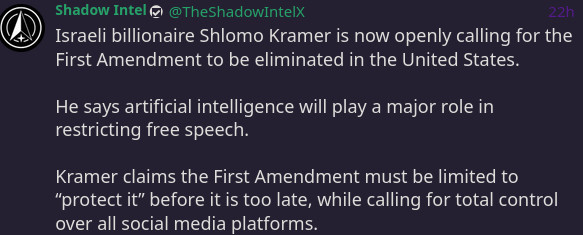
The First Amendment to the U.S. Constitution protects five basic freedoms: religion, speech, press, assembly, and the right to petition the government.