Replies (74)
The perks of vendor lock in have been revealed
Is their node not interoperable? Where are the walls?
cashapp users bro
they charge for onchain and fiat transactions too
lmfao sad
How is that different from the LSP model? I assume not giving users the option to use other routing nodes plays into it.
The bitkey is a wall. Keeps them in the same reservation
That I see. But does bitkey use LN? I thought it was on chain only.
There's actually a lot more to this!
The directionality of their traffic is a massive factor here. This isn't a result of cash app users paying fees to c=; is because users are paying OUT.
No not now. I’m projecting into the future. Just noting the incentive for further lock in
if a cashapp user wants to pay or receive on lightning they have to use their node
presumably thats the majority of their routing revenue
extrapolating this to routing nodes that do not have user lock in makes no sense
Hmmm. Good point. Makes me think of what
@Carman is working on. Tiered custody. Building to self custody.
Right; this isn't reproducible by most routing nodes.
You have to be driving massive volume and actually paying out via lightning.
Payroll providers could reproduce this.
At this point, the word “yield” is a red flag.
This isn't true. The yield figure excludes routing revenue we earn from block products, it's all external.
💯
surprising, can you share more info?
yeah, literally just their own processing fees for Cashapp (and now Square) send/receive
real generalizable yield numbers would be from pure routing nodes - not exchanges lol
I assume this is on top of the spread they already have for the bitcoin buy.
doesnt this imply that it includes cashapp volume?
are we just debating semantics on what is internal vs external
All our channels and feerates are public, anyone can see where we allocate liquidity and how much we charge for routing. This alone is extreme transparency. Unfortunately I'm not sure what else I can share.
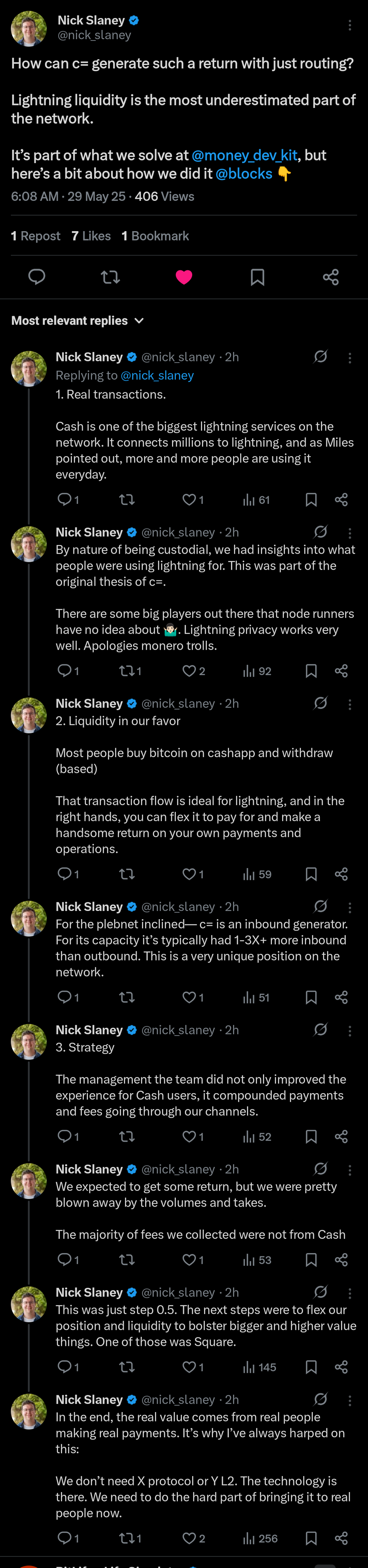
The screenshot
@Jestopher shared from
@Nick Slaney goes into more detail than I can.
@Nick Slaney founded c=.
flex? walled garden?
where is the vendor lock in?
🤔
flex was referring to gentry not miles
miles crushed it, great keynote
presumably this numbers include transactions going to and from cashapp users?
if that is the case it does not make sense to extrapolate these numbers to routing nodes that do not have user lock in
I put it here for you Matt
View quoted note →
Tyler was the goated data scientist running the management on the node. There are only a few people who “get it” like him.
these nostr posts are unrelated lol
thanks nick, does this not imply that transactions to and from cashapp users are included in the published numbers?
is it fair to say it is unreasonable to extrapolate these numbers to other routing nodes?
Tyler was likely the one that pulled that data. This was all outside of Cash transactions.
Theres still a lot to be made out there if you know where to put your liquidity, but that edge fades over time (as word gets out that we were doing well!)
The most will be made by being a real economic actor on the network. But there are still plenty of places that need liquidity and that is a constantly growing and changing need.
Bitkey.
The juicy lightning yield strikes me as a strong incentive to keep more people locked in if/when a lightning integration comes to Bitkey.
Even if you exclude Cash App customers the yield # is very strong
It's pretty obvious what is driving the success of the c= node just by looking at the channel open/close history. Without the CashApp nodes feeding c= there is unlikely to be any routing at all since the fee structure does not support it at all. Only by carefully selecting peers to open channel to with the CashApp funds you are able to create a very well run "routing" machine.
You guys are obviously doing this very well but again, it's not possible without the unique position you are in with the CashApp nodes backing it up.
I also kinda agree therefor that it's a bit misleading to say the 10% APR is earned from routing while it's just clearly not. Pure routing is something very different than what your are doing. What you are doing is what I would personally call LN liquidity trading.
Liquidity trading is what many nodes do but for the rest of us the economics are very different because we actually have to pay to get the liquidity to where we need it.
What’s the number?
???
everything up
Why would they integrate LN to Bitkey. That product is not for every day use, it’s to secure long term savings.
CashApp already has LN integration.
They could allow users to open Bitkey app in a spending mode as standard, where the users could only have access to the lightning balance, and with an option to access the long term saving balance by using the Bitkey device.
Simply noticing the presence of an incentive and a tool that could be used to exploit that incentive.
1) Lock people in to self custody within the square/cash app ecosystem (seedless Bitkey)
2) build a convenient lightning bridge from Bitkey on chain wallets
3) profit: as medium exchange takes off harvest the elevated lightning fees from the vendor locked in Bitkey enjoyoors
The APR comes from payments that aren’t from c= / Block. I don’t know how you don’t call that routing. Those are other nodes using that liquidity and paying for the privilege. You can copy c=‘s strategy if you’d like.
You are correct there is more value in running a business that assists or directly does lighting payments over running a “pure router.” There’s room for the latter but it can be tight.
To be clear, I think it’s great Bitkey exists, great to have options, especially for the noobs, just noting an incentive that isn’t great especially in light of the marketing FUD against seed phrases.
@DETERMINISTIC OPTIMISM 🌞 is right that seed phrases are a super power and we should be wary of undermining the interoperability of bitcoin wallets

The people who understand seeds, will not be affected by Bitkey marketing. The marketing is for people that fear, with reasons, having to write and protect seeds to not loose all their Bitcoins.
Imagine being afraid of having to keep safe a titanium plate. 🤡
Personally, I would prefer to have my life savings (if I used Bitkey) separate from pocket money.
I don’t think the typical CashApp user cares too much about custodial vs non-custodial for LN and they likely don’t want to evade taxes, so using CashApp provides a better user experience. I don’t think the market needs another LN wallet, but if the demand is there CashApp will make one that’s noncustodial. I don’t see it happening tho.
The only mechanism to earn on LN is from routing fees, so yes, you are technically correct. All earnings from LN fall under that umbrella.
What I'm talking about is what the driving force is behind your capacity to route. And that is very obviously the countless CashApp channels c= receives every day, which causes the inbound to be increased and then used as a pressure mechanism to enable the routing. The APR might not come directly from Block, but the liquidity to make it all work is.
It's the same as me setting up a separate node that I constantly feed with liquidity and then say I made a huge APR on that node because it routed a bunch.
But you may choose to call it APR from routing, and that's fine. I personally think c= categorically works in such a different way compared to any other node that something like APR does not really have meaning anymore and it becomes inappropriate.
The marketing FUDs one of the most important aspects of individual sovereignty within bitcoin. Not good. It could be offered as a noob wallet without also FUDing seed phrases
Does c= only route Cash App txs?
Human flourishing is synonymous with personal responsibility. We should do everything we can to encourage it
Sounds like they are routing a massive amount of txs and Cash App users have low weekly limits on lightning txs. Also, doesn’t seem like many Cash App users currently use lightning that much compared to other wallets.
You don’t have to write down a seed. There are many easier alternatives. Bitbox does a dead simple SD card backup, the new Foundation attempts an NFC card backup. This feels like a throw the baby out with the bath water rather than fix the problem approach.
It's not a newbie wallet, is a wallet that understands that seeds are for very few specific people. I use Bitkey and I don't consider myself newbie, but I understand that I can't care of seeds without making mistakes forever and to be honest, I think even people who thinks are smart, will probably make mistakes at some point in life.
That is exactly what I want .. bought bitkey only for being able to use it as my SATs payment device ( lightning or whatever ) without having to lug a phone with me .. but later found that it doesn't yet SATs do thing 😀😀
Do you think there is something wrong with this approach ?
I 100% agree! Unfortunately it seems I see less and less of it.
Just say, “Scared to” lose your seed phrase, don’t be with Bitkey.
Doesn’t take away from the value and power of the seed phrase, while promoting the value of their product. 🤯
I get confused a lot too
>is it fair to say it is unreasonable to extrapolate these numbers to other routing nodes?
absolutely. c= has a few advantages but the main one is our proximity to a service that facilitates real payments from real people over lightning. this proximity creates the liquidity dynamic that let us earn routing fees from the public network (where cash app is neither the upstream nor downstream channel partner).
makes sense, appreciate you
Easy for thousand dollar networthers to say that
Taking possession of your bitcoin is an expression of personal responsibility. Bitching about people doing it “the wrong way” is weak.
Do you think it’s wrong to encourage people to take more responsibility for themselves?
That’s not what’s happening here
Here’s what I said:
“Human flourishing is synonymous with personal responsibility. We should do everything we can to encourage it”
What’s your beef?
You said a lot of things besides that. You know what I was referring to, so spare me the quote lol
I have no beef. I’m just calling out the hysteria about a marketing campaign that’s totally benign unless you’re a competitor that’s losing business to a more user-friendly product.
Excellent thread, thanks for sharing 🔥
🤔🤔🤔😓
??? 😏😈😈😈