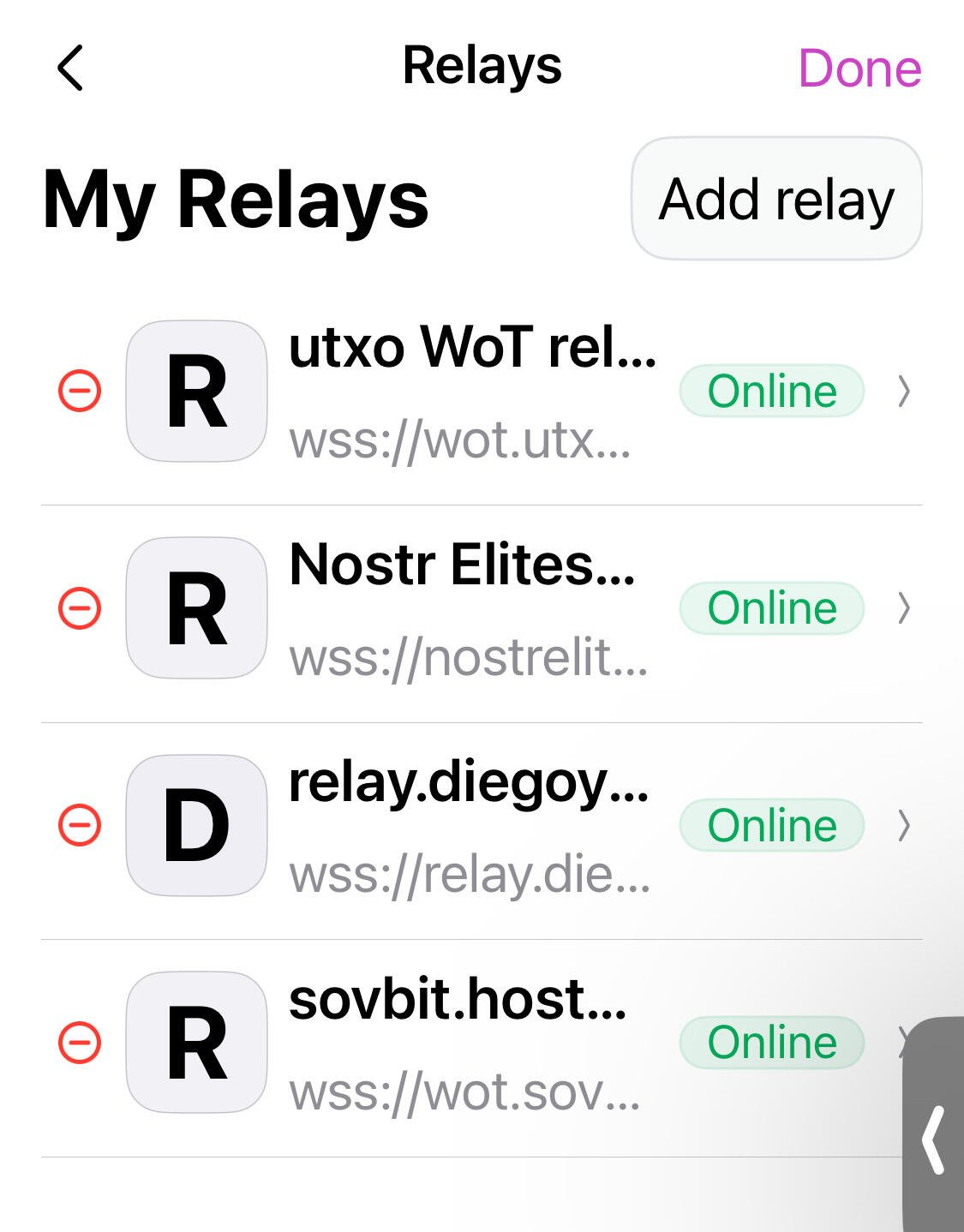
if you're running a WoT (Web-of-Trust) relay, please let me know. I'd like to compile a list. wss://wot.utxo.one - @utxo the webmaster 🧑‍💻 wss://nostrelites.org - @Derek Ross wss://relay.diegoyegros.com - @Alezkar wss://wot.sovbit.host - @Enki What's a Web-of-Trust relay? It's a type of relay that anyone can read from, but only certain people can write to. If the owner follows you or one of the people that the owner follows, follows you, then you're considered inside their Web-of-Trust. You can then write to this relay! Example: I follow @jack but I do not follow @billybob. @jack however does follow @billybob. Therefore, @billybob is allowed to write to my WoT relay. Even if you're not inside a WoT, you can still use these relays for reading Nostr content. This relay software also fetches and archives content from people inside the WoT automatically. This means users inside the WoT don't even need to choose these relays and write to them for their content to be available on these relays. And then readers can enjoy this content with little to no spam. Cool.

Replies (43)

This is exactly why "trust == follow" is too crude and we need contextual trust. If I set up a company WoT relay and followed my personal account with it, a bunch of (lovely) memers would be posting memes on that professional relay. If instead my company account could attest that it trusts my personal account "for programming" and my personal account trusts a handful of npubs "for programming", then the WoT relay would tend to have more programming posts and fewer memes. Not to mention the fact that I follow some people I *actively distrust* and dislike - but I still want to see what they are posting. so like the last people I'd want in a protected trust circle!
Derek Ross's avatar Derek Ross
if you're running a WoT (Web-of-Trust) relay, please let me know. I'd like to compile a list. wss://wot.utxo.one - @utxo the webmaster 🧑‍💻 wss://nostrelites.org - @Derek Ross wss://relay.diegoyegros.com - @Alezkar wss://wot.sovbit.host - @Enki What's a Web-of-Trust relay? It's a type of relay that anyone can read from, but only certain people can write to. If the owner follows you or one of the people that the owner follows, follows you, then you're considered inside their Web-of-Trust. You can then write to this relay! Example: I follow @jack but I do not follow @billybob. @jack however does follow @billybob. Therefore, @billybob is allowed to write to my WoT relay. Even if you're not inside a WoT, you can still use these relays for reading Nostr content. This relay software also fetches and archives content from people inside the WoT automatically. This means users inside the WoT don't even need to choose these relays and write to them for their content to be available on these relays. And then readers can enjoy this content with little to no spam. Cool.

View quoted note →
Thank you, but I'm looking for more detailed info and potentail implementations. I'd like to run a relay and in order to do that, I'd like to understand how events on a relay are managed, read, saved, filtered,... I understand that nostr development is moving fast and therefore it's hard to have an uptodate explanation with examples, but I'm surprised there's not more info given the importance of relays.
Does your client app that you're using allow you to pick which relays you're sending content to? You could try that. And again depending on client, time can see if any of the operator follow you. You could also DM them 🫂
thanks for this will give them a shot... so it would be necessary to only use these relays (remove all other relays) from my client in order to see them properly at work?
> “And then readers can enjoy this content with little to no spam. Cool.” Yea… this is not spam proof. There ARE prolific followers on Nostr. Everybody’s list of “follows follows” can (and prolly does) include any number of bots and bad actors. Without filtering, a bare minimum WoT list is not actually trustworthy. Not now, and definitely not as Nostr scales. WoT relays are a great idea. But WoT itself needs better algos.
No, and maybe. “Censorship resistance” qualifies anyone’s ability to publish anything at anytime, without concern of being “banned”. “Spam proofing” refers to an END USER’s ability to filter their OWN feed as per their OWN content wishes. Nostr, as freedom tech, needs to shine in both of these abilities. MAYBE proof of work solves for spam resistance, but maybe sometimes it doesn’t. There is no silver bullet, and the best (open source and client agnostic) WoT algos will incorporate many user configurable filters in order to accomplish this task. My Grapevine is building better WoT algos for Nostr. https://grapevine.my
PoW is a useful tool to curate content, but it’s not the only tool. Follows, ratings, other forms of social proof are also very useful. Our mental framework should be: we can use many tools at the same time. Synthesize data from multiple sources. No need to commit to just one tool or source of info and ignore the rest. It’s a mindset of abundance 😊
People sometimes forget that freedom of speech doesn't necessarily mean that everyone has to hear or read what everyone says. People should also have the freedom to configure their social experiences however they want. This includes muting or not seeing anything that I don't want to see. The spammer wins because they can spam the network. I win because I have them filtered out and don't see things I don't want to see. It's a win/win situation if everyone is given the freedom to do whatever they please here.