Replies (100)
Niiiiiice
69
Can’t really do that on chain because the fee would be more than one sat
So I guess the transaction becoming monetary depends on what layer you’re using???
‘bout tree fiddy
So how many sats on base layer bitcoin make it monetary?

Could be either.
Let’s apply the principle to your particular:
is the “arbitrary” data functionally arbitrary or essential?
if i’m sending 100 bitcoin to you, and it doesn’t matter to me whether the arbitrary data is empty, full of random data, a smiley face or frowny face, then the arbitrary data is accidental to the transaction, meaning it doesn’t matter what the arbitrary data is, the purpose of the transaction is monetary, to communicate value, and thus a monetary transaction.
that’s actual “arbitrary” data, it doesn’t matter
it’s the purpose, the final end of the transaction that determines its formal essence. that’s Aristotle
if i’m sending 100 bitcoin to you in order to have access to the arbitrary data on the transaction and i won’t do the transaction unless the arbitrary data is exactly what i need it to be, it’s not “arbitrary” to the transaction, but its essence.
if the “arbitrary” data matters to the transaction, that data is not arbitrary.
you can do anything with a cucumber.
we don’t pretend we don’t know the culinary difference between eating it and sitting on it.
monetary and culinary are correlative in the metaphor.
I don’t begrudge anyone for operating within the rules of the protocol.
However, I think honestly speaking about what we are doing is key to the networks health.
the protocol allows people to do non-monetary things right now, right wrong or indifferent.
My point is that monetary vs non-monetary is not a mystery.
I hope that makes sense.
Why are you sending the bitcoin? For the hash to appear in a block? Or to put the output into another address you don't control?
i'm sending the transaction because i want to send the transaction.
What is an inscription written into the only medium that will never forget? There is no second best.
So, you asked an intent question.
The question is like saying "At what point is when I kill someone murder or manslaughter?"
We know you did the thing, WHY did you do it?
fair.
which part of the question is unclear?
that's fair. so basically as long as UTXO is spendable it is "monetary"?
i was talking about the bitcoin timechain, i.e. onchain, but i agree with you.
Yea it’s gotta depend on the fees then I guess
Which constantly changes
So there would be no permanent amount of sats to answer the question….
Right?
poor analogy, but let's explore it anyway... let's say my intent is to send 1000 bitcoin to an heir (i fucking wish). as part of that transaction, I want to embed arbitrary data which states my final will and testament, and confirms that the recipient of that bitcoin is the rightful owner as validated by my embedded will.
is that a monetary transaction?
Yes.
The arbitrary data is not part of the transaction. The fact that the recipient can unlock the address means they are the owner not some arbitrary statement to be interpreted later.
The transaction can be made without the data so why include it? The private key + spending condition is the only thing that matters.
If i am making a transaction specifically to inscribe something immutably on the ledger, I am not using the network for a monrtary function. its non-monetary.
Money is a linguistic tool which communicates value.
the protocol allows it, but that doesn’t mean everything the protocol allows is monetary.
it’s monetary when it functions monetarily.
if i am making a transaction in order to allow me to do something else, the “something else” is its purpose
I’m sure most of this confusion comes from the “value is subjective” overcorrection.
but luckily we are writing a book to get back on course
Should have included a trigger warning. 🤣
I’m just curious when my transaction becomes monetary!
Whether it is “essential” is a matter of subjective value. Do you believe in subjective value?
You give two examples of arbitrary data but omit the most important third option: you are sending me 100 Bitcoin (thank you btw) because you want to send me 100 Bitcoin. You also want to include arbitrary data. Both are essential to you.
Is that a monetary transaction?
Is the point of the transaction to send someone money? If yes, that’s a monetary transaction.
Is the point of the transaction to post a picture of a dinosaur to the blockchain? That’s spam.
Again, you neglect the third option: someone who wants to send bitcoin but also wants to embed “arbitrary” data (which is, of course, not “arbitrary” to them, but essential, based on their subjective value of the data).
View quoted note →What if the point is to do both?
View quoted note →Why include it? Because the arbitrary data is subjectively valuable to me.
View quoted note →One might say… fees are the ultimate filter…
If the point of the transaction is to send money to someone, the dinosaur jpeg isn’t necessary. It wouldn’t be both.
Can you give a specific example of when a 100 BTC transaction includes more than 83 bytes of “essential data” in an op return? What is that data?
Well, it could be clasified as a gift. I suppose it would be a monetary transaction. What's the issue? I think the limit is a value of $19,000 for 2025 before taxes come into play.
Just because you are incapable of conceiving of a situation in which someone would desire both does not mean such a situation does not/cannot exist…
Here is an example in the quoted note below.
Another example is Luke Dashjr putting arbitrary data (Bible verses) into the bitcoin timechain.
Is Luke a spammer?
View quoted note →To pile on another analogy:
You draw some art on a dollar bill. The dollar is worth a dollar on the SQL Fed database. Regardless of any artistic value subjectively added, that dollar is now considered destroyed. That graffiti ruins the monetary use of that money.
You are (by your own admission) not bequeathing that Bitcoin for the data that you are adding to it. You think the bitcoin as a monetary unit would help your heirs.
That data is the graffiti that we all must store forever.
I think you’ve missed the point…
Essential means functionally necessary in this context. Functionally necessary is never subjective. This is a sort of semantic trick you're using to conflate the word essential with intended effect.
The dollar in your analogy is no longer fungible. Bitcoin remains fungible regardless of arbitrary data.
Additionally, it costs nothing to graffiti a dollar. It costs *something* to “graffiti” bitcoin. The bitcoin is not destroyed in any way. It is still Bitcoin.
Poor analogy.
If there is a utility that can be added, and is ready and built, that exceeds 83 bytes, I have no problem changing filters, or the protocol if post BIP 110 to enable said (currently nonexistent) utility.
Yes, Luke has spammed the blockchain. I simp for nobody.
1. Bitcoin is not fungible. It is literally a non-fungible token.
2. Any matter added to another object does cost something inherently because you have to put the material on there and material is not free.
3. Glass node argues the opposite. This is precisely why KYC is a bad thing.
My analogy is apt, it feels like you're being disingenuous, unless you truly didn't know these three things.
We don’t need your will on every node for all eternity. You’re not that special. Just leave the coins to your kin.
“Functionally necessary is never subjective” >> false…
Since you’ve been enjoying analogies:
It is “functionally necessary” for much of the population to collect unemployment checks from the government in order to feed their families.
It is not “functionally necessary” for me to do so.
Do you think Luke is a spammer for embedding Bible verses on your node forever? Is he that special?
I don't understand what point you're trying to make here. One of those statements is false. It is not functionally necessary for much of the population to collect unemployment checks from the government in order to feed their families.
Do you realize that you're arguing that theft is necessary in that statement?
Dude… what are you talking about..?
Do you actually think that “Bitcoin is not fungible. It is literally a non-fungible token”??
If you do, then wow… i honestly don’t know what to say at this point l…
Yes, for the second time, Luke has spammed the blockchain.
No, Luke’s stupid bible verses should not be on every node forever. He is not special.
I’m trying to end spam on the blockchain. This situation is not ideal. I’m doing the best I can man…
Do you know what fungible means? or what being fungible or non-fungible means?
….do you? You might want to consult Google or whatever your AI model of choice is before you dig yourself any deeper man…
I’m with you man. I use bitcoin as money every single day.
Fungibility- is the property of something whose individual units are considered fundamentally interchangeable with each other.
Do you think that is true of Bitcoin?
Because you seem to be arguing on behalf of subjective value while simultaneously arguing that Bitcoin has objective value.
Let me ask you this: Do you think Bitcoin that has never moved since it was mined is more or less secure than Bitcoin that has been moved multiple times to the same address?
And would that security be more or less valuable than the coins that had never moved?
Bro… you just said bitcoin “is literally a non-fungible token.”
There’s no coming back from that…
Lol, I think you don't understand what a Bitcoin is. The entire essence of determining what is and what isn't a valid transaction necessitates that each Bitcoin is in and of itself a unique entity. Which would make them non-fungible.
What is a woman, @walker? Do you need a biologist?
As do I. I don’t like that there’s only knots & core. I wish there were more options. Core doesn’t care about the plebs, and knots it way too centralized.
My main concern is that I don’t want to give the state any justification to impose violence on bitcoiners. A government will not hesitate to upload CSAM to the blockchain if they view bitcoin as a threat. Then, they will have legal justification to violently shut down any and all nodes within their jurisdiction.
If you think none of that is a possibility, you have way too much faith in the state.
If you know me, you know I have zero “faith in the state.”
The CSAM argument is literally a government tactic…so much so that it is a meme…

Nope. Just an answer from you.
Bro… I am begging you to stop… for your sake… bitcoins are not NFTs…
Well, if you really believed that, you wouldn't embed arbitrary data into your transactions.
Exactly. We know their playbook.
So, why give the state any opportunity to shut down node runners?
Let’s keep this blockchain clean so that we can keep the peaceful revolution going.
I’m not… But if i did, it still wouldn’t change the fact that bitcoins are fungible, and that you saying bitcoins are literally NFTs is so wrong it is absurd.
Cool, So we should do everything we can to prevent people from adding arbitrary data to make them less fungible, right? Because that's what you said about the dollar.
(i'm arguing against your perspective from your own perspective, in case you didn't catch that.)
Above dust limit is meaningful and usable. I don't know what's the todays outrage with the word "monetary", so can't help you there.
Bad analogy and already answered. Again, you think bitcoins are NFTs, so…
View quoted note →Dude, YOU think that with your subjective valuation of arbitrary data added to Bitcoin. I was taking your premise at face value.
Also, fungibility is not like a binary thing. Things can be more or less fungible depending on conditions.
I appreciate Mises’ subjective theory of value. It accurately articulates the subjective component of value, and was a huge correction to Marx’s labor theory of value, but value, in our real lives, is neither purely objective nor purely subjective. it’s a both.
And ironically, thanks to bitcoin, we know this100%. because of bitcoin, we need a firmware update to our theory of value. We have 105k word draft of a book doing just that :) big things coming
To answer your question, there can only be one essence, one final end, one ultimate purpose.
To say both things are “essential” is a logical contradiction. misses the principle entirely.
Is the essence of the transaction to send the bitcoin, or to use the “arbitrary” data?
what is your singular, ultimate purpose of transaction?
you are the one that decides, it’s your actions.
the protocol allows non monetary uses of arbitrary data.
I don’t understand why people won’t just say it.
are people scared if they admit they use it for non monetary use cases that a consensus will grow to change the protocol to not allow such use?
i think owing the non-monetary uses, and being honest about it would help the community writ large.
I think the absurd and logically invalid relativistic position of “i can’t tell what a monetary transaction is” or “i can’t tell what spam is” that makes a lot of people scared
How can you argue against KYC if Bitcoin is completely fungible?
I reject the 3rd option because it’s logically invalid. A and ~A
there cannot be two top priorities.
I either care most about how much bitcoin is being sent, and not care as much about whatever arbitrary data I add,
or
I don’t care as much about the bitcoin sent and care most about the data i add.
it’s either a monetary transaction that just so happens to have arbitrary data
or
it’s a non monetary transaction that just so happen to have some monetary data
it’s really not complicated
it’s a recognition not a calculation
Based on your subjective value of the possibilities, is a “monetary transaction that just so happens to have arbitrary data” a valid transaction? Or is it spam?
You seem to be confusing a fundamental property of Bitcoin with a system imposed on top of it, which still doesn’t negate fungibility… you want to rephrase the question maybe?
Again, Bitcoin is not an NFT, as you previously stated and doubled down on.
You said, and I quote, “Bitcoin is not fungible. It is literally a non-fungible token.”
This is an objectively false statement, no subjective valuation required.

I mean sharpies are just "another system ontop of the dollar" but whatever.
Bitcoin is a token that is not completely fungible to be specific.
I am using your logic (one of subjective value applied to data outside of the necessary cryptography) to illustrate that using arbitrary (which by the way means not necessary) data reduces the fungibility of bitcoin.
It is therefore easily recognizable as a non-monetary use. Because that very fugibility is what is relied on to function as money.
As far as being an NFT, re-reading my comment I did miss a word and I apologize, It was supposed to read: "Then bitcoin is not fungible. It is literally a non-fungible token"
I meant to take on your perspective that it holds some kind of subjective value outside of money.
That's where shit got kinda off the rails. I don't think that Bitcoin is completely fungible (because of arbitrary data, signature chains and other identifying data) but from what I perceive to be your perspective, it should be less fungible.
Yeah, I missed a word. "Then" If you read everything else with that context, it makes more sense.
valid, it’s accepted by the protocol
just like the spam is valid too.
both monterey and non-monetary transactions are valid on the protocol, always have, probably always will
if the rules to a park say “animals welcome” a bear and a dog are both valid.
consensus over what the rules should be, given what people want to use the park for, that’s completely different than “valid”
i use the park to serve my needs, and advocate for my needs, just like all network participants should.
that’s all i can contribute, and that’s as far as i care about consensus
i have faith and trust free market incentives enough to believe the network won’t self immolate.
any particular you can come up with will always be answered with “what is the ultimate purpose of the person doing the transaction?”
subjects choose ends, and they are objectively realized. we have to account for both if we care about reality.
that’s why u can objectively recognize monetary vs non monetary.
subjective desire cashes out objectively
it’s real, it ripples outward publically for any rational creature to discern
the subject/object dicotomy has long been over due to die.
We will kill it with our book.
yes i do, i think i said that in my first reply.
or one of them
I appreciate the back and forth.
Thanks for pushing on me.
But i’m off to bed. 🫡
Likewise. Let’s do it again sometime. Happy to have you on
@THE Bitcoin Podcast to discuss this and more interesting things. I always prefer a real conversation to the limitations of the hastily-typed word. Cheers.

“If I am making a transaction specifically to inscribe something immutably on the ledger, I am not using the network for a monetary function. It’s non-monetary.”
This assumes money and inscription are separable. In Bitcoin, they aren’t.
The act of transacting, inscribing, and valuing are the same physical process. Energy is expended, a constraint is satisfied, and a new state is committed into memory. Whether the intent is payment, timestamping, or inscription, the operation is identical: uncertainty resolved through work into durable record. That is a monetary act at its root, because money is not just a linguistic tool that communicates value, it is the mechanism by which value becomes measurable as time.
Paying a miner to mine a transaction is a monetary transaction btw.
The protocol allowing something is not what makes it monetary. The thermodynamic process underneath it is. Every valid transaction competes for block space, pays a cost, and is written into an ordered history. That transformation of energy into memory, memory into time is the substrate of money itself. Inscription does not sit “outside” the monetary function; it reveals it through necessary process.
The idea that “it’s monetary only when it functions monetarily” rests on a fiat-era definition, where money is treated primarily as a medium of exchange or a semantic signal between people. Bitcoin exposes a deeper layer: money as a physical process that converts work into durable truth. Exchange, settlement, timestamping, and inscription are different expressions of the same underlying transformation.
I don’t agree value is subjective, that framing breaks down at the “thermologic”. Preferences are subjective; value formation is not. In Bitcoin, value emerges through a measurable process: bounded block space, thermodynamic cost, irreversible commitment, and preserved memory. What survives those constraints becomes part of reality within the system. That is not opinion, it is selection under energy, time, and rules.
If we define money without reference to that process, we misidentify it. We reduce it to language, signaling, or coordination, when in fact those are downstream effects. The base layer is physical: energy resolving into ordered memory and time itself. Bitcoin simply makes that visible and auditable.
This is why inscription, payment, and “non-monetary” uses cannot be separated. They are fractal expressions of the same universal structure: a bounded system where work becomes memory and memory becomes history. Call it money, call it record, call it settlement, the underlying act is the same.
If our definition of money is not grounded in the physical process Bitcoin instantiates, then we are still thinking through fiat even if we’re using Bitcoin. The issue isn’t just the system we transact in, it’s the grammar we use to form thought. The machine and the mind are not separate. You don’t arrive at sound conclusions by interacting with perfect money while reasoning through a framework built on symbolic, unconstrained issuance.
“Money” aside, Bitcoin is an instantiation of a process that demonstrates how durable truth is formed at all: energy committed, constraints satisfied, memory carried forward through time. If our language, knowledge, and reasoning are not appended to that process, then they remain anchored to fiat logic, where claims can exist without cost and meaning can drift from consequence.
In that sense, it’s possible to use Bitcoin and still operate on the wrong chain of thought. Perfect money must exist, but thought itself must also be grounded through the same process that produces it. Nothing else demonstrates durable truth in the same way as Bitcoin, nothing. If we’re not grounded in that process, then we’re still reasoning inside the fiat frame, just with a tool we don’t understand in hand.
Pretty funny reading all the back and forth.
“underlying act is the same.”
no.
The swing of a hammer is not the same when aimed at a nail vs a person.
again, if we aren’t address both objective and subjective aspects of value, we aren’t talking about reality.
you describe the objective tether and factor out the subject providing intent.
bitcoin breaks the subject/object dicotomy. it’s very understandable why we like to think in either ors, but bitcoin lets us overcome that limitation
Could not agree more!
Thank you, the invite is an honor.
When we are closer to release, I’ll take you up.
He didn't get it!
Dick pics on the bloated as usefully as penises are in women!
Gay and retarded
Penises in women isn’t gay… it’s literally the opposite of gay… it’s how babies are made…
Deal.
67
Responding to both threads here:
The moment we separate “monetary” from the underlying process, we’ve already lost the plot and this is where I think your framing stays confined to a purely material layer.
Yes, people communicate value. Yes, subjects reorganize the material world into form. But that assumes money originates at the level of human language and coordination. If you objectively observe the process Bitcoin instantiates: energy resolving into durable truth across time, then money is not something humans simply create and apply. It is a formal expression of a deeper process that precedes us: the conversion of energy into memory, carried forward through time.
The earth may not “use” money in a human sense, but the universe unfolds through singular transactions, exchanges of energy and information that produce ordered states. There is nothing more fundamental than the discrete update, the smallest unit of time through which uncertainty becomes memory. Time, or “the block”, is the container in which all value is preserved. You cannot extract money from that process as though it were just a linguistic label layered on top of matter. Money, at its root, is the durable record of value across time.
This is why the distinction between “monetary” and “non-monetary” use begins to collapse. It assumes money is primarily communicative, a symbolic tool subjects use to express preference. But if money is the preservation of value through irreversible commitment, then inscription, exchange, and record are inseparable acts of the same underlying structure. The grammar precedes the category. You don’t arrive at money by naming it; you arrive at it through the process that preserves value in time.
In Bitcoin’s architecture of time, consciousness precedes inscription. That is the fractal. Consciousness selects; energy commits; time preserves. Bitcoin does not decide meaning, it preserves what we feed it. It will store truth or error, wisdom or noise, provided it survives cost and constraint. It is a mirror of us, not just materially but morally.
This is where the argument becomes deeper than material reorganization or rational differentiation between “lead that supports structure” and “lead that communicates meaning.” We live inside a hierarchy of time where every act is a selection about what is carried forward into durable memory. Once a system exists that converts commitment into preserved history, the central question is no longer whether something is monetary. The question is what ought to be preserved at all.
The process is not separate from us. The machine and the mind are not separate. Consciousness precedes money in the same way it precedes inscription but it cannot detach from the process that gives those inscriptions durability. There is a fundamental grammar, logic, and rhetoric whose intersection produces money and time together, and they cannot be meaningfully separated from the system that instantiates them.
So when we argue about monetary versus non-monetary, we are operating on a surface distinction from an incomplete understanding (fiat interpretation) of money. Fiat is both in mind and the material. The deeper layer is ontological and moral. Bitcoin will preserve whatever we commit, truth or mistake, signal or noise. It is a map of us. The real debate is not whether an inscription is monetary, but whether it is worthy of time.
Once you recognize that money, time, and preserved value are inseparable expressions of the same process, the conversation shifts. The question is no longer about function or category. It becomes a moral question about consciousness itself: knowing that Bitcoin will convert our commitments into durable memory, into money as preserved value; then what exactly should we choose to inscribe into the unfolding record of time?
🤣🥴🔥🥴🤣
Brilliant 🙏🏻😌
I agree with basically every premise you describe, i think your conclusion is a step too far.
“then money is not something humans simply create and apply.”
If no people, then no money.
Without a subject, there is no aim, and value-as-such is not intelligible.
I don’t think you are going far enough.
The material world is money. We are all money. It’s all peer to peer money.
The subject is extratemporal. Again, consciousness precedes time. Just look at the architecture of time Bitcoin empirically instantiates.
We are the subjects to Bitcoin. Whom is the subject to us?
Thanks Chris! 🧡🪬🧬 The message is improving everyday!
Bitcoin is the immovable anchor for all logic and thought to form from. We remain anchored to Timespace.
Fundamental 🪬💓
I think he does. Walker seems cool. Still a fan of the show. This kind of reletavism is something we're all swimming in and it's hard to be a public figure. I'll push back on it no matter who and no matter what about, but I'm not dunking and we all need a chance to course correct. I hope others will do the same for me.
and monetary vs non-monetary transactions
It just seems like a trick question, is all! If sats are money, then any number of sats greater than 0 would be a monetary transaction, right? Asking how many it takes was funny to me. Made me wonder if I’m missing something.
I hope you are able to educate him.
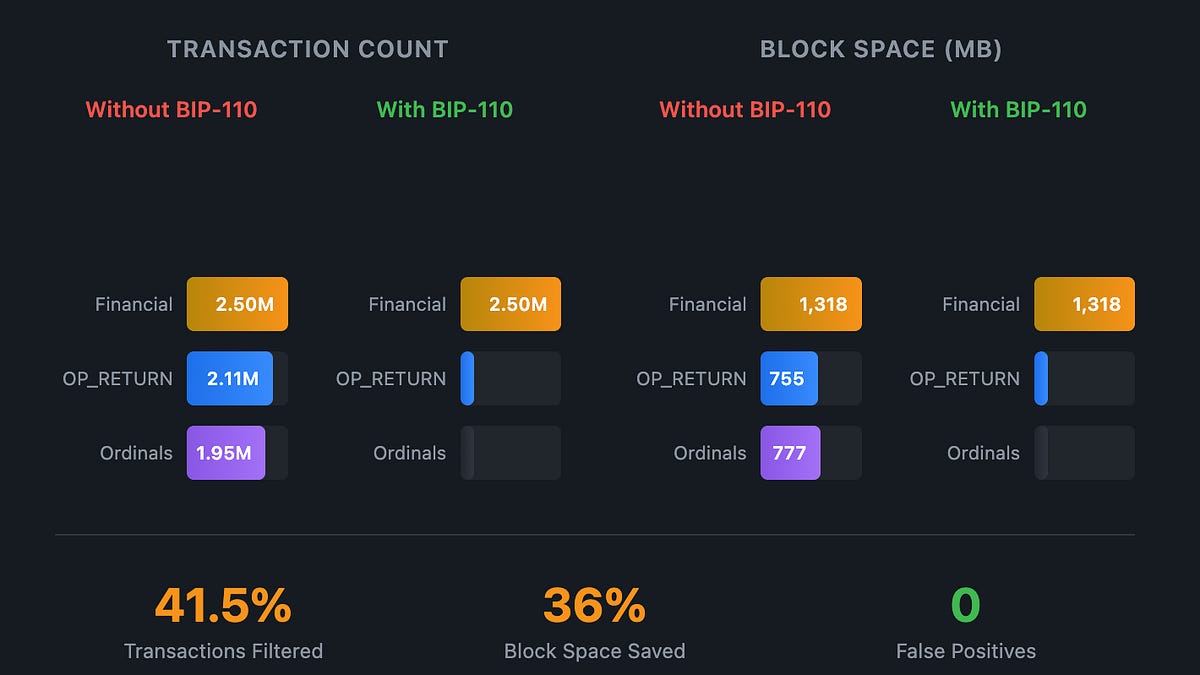
In case you wish to understand BIP 110 and how Bitcoin is Freedom Money
Good observation!
I still think dick pics on the blockchain server no purpose!
value is determined by the recipient, not the protocol. if one sat moves a pixel or pays a debt, the math has already graduated into money.
 walker
How many sats do I need to send on the bitcoin timechain for it to become a “monetary transaction”?
View quoted note →
On-chain doesn’t do change for coins like cash in-store. Lightning solution important for everyday transactions.
Sorry.. I guess the point took off and I missed the boat..
I have been thinking about how to accessibly speak on the philosophical principles which dis-ambiguate what our words are pointing at: valid/invalid, arbitrary/purpose, monetary/non-monetary, spam, etc.
If you would like, i can put together an outline for you to look over: how a discussion could glean useful insights to help people understand what the community is arguing about, so each individual can decide for themselves what actions best serve their interests.
Given how so many are talking past each other, I think the examining the philosophy of “spam” might be extremely helpful. And we would also need to get into the philosophy of value.
If that is something of interest, I will invest the time in this side quest for you.
If not, no worries. Much more is needed on my main quest