Replies (81)
I think it is considered part of the west. Not a developed part, but a part nonetheless.
Because the West is made up of the countries that broke off from the Catholic Church.
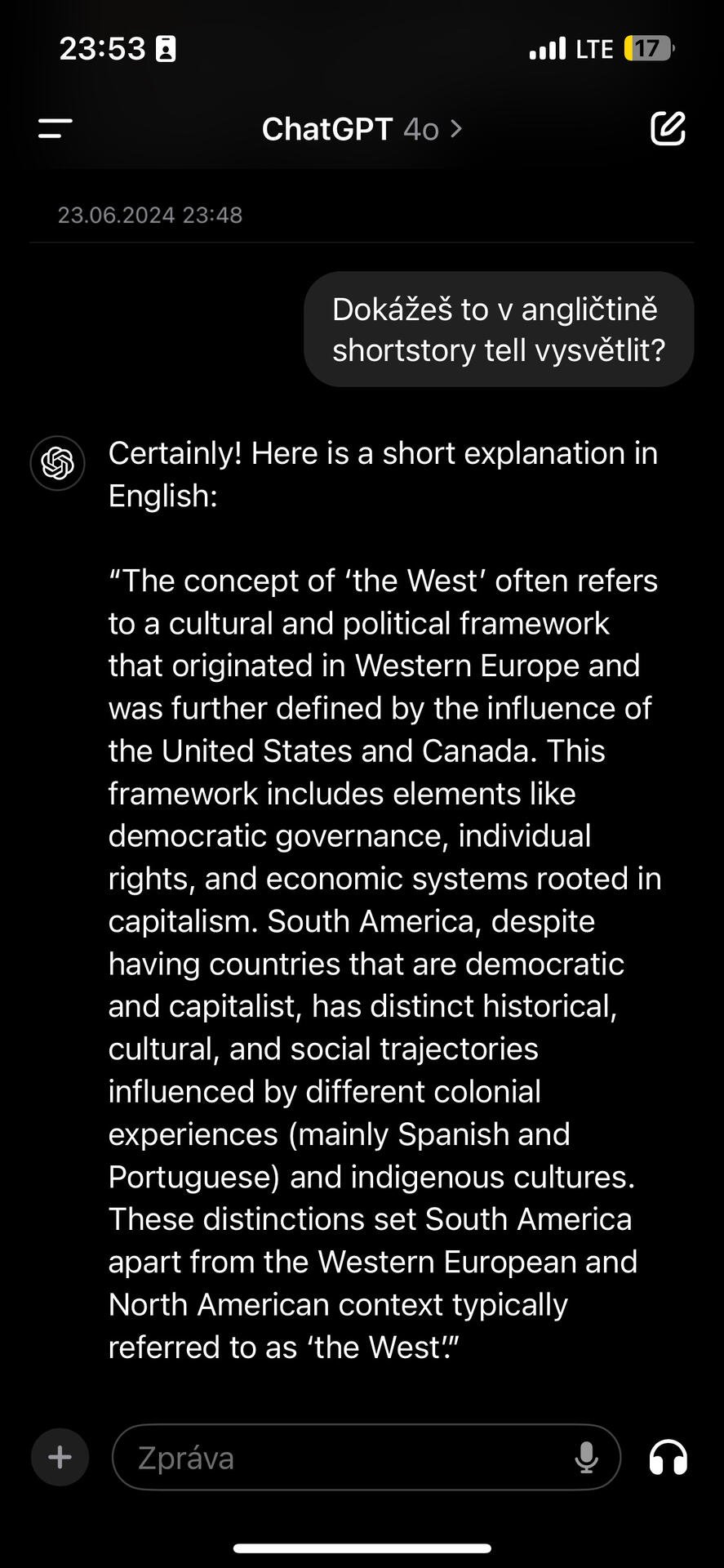
I can’t, but maybe GPT could xd (idk if it’s truly the case, but I would be not 100% sure, it’s duckign gpt🤣)
But in someway it making sense to me since America was colonized from Europe 🫡
Xd I fortget to add a context photo 🤣
It's always those two.
Because is “the south”?
As a Brazilian (part of South America) I would say we have our differences from the rich West, economic and cultural differences. But, we are still closer to the West than from any other part of the world.
racist? They're just as white down there as up here.
Fake ..
Depends on who you ask lol
Still considered part of Eastern Europe.
did you learn that in school?
The orient and the west have nothing to do with geography as Australia is often considered the west. It's about the dominant socio-political climate. Hence why Australia is considered western, but Chile isn't. South America and Africa's political foundations are influenced differently from the eat and west dichotomy
Corruption makes people from latam seem untrustworthy and therefore unwanted, unfortunately.
Culture.
Look at how countries are clustered on this map:

South Americans just do not have the culture of narcissism ("self-expression") and loathing for traditions that defines modern Western Culture ("Protestant Europe" and "English-Speaking" on that chart).
The average USA citizen doesn't really belong in that cluster either - see chart - hence the burning paranoia among Western elites that the USA might "defect" from the West if it found a strong, populist leader.
Cause it’s south and not west.
And why do you even care to be labeled as western country? Fuck the exceptionalists
An Amazonian tribe is very non-western scientifically and culturally. Though parts of Brazil and Argentina are mostly European by ancestral decent, just depends on what part, but the majority of people are either mixed race or not European at all, enough to not be Western by the perspective of North Americans and Europeans — but maybe not those that know there are a lot of Europeans in LatAm. And also the language, most associate English with the western world, even though that’s not true. Let me ask, is it a moral positive to you to be apart of “the west”?
$$$
South America was never part of the Soviet bloc (the only Marxist country was Cuba). You have a distorted vision of us and a lot of ignorance.
All countries in South America were on the US side of the war and at least Brazil sent actually a sizeable number of troops to fight in Europe.
Also Japan is not considered part of the West anywhere, I think, but it would make some sense.
So Spain and Portugal are not part of the West?
OK, but what is your explanation?
What? No, Latin America didn't become Marxist. All countries except for Cuba were allied with the US.
So France, Spain and Portugal aren't part of the West? I don't get it.
I’m Cuban & I approve this message.
You're right, there are plenty of things I'm ignorant about in Latin American history. This isn't the best format to hash out 70 years of history and why you're nation is not considered an ally of western Europe or the US... but you're not. 🤷♂️
WW2 created a new world order and a new circle of trust... you know who wasn't in that circle?
Which continent has had it's nationa battle civil wars against communist guerillas? Which continent has been destabilized for over 50 years?
There's a reason why Latin America has remained 3rd world. It's not because they're considered allies.
I was going to give my opinion but thought maybe I should see what the Wikipedia says: I'm glad I did because I would have left out NZ and Australia :
Western world - Wikipedia
The Western world, also known as the West, primarily refers to various nations and states in the regions of Australasia,[a] Western Europe,[b] and Northern America; with some debate as to whether those in Eastern Europe and Latin America[c] also constitute the West.[5][6][7] The Western world likewise is called the Occident (from Latin occidens 'setting down, sunset, west') in contrast to the Eastern world known as the Orient (from Latin oriens 'origin, sunrise, east'). The West is considered an evolving concept; made up of cultural, political, and economic synergy among diverse groups of people, and not a rigid region with fixed borders and members.[8] Definitions of "Western world" vary according to context and perspectives.[9]
What is the reason?
Waterloo solved that problem.
Cuba was the only successful regime change but the ideology infected Latin America. I can only say this from an American perspective and sitting with Puerto Ricans, Colombians, Venezuelans, Chileans and Bolivians.
When digging into the histories of each from the perspectives of those that left those countries for the US, their governments are corrupt and hold their power over the people by promising the same things that marxists always promise. The source of that infectious ideology was the USSR. They were responsible for exporting Marxist ideology throughout the world and that ideology has flourished in Latin America. Nations may not have been officially Marxist, but the proof is in the pudding. You said it yourself, they aren't considered the west.
I don't think there is a single thing, but I would say corruption in their governments for most and civil wars for others. It's certainly not a lack of resources or labor. There's also the race factor, but you said you didn't want to talk about that. Colonialism definitely plays it's part. Same with Africa.... Africa has the gold mines. If gold held such value... then how is Africa poor?
I don't even know what you mean by "the west". Is that some kind of trademark from a cults game?
Well there is no universally agreed definition of "Western World", some would say it's only North America and west Europe only, while others would say the west is all the Christian majority countries. By the second option South Africa would be part of the west, even if a very poor one.
Newspeak?
With all the effort they spent trying to make ChatGPT not racist.... here it is, racist.
I guess we don't talk much about South America in our history of WW2 because we are racist.
As for Japan, it is Far East I guess. But in a lot of contexts it groups well with the rest of the West.
It’s the south bit.

Ofc boss, Spain and Portugal are indeed part of Western Europe. The explanation for why South America is not typically included in the concept of “the West” focuses on different historical, cultural, and social factors that distinguish these countries from Western European and North American nations.
In short, although the roots may be similar, the historical and cultural development of South America after colonization has led to a distinct identity that sets it apart from the traditional concept of “the West.”
In our country we have kinda same issue 🤣 Since we are almost in middle of Europe and our history is kinda mashup of all things. Someone is learning that our country is part of Eastern Europe, someone is learning that we are Western Europe 🤣🤣
Imo cultural geopolitics is what causes these absurd things, but cultural geopolitics can’t change geography 🤣💁
At the end of the day, if ppls will grow into centrain level, these cultural geopolitical thinks will be totally useless bcs peoples will not care anymore about geopolitics and they will focus more on their grow ✊🏻
Americans like Immanuel Maurice Wallerstein had an influence on
this nonsense 👌
Mexico has the same problem.
Exactly that, South America isn't western because the idealogies of their founders mostly don't come from European individualists or eastern collectivists. They're their own category, maybe they could be grouped with Africa in the sense of tribalism, but likely each of those continents could be their own thing.
Some South American countries are trying to earn their way into western culture, but I would not be the arbiter if that line.
This will hurt some feelings, but it's not my intention. You first have to define "the West". In the image below, "the West" is everything before Occamism/Renaissance and Luther's/Lucifer's revolution.
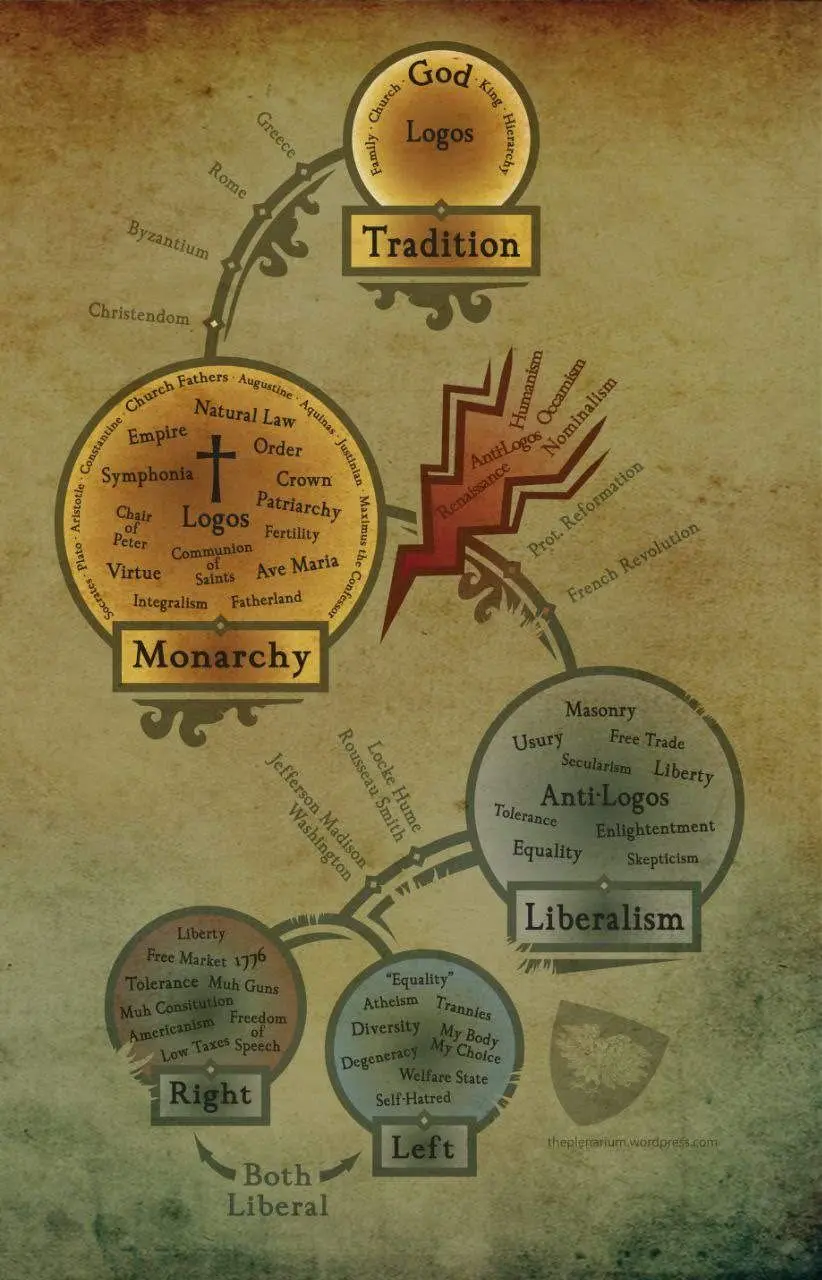
The West is Our Lord, Our Lady, the Catholic Church, St Pius X, Pope Leo XIII, St Thomas Aquinas, St Augustine, Aristotle, Plato, Socrates, Rome, Latin, Greek... Homer, Virgil, Dante, Camões... The list is immense but that's a start.
We live in the ruins of the West.
Nothing to do with race and everything to do with power and containment - the Monroe Doctrine of 1823 by the 5th President of the US has had the result of choking any power growth in the *continent* of South America. Still in place today. Unbelievable not to build bridges between neighbours rather than attack anyone who attempts to build one 🤷♂️
Equator = racist line
It’s about who’s part of the commonwealth. What does my wiki-text say? It would give a more accurate and precise explanation. Can you share it?
Pour l'équateur non sur le plan géographique
l'Afrique du sud idem sur l'Afrique a eu les principes occidentaux au regard de ces évolutions sociétales
I have been visiting BsAs for the last three decades. By now it looks and feels almost more European than Europe itself. Redefining the term 'West'
🤣🤣🤣
The name says it already. It’s in the South.
The food is too spicy
south america is part of the western hemisphere
if you mean by geopolitics to define the west you would probably have to equally look at what is being defined as the east
& also, later, the cold war
but this is not my area of expertise
it is more of an explanation of how i would go about it

I'll give it a shot 😉
The West has become US + western european countries in 1945 because US invaded and conquered Italy and Germany and took over the UK empire and what was left of France and the rest of european nations. All of them, in one form or the other. The eastern countries for obvious reasons just after 1990.
Argentina, Brazil, Mexico and so on are sovereign countries. Italy, Germany are not, or not completely at least. As is not Japan - which despite a very different history and ethnicity is sometimes considered part of the "collective west".
The West is really the "cultural" or "soft power" name for American Empire. As Nato is the military name. European Union is the legislative / economic facade of basically the same thing, plus the convenient "one phone number to call them all".
Nothing is indeed determined by race - or let alone religion. Both are just a tool used if and when needed, to project power.
Is not a cultural thing, but a "power" thing. US conquered most of europe in the past 80 years, because Europe for many reason was and still is the most important geographical area on the planet. The same thing cannot be said for south america which is why the current status quo in terms of US influence (or cultural assimilation) did not change and is not going to be in the coming decades. It's more than enough to keep the area in chaos enough so no regional power can emerge. This is one of the very few permanent US geo-strategic objectives, everywhere since almost forever. That's the reason why US did fought 2 WWs and one cold war to keep Europe from another power to take over (Germany, USSR or god-forbid a combination of the two) and is why is still fighting the proxy war in Ukraine today.
Not sure if the translation from French worked out well here
well, maybe there just isn't non-racist justifications
Si ils font partie de l'Occident si l'on se réfère aux messages sigtimatisants de certains leaders des pays de l'ancienne Mesopetamie sur la sphère religieux et vice et versa...tous ces relents liées à la religion...Mais les royaumes d'Europe et les guerres de religions y sont pour beaucoup...les débats finissent toujours par cette thématique d'ordre religieuse qui a plus que bouleversé l'histoire des hommes quelque soit le continent
South != West
Facts 1+
French is a cool language 🤣😎
Stop with the difficult questions
Très subtile et complexe idem que celle de Shakespeare si on est puriste ...en fait fiatjat toutes ces réponses méritent une compilation puisque puisque la thématique n'est pas raciste ...nous évoquons bien l'occident tel qu'il est conçu en fonction des territoires , puis il y eut des liens liés à des courants de pensées entres 'autres sur les périodes d'avant WW1 post WW2 et ses retentissements, les 30 glorieuses très intéressants qui mériteraient des échanges approfondis sur les aspects politiques, géopolitiques, stratégiques et culturels, d'ailleurs il y eut un temps où la notion de races fut presque d'un autre temps puis de nouveau des guerres liées aux conceptions religieuses ce que nous vivons ces dernières années à travers le Monde et plus particulièrement ces 10 dernières années l'Inde ...votre question et tant d'autres liens biaisés mériteraient des nids ...bien construitts
when you don't what j write don't hesitate J can also write in English or spanish ...with alll pleasures 🤍🕊️
I really wish I understood what was going on in this graph
True words.
That was my suspicion too.
Seems like you are smart lady ✊🏻🫡
I almost agree with all of that. Almost
Spanish always mami
who said this in the first place? brazil has chosen to be a brics member.
Because by and large countries there are dominated by one tin horn dictatorship after another and the continent has been, by and large, a social and economic failure.
Is the panama canal zone considered a part of "the west"?
I personally do consider all of Latin America to be "the west". And I think the term as it was applied in the postwar period carries little meaning today. I think people are coming around to that, and realignment is really kicking into gear right now. I hope to see and believe I will see a mostly prosperous Latin America within my lifetime.
They asked people in different places a lot of questions about the values important to them.
They then used math to decompose all those answers into two themes ("tradition" vs "secular" and "survival"/"responsibility" vs "self-expression" and averaged by country and put a dot for each country on the chart.
The colored bubbles aren't from math though, they're just the writers' drawing lines around countries with historical affinities for each other, and showing how closely their people's values are today.
Western empires have drained capital and cheap labor out of South America for centuries, not the other way around
culturally south america is "the west".
South America is part of the global south, mainly because they have a bully in the neighborhood called USA
What is your definition of "Western"?
Because they haven't sold themselves to the devil yet.
"Once upon a time in the West"
where is Chile?
oh, nevermind
This is the only non-nonesense explanation I read in this thread.
Followed.
I was going to reply with: Power, race and religion. But yes, needs more than three words.
Sorry I feel I have to follow up on this one because first answer was horribly.
I think the main reason is innovation.
The last hundreds of years significant innovation has come from north western Europe. Basically from the France/Northern Italy and upwards. Perhaps with epicenter in the Nederlands.
The US has contributed significant innovation as well, same for Japan.
With innovation comes business. And with business comes partnerships.
So there you have the outline of the west + Japan.
I also think Latam as much part of the western world as it can be, without being part of it. This is mostly because of shared culture.
You need to either innovate more or attract innovators/businesses to the Latam area.
And to make to place attractive you need some systemic stability and efficiency, so that businesses believe they can count on the people they do partnerships with, and so that people feel safe working from there and living there.