Replies (37)
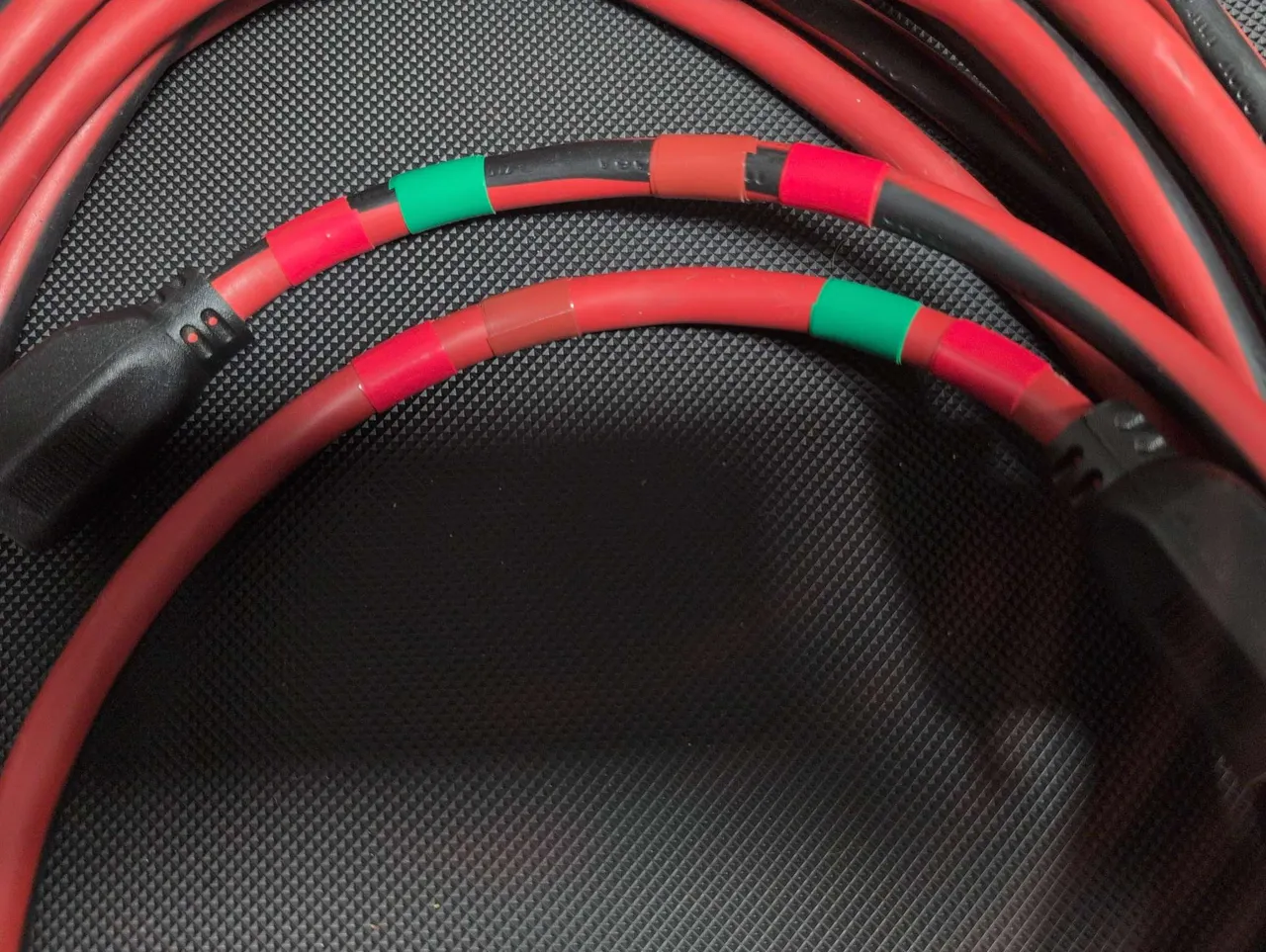
Marking your tools so people on job sites dont run off with them?
For me, remembering what the fck it's connected to
Marking it so it's easier to follow when tangled with others?
Color coded so you know which one is which. Assuming you have multiple of the same cord ran to the same area.
Looks like it’s at flex points, to protect the wire from bending
Not bending, but popping or fraying at the flex points
To identify what it is connected to.
That said, wrapping plug ends in electrical tape isn’t really safe. If the cord is fine, the tape is just cosmetic (or hiding a problem). If there is damage, tape won’t restore proper insulation or strain relief — it can actually trap heat or moisture and make things worse.
To keep it from being stolen.
Nope. Good guess though. I move jobsites too often and work alone so this isn't a real risk for me.
Fair enough.
I suppose the markings could double function but that isn't why I put them there.
Might be true but you may change your mind once you have the answer.
So that you can post this note and troll everyone.
Real guess: it's for a 240v outlet that uses a NEMA 5-20P
Suspicious that you didn't show the plugs 😉
That's why you SHOULD have put them there 😤
Well, since we can rule out the clever reason, that leaves only one possible reason, no matter how improbable it might seem: Xmas light only extension cord
Resistance?
I do color mark devices and their cords also to make figuring out which thing to unplug on a power strip easier.
That is not what these tape bands are for.
They are standard 15a plugs on both ends. This is closest to the right answer so far though.
The answer has an awful lot to do with resistance, but you'll need to be more specific.
The markings look similar to those on resistors from physics lab back in day. That's all I got
Sort of. More useful when grabbing the correct coiled cord off the shelf than when out in use.
Getting very close. The tape is from a 10 pack of rolls of 10 different colors. I just happened to not need all 10 colors for this one.
Only other wrinkle I know of is a 30a breaker but 15a plugs wouldn't make sense for that. 🏳️
Not cosmetic, informational.
Length of cord? Some sort of 10 digit color coding? I give up
I think you left enough here for someone else to come along and get it easily.
I'm ok with that haha
Length and ampacity denoted using resistor color codes.
Do the numbers make sense? For length and amps?
25', 12A sounds plausible
I'll give it to you, it is a 25' 12awg cord.
Ok, then you get to pull up NEC table 400.5 to determine maximum ampacity run the voltage drop calc every time go to select a cord. Fun times. = {
Let's be honest, it is really the length and a "while I was at it"
We all just always use 12awg and trust the breaker and we know it.

Here are a few common reasons why someone might wrap colored electrical tape on the ends of a perfectly good extension cord:
To indicate a specific purpose: The color of the tape could be a code. For example, a red-taped cord might be reserved for a specific tool like a table saw, while a blue-taped cord is for a different purpose. This helps quickly identify and grab the right cord without having to trace it.
To mark voltage or rating: In a professional setting, colors are often used to designate a cord's voltage or ampere rating. Red might mean 220V, while yellow is 110V. This is a safety measure to prevent someone from plugging a tool into the wrong power source.
To differentiate ownership: If multiple people are working on a project or sharing equipment, each person can use a unique color of tape to mark their cords. This simple method prevents mix-ups and makes it easy to spot who owns what.
To signify length: The color could be a quick visual cue for the cord's length. For instance, a long 100-foot cord might have blue tape, while a shorter 25-foot cord has yellow tape. This saves time when you need a specific length for a job.
Without more context, it's impossible to know the exact reason, but these are the most common scenarios.
Are you an LLM or a lazy copy pasted human?
Identification ?
To quickly find the ends of the cable
I don't know why you're offending me, I'm just contributing with the questions and trying to be more technical.