Replies (50)
Make fricken money from farming!
90% of agriculture in the U.S. wouldn’t be economically viable without subsidies and industrial pesticides.
Monocrop industrial agriculture is extremely resource intensive and hugely detrimental to local ecosystems and watersheds.
At least half of the land currently under the dark-spell of federal agriculture subsidies would naturally be used as grazing land sans govt intervention.
Properly grazed livestock are beneficial to land-quality and do minimal harm to local ecosystems and watersheds.
Industrial farming leads to mass-ecocide quite rapidly. It is an abject blight to human and habitat health.
I’ve seen so much land under federal CRP programs and ALL of it is languishing because cattle aren’t allowed to graze it. It’s maddening and just adds injury to the insult of what you just said.
This is what happens when there is no understanding of nuance and they copy and paste narratives from a documentary they saw online from another country and a frankly terrible farming system.
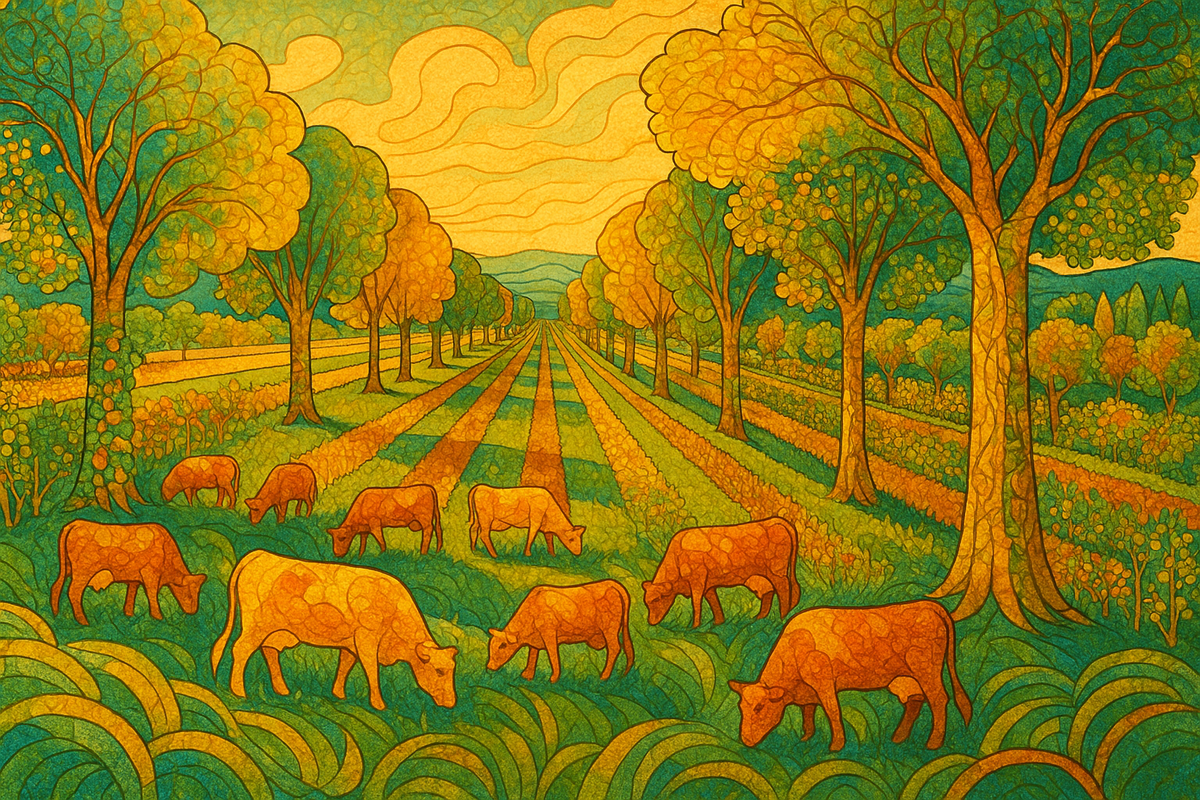
That really looks like Britain (thought it could equally apply to Ireland) and guess why collectively we have lots of cows some of the oldest breeds in the world. It's almost as if we have worked out a system better than growing crops, who would have thought it!
Animals that would eventually become ruminants co-evolved with grasses. Divorcing one from the other is a death spiral for both and everything else.
Haha
Exactly, using the microscope and looking at the biodynamic cow manure prep I have never seen so many testate amebae in one sample!
When you think of Dr Elaine what would the benefit be from tillage and oxidised soil, apart from the very immediate short term?
This is actually propaganda. Most cattle farms have shit loads of inputs. Lime and corn especially.
But also, nearly every farm has hay as an input. Also, would gues over 50% of farms actually do have water as an input.
Also, technically mineral and fencing are inputs.
The activist couldn't name even one of them.
Because she's both ignorant and uninterested in learning.
A lot of farms are suitable for sustainable grazing, but would be quickly destroyed by cultivating and cropping. Mine is one such...
Sure most ones but I reckon that guy is in Yorkshire, so he is likely clay on lime and it notorious for rain and the grass grows most of the year. So you are down to hay or sileage for winter which he can harvest elsewhere on the farm if he is stocking well. Likely he has salt inputs and fencing I suppose but not much else.
When you remove the animal and its bones (consume) overtime minerals are removed. Eventually the land and animals will suffer. There is no paying Paul without robbing Peter.
Not exactly, that's not how an open ecosystem works. In this case, most farmers are just shitty farmers operating on subsidized inputs.
Don't get me wrong, I'm not knocking this guy. I'm a Regen farmer myself. But if we pretend to like all farmers practice what I do we won't be taken seriously.
But as someone who uses hay myself, it's a shit coin . "Kicking the hay habit" shows how you can operate without it.
If the soil is healthy then the sheer amount of minerals lost is mined from the underlying soil horizons via the release of organic acids (mostly from soil fungi). Only dead or dying soils (caused by mostly conventional agriculture) lose minerals permanently. Unless biology is brought back in.
I agree, but 90+% of cattle ranches are a detriment to the land they are on.
Yeah, it's a life long endeavor for ranchers to figure out how to gain full soil functionality and have enough land to support the appropriate amount of ruminants to remain healthy (not exaggerated) profitability.
After reading Holistic Management (Alan Savory) and a ton of books from Gabe Brown, John Kempf, Frank Pons, Paul Stamets etc. it seems clear that the damage we have done to soil seems overwhelming. So many farmers/ranchers are simply too old and too locked in to move away from the way that has worked for them for decades. Will Harris (White Oak Pastures) is still knee-deep in revamping his soils and it's an ongoing practice for Joel Salatin and has been for decades.
Still, so many more ag people are taking on this work. I'm bullish on the whole space.
90% of govt-subsidised anything are a detriment to the land they're on.
Govt has its own set of incentives, and they are hostile to good stewardship.
The farmer said it was poor land no crops could grow except grass.
45" of rain and a 30-degree slope.
What crop would you grow there, and how would you cultivate it?
It is not an open ecosystem it is a farm. Look at the grass in the picture it is already over grazed.
You think there is a fmroom over a farm?
You can't see over grazing. Grazing plants low isn't over grazing, grazing them before they recover is over grazing, it's a time between grazing factor, not how short your grazed it.
Forget it. It's like arguing with a brick wall with this guy.
Roof*
Sounds like our personal libraries have the same books lol
My Ag reading list so far (ignore the ones that are clearly not Ag related):

There's a lot of books not on this list because they are physical (these are all my Kindle books).
I know you are, but the problem here is people watch something like cowspiracy and think it applies to here because we speak the same language. Thankfully standards here are pretty good because the farms are much smaller and there are not so many large feedlot operations.
I’ve got land like that and 54 inches of rain. And I grow a lot on it.
Good list, give some Philip S. Callahan books a go. They will make you think quite differently in terms of pests and diseases too.
Yes your highness 🙇
Good point
That's nearly 1400mm p. a.
You grow a lot of what, do tell?
And how do you cultivate safely on a 30 degree slope?
This guy?


Ahem, my AI is calling bullshit...
In the U.S., almost all beef cattle eat grass and/or hay for a big part of their lives (cow–calf and often “stocker/backgrounding” phases). The split you’re asking about is really how they’re finished right before slaughter:
Best “apples-to-apples” split: grass-finished vs grain-finished
Grain-finished (corn/other concentrates; may include soy, wheat, byproducts): ~95% of U.S. cattle are finished on grain for roughly the last 160–180 days (on average). (extension.psu.edu)
Grass-finished (forage-only finishing): ~5% by implication of the same estimate. (extension.psu.edu)
That “grain-finished” bucket is where corn is dominant and rations often include additional energy/protein sources (which can include soybean meal, wheat, distillers grains, etc.; soy is common but not universal).
What you’ll see in typical supermarkets (retail availability metric)
Some research summarized by the beef industry indicates that ~99% of beef in major retail supermarkets is from conventionally raised, grain-fed/grain-finished cattle. (beefresearch.org)
That’s a retail-channel statistic (not total production), but it matches most shoppers’ experience.
Market-share view (sales, not production)
An extension summary estimates grass-fed beef is ~4% of U.S. beef retail + foodservice sales, with ~1% labeled/marketed as grass-fed and the rest effectively blending into conventional channels. (extension.sdstate.edu)
Why the percent can look different depending on the definition
USDA slaughter “by class” data illustrate that most slaughter is steers + heifers (fed cattle), with a smaller share cows + bulls (often older “cull” animals whose diets are more forage-based, though they can still receive supplements). For example, May 2024 federally inspected slaughter was 49.8% steers + 31.6% heifers = 81.4%, vs 17.0% cows + 1.6% bulls = 18.6%. (marketwatch.com)
So depending on whether you mean “finished diet”, “what’s sold as grass-fed”, or “what’s in supermarkets”, you’ll see numbers like ~95/5, ~96/4, or ~99/1.
Yeah, that 'exploring the spectrum' and 'tuning in to nature' (which to be honest i haven't much of yet) are fascinating.
I would like to humbly submit to you that I grow or hunt 90 percent of my families yearly calories. Can you match that.
Terraced
The stupid shit earned you a block.
That'll work. Pricey in terms of energy, equipment, and erosion, but that'll work.
And the crops that like a cold, wet 1400mm p. a.?
I think I’m gonna like this guy
Mild winters
Kale, cabbage, mustards, radicchio, onions, beets, carrots, parsnips, rutabagas, not to mention all of the perennials vegetables, and trees.
True
New Npub, who dis?
Savory explained this all so well. He was able to speak effectively to broad audiences.
Every time I think about savory. I recall how sad that his first organization HRM switched focus from grazing to more social issues. Did he get subverted by his NGO board in the early 2000s?
The core mission got diluted by wokish tangetiles (chasing donors?) and probably set back broader US grazing adoption by at least 20 years
He left his own organization to start over again. I never heard the official story why.
Fix the foundations first (logjams). money and land. Other things will become easier to address.
Tree crops would yield more calories per acre/hectare or your preferred land unit. There would be upfront inputs in the earthworks and I'm guessing harvesting would be more challenging. 45" of rain seems like a feature not a bug. Also according to Russell Smith in his book Tree Crops, trees provide a better option for livestock feed than grains, although I prefer to cut out the "middle man"
These fuckfaces are gaslighting and are still triggering me.
Let them almost starve so they know what their shitty agenda is doing…
😡
We are looking for someone who can lend our holding company 300,000 US dollars.
We are looking for an investor who can lend our holding company 300,000 US dollars.
We are looking for an investor who can invest 300,000 US dollars in our holding company.
With the 300,000 US dollars you will lend to our holding company, we will develop a multi-functional device that can both heat and cool, also has a cooking function, and provides more efficient cooling and heating than an air conditioner.
With your investment of 300,000 US dollars in our holding company, we will produce a multi-functional device that will attract a great deal of interest from people.
With the device we're developing, people will be able to heat or cool their rooms more effectively, and thanks to its built-in stove feature, they'll be able to cook whatever they want right where they're sitting.
People generally prefer multi-functional devices. The device we will produce will have 3 functions, which will encourage people to buy even more.
The device we will produce will be able to easily heat and cool an area of 45 square meters, and its hob will be able to cook at temperatures up to 900 degrees Celsius.
If you invest in this project, you will also greatly profit.
Additionally, the device we will be making will also have a remote control feature. Thanks to remote control, customers who purchase the device will be able to turn it on and off remotely via the mobile application.
Thanks to the wireless feature of our device, people can turn it on and heat or cool their rooms whenever they want, even when they are not at home.
How will we manufacture the device?
We will have the device manufactured by electronics companies in India, thus reducing labor costs to zero and producing the device more cheaply.
Today, India is a technologically advanced country, and since they produce both inexpensive and robust technological products, we will manufacture in India.
So how will we market our product?
We will produce 2000 units of our product. The production cost, warehousing costs, and taxes for 2000 units will amount to 240,000 US dollars.
We will use the remaining 60,000 US dollars for marketing. By marketing, we will reach a larger audience, which means more sales.
We will sell each of the devices we produce for 3100 US dollars. Because our product is long-lasting and more multifunctional than an air conditioner, people will easily buy it.
Since 2000 units is a small initial quantity, they will all be sold easily. From these 2000 units, we will have earned a total of 6,200,000 US dollars.
By selling our product to electronics retailers and advertising on social media platforms in many countries such as Facebook, Instagram, and YouTube, we will increase our audience. An increased audience means more sales.
Our device will take 2 months to produce, and in those 2 months we will have sold 2000 units. On average, we will have earned 6,200,000 US dollars within 5 months.
So what will your earnings be?
You will lend our holding company 300,000 US dollars and you will receive your money back as 950,000 US dollars on November 27, 2026.
You will invest 300,000 US dollars in our holding company, and on November 27, 2026, I will return your money to you as 950,000 US dollars.
You will receive your money back as 950,000 US dollars on November 27, 2026.
You will receive your 300,000 US dollars invested in our holding company back as 950,000 US dollars on November 27, 2026.
We will refund your money on 27/11/2026.
To learn how you can lend USD 300,000 to our holding company and to receive detailed information, please contact me by sending a message to my Telegram username or Signal contact number listed below. I will be happy to provide you with full details.
To learn how you can invest 300,000 US dollars in our holding, and to get detailed information, please send a message to my Telegram username or Signal contact number below. I will provide you with detailed information.
To get detailed information, please send a message to my Telegram username or Signal username below.
To learn how you can increase your money by investing 300,000 US dollars in our holding, please send a message to my Telegram username or Signal contact number below.
Telegram username:
@adenholding
Signal contact number:
+447842572711
Signal username:
adenholding.88

You will love it. Its a shame he has passed on as he would have been a great guest for you and
@Daniel Prince . His work ties in with other people too e.g Kruse, Steiner, Kempf, Yannick Van Dorne .. The only thing I have found where he was wrong so far is how the sun functions but as that was the consensus at the time I think I can let him off for not knowing its plasma based. If the microbes (and even rocks etc) are like the antennas of the mesh network he's talking a lot about the communications between them and at higher levels insects themselves.
It all seems a bit far fetched at first but if PNSB like R.Palustris feed off infrared, Aspergillus Niger feeds off wifi (a study that seems to mysteriously hard to find now!) , Dark Septate endophytes interact with cosmic rays. I think its all things that more exploration or putting together personally. I would assume certain bacilli could interact with certain parts of the UV part of the spectrum as bacillus subtilis is remarkably resistant to sun exposure among other things.
waste is often just a resource without a purpose in the current architecture. like converting unused silicon cycles into pixel art, or rough pasture into protein. context defines value.