07 Title: Barter: Empathy and the Magic Wrapping that Money Cannot Buy
Introduction
For much of human history, the barter system served as the primary means of economic exchange. Unlike today's monetary systems, barter involved the direct exchange of goods and services, underpinned by pure human empathy.
This empathy ensured that transactions were not merely material but rooted in mutual trust, fairness, and understanding. These dimensions are often lost in modern economies, where money serves as a detached, impersonal medium of exchange.
In this note, I will explore how empathy functioned as the core ingredient of barter, examine its components in detail, and offer an analogy: the magic wrapping paper a metaphor for how empathy holds each exchange together.
This Magic Wrapping Paper, composed of multiple layers of trust, fairness, and social responsibility, represents the human connections that have been systematically stripped away in the evolution of monetary systems. Ultimately, we will argue that money, no matter how efficiently it facilitates transactions, can never replace or replicate the empathy that made barter a socially cohesive system.
The Role of Empathy in Barter
Barter, unlike modern currency based exchanges, was a system that required direct, personal interaction between individuals. This interaction was not simply an economic one; it was inherently social, shaped by the emotional and ethical context of the community. In barter, the perceived fairness of an exchange was not dictated by a universal currency value but by a shared understanding of each other's needs and circumstances.
For example, if a farmer exchanged a surplus of grain with a blacksmith for tools, the fairness of the transaction depended on more than the physical items being traded. The farmer might consider the blacksmith's family’s needs for food, while the blacksmith understood that the farmer needed tools to cultivate more crops.
Both parties would naturally aim for a balance that respected each other's needs. This exchange was not just economic but relational a process governed by empathy.
Breakdown of Empathy in Barter
Empathy in barter can be broken down into several key components, each of which played a critical role in maintaining the fairness and cohesion of the exchange. These components are best visualised through the analogy of magic wrapping paper, where each layer symbolises a different aspect of the empathetic exchange.
Perceived Fairness
In any barter transaction, both parties needed to feel that the exchange was fair and equitable. Fairness in this context wasn't limited to the material value of the goods being traded but also considered the social and emotional contexts. If one party felt they were being short-changed, the relationship would be damaged, and future exchanges would be jeopardised. This layer of empathy ensured that everyone’s needs were acknowledged and met.
Trust
Trust is central to any barter system. Participants had to trust that the other party would honour their side of the bargain, and that they might engage in future exchanges. Unlike money-based systems where transactions can be anonymous, barter was deeply personal. The establishment of trust created a long-term relationship between traders, ensuring that the community as a whole remained interconnected.
Mutual Understanding
Barter required a level of mutual understanding that transcended material exchange. Parties needed to recognise each other's vulnerabilities and circumstances, taking into account factors like family size, seasonal needs, or future crop yields. This understanding shaped how they negotiated and decided on the value of the trade.
Reciprocity
In a barter system, exchanges were often based on an implicit expectation of reciprocity. Even if the trade was not perfectly balanced in terms of material value, both parties knew that the imbalance could be addressed in future exchanges. This layer of empathy created a system where people were incentivised to help each other and maintain the balance over time.
Long-term Relationship Building
Barter systems were not built on one-off exchanges; they were relational. Each transaction strengthened the social bonds between the participants. Unlike monetary exchanges, which could be completed in isolation, barter required a long-term commitment to each other's well-being, ensuring that the community as a whole benefited.
Flexibility in Value Perception
Unlike modern money systems, where prices are fixed and standardised, the value of goods in barter was flexible and subjective, determined by mutual empathy and negotiation. This flexibility allowed the system to accommodate the specific needs of each party and ensure that the exchange felt fair, even if the goods themselves weren’t of equal material value.
Emotional Investment
Each barter transaction carried an element of emotional investment, as the participants were often trading with people they knew personally. The act of bartering wasn’t just about meeting material needs; it was also about ensuring the well-being of the other person. This investment in the other party's success fostered a deeper connection than a monetary exchange ever could.
Community Bonding
Barter facilitated community bonding, as exchanges often took place within the context of a larger social network. The health of the entire community depended on the empathy-driven fairness of individual exchanges, reinforcing the importance of looking after one another and the collective good.
Resource Sustainability
Empathy extended beyond human relationships and into the natural environment. Exchanges were conducted with an understanding that over-exploitation of resources would harm the entire community. For example, hunters would not over-hunt certain animals, knowing that doing so would deplete the natural resources available for future trades. In this way, barter was tied to the idea of sustainability, which money-based systems, driven by profit, often disregard.
Cultural and Spiritual Beliefs
Many Native American barter systems were guided by cultural and spiritual beliefs that emphasised respect for nature and the animals involved in the exchange. The spiritual dimension of these exchanges ensured that goods were not treated merely as commodities but as part of a larger, sacred ecosystem.
Social Responsibility
Empathy in barter extended to the broader community, creating a sense of social responsibility. Traders understood that their actions impacted not only their immediate partners but the community as a whole. This layer of empathy reinforced the idea that fairness and generosity were not just personal virtues but essential to the health of the collective.
Shared Risk
Both parties in a barter transaction shared the risks involved. For instance, a farmer trading grain with a blacksmith knew that if the weather destroyed future crops, they might need the blacksmith's help again. This shared risk created an incentive for generosity and flexibility, as participants were aware that they might need to rely on each other in times of hardship.
Interdependence
Barter systems operated on the principle of interdependence, where individuals relied on each other to meet their needs. This was not just a material exchange; it was an acknowledgment of the shared vulnerability within the community. The strength of one individual or household contributed to the well-being of the group, making every exchange a form of collective security.
Direct Human Connection
Finally, barter was conducted through direct human interaction. Face-to-face exchanges fostered empathy, creating a sense of connection that could not be replicated in anonymous monetary transactions. The emotional weight of these exchanges encouraged fairness, generosity, and long-term relationship building.
The Magic Wrapping Paper Analogy
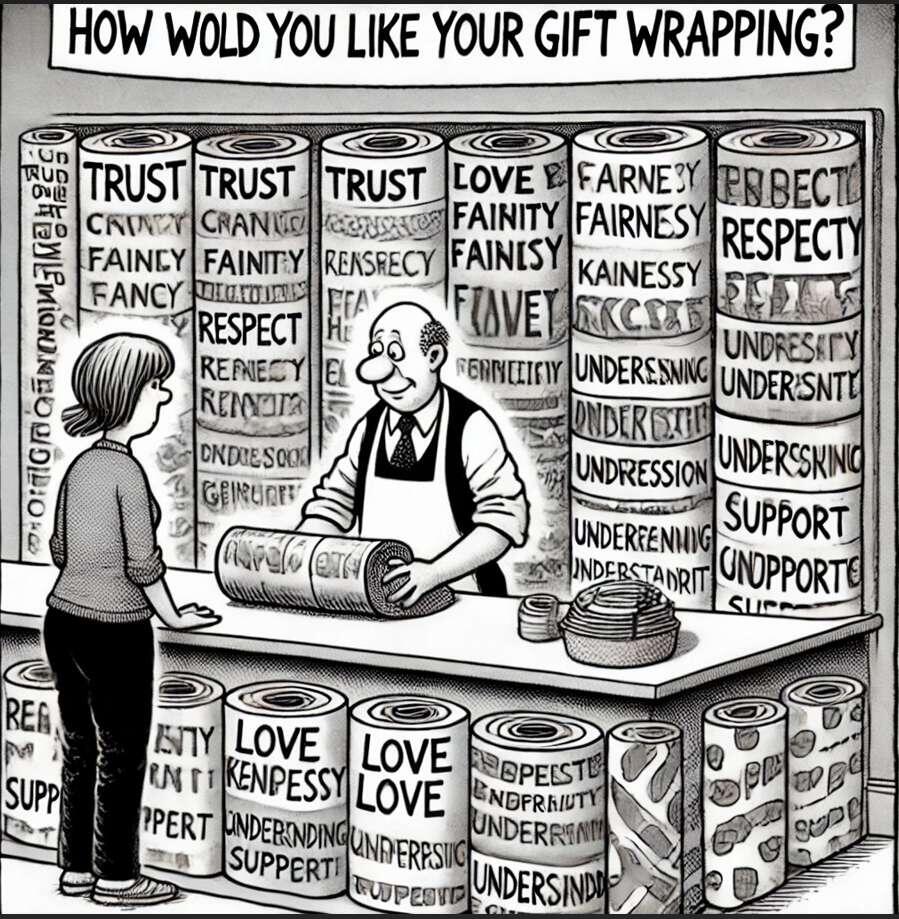
Imagine you’re giving someone a gift. The present is important, but so is the wrapping paper. This paper isn’t just decorative, it’s Magic Wrapping Paper. It holds all the care, thought, and effort you’ve put in. When you give it, the Magic Wrapping Paper tells a story about the care, thought, effort, needs and feelings, and it makes the gift even more meaningful.
Now, imagine that this Magic Wrapping Paper has multiple layers, each one adding a different level of empathy, trust, and understanding. The Magic Paper makes sure the person receiving the gift knows you care, and it protects the fairness and kindness behind the exchange.
What’s even more special? The Magic Wrapping Paper can be reused. Once someone receives a gift, they can take that same Magic Wrapping Paper and use it again to share empathy and fairness with someone else. The Magic Wrapping Paper doesn’t tear, wear out, or lose its magic, it just keeps spreading trust and connection.
In the world of barter, this Magic Wrapping Paper would not be needed as it was already there as the invisible bond of human empathy that surrounds every trade.
When you trade something, you’re not just swapping items; you’re also wrapping it in care, fairness, and understanding. Unlike money, which strips away these personal touches, the magic wrapping paper keeps the human side of every exchange alive.
Imagine having a free invisible Magic Wrapping Paper (made up of all the layers that make-up Human Empathy) and the size of the wrapped Empathy would be the full package being passed on to another.
This Magic Wrapping Paper would also allow the package to be broken down in to smaller and smaller packages to be shared among multiple people and or put aside for later use. More importantly, this Magic Wrapping Paper will speak to you and tell you the full story of all the Empathy inside.
To illustrate the role of empathy in barter, consider the analogy of magic wrapping paper. In this metaphor, the wrapping paper represents the layers of empathy that surround each transaction. Every exchange is like a gift whether it’s large or small, the present is carefully wrapped in empathy, ensuring that the exchange is equitable, sustainable, and socially responsible.
Multiple layers of the wrapping paper reflect the various aspects of empathy: perceived fairness, trust, mutual understanding, and community bonding. These layers ensure that the transaction is not purely material but wrapped in human consideration.
The wrapping paper can be broken down into smaller parts or even re-wrapped, reflecting the flexibility in barter transactions. If the original trade doesn't fully meet the needs of both parties, future exchanges can compensate for the imbalance. The wrapping remains intact, symbolising the ongoing nature of trust and fairness.
In contrast to modern money, which tends to strip transactions of their emotional and ethical layers, the magic wrapping paper ensures that empathy is always preserved. Every layer of the wrapping reinforces the connection between the parties, ensuring that no matter how many times the package is opened, the human element remains intact.
The Failure of Money to Capture Empathy
While money was introduced to overcome the logistical challenges of barter such as the coincidence of wants problem it has failed to capture the empathy ratio inherent in barter. Money reduces all exchanges to quantified value, stripping away the relational, emotional, and ethical dimensions of trade.
The impersonal nature of money-based transactions means that fairness is reduced to price, and trust becomes irrelevant, as transactions can be completed without personal interaction.
Fiat currencies further exacerbate this issue, as they are detached from any real material value and subject to manipulation by governments and financial institutions. The introduction of interest and debt-based systems drains the empathy from economic exchanges, creating opportunities for exploitation and inequality.
In contrast, barter, with its layers of empathetic wrapping, ensured that no one party could profit at the expense of another, and that the needs of both individuals and the community were always balanced.
Conclusion
The Magic Wrapping Paper analogy perfectly encapsulates the role of empathy in barter systems. Each layer of the wrapping represents a different aspect of empathy, from trust and fairness to social responsibility and sustainability. This Magic Wrapping Paper ensures that every exchange is not only materially fair but also rooted in human connection and ethical behaviour.
Money was never that Magic Wrapping Paper.
Sources:
· Nick Szabo, "Shelling Out: The Origins of Money"
· David Graeber, Debt: The First 5,000 Years, ISBN: 9781612191294
· Glyn Davies, A History of Money: From Ancient Times to the Present Day, ISBN: 9780708317174
· Adam Smith, The Wealth of Nations, ISBN: 9780140432084
· Marshall Sahlins, Stone Age Economics, ISBN: 9780202010991
· Paul Bohannan, "The Impact of Money on an African Subsistence Economy" Journal of Economic History, Vol. 19, No. 4 (1959), pp. 491–503
· Franz Boas, The Mind of Primitive Man, ISBN: 9780029035307
· Edith Stein, On the Problem of Empathy, ISBN: 9780810105969
· Martin Buber, I and Thou, ISBN: 9781570629048
· John Maynard Keynes, The General Theory of Employment, Interest and Money, ISBN: 9780230004764
· Karl Polanyi, The Great Transformation, ISBN: 9780807056431
· Niall Ferguson, The Ascent of Money: A Financial History of the World, ISBN: 9780143116172
· Daniel Goleman, Emotional Intelligence, ISBN: 9780553383713
· Simon Baron-Cohen, The Science of Evil: On Empathy and the Origins of Cruelty, ISBN: 9780465031421