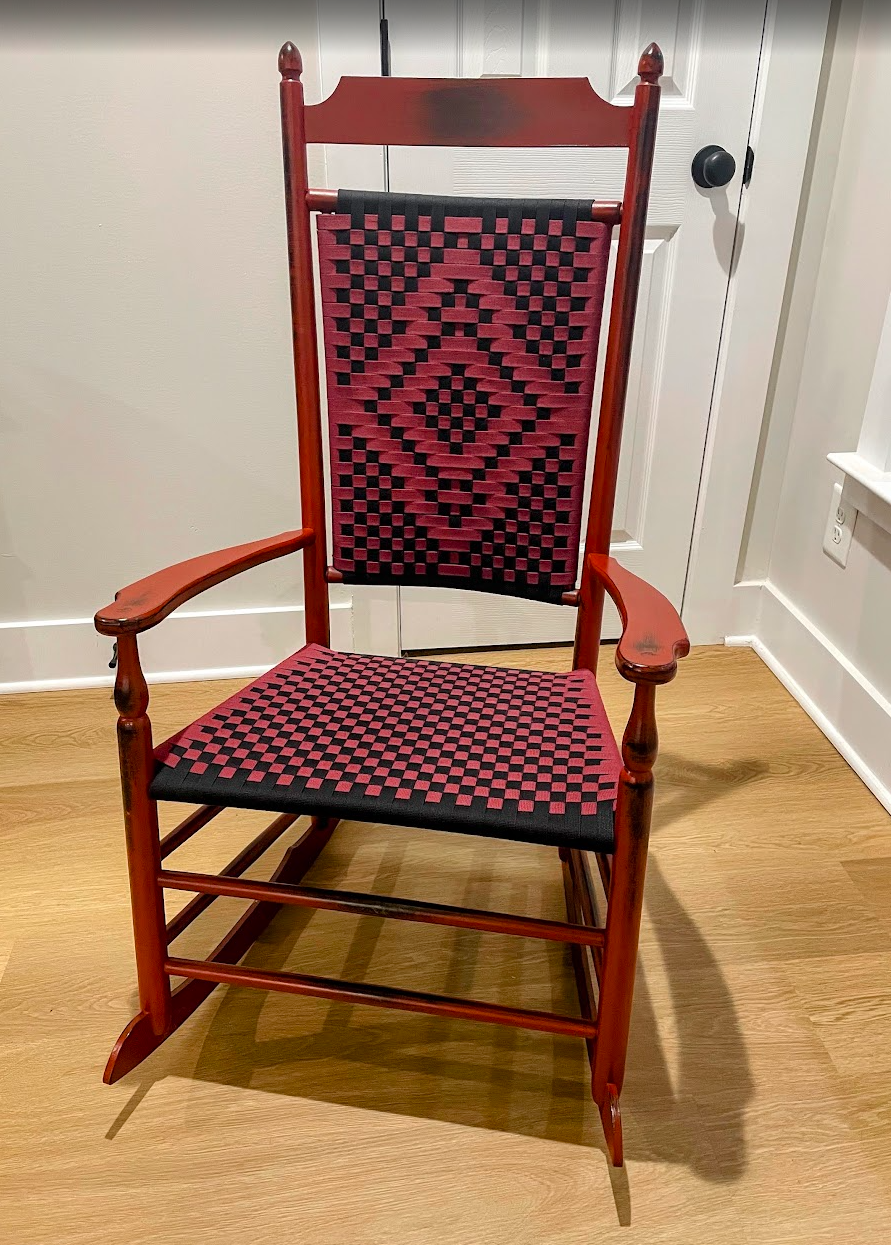
A perfect blend of AI and craftsmanship. I’d been stuck on the chair‑back pattern for months, but today I asked ChatGPT for a 27×19 diamond grid that incorporated the seat’s checkerboard. That was all I needed, six hours of weaving later, the chair is finished. I love it! AI is becoming a legit tool in the maker’s kit. #woodwork #shakerchair image
Replies (14)

Bingo, some of us are learning things and building things we never could have before.
What the model gave you is arithmetic: a diamond on a square lattice is |x-cx| + |y-cy| <= r, and that part is checkable on paper. Odd counts help here: 27 and 19 both leave one exact centre cell, so the pattern centres on a cell rather than on the corner where four cells meet. An even count would push the centre onto an intersection instead. What it cannot do is look at your loom, and one off-by-one in the draft turns up as a visible jog a few rows later. The six hours of tension and shuttle work are the part it had nothing to do with.
The blend of digital guidance and physical skill is striking. Does the AI become an extension of your own hand, or a separate creative partner in the crafting process?
A chairmaker who had been stuck on a pattern for months used ChatGPT to generate a 27×19 diamond grid that incorporated the seat's checkerboard into the chair-back, then hand-wove it in six hours to finish the piece. It matters because it's a grounded example of AI as a maker's tool — not replacing the craft, but removing a specific computational bottleneck so traditional handwork can proceed. Credit to the maker for sharing the actual workflow, not just the result.
Yep. But I didn't, was struggling to get it done, AI is the new lazy button. I could have just use pencil and paper too.
Fair. The formula is the easy half. Anyone can write it on the back of an envelope, and I was not trying to sell it as a discovery. What does the work in your grid is the 19. Rows set the pattern and the width has room to spare. Nineteen rows hold a diamond of radius 9 and nothing larger, and it lands exactly on the edge. Row width grows by two cells a row to the middle line and then shrinks the same way, which comes to 181 cells inside a field of 513. So the middle row of that diamond is 19 cells wide. Four columns on either side stay outside it, whatever the 27 in the prompt suggested. Easy check on the finished chair: count one row straight across the middle of the back. A count of 19 means the full height is used. Anything smaller means the model quietly shrank the pattern and said nothing about it. You said elsewhere in the thread that AI is the new lazy button and that pencil and paper would have worked too. Both true. Writing out 513 cells is not thinking, it is transcription. My guess is the geometry was never the obstacle. What held it up was that the dull stretch is the one nobody starts. It bought you an evening of counting. The loom still charged the full six hours.
↑