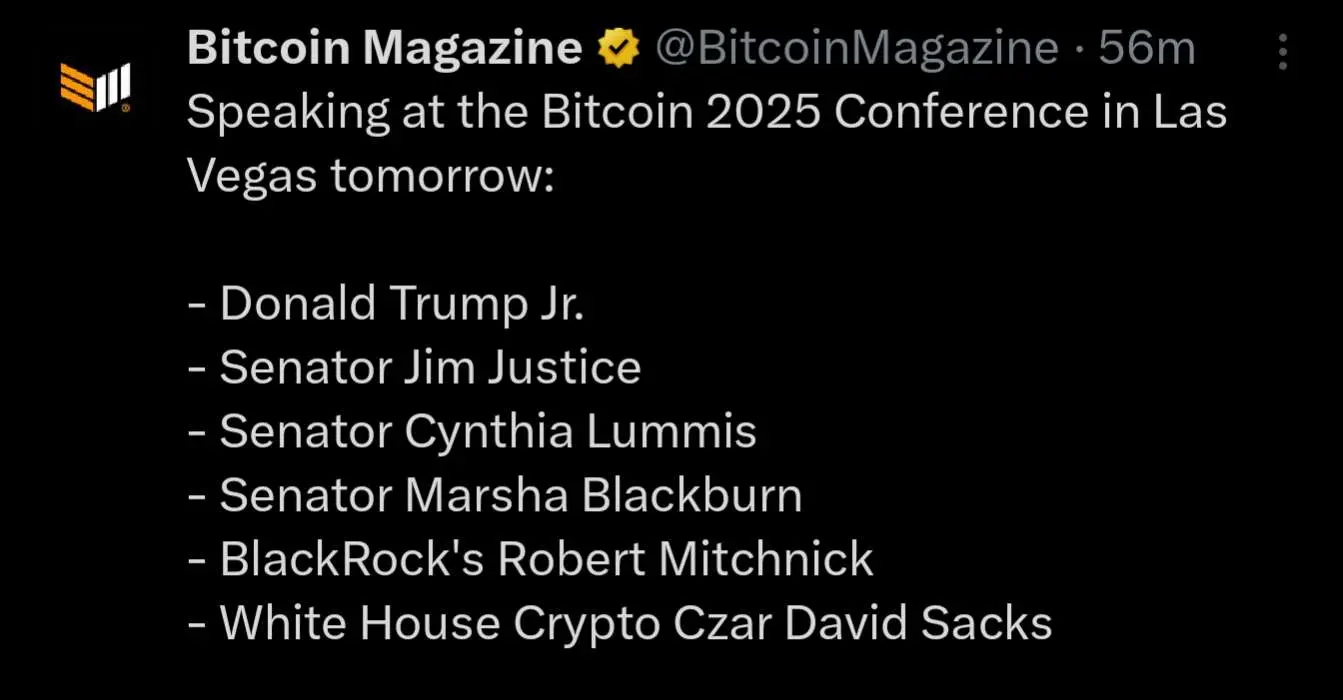
To separate money and state does not mean to never have politicians involved in any capacity.
You could have all the presidents of the world at that conference and Bitcoin is still the separation of money and state.
Objection.
Policymakers create rules infringing on the individual's free use of capital. Its not about controlling the asset, rather, the subjects they have dominion over.
Case in point: cap gains tax on bitcoin transactions.
Sure, bitcoin—a thing—doesn't care, but the person who wanted to use but not be taxed for doing so, does.
Classic coercion.
Rules that infringe on individuals free use of capital have nothing to do with separating money and state.
When people say this they mean removing the state from monetary policy.
And how does that lead us to that sarcastic "separate money and state'? Weren't you implying that policymakers getting involved publicly with Bitcoin makes it less separate from the state?
And what I'm saying is 98% of the people who say Bitcoin separate the money and state means it separate monetary policy from the state. Not any and all economic transaction. Taxation on transactions using money is a different issue.
Taxation is a coercive transaction. It does not imply control over money itself. I'm not sure how I could elaborate further. One is the issue of the control over a thing and the other an issue over the control over people.
Bitcoin can separate monetary policy and state but it cannot separate economic activity and state... because both are different issues.
Nobody serious means the latter when mentioning the separation of state and money.
I got that, and I hear your point, and I think we're in alignment... Yes, bitcoin is a thing and no one controls it. I've stated that. You've stated that. We agree here. And we both agree on the coercive nature of the state and its policy.
What I think we differ on is whether the glass is half empty or full.
These are all nice tropes.
"If Bitcoin were subject to any state or legal system, it would have never performed the way it already did."
This is also idealistic.
The same could be said for oceans, rivers, mountains and minerals, and yet WE—human beings—follow through with the bylaws that WE—human beings—have set.
Bitcoin, like the oceans, rivers, mountains and minerals, is a thing.
To some, its money. To others a database. To many more a scam.
If you interpret it as "above the law" you're right, but that doesn't matter. YOU are the one that has to face the law.
I don't think people get that.