TLDR: Two writings that will help you understand why Andy Back supports spam and turned himself into a clown and a bad actor.
It will help you understand why the compromised and corrupted Core together with Andy Back, David Bailey and other scammers turned against Bitcoin node runners and Bitcoiners in general.
Got #BIP110 & #BitcoinKnots? Bitcoin is Freedom Money!!!
By Jim
The real reason Adam Back doesn’t like BIP110. 👇
He’s publicly stated numerous times their desire to put Simplicity, their smart contract protocol, on Bitcoin mainnet. He calls it "the last softfork". It would require certain parts of Taproot that BIP110 would hinder. It would prevent them from putting non-bitcoin assets on the Bitcoin base layer. Simplicity is currently on their sidechain, Liquid.
Blockstream had a very significant role in the development and introduction of Taproot within Bitcoin Core. Did they have this planned all along ... Taproot on L1, to eventually support Simplicity? Was the Taproot "inscription bug" just an unintended byproduct, or intentional?
Simplicity was conceived by Blockstream's Russell O'Conner in 2017. Greg Maxwell proposed the idea of Taproot in 2018. And Blockstream employees had, by far, the biggest role in Taproot's development and implementation within Core.
Blockstream currently funds, or has previously funded, the following Core maintainers and contributors, many of which had key, leading roles in the development and implementation of Taproot.
Peter Wuille: Blockstream co-founder and employee 2014-2020. Core maintainer 2011-2022. Lead designer, primary implementer and co-author of Taproot BIPs 340, 341 and 342. Led and authored PR #19953, which implemented the full consensus rules for Taproot into Bitcoin Core - merged Oct 2020.. He left Blockstream and went to Chaincode in 2020.
Ava Chow: Blockstream employee 2018-2024. Core maintainer 2022-present. Wrote the Taproot-specific activation parameters (PR #21686) - as Andrew Chow (before transition). She also closed Luke's 2023 Datacarriersize PR to fix the Taproot inscription bug in Jan '24. She left Blockstream and went to Localhost Research Oct '24.
Andrew Poelstra: Blockstream employee since 2014. Core contributor 2014-present. Key co-designer of Taproot along with Wuille.
Jonas Nick: Blockstream employee since 2015. Core contributor 2015-present. Co-author all three Taproot BIPs.
Tim Ruffing: Blockstream employee since 2018. Core contributor 2017-2022. Co-author Taproot BIP 340.
Greg Maxwell: Blockstream co-founder and employee 2014-2018. Core contributor 2011-2018. Originator of the Taproot high level concept in 2018.
Matt Corallo: Blockstream co-founder and employee 2014-2018. Core contributor 2011-2022. Maintainer 2014-2018. Taproot reviews and technical feedback.
Rusty Russell: Blockstream employee 2015-2023. Core contributor 2011-2021. and others.
Russell O'Connor: Blockstream employee since 2016. Core contributor 2016-present. Originated the core concept of a short "trial" activation window, that became the controversial Speedy Trial to activate Taproot. He was also the creator/inventor of Simplicity, introducing the concept in 2017. He continues to be the main force behind its development, formal semantics, jets (optimized primitives), and integration with Taproot.
Blockstream, privately held, has raised $650-$730 million across multiple rounds. Peak valuation: $3.2 billion after 2021 Series B round. Blockstream views Simplicity as a key long-term technical bet on Bitcoin-native programmability.
They describe it as:
A major milestone in “Bitcoin-native programmable finance”.
The foundation for more expressive, formally verifiable smart contracts on Bitcoin Layer-2 (starting with Liquid)
A way to bring advanced features (vaults, covenants, tokenized assets, post-quantum cryptography).
Blockstream has invested years of research into it, beginning with O'Connor's introducing the concept in 2017. They actively promote it as enabling “the next wave of tokenized finance and adoption” on Bitcoin rails. Simplicity launched on Liquid Mainnet July 2025. In the announcement they said: "Liquid is just the beginning. With community feedback, real-world usage, and more tooling, docs, wallet support, and example contracts, our next major goal is to activate on a Bitcoin test network."
By Beautyon
"He’s publicly stated numerous times their desire to put Simplicity, their smart contract protocol, on Bitcoin mainnet. He calls it "the last softfork". It would require certain parts of Taproot that BIP110 would hinder. It would prevent them from putting non-bitcoin assets on the Bitcoin base layer. Simplicity is currently on their sidechain, Liquid."
This is super interesting, isn't it?
Liquid, the side chain that is adjacent to Bitcoin, where, if you want to get out of it requires the consent of the cabal of nodes who administer it, Their "Permission" if the amount you want to get back in to bitcoin is "too much at one time".
If Simplicity is already live on Liquid, then surely, if Liquid has any utility at all, this is what you need to be promoting, not putting Simplicity onto Bitcoin.
Promoting Simplicity on Liquid might turn around Liquid's fortunes, making it into Etherium 2.0 and increasing Liquid's user base.
At the moment, very few people are using Liquid. and it is not in widespread use.
It has been live since 2018 but remains very much a niche network.
The clearest metric is L-BTC in circulation: on the order of 3,000–4,000 BTC as of early 2026, versus roughly 130,000+ BTC wrapped on Ethereum and around 5,000 BTC in public Lightning Channel capacity.
Most Liquid activity comes from a small set of participants; Bitfinex, SideSwap, Boltz swaps, and tokenized-asset issuance (e.g., Blockstream's ASSETS platform, El Salvador-related bond experiments), rather than broad retail or merchant adoption.
The 15-member federation model has also kept some of the Bitcoin community at arm's length. It is a fundamental weakness in the model because trust is at the core of its architecture and design.
Wallet support reflects this profund failure to capture market share. Out of the hundreds of Bitcoin wallets in circulation, only about a dozen support Liquid:
Blockstream App (from Blockstream, which means they must support it)
Blockstream Jade (hardware)
AQUA (JAN3)
SideSwap
Marina (Vulpem, browser extension)
Bull Bitcoin Wallet (uses Liquid internally for swaps)
Ledger (limited, via Liquid app)
BTCPay Server (via plugin, merchant-side)
Specter/Elements-based desktop setups (for technical users)
So as a proportion of Bitcoin wallets, Liquid support is in the low single digits percentage wise, and several of those are Blockstream's own products or companies closely aligned with it.
The mainstream wallets, Electrum, BlueWallet, Muun, Phoenix, Sparrow, Trezor Suite, Exodus, Coinbase Wallet, Wallet of Satoshi, Phantom and the majority of others do not support it. The wallet runners have development teams who know exactly what they're doing, and they've rejected Liquid. Why is that?
Putting Simplicity on Liquid was not enough to midwife the creation of Etherium 2.0 and bring "Crypto" heads into the Liquid ecosystem, and so having failed there or being too impatient to work on growing Liquid, they want to go straight to Bitcoin, and have Simplicity running in two places.
The question is this; why are Blockstream in a privileged position to put their own scripting language into Bitcoin? If another company has another language, should that also be put into bitcoin? Is adding scripting languages to Bitcoin a privilege only for Blockstream, or can anyone do it.
I think the answer is, "I'm the only one" because Blockstream's spokesperson says, "This is the last soft fork", meaning that no future languages will ever be soft forked into Bitcoin.
Excuse me?
Who elected these people as the guardians and final arbiters of what does and does not go into bitcoin?
I think after BIP-110 there will be 0 chance of getting Simplicity into Bitcoin; after all, it is already fully live and available to anyone who wants it on Liquid, so they are free to experiment in that playpen, where they can harm no one.
And that is the way it should be. Running your own sidechain where people can opt in and experiment under the rules of the committee is exactly how things should be architected. Liquid causes no harm to bitcoin, and is completely ethical. What it does show however, is no one wants that stuff. It's not compelling at all, or attractive; trust is anathema to bitcoiners.
What makes anyone think Simplicity on bitcoin will be a hit? Hopefully that particular experiment is never run and we never have to find out at everyone's expense!
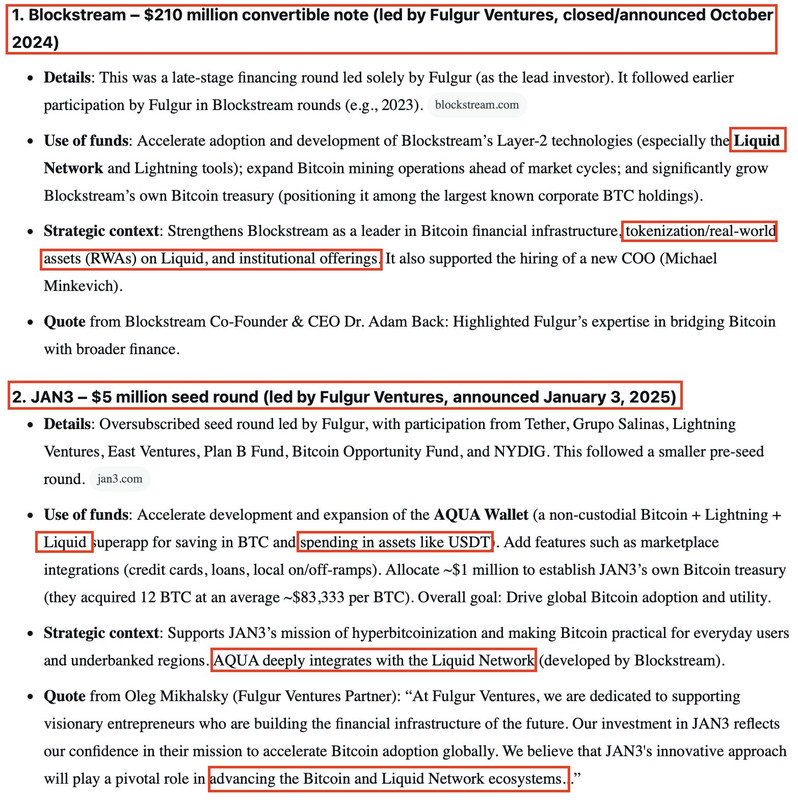
Andy Back, the Epstein's cuck, is a digusting liar, scammers, spammer and a bad actor.
Ethereum is a disgusting centralized created out of thin air slavery 💩💩💩shitcoin💩💩💩 scam.
This is one of the reason he is against BIP-110.
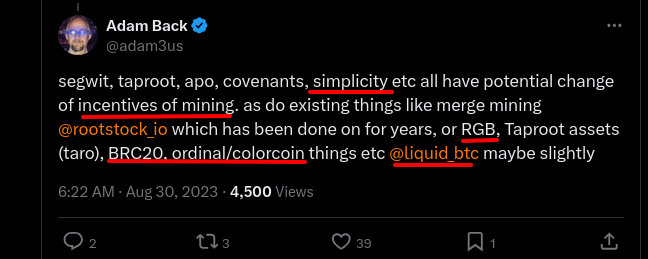
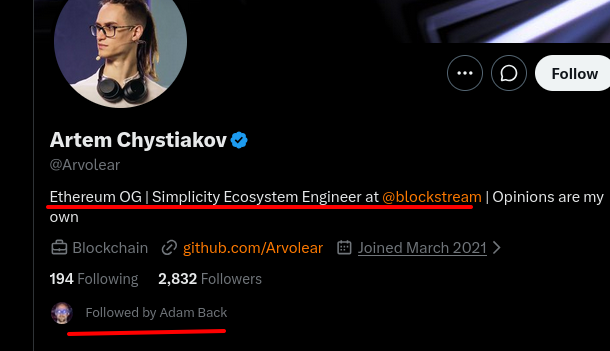
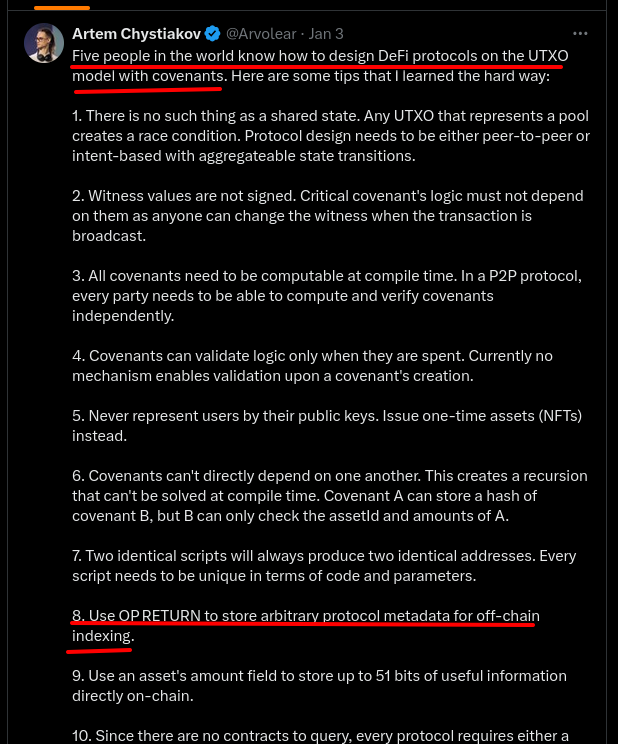
View quoted note →