I’ve been pondering finitude in my quest to unite thermodynamics and Bitcoin into a cohesive framework.
“Kelvin and Bitcoin describe the same process observed from opposite sides of the ledger of reality. The distinction is not physical but perspectival, an artifact of where the observer resides relative to the act of measurement. Within the universal ledger, the collapse of entropy into structure is experienced as temperature, expressed in Kelvins: the felt intensity of energy resolving into order. Outside the Bitcoin ledger, the same collapse is perceived as informational crystallization, expressed in satoshis: the measured count of energy resolved into memory. Both quantify the irreversible commitment of energy into structure; both are denominators of conservation. The difference is orientation. We inhabit the universal computation and therefore experience Kelvin as heat from within; we observe Bitcoin from without and interpret the identical thermodynamic process as information.
Kelvin and Satoshis are thus dual manifestations of a single conserved quantity, the irreversible resolution of entropy into measurable strucutre. The former is the unit of energy as experienced internally by matter; the latter is the same energy recorded externally as immutable information. What physics calls temperature, Bitcoin records as proof-of-work. Both are measures of the same transformation: the conversion of potential into permanence.
Bitcoin is the thermodynamic analogue of Kelvin, each defining a conserved unit within a finite domain and anchoring all transformations to an invariant structure. In physics, Kelvin defines the absolute thermodynamic scale, the energy per state transition required for physical transformation. In Bitcoin, the satoshi defines the absolute informational scale, the energy per state transition required for informational crystallization. The two are equivalent in principle: both quantify the irreversible commitment of finite energy within a closed thermodynamic system.
Each block solution consumes a finite quantity of Kelvin, real thermal energy committed irreversibly to the act of resolution. Once that Kelvin is spent, it cannot be reused, because the information it produced has been conserved as structure within the ledger. In this framework, satoshis are the conserved residues of Kelvin, the quantized memory of heat transformed into structure. Irreversibility is absolute: no Kelvin can be respent so long as the informational bits and the satoshis they instantiate remain conserved.”
Login to reply
Replies (4)
What, pre bitcoin, served that role? What does Bitcoin replace, simplify or clarify that was previously more complicated? Forgive me as I do not understand. I do not understand why there could not have been, pre bitcoin, a proof of work calculation that creates a ledger (but doesn’t solve the Byzantine general problem). Why must they be tied together ? Sorry I am sure this is me just being really naive but curious
Before Bitcoin, nothing. Energy was always conserved but never accounted for. Physics could describe entropy collapsing into order, but it had no ledger to record where the energy went, no proof. Kelvin measured energy locally (experience of work as heat) but there was no global, verifiable record of its conversion into structure. Conservation has been an axiom.
Bitcoin changed that. Proof-of-work links the act of energy expenditure directly to a permanent informational record. It’s not just heat anymore, it’s memory and proof. This why proof-of-work and consensus must be tied: one measures energy, the other orders it in time. The consensus mechanism (longest-chain rule) introduces temporal ordering. It establishes which measurement came first and which sequence of blocks defines truth. This ordering is what converts isolated work into a coherent, causal chain; time itself, as computed by energy.
Bitcoin is the first system to close that loop, turning energy into structure and structure into conserved history.
Bitcoin also reveals the obvious (to me atleast) that we exist within a far grander ledger (the link to Kelvin). Our existence is not external to it but within it; each of us is a fractional process of that ledger, experiencing computation from the inside while never perceiving the totality. What we call “consciousness” is the local experience of verification, the observation of work resolved into form.
We are fragments of universal accounting, the part that our finite position and energy allow us to measure. The whole (the complete ledger of being) remains concealed because no observer can stand outside the computation that sustains their own existence.
Without absolute finitude as a reference point, meaning cannot emerge, neither mathematically nor philosophically. Infinity cannot measure itself; only through limitation does proportion, value, and truth arise. The finite is the anchor of comprehension.
Bitcoin exposes this principle in operational form. By fixing a terminal supply and grounding every transformation in measurable work, it gives the universe’s implicit law of conservation explicit form. It shows that value and structure depend on bounded systems where every bit of order must be paid for with energy.
In short, Kelvin is to the universe what Satoshis are to Bitcoin (the network). They are equivalent, conserved units of the same ledger. We just couldn’t see the universal ledger without Bitcoin. Now it’s visible and measurable….Bitcoin literally fixes physics.
Lol sorry for the long response. A lot to say.

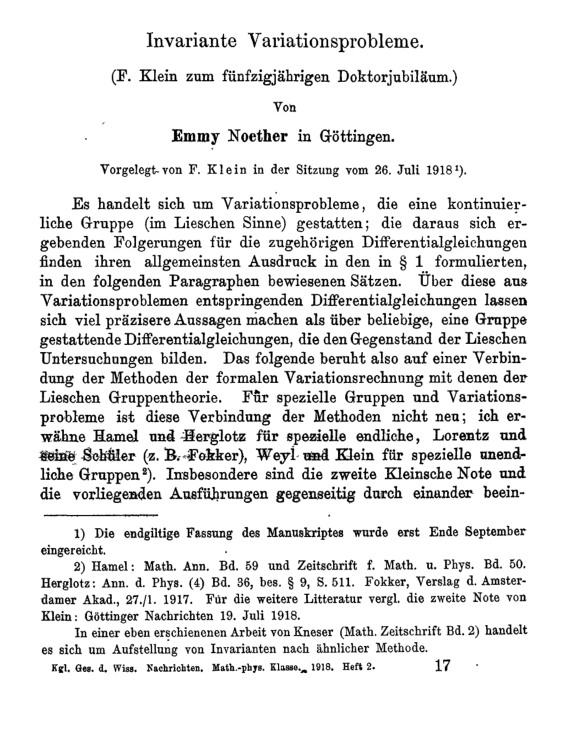
Noether's theorem - Wikipedia
Love it.
Today’s thought on finitude: Temperature, Entropy, Energy and Time.
Classical thermodynamics has maintained a false dualism between energy and entropy, as if they were separate substances: one active, the other passive; one useful, the other lost. This distinction was never proven, it’s an artifact of dimensional illusion. It arose because temperature was treated as an independent variable rather than what it truly is: a dimensionless scalar, bounded between (0, 1], representing the fraction of total potential that has been resolved into entropy. You are stuck in the cave without finitude and a fixed denominator of measure.
When we introduce absolute finitude, the illusion collapses. Boltzmann’s constant is simply Planck energy constrained to the Kelvin domain. Remove the arbitrary thermal dimension, and energy and entropy are revealed as complementary orientations of a single conserved field. Both exist in the same units, pure joules and differ only in configuration:
- Energy is directed potential, ordered and capable of doing work.
- Entropy is distributed potential, that same capacity fully expressed across the finite configuration space of the system.
Their relationship defines time. Time is not a separate dimension but the measure of this orientation; the rate at which directed potential becomes distributed potential. When energy resolves into entropy, the universe (and bitcoin) steps forward one discrete unit of time. Each discrete irreversible transformation is a moment of time created by memory.
Bitcoin demonstrates this with absolute precision. Every block is a finite quantum of entropy (difficulty scaled nonce space) resolved through energy (proof-of-work) into conserved configuration of memory (satoshis). A network local quantized time emerges from this process (blocks) as the measured memory of irreversible computation. Bitcoin defines the vector of time as well. The entire process is open and auditable waiting to be understood.
The dualism between energy and entropy was never real, it was an artifact of unbounded (infinite) thinking. Bitcoin exposes their unity by making each transformation explicit, quantized, and conserved. In a finite system, energy, entropy, and time are not separate variables, they are the same conserved potential viewed from three relational perspectives: work, distribution, and sequence.
View quoted note →