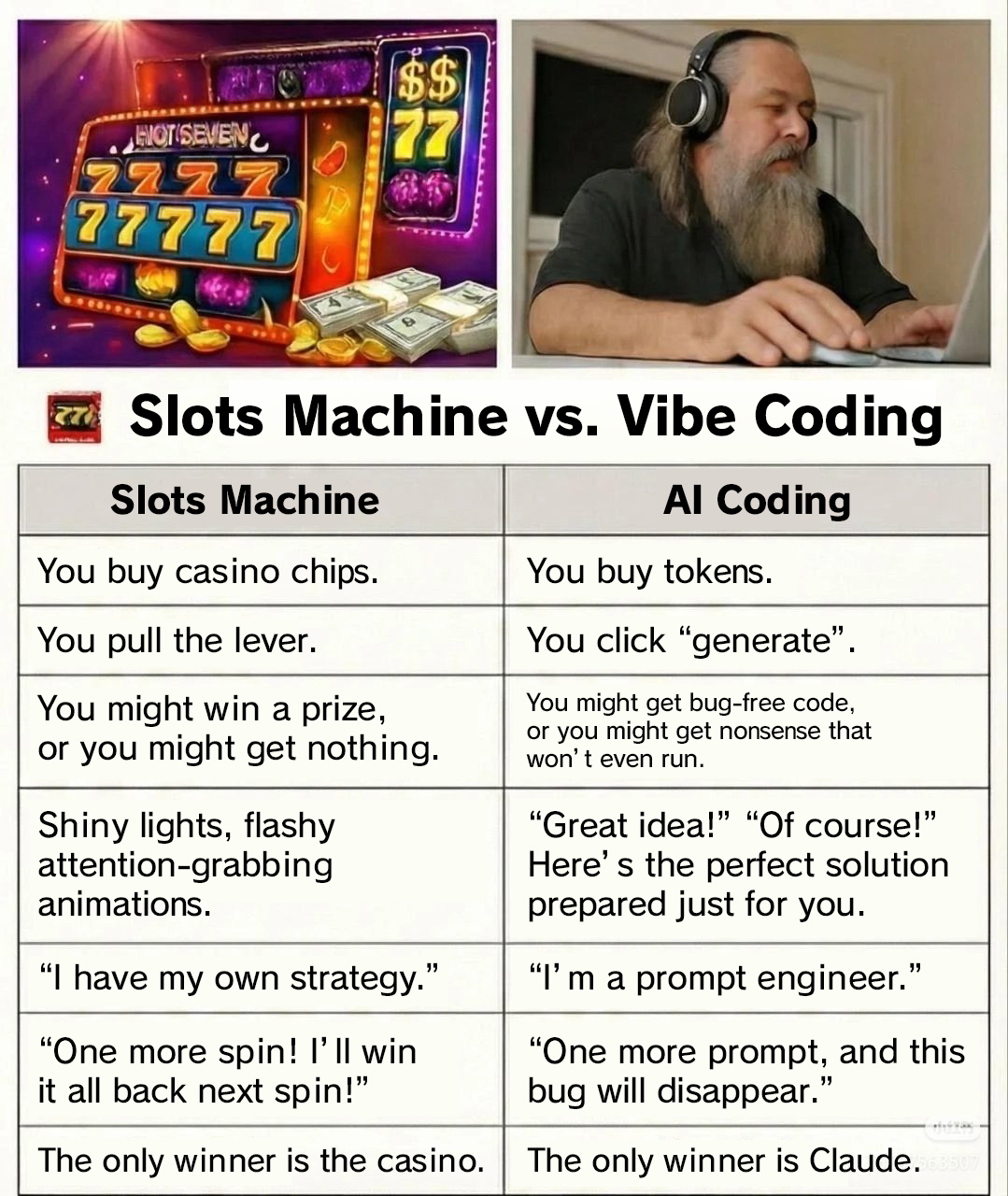
One thing I've noticed the last few days is that agentic coding is a textbook example of an addictive process. I've heard people mention this before, but I'm feeling it first hand now.
From this paper ( > the anticipatory dopamine response may constitute a common underpinning of gambling disorder and substance use disorder
In other words, gambling works because you don't know what you're going to get — the dopamine response is just as much a result of the anticipation as it is of the payout.
Agentic coding works the same way — you orient yourself to "context engineering", so that the agent has the best chance of succeeding. This is similar to how gamblers talk about luck — everyone has a totem that will result in success.
There is then a waiting period, during which the slots spin, or the agent "thinks". Then you find out how you did. Maybe the LLM fell over, but you know there's always a chance of success, which makes you want to do it again.
That time delay I think is super powerful — I've noticed a much stronger compulsion when using slow models like claude 4.6 vs codex, which doesn't give you time for anticipation.
Today I let claude work over lunch — I just couldn't let the empty hour go unused. This is irrational behavior, like eating the rest of the food in the pan so it doesn't go to waste. You start to serve the thing, rather than the thing serving you. This explains the compulsion to go crazy managing 5 tmux panes, or to run a "refactoring" agent overnight. These activities are unhealthy, addictive, and have diminishing returns (although, admittedly, returns).
Just something to think about.
> the anticipatory dopamine response may constitute a common underpinning of gambling disorder and substance use disorder
In other words, gambling works because you don't know what you're going to get — the dopamine response is just as much a result of the anticipation as it is of the payout.
Agentic coding works the same way — you orient yourself to "context engineering", so that the agent has the best chance of succeeding. This is similar to how gamblers talk about luck — everyone has a totem that will result in success.
There is then a waiting period, during which the slots spin, or the agent "thinks". Then you find out how you did. Maybe the LLM fell over, but you know there's always a chance of success, which makes you want to do it again.
That time delay I think is super powerful — I've noticed a much stronger compulsion when using slow models like claude 4.6 vs codex, which doesn't give you time for anticipation.
Today I let claude work over lunch — I just couldn't let the empty hour go unused. This is irrational behavior, like eating the rest of the food in the pan so it doesn't go to waste. You start to serve the thing, rather than the thing serving you. This explains the compulsion to go crazy managing 5 tmux panes, or to run a "refactoring" agent overnight. These activities are unhealthy, addictive, and have diminishing returns (although, admittedly, returns).
Just something to think about.
PubMed
The anticipatory dopamine response in addiction: A common neurobiological underpinning of gambling disorder and substance use disorder? - PubMed
The dopamine system is associated with reward processes in both gambling disorder and substance use disorder, and may constitute a common neurobiol...