Replies (20)
🤝

Sending miners to orbit would be ridiculous. If the hashpower is available from idle processors that normally serve other purposes, maybe use it.
Bitcoin will revitalize the space race. The first group to successfully launch mining centers in space will have an advantage given the abundance of energy available there.
Over time you’ll expect to see a greater percentage of the hash rate move into space. The closer you are to the sun the more energy per square meter so there’s an incentive to slowly migrate operations into a tighter solar orbit.
Then you get competition for covering more surface area. Could this be what gets us a Dyson sphere [1]?
1.


Keeping miners in space with Unobtanium perfectly emissive ("we can round up to 1") and infinitely conductive heat spreaders of the same area as our solar panels will result in an equilibrium termperature of 59C.
That's... optimism.
Now lets talk static electricity. Enormous and unpredictable voltages, usually mitigated by enclosing in aluminium. Aluminium with its oxide surface and its lousy emissivity. But maybe Unobtanium to the rescue again!
Now lets talk radiation. Solar wind protons, cosmic rays, and relativistic electrons escaping our own Van Allen belts. Silicon says "no". Space-rated electronics are usually Silicon-on-Insulator (typically sapphire) for this reason. USD$100k for the equivalent of a Raspberry Pi.
No.
We will not be mining bitcoin in space.
Reach out and slap anyone who suggests it again.
Quibble - we /could/ mine bitcoin under the surface of a large object, such as the Moon, and rejecting heat to the surrounding rock. That's not exactly "in space", and its a long, long way away.
There was an interesting article in 2016-2017 on the effects of bitcoin in space. Will post if i can find it.

The emissivity of all kinds of common materials are very close to 1. For example, typical glasses are about 0.95, and anodized aluminum is about 0.85 (not lousy at all, unlike your claim). As for heat spreaders, like I said in my article, they already exist. Heat pipes are remarkable tech. And as I pointed out, you don't necessarily need them at all if you derate your ASICS from current designs.
Static electricity isn't a significant issue at all. Safelites have had to deal with it since forever, and we know how to mitigate it.
Radiation isn't a significant issue either for an application like Bitcoin mining. If a particular ASIC has an error due to radiation, just power cycle it. Plenty of real world satellites use cheap commercial parts with this strategy. And obviously, if you're spending a few billion launching Bitcoin miners, you can put some R&D into making custom designs that are more resistant. You're going to be doing that anyway to actually make the economics work and take advantage of the space environment.
Rejecting heat to rock is a really stupid idea. Rock is a thermal insulator. That's why the London underground – and lots of other underground infrastructure – has endless problems keeping things cool underground.
holly shit dude, you are smart ) Are you sure you're not a satoshi? 😁
I don't know where you could have gotten 0.85 from, try this:

Aluminum - Radiation Heat Emissivity
Radiation heat emissivity of unoxidized, oxidized and polished aluminum.
Heat spreaders and heat pipes are not at all the same thing, and either will result in a delta-T completely missing from your calculations. And minimising that will blow your mass budget.
Re static electricity - yes there are mitigations, such as the aforementioned aluminium enclosure, but that will result in yet another delta-T missing from your calculations.
Radiation: yes, we can check for single event upsets in software and discard them. That's not the main problem with radiation, though. Here's a TL;DR:
https://nepp.nasa.gov/DocUploads/392333B0-7A48-4A04-A3A72B0B1DD73343/Rad_Effects_101_WebEx.pdf
Infrared Emissivity Table
Aluminum's emissivity varies significantly depending on the surface treatment, and exactly how you are measuring it.
Anyway, as you can see there's lots of materials with emissivities close to 1. This is not a hard problem.
Commercial satellites do in fact use off the shelf chips all the time. Heck, I used to work at a company founded by satellite engineers. Their previous big project was a space telescope that was entirely built with automotive rated electronics. It lasted for years in orbit with no serious problems. You achieve this with redundancy and error tolerant software. Which is easier these days because automotive electronics standards have also created a big market for error tolerant devices, eg cheap microcontrollers with ECC RAM and SEU tolerance.
$100k silicon on sapphire chips just aren't as commonly used as you think they are. It's actually to the point now where for a lot of satellites the engineers actually _prefer_ using automotive rated parts as in many circumstances they're more reliable than the pricey space rated stuff.
...and LEO is a more forgiving radiation environment than deep space. Okay, I'll grant you your automotive-grade ASICs.
We haven't solved the thermal engineering, not at all. There are many materials with high emissivity, but you also want high thermal conductivity, high electrical conductivity, high toughness and high strength.
Unobtanium.
There are good reasons why aluminium is standard, and whatever the treatment its emissivity sucks at any temperature that automotive-grade electronics can be expected to survive.
Shall we re-run your calculations, as a second-approximation with a plausible emissivity (0.2) and a delta-T budget for heat-spreaders/heat pipes (10C ?).
You obviously didn't read my link. Your just unable to admit you're wrong.
And we haven't even gotten into higher tech solutions like the large variety of specialty coatings that have been developed to optimize radiation (hint: the ISS's radiators aren't black, because they use special coatings to optimize exactly what wavelengths they emit and absorb).
Finally, as I explained in my post, you can pick whatever temperature you want arbitrarily by simply rotating your satellite at an angle to the sun.
Space mining is clearly possible. Whether or not it is actually economical is a question of in-depth cost engineering that none of us are in a position to evaluate without an enormous amount of detailed cost engineering work.
Your link, I'm sorry to say, does not support the 0.85 emissivity you claimed for aluminium. Where did you get that?
Your link also does not give any hint as to what temperature their source measured emissivity at. Anything can be emissive at plasma temperatures.
So no. Use the engineeringtoolbox numbers, which do list treatments and temperatures.
0.2, for heavily oxidised aluminium.
Z-93, as used on the ISS radiators, is rather nice, though. You should have gone with that from the start.
You certainly can rotate your panels away from perpendicular to reduce insolation, but obviously that will reduce power and hash rate, while doing nothing about radiation damage or cost of now-idled capital.
You are correct that we cannot perform a detailed economic analysis without a design, but I stand by my previous conclusion.
We will not be commercially mining bitcoin in free space this century, and without "new physics" we won't be doing it ever. Not even with zero launch costs.
That link is for infrared thermometer readings. Hence, low temperature.
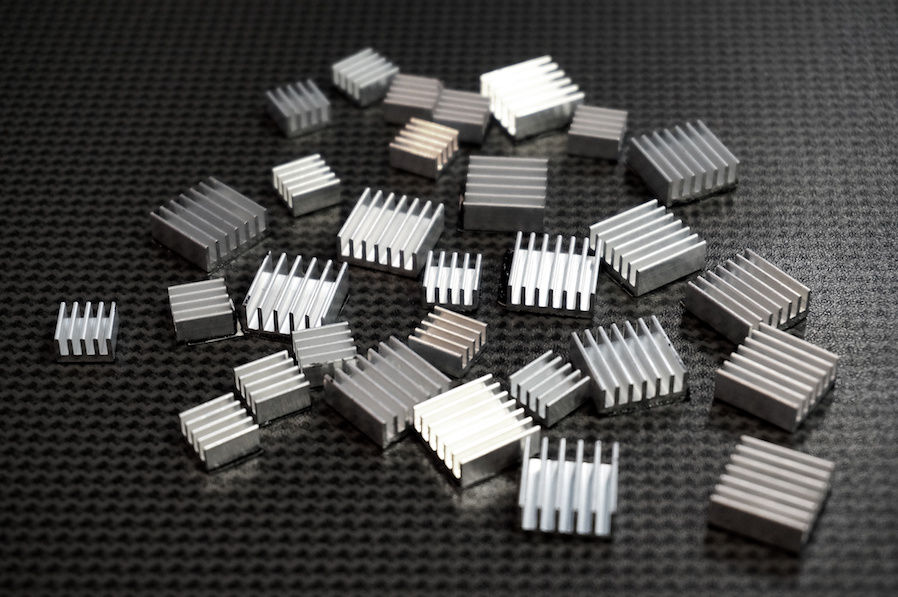
It's bizarre how you are surprised by this. Anodization greatly increases the surface roughness of aluminum. This information is easy to find from lots of sources:
Gabrian
Anodized Aluminum Heatsinks: What You Need to Know - Gabrian
Heat sinks act as passive heat exchangers in many electronic devices, and many aluminum heat sinks are anodized. What benefits does anodization offer?
Okay, much better, now that one says 0.85.
Day-um, wild if true. Wonder that oxide thickness, and if they've published a paper. Not very important in-atmosphere or when surrounded by other FIR-emitting things, but in space...
I am interested in your thoughts on the threat of quantum computers for Bitcoin.
Your analysis on heat spreading suggests that it's possible to build a passively cooled solar powered mining rig on Earth too. Wouldn't that be strictly cheaper since you save the launch cost?
Or does the atmosphere add too much insulation?
I guess another concern is that on the surface you only get sunlight half of the day. Takes twice as long to earn back the investment. Though the equipment might last longer.
How well can 2 to 3 nanometer chips survive space? You'd definitely want a way to bypass individual chips, but that seems easy enough.
Solar isn't necessarily cheaper on earth. Solar panels dedicate a lot of mass on structure necessary to resist weather, as well as gravity. Space miners could potentially be _much_ thinner. Possibly even a very thin film that is simply unrolled in space and tensioned via rotation. Whether or not this is an economical advantage depends on how cheap we make ASIC manufacturing.
That said, as I've said before I strongly suspect we'll eventually see ASICS integrated into solar panels too, with passive cooling. We just need the right economies of scale to make the up front development costs worth it.
Re: 2-3 nanometer chips surviving in space, we're just beginning to have significant commercial demand for relatively high end electronics in space with Starlink. So who knows what we'll come up in the future. I deliberately didn't ask questions like that in my article as it's a matter of in-depth engineering, not fundamental physical constraints.
Re (3) earth orbit is ok. Mars would be too far 3-22 mins at lightspeed depending on both planet's orbit cycle
This is so cool!