This happened during a demo of Tollgate, a tool for OpenWRT routers which let's users pay for WiFi with sats-denominated ecash. Friend of mine connects his phone to the wifi hotspot and is shown a captive portal that says it wants ecash from a certain mint. Friend doesn't have ecash. But I do.
I whip out my phone and create a 100 sat token, show it to him as a QR code, which he copies and pastes into the captive portal. A few seconds later, he's online. 1 sat = 1 minute internet.
We're just scratching the surface of what's possible.
Replies (21)
Though this also shows the limitations of ecash. If that were a 127sat token, it'd be damn near impossible to scan.
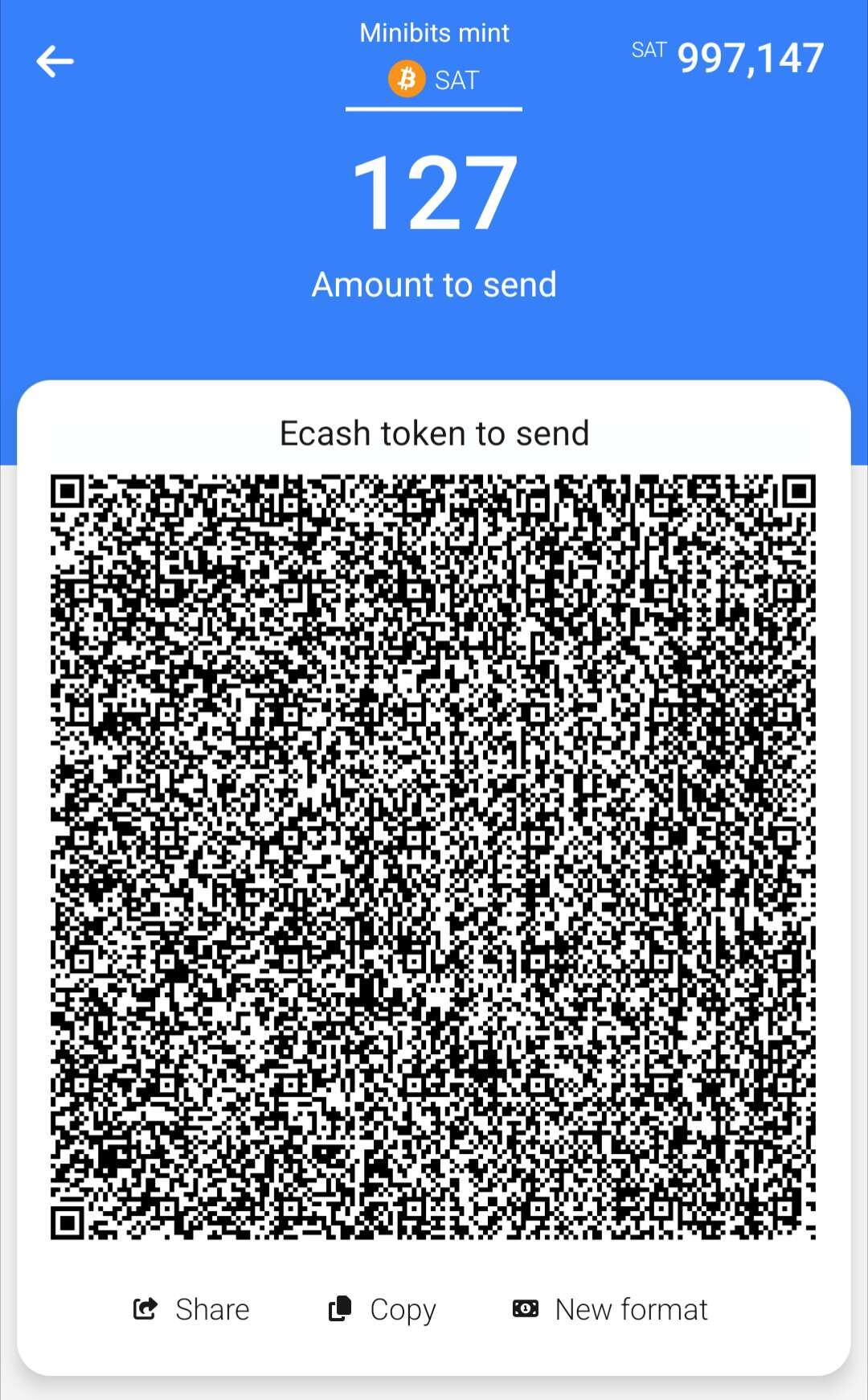
I'm using cashu.me which supports animated QR. We need to ask
@Minibits to adopt it pls ser it's trivial to implement.
It's 1 sat less than a power of 2 which is always nifty
damn, I had to read it several times to get it, and even when you are right, that is the exact reason why is not popular, it is too complex to get even for Bitcoiners 🤝
Switch QR to the new v4 format, makes QRs much more readable. It's the default on latest Minibits.
Mind blowing... 🤯
👀
That was a v4 format QR code.
Clever as the engineering undoubtedly is, I'm not sure the goal is worthwhile.
I remember the 1990s when access to *dial-up* net access was metered by the MB or by the minute. It took a lot of work to replace that with all-you-can-eat broadband. Going back to metered access seems like regression to me, not progress.
 calle
calle
This happened during a demo of Tollgate, a tool for OpenWRT routers which let's users pay for WiFi with sats-denominated ecash. Friend of mine connects his phone to the wifi hotspot and is shown a captive portal that says it wants ecash from a certain mint. Friend doesn't have ecash. But I do.
I whip out my phone and create a 100 sat token, show it to him as a QR code, which he copies and pastes into the captive portal. A few seconds later, he's online. 1 sat = 1 minute internet.
We're just scratching the surface of what's possible.
View quoted note →
Tap "New format" at the bottom for a v4. Should be in avg 30% more efficient.
Just in case you're missing the point: the innovation is not that it is metered, the innovation is that you can have KYC-free service, just like buying an apple at the corner store doesn't require KYC.
This was impossible before bitcoin, and impractical before ecash.
Is paying to connect to random WiFi a thing where you live? I've never seen that in Aotearoa, or in China for that matter. Most people use mobile data (cell network) and WiFi is either password-protected or open and free to use.
it's not metered, you're paying for time, just like any other ISP.
it's not metered, you're paying for time, just like any other ISP.
"it's not metered, you're paying for time."
Pick one. Paying for time or data is what "metered" means.
"just like any other ISP."
Maybe where you live.
 Electric Sheep
Is paying to connect to random WiFi a thing where you live? I've never seen that in Aotearoa, or in China for that matter. Most people use mobile data (cell network) and WiFi is either password-protected or open and free to use.
View quoted note →
most ISPs are a subscription model, where you pay per month. This is normal most places. That's metered access, just on a longer timeframe than your willing to consider. But there's really no difference.
Pay one month in advance vs 1 minute in advance. Same principle, just better granularity with LN.
> most ISPs are a subscription model, where you pay per month. This is normal most places. That's metered access, just on a longer timeframe than your willing to consider. But there's really no difference.
If you take a taxi, they have a meter, so they can charge you per distance travelled. So that's metered. If you give your mate $10 to drive you somewhere, that's a fixed fee. There's no meter running, so it's not metered.
By the same token, if you pay for an internet connection for each hour/ GB you use, that's metered internet. If you pay a fixed price per month for a connection, that's a fixed fee. There's no meter running, so it's not metered.
This difference matters.
Here in Aotearoa, the move from metered to unmetered internet is a big part of what made it affordable to the average person. The introduction of metered mobile data then created a 2-tier internet. Where some people have unmetered WiFi at home, and can use the net with no time or data limits. While other people can only use the net as much as they can afford mobile credit.
IMHO we need to be pushing for universalisation of unmetered internet. So coming up with better ways of metered internet doesn't excited me that much. Sorry.
you want free access, i.e. communism?
If not, you need to pay, and there's only two ways to pay, either unlimited data within a paid time window, or per amount of data, time window being irrelevant (mostly, might have expiration).