
Unlocking Knowledge: Bitcoin in Plain Language
This series continues to translate the original white paper by Satoshi Nakamoto to plain language. The goal is to have easily shared content, and send new people directly to nostr to read it. The original content will be posted, with the plain language below.
Please show support by sharing or sending sats.
Hash - A secure, scrambled message created by Bitcoin's special tools
Disk Space - Digital or virtual "space" on a computer's hard drive, measured in MB, GB or TB. Like boxes filling up a closet or room in a home. The blockchain currently takes up over 500GB of disk space.
7. Reclaiming Disk Space Paragraph 1
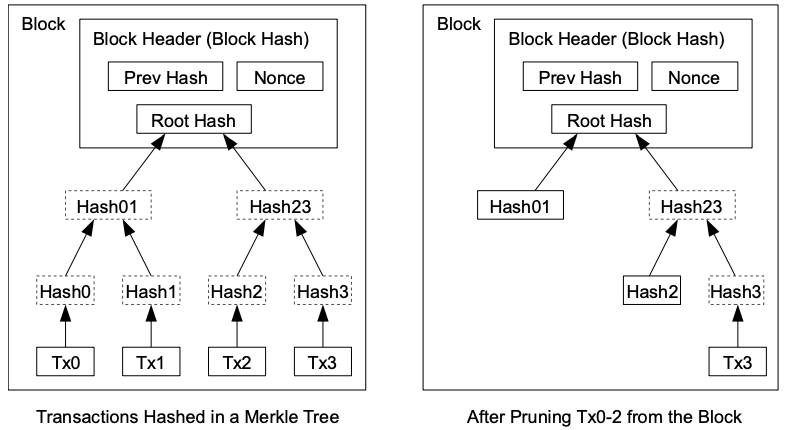
Once the latest transaction in a coin is buried under enough blocks, the spent transactions before it can be discarded to save disk space. To facilitate this without breaking the block’s hash, transactions are hashed in a Merkle Tree [7][2][5], with only the root included in the block’s hash. Old blocks can then be compacted by stubbing off branches of the tree. The interior hashes do not need to be stored.
Plain Language
Imagine our puzzle game with a lot of pieces. In the game, each piece represents a transaction, like buying something with Bitcoin. Now, to make sure everything is secure and organized, we put these in a tree structure, like branches and leaves are connected on a tree.
Every time someone makes a new transaction (buys something with Bitcoin), we add a new piece to our puzzle game. But to save space and keep things tidy, once a bunch of new pieces are added and the game is getting too crowded, we decide to bundle them together under a few big branches in our tree structure.
To make sure everything is still safe and nobody can cheat, we use a technique called a Merkle Tree. If you had a big tree with many branches, instead of checking each branch individually, we only need to check the main branch, which we call the root. This root is the key piece that holds everything together.
When we want to save more space, we get rid of some old branches of the tree, as long as we keep the main roots intact. We don't need to remember all the smaller connections (interior hashes) between the branches because we can always trace everything back through the main roots if we need to.
How many blocks in the blockchain are enough before you discard the unnecessary branches of the tree? This depends on how secure you want to be. Others help confirm transactions on the blockchain, and different amounts of confirmations range from a minimum of 3 to double digits. Once the transaction is "confirmed" the tree discards the information it doesn't need.
In simpler terms, in the Bitcoin puzzle game, when there are too many transactions, they bundle them up using a Merkle Tree structure. This helps keep things organized and secure while saving space, like compacting the puzzle by removing unnecessary branches while keeping the main connections intact.
The important parts of past transactions are saved, and can't be tampered with. The unnecessary parts are discarded, conserving disk space for everyone who has a copy of the Bitcoin blockchain on their computer.
#bitcoin #crypto #btc #blockchain #cryptocurrency #hodl #digitalgold #decentralized #satoshi #cryptonews #satoshinakamoto #whitepaper #bitcoinwhitepaper #nostr #grownostr

