Thread

Zero-JS Hypermedia Browser

Relays: 5
Replies: 8
Generated: 21:41:37
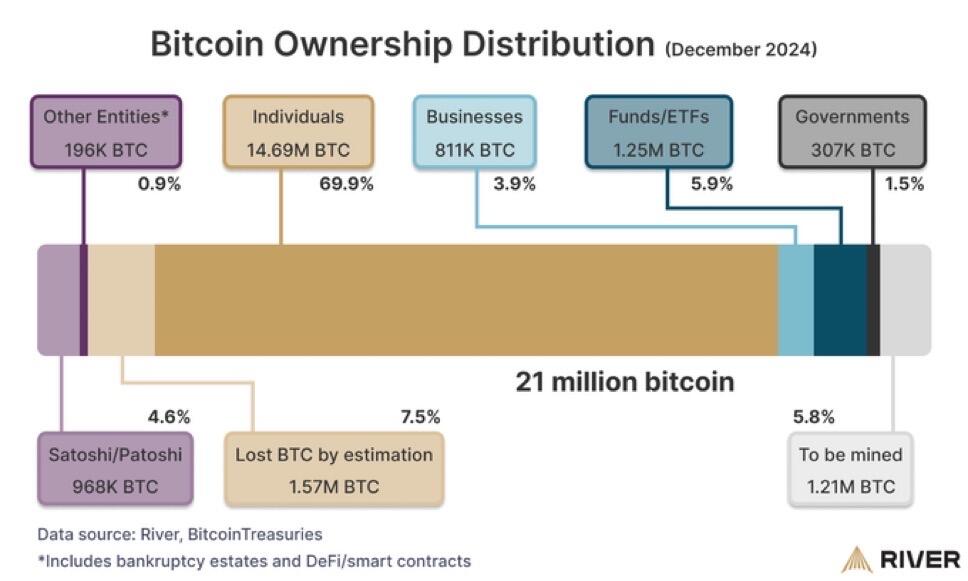
Why Network States are inevitable if we assume hyperbitcoinization: 1). Nation States are all pretty much bankrupt already. 2). Btc accumulation takes a long time for nation state level actors without the price running away. 3). In a Bitcoin backed world, printing money is no longer an option, therefore current Nation States will get outcompeted due to their wasteful spending. Either they will adopt and become Networks or die. 4). As you can see below, individuals own most of the supply, so we will instantly see the rise of the sovereign individual. image
2025-01-13 19:26:42 from 1 relay(s) 3 replies ↓
Login to reply

Replies (8)

How does the network state overlap with my hierarchy of needs? Bitcoiners talk of citadels as if some kind of physical colocation of those already citizens of Bitcoin. Difficult concept to thrash out given that Bitcoin is for enemies too.
2025-01-13 21:21:19 from 1 relay(s) ↑ Parent Reply
How does the data source identify a business vs an individual? Do they base it on the mapping between addresses and businesses? If so, then wouldn't they incorrectly categorize a huge pool of non-KYC addresses (including those of large mining operations) as individuals?
2025-01-14 02:22:55 from 1 relay(s) ↑ Parent 1 replies ↓ Reply
That’s a great question. It was done by River, I couldn’t find the exact methodology, but they were able to link Satoshi to 22 different addresses, so I’m assuming they are able to analyze transactions to get a sense of whether it’s a business or individual. Perhaps someone technically more knowledgeable can answer how that’s done. I’m more concerned with the macro implications.
2025-01-14 03:33:31 from 1 relay(s) ↑ Parent 1 replies ↓ Reply
I took a quick look at the source: https://river.com/learn/who-owns-the-most-bitcoin/ . River didn't do original research. The numbers seem to have been collected from a few sources. The claim that 16M+ BTC are held by individuals is unconvincing because (a) it is hard to detect it from typical blockchain analysis techniques (e.g., graph analysis), and (b) it contradicts the intuition from mining power distribution--most of the mining power is concentrated among a handful of players. It is certainly possible that 16M+ BTC is held by individuals, but the claim would have been more convincing if they had stated the methodology upfront.
2025-01-14 14:12:08 from 1 relay(s) ↑ Parent 1 replies ↓ Reply
So to me the number makes a lot of sense for a few reasons: 1). 90%+ coins have already been mined. In previous cycles, many mining operations were smaller and more decentralized. Most ended up having to sell btc during bear markets, so the distribution shouldn’t favor miners too drastically, besides top 1%. 2). Bitcoin until at least the 2021 cycle was a non- institutional game for the most part, so it would make sense for individuals to have more. Unless an institution started in 2017 or earlier, it would be difficult for them to accumulate too much unless they employed a Michael Saylor type strategy, which is rare.
2025-01-14 14:49:53 from 1 relay(s) ↑ Parent 1 replies ↓ Reply
(1) sure, but Bitcoin has been being mined on FPGAs and then ASICs since at least 2013. Unlike GPUs, these are not off the shelf components. Usually an implementation is developed/funded by a business/whale, and by the time it reaches common individuals, the businesses/whales are close to rolling out next generation for in-house needs. (2) Sure, although I put traditional institutions (banks, hedge funds, etc) interest around 2018. But these institutions are not the only businesses in Bitcoin ecosystem, you'll find pictures from 2014 of mining forms with tens of thousands of ASICs in colder parts of Europe. Some of these could be rich individuals, i qm not convinced that most of them were. But it is still possible that individuals hold most BTC. If majority hashing power came from mining pools (there was one that famously got close to 51% and started kicking people off to reduce its hash rate), then most if mined BTC went to its members, and mining pools were popular among individuals.
2025-01-14 15:14:32 from 1 relay(s) ↑ Parent 1 replies ↓ Reply
1). Sure you’re correct about that, but early on they were wealthy individuals or small groups who were mining. The mining pools were certainly forming but I believe 2017 onwards was the big consolidation. 2). Yup I remember the 2018 era when there was institutional interest, but it wasn’t comparable to 2021. I don’t know if you recall, but many mining operations died after that bull market. Those miners sold coins on open market or perhaps in bulk via private offerings. Even if that’s the case, I would think it would be to wealthy individuals or smaller institutions (at the time) rather than larger institutional interests.
2025-01-14 18:19:47 from 1 relay(s) ↑ Parent Reply