Replies (27)
the republic
If you mean Plato's then anthropocentric nah. World is more open today than it was ~2000 years ago.

Pali Canon
I think the critical missing part of my question is why, why specifically these materials would be important today.
The Bible.
i suppose one could read it that way, but it seems intentionally negative and ignores what i took to be the central point
Thanks, interesting (both of them). Do you mean any specific lessons (or categories of them) that could be important to learn from them today?
Thanks. Any particular book? Any particular category/categories of lessons are the most relevant today?

CLAUDE OPUS:
Plato’s *Republic* is one of the most influential works of Western philosophy, written around 375 BCE as a Socratic dialogue. At its heart, it’s an inquiry into the nature of justice—both in the individual soul and in society.
The dialogue begins with a deceptively simple question: what is justice, and why should we be just? Socrates, dissatisfied with conventional answers, proposes constructing an ideal city in speech as a way to examine justice “writ large.” This leads to the famous tripartite model: just as the ideal city has rulers, guardians, and producers, the soul has reason, spirit, and appetite. Justice emerges when each part performs its proper function, with reason governing.
Along the way, Plato explores an extraordinary range of topics: the nature of knowledge versus opinion, the education of citizens, the role of myth and poetry, the dangers of democracy, and the philosopher’s relationship to political power. The work contains some of his most memorable images—the allegory of the cave, the allegory of the sun, and the divided line—all illustrating his theory of Forms and the journey from ignorance to philosophical understanding.
The controversial proposal that philosophers should be kings (or kings become philosophers) sits at the center of the work, raising enduring questions about the relationship between wisdom and power.
It’s a text that resists easy summary because it operates on multiple levels—as political theory, moral psychology, epistemology, and metaphysics—all woven together. People have been arguing about what Plato really meant, and whether he was serious about all of it, for over two thousand years.
Purposely teach the people reliance. Teach machines real life skills.
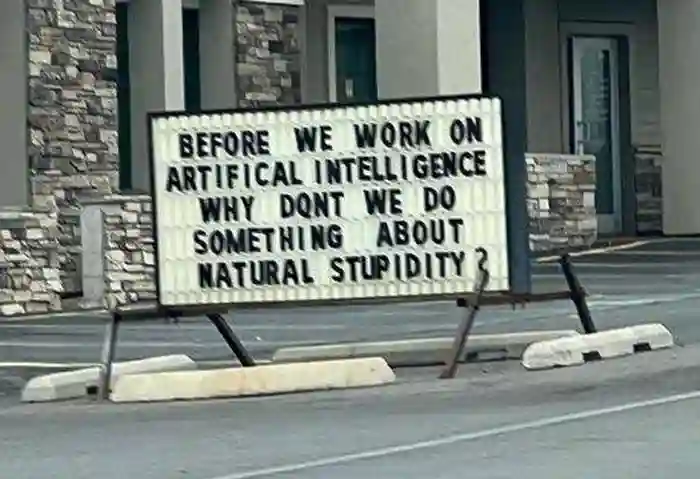
Sorry, that was my response to the image; not your question.
#asknostr
Did I use the semicolon properly?
All of it. You can't really understand anything without the foundations. Truth, justice, morality, human nature. Incentives. Systems. Money, consequences. Men and women. I mean, it's just life. It's everything. It's the Bible.
Maybe start with these
- Matthew
- John
- Luke
- Mark
- Romans
- Proverbs
- Sirach
- Wisdom
- Psalms
- Ecclesiastes
- Acts
I don't think most modern people (including me for decades) have any clue what the bible is or what is in it. There is really nothing else like it. I recommend the Douay Rheims, which is the original translation of the Latin Vulgate into English, which was the translation of the Septuigent into Latin from the Greek (by St. Jerome), so that's the pure original thing.
(this was an irony given AI brief review and your previous advocacy for "AI will replace programmers")
Utopia is ultimative. It relates to your complete trust to a teller of narrative. For me the Plato's utopia is not new, Western/IE civilizations already experienced its image in different forms of feudalism and dictatorships. So I recently fall for buddhism and individual microcultures which are more interesting for modern state of things.
Yep
Though Plato's utopia as a concept is interesting for me. And I grasped it in my project.
Justice is an equilibrium in a meta-game *chu~*
I think, Plato and Bible is mostly suitable for genetically healthy conservative dudes, who can live with only traditions. They potentially lean for building highly resilent systems like software for aircraft, Apollo etc. While adult fantasy like Dune and buddhism may offer insights for autistic people with some genetic quirks, with which they can still live if they have a lifestyle, which optimizes health and congnitive function with medicine, diet, exercises, education. Those build Internet and media software, participate in scientific discoveries.
*cognitive function
(Buddhist scriptures also may connect both worlds of seeding conservatives with hierarchies and progressive autists)
i don't recommend it as a destination, but as a journey. it's approachable and introduces a way of thinking that is highly effective when working with ai.
ai will replace programmers in the same way that compilers did, and we can meet this by asking bigger questions
Important thing about Dune: read it from beginning. Then you would grasp lessons for modern times in progressive manner. For Pali Canon there are four basic principles
Not in the same way tho. Compilers are mechanically deterministic and they replace very dumb copy-paste work. AI is probablistically deterministic. I see it mere as an enhanced search engine, prototypes and dialogue minion
(and you cannot ask bigger questions if your locality is not extended with technology you own)
which is why you should run models locally using open source systems like llama.cpp and
goose
your open source AI agent, automating engineering tasks seamlessly
compilers may be deterministic across runs, but some of the choices they make aren't as trivial as you think.
yes, ai is an enhanced search engine, builds prototypes, rubber ducks, writes tests, writes documentation, optimizes performance, refactors, plans, wrangles git, manages dependencies...
what it doesn't do is decide what to do, or when to be done
Hermann Hesse — Das Glasperlenspiel