Btrust Builders's avatar
Btrust Builders
builders@btrust.tech
npub1353s...gajp
Training the next generation of open-source Bitcoin and Lightning developers from Africa
We just wrapped up week 5 of the Bitcoin CLI live cohort.🧑🏾‍💻 This week the cohort went deeper into Bitcoin scripts and explored how more advanced spending conditions are built into transactions. In chapter 10, participants learned how Bitcoin scripts are embedded into P2SH (Pay-to-Script-Hash) transactions. This introduced a new way to lock funds using custom scripts while keeping the transaction itself simple. The cohort explored how P2SH works, how multisig scripts are constructed, and how different SegWit script variations interact with these structures. By the end of the chapter, participants understood how funds sent to a P2SH address can later be unlocked by revealing and satisfying the script. In Chapter 11, the focus shifted to timelocks inside Bitcoin scripts. Participants learned how scripts can control when funds become spendable using two important opcodes: CheckLockTimeVerify (CLTV) and CheckSequenceVerify (CSV). These tools allow developers to create more flexible conditions, such as delaying spending until a certain block height or enforcing relative time delays. Throughout the week, participants completed technical exercises, collaborated with their assigned partners, and prepared discussion responses. During the live study session, participants shared their insights and the faculty helped guide group discussions around the week's topics.
We just concluded week 6 of the Mastering Bitcoin live cohort. 📚 This week focused on understanding how the Bitcoin blockchain works and how new blocks are created through mining and consensus. Participants explored the structure of the blockchain, including how blocks store transaction data, how blocks are linked together using cryptographic hashes, and how the block header contains the key information used to secure and validate each block. The cohort also examined merkle trees and how they efficiently organize transactions inside a block, allowing nodes to verify transactions without needing to download the entire blockchain. In addition, we studied the mining⛏️ process and Bitcoin’s proof‑of‑work consensus mechanism, learning how miners compete to solve cryptographic puzzles, how difficulty adjustments keep block production consistent, and how block rewards and transaction fees incentivize miners to secure the network. We also discussed how consensus emerges across the distributed network, ensuring that all nodes agree on the valid chain while maintaining Bitcoin’s decentralized and trustless design. Throughout the week, participants reviewed the assigned materials, collaborated with their partners, and worked through discussion questions to deepen their understanding. During the live session, participants shared insights with the group and the faculty led the discussion on key ideas from the readings.
We just wrapped up week 4 of the live cohort of the Bitcoin CLI pathway. 🚀 During the week the cohort explored how Bitcoin transactions can go beyond simple payments. In chapter 8, we learned how transactions can include additional conditions. Participants explored locktime, which allows a transaction to be valid only at a certain time or block height, and OP_RETURN, which makes it possible to attach small pieces of data to the blockchain. These features show how bitcoin transactions can be more flexible than just sending funds. In chapter 9, the focus shifted to Bitcoin Script, the programming language that defines how bitcoin can be spent. The cohort explored how scripts set the rules for transactions, and why testing scripts is important when designing spending conditions. Throughout the week, participants reviewed the study materials, completed the technical exercises, and met with their assigned partners to discuss key questions. During the live study session, participants shared their insights and faculty members led short discussions with the group. Week 4 helped the cohort move from basic transactions to understanding the scripting logic that powers Bitcoin.
We just concluded week 5 of the Mastering Bitcoin live cohort. 📚 This week focused on transaction fees and the structure of the Bitcoin network. Participants explored how Bitcoin transactions compete for block space through fee rates, how wallets estimate appropriate fees, and mechanisms such as Replace‑By‑Fee (RBF) and Child Pays for Parent (CPFP) that allow transactions to be confirmed faster when needed. The cohort also examined how the Bitcoin peer‑to‑peer network functions, including how nodes connect and discover peers, how blocks and transactions propagate across the network, and the roles of full nodes, lightweight clients, and mining nodes. We further explored mempools, block relay, and how different node types interact to maintain the decentralized network. Throughout the week, participants reviewed the assigned materials, collaborated with their partners, and worked through discussion questions to deepen their understanding. During the live session, participants shared insights with the group and led a short discussion on key ideas from the readings.
We’ve just wrapped up week 3 of the Bitcoin CLI live cohort. Over the past week, participants explored chapters 6 and 7, diving deeper into how Bitcoin transactions can be expanded beyond the basics through multisignatures and Partially Signed Bitcoin Transactions (PSBTs). The focus was on understanding how multiple parties can collaboratively create and authorize transactions. Participants learned how to create and manage multisig wallets, spend from them, and think through real-world use cases where shared control of funds is essential. They also worked through the PSBT workflow, gaining hands-on experience with constructing, funding, and signing transactions across different stages. Throughout the week, participants applied these concepts through practical exercises and met with their study partners to discuss key ideas, compare approaches, and deepen their understanding. We then came together for the live session, where participants shared their insights, walked through their solutions, and led discussions on the challenges and possibilities unlocked by multisigs and PSBTs.
This week we wrapped up Week 4 of the live cohort, continuing our deep dive into how Bitcoin enforces rules and verifies transactions. Over the past week, participants studied chapters 7 and 8 of Mastering Bitcoin, met with their learning partners to discuss the material, and then came together for the group session. The week began with a closer look at authorization and authentication in Bitcoin. Instead of relying on identities, Bitcoin uses scripts to define the conditions for spending funds. The group explored how these scripts are evaluated, and how transactions are only valid when those conditions are satisfied. From there, the conversation moved into Bitcoin Script itself. Participants looked at how the stack-based language works, how input and output scripts are combined during validation, and how different script types like P2PKH, multisig, and P2SH are used in practice. The group also discussed timelocks and how they can restrict when funds are spendable. After building a foundation with scripts, the cohort shifted into digital signatures. Participants learned how signatures prove ownership of funds, authorize transactions, and protect transaction data from being altered. The group walked through how signatures are created and verified using private and public keys. The discussions also covered the differences between ECDSA and Schnorr signatures, and why Schnorr offers improvements in simplicity, efficiency, and privacy. Participants explored how signatures can commit to different parts of a transaction using SIGHASH flags, enabling more flexible transaction designs. A key focus was the importance of randomness in signing. The group reflected on how reusing a nonce can expose a private key, reinforcing how small implementation details can have serious consequences. By the end of the session, participants had a clearer picture of how Bitcoin enforces spending conditions and verifies transactions without relying on trust. The discussions helped connect scripting and signatures into one coherent system that underpins how Bitcoin works.
We’ve just wrapped up week 2 of the Bitcoin CLI live cohort. Over the past week, participants worked through chapters 4 and 5 of the course, continuing to build practical experience interacting with Bitcoin through the command line. The readings and exercises focused on how transactions are sent using bitcoin-cli, and how developers can better understand and manage transactions once they’ve been broadcast to the network. Throughout the week, participants practiced the concepts through hands‑on exercises and met with their study partners to discuss the key ideas from the chapters. We came together today for the live session with faculty, where participants shared what they learned, walked through their questions, and discussed some of the challenges they encountered while working through the exercises.
This week we wrapped up week 3 of the live cohort of the Mastering Bitcoin pathway, continuing our deep dive into how Bitcoin works under the hood. Over the past week, participants studied chapters 5 and 6 of Mastering Bitcoin and met with their learning partners to talk through the material before joining the group session with faculty. The week began with a closer look at bitcoin wallets and recovery. Bitcoin wallets don’t actually store bitcoins. Instead, they store the keys that give someone control over the bitcoins recorded on the blockchain. The group discussed how early wallets generated keys independently, which meant users had to back up their wallets frequently to avoid losing access to funds. From there, the conversation moved to how modern wallets solve this problem using deterministic key generation. Participants learned how a single random seed can be used to generate many keys and addresses, making it possible to recover an entire wallet from one backup. The group also explored hierarchical deterministic (HD) wallets, which organize keys in a tree structure and allow wallets to create new addresses while keeping private keys secure. The discussions also touched on recovery phrases, often called seed phrases, and why backing them up safely is essential. Participants reflected on how these recovery systems help users protect their funds while still making wallets practical to use. After exploring wallets and recovery, the cohort moved into bitcoin transactions and how value actually moves across the network. Instead of coins being physically transferred, Bitcoin works by updating a shared record that shows which keys control which bitcoins. Participants unpacked how transactions are structured, looking at the roles of inputs and outputs. Inputs reference previously received funds, while outputs define where the bitcoin will go next and the conditions required to spend it. The group also explored several deeper parts of the transaction structure, including scripts, witness data, and Segregated Witness (SegWit). These components help verify that transactions are authorized and make the system more efficient and secure. By the end of the session, participants had a clearer picture of how wallets manage keys and how transactions move value through the network. The discussions helped connect the ideas from earlier chapters about keys and cryptography with the practical mechanics of sending and receiving bitcoin.
We just kicked off the first 2026 live cohort of the Bitcoin CLI pathway, bringing participants together to begin exploring how to work directly with Bitcoin using the command line.🚀 Over the past week, participants worked through the opening chapters of the course, starting with an introduction to why learning Bitcoin through Bitcoin Core and its command‑line tools matters. The readings explored how Bitcoin differs from traditional payment systems, and why developers often interact directly with the core software to build reliable applications on the network. From there, the cohort moved into setting up their own Bitcoin environments. Participants learned how to deploy a Bitcoin Core node on a VPS, exploring the different types of nodes that can run on the network and the trade‑offs between them. Along the way, they discussed the differences between mainnet, testnet, and regtest, and why testnet is useful for experimentation and development. Once their environments were running, participants began getting familiar with bitcoin-cli, the command‑line interface used to interact with a Bitcoin node. They practiced verifying that their nodes were running correctly, exploring the structure of their Bitcoin setup, and using basic wallet commands such as generating new addresses to receive testnet bitcoin. Throughout the week, participants paired up with study partners to talk through the discussion questions, compare their experiences setting up their nodes, and work through the technical exercise provided in the course materials. These conversations came together in the group study session with faculty, where participants shared what they discovered, asked questions, and reflected on what it means to run and interact with Bitcoin infrastructure directly.
We've just concluded week 2 of the live cohort for the Mastering Bitcoin pathway. 📚 Over the past week, participants studied chapters 3 and 4 of Mastering Bitcoin, discussing the material with their learning partners before coming together for our live session with the faculty. The conversations focused on how Bitcoin actually works behind the scenes. We explored Bitcoin Core as the reference implementation, what it means to run a full node, and why independent verification is such an important part of the network. We also examined how developers interact with Bitcoin Core through tools like the command line and JSON‑RPC. From there, we moved into the foundations of Bitcoin cryptography. Participants unpacked how private and public keys work, how signatures prove ownership, and how addresses are derived to make sending and receiving bitcoin possible. Week by week, it’s all starting to come together. On to the next! 🚀
This week we kicked off the first live cohort of the Mastering Bitcoin program, bringing together participants, faculty, and the Btrust team for the start of a deep dive into how Bitcoin actually works. Over the course of the week, participants explored the foundations of Bitcoin through the opening chapters of Mastering Bitcoin by Andreas M. Antonopoulos. The discussions started with understanding Bitcoin not just as digital money, but as a system made up of several technologies working together. The group unpacked how Bitcoin enables value to move across the internet without relying on centralized intermediaries, and how the network itself is built around open protocols that anyone can run and verify. From there, conversations moved into the mechanics of how the system operates. The group unpacked key components of the Bitcoin ecosystem, including wallets, cryptographic keys, transactions, the peer-to-peer network, and miners. To make these ideas more concrete, participants also walked through the lifecycle of a Bitcoin transaction, from creation in a wallet, to broadcast across the network, validation by nodes, and eventual inclusion in the blockchain. Over the next few weeks, participants will continue building their understanding step by step, moving from these first principles toward the deeper technical layers of the protocol.
As the Btrust Builders program continues to grow, we’ve learned that scale should never come at the cost of quality or faculty well‑being. That’s why our 2026 pathways introduce a new hybrid engagement model designed to serve more developers without compromising the learning experience. In 2026, each pathway runs in two formats: a high‑touch live cohort and an open self‑paced track. This approach allows us to combine structure and flexibility, giving every developer a way to learn that fits their experience, schedule, and goals. The live cohort is more in-depth. Each one is capped at around 100 learners, guided by chaperones, and built around weekly sessions, breakout groups, and feedback loops. It’s designed for developers who are ready for structure, accountability, and peer discussion. Live cohorts provide strong signaling for fellowship readiness, making them a great fit for learners seeking an intensive, guided experience. The self‑paced track is the default mode and just as central to the Builders experience. It gives learners full access to all pathway content, a dedicated community channel, pacing guides to help them stay consistent, and scheduled office hours for support. It’s an intentional, supported route for independent learners who want to move at their own speed and still remain connected to the Builders community. Every participant, live or self‑paced, is part of one Builders ecosystem. You can start self‑paced, join a live cohort later, and, when ready, progress toward the Open Source Fellowship. The goal is to make sure learning never stops, regardless of where you begin. We’ve also refined how developers are selected into live cohorts to maintain both diversity and readiness. These filters are applied intentionally but never rigidly, readiness and quality always come first. Both Q1 2026 Pathways, Mastering Bitcoin and Learn Bitcoin from the Command Line, will follow this hybrid model. Learners can choose the path that fits them best. Those who want structure and accountability can join the live cohort, while those who prefer independence and flexibility can dive into the self‑paced track with full Builder support. This model helps us reach more learners, sustain our faculty, and keep the Builders learning experience consistently excellent as we scale across Africa. Learn more about the pathways and the hybrid model here: https://pathways.btrust.tech/index
Btrust Builders's avatar
Btrust Builders 2 months ago
Bitcoin’s open‑source ecosystem only thrives when contributors are supported not just to learn, but to stay, grow, and lead. In 2026, we’re evolving Btrust Builders into a scaled, high‑quality contributor pipeline designed for long‑term impact. This year’s program builds directly on the insights from our 2025 Builders experience, with clearer structure, stronger systems, and a deeper commitment to sustained open‑source contribution. The 2026 Builders journey is designed as one continuous path. Developers enter through open applications or via the BOSS challenge, move through structured learning pathways, accelerate through a selective Open Source Fellowship, and progress toward grants, long‑term contribution, and ecosystem roles. What makes Builders 2026 different is our focus on durable outcomes. We care about retention as much as graduation. We care about whether developers are still contributing six to twelve months later. And we care deeply about creating a program that is sustainable for both participants and faculty. This year includes multiple entry points, clearly defined pathways, an always‑on Resource Hub, a ten‑week Open Source Fellowship, and a calendar that creates a steady rhythm of learning, contribution, and outcomes throughout the year. If you’re a developer interested in contributing to Bitcoin open‑source, or someone exploring what that journey looks like, we invite you to learn more. Read the full blog to understand the 2026 program design, explore the Builders Pathways, check out the 2026 program calendar and apply to join this year’s cohorts: If you’re not ready to apply yet, the Builders Resource Hub (https://pathways.btrust.tech/resource-hub) is always available and designed to help you start learning and making your first contributions. image
Btrust Builders's avatar
Btrust Builders 2 months ago
In 2025, we took a major step forward in strengthening Africa’s Bitcoin developer pipeline through the Btrust Builders program. 🚀 Over the course of the year, 493 developers across Africa and beyond were supported through Builders pathways, selected from 1,800+ applications, a 180% increase from the previous year. Developers joined from 15+ countries, spanning West, East, Central, and Southern Africa, with additional participation from South America, Europe, and South Asia. We evolved from a single‑cohort program into a continuous, modular learning pipeline, supporting developers at different stages; from first exposure to Bitcoin, through hands-on technical learning, and into real open‑source contributions. In 2025, we delivered: • Foundational learning through Mastering Bitcoin • Hands‑on technical practice via Bitcoin from the Command Line • Protocol‑level development in Rust for Bitcoiners • Programming fundamentals through Language Clubs (Python & C++) • Advanced open‑source onboarding through Start Your Career in BOSS To bridge learning and contribution, we also launched our first Open Source Bootcamp. Over four weeks, 38 developers from 7 countries submitted 103 code contributions, opened 50+ pull requests, and saw 12 PRs merged, including 3 to Bitcoin Core. The impact went well beyond training. Several Builders alumni transitioned into fully funded open‑source work, supported by @Btrust and @HRF, contributing to projects like Bitcoin Core, LDK Node, BlueWallet, Bitcoin Dev Kit, and Rust‑Payjoin. Others went on to start their own Bitcoin projects, applying what they learned to build new tools and infrastructure in the ecosystem. We also launched the Builders Resource Hub, which has since been widely shared across the Bitcoin developer ecosystem as a go‑to learning library for open‑source contribution, tooling, and deep technical study. Check it out here: https://pathways.btrust.tech/resource-hub In recognition of this work, the @African Bitcoiners team named Btrust Builders the 2025 African Bitcoin Project of the Year at the 2025 @Africa Bitcoin Conference. All this was made possible by the dedication of faculty and chaperones, many of whom are alumni themselves; mentors who gave their time, experience, and patience; and the core Builders team, including Stephanie Titcombe, the program lead, and Kelvin Isievwore, the engineering lead, who carried the vision from design through delivery. Just as importantly, the wider Builders community, learners, alumni, contributors, and supporters, shaped the culture that made collaboration, accountability, and growth possible.🧡 We’ve shared what worked, what we learned, and how Builders has grown into a long‑term contributor pipeline helping decentralize Bitcoin development. ➡️ Read the full blog for more: image
Btrust Builders's avatar
Btrust Builders 3 months ago
1 day to go! 🚨 Thinking about a career in Bitcoin open-source development? The BOSS Challenge by Chaincode Labs is designed to help developers take their first steps into the Bitcoin open-source ecosystem. Alumni from previous cohorts have gone on to build funded careers in open-source development. Applications close tomorrow, and you have until January 12 to complete the preliminary challenge (Saving Satoshi). Apply to join the 2026 cohort here: https://job-boards.greenhouse.io/chaincodelabs/jobs/4067627009 image
Btrust Builders's avatar
Btrust Builders 4 months ago
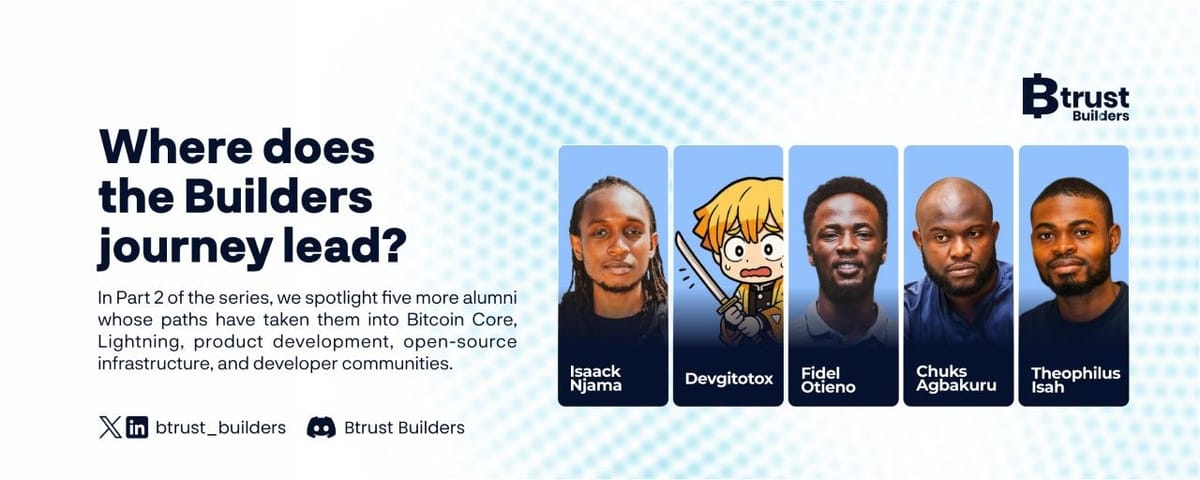
“The ₿OSS program was intense, fast‑paced, and fun. It changed my life.” Chuks Meet Chuks, a software engineer from Lagos 🇳🇬, one of the outstanding 2025 ₿OSS alumni whose journey embodies what the program is all about: growth, contribution, and impact. With over eight years of experience building and maintaining complex software systems, Chuks joined the BOSS Challenge eager to expand his understanding of Bitcoin and Lightning Network development. The program helped him dive deep into open‑source collaboration, system architecture, and critical protocol work, areas that now define his career. Since graduating, Chuks has contributed extensively to key Bitcoin and Lightning open‑source projects, including Lightning Dev Kit (LDK), LDK‑Node, and SimLN, where his improvements have strengthened code reliability, testing infrastructure, and payment protocols. He’s also building PeepsWire, a Lightning‑powered video calling application showcasing how Bitcoin can drive real‑world innovation. Today, Chuks continues to work full‑time in the ecosystem through the @Btrust starter grant, accelerating his work on BIP 353 integration (Human‑Readable payment addresses) and improving simulation tools that help developers test and advance the Lightning Network. Chuks’ journey started with the ₿OSS program, and now continues through funded open‑source work that’s shaping the future of Bitcoin engineering. Ready to begin your open‑source journey? Applications for the 2026 ₿OSS Challenge, by Chaincode Labs, are open. This structured, hands‑on program helps new developers take their first steps into Bitcoin open‑source, gain mentorship, and build a path toward sustainable, funded careers, just like Chuks did. 🗓️ Applications close: December 31st, 2025 🗓️ Program starts: Week of January 12th, 2026 📝 Apply for the 2026 cohort: https://job-boards.greenhouse.io/chaincodelabs/jobs/4067627009 🔗 Learn more about the program:
Btrust Builders's avatar
Btrust Builders 4 months ago
“The ₿OSS challenge really helped me think deeply about Bitcoin and learn more about it and open‑source development.” Rita, 2025 ₿OSS alumna. Meet Rita, a Lagos🇳🇬‑based software developer and one of the 2025 ₿OSS alumni. Before joining the program, Rita already had over three years of experience building and improving fintech and logistics solutions. But her time in the ₿OSS program became a turning point. Through the program, she deepened her understanding of Bitcoin technologies and the Lightning Network, contributing to major open‑source projects like LDK Node, Warnet, and CircuitBreaker; critical components that underpin the scalability and resilience of @Btrust grantee, Rita is continuing her work full‑time on LDK Node and Warnet, focusing on improving transaction lifecycle management, payment tracking, and developer tools to make Bitcoin infrastructure even more reliable and user‑friendly. Rita’s journey is a great example of what’s possible through the BOSS Challenge, created by Chaincode Labs. This is a structured, hands‑on program designed to help developers start building open‑source Bitcoin projects and grow into funded contributors. Ready to build your own Bitcoin story? Applications are ongoing for the 2026 BOSS cohort. If you’re a developer passionate about learning, contributing, and building for Bitcoin, this is your chance. 🗓️ Applications close December 31, 2025 🗓️ Program starts the week of January 12, 2026 🔗 Learn more about the program: 📝 Apply for the 2026 cohort: https://job-boards.greenhouse.io/chaincodelabs/jobs/4067627009
Btrust Builders's avatar
Btrust Builders 4 months ago
Meet Shammah Agwor, one of the 2025 BOSS alumni, a passionate software engineer from Port Harcourt, Nigeria 🇳🇬, who has steadily grown into an active Bitcoin open‑source contributor. Shammah’s journey began long before joining the BOSS program. With a background in security engineering and years of experience in backend systems, he discovered his true calling in Bitcoin open‑source development. Through the program, he deepened his work in Rust‑Payjoin, a privacy‑enhancing Bitcoin project focused on improving transaction privacy and disrupting common input ownership heuristics. Today, Shammah continues to contribute full‑time to Bitcoin open-source. His work on Rust‑Payjoin includes major improvements like metrics collection for adoption tracking, caching mechanisms for performance, and better code structure for maintainability, all critical to strengthening Bitcoin’s privacy layer and reliability. Shammah’s ongoing impact as a @Btrust‑funded grantee reflects what’s possible for African developers who take that first step into the ₿OSS ecosystem. Ready to start your own Bitcoin open‑source journey? Applications are now open for the 2026 ₿OSS Challenge, in partnership with Chaincode Labs. This is your chance to gain hands‑on experience, mentorship, and a pathway into the global Bitcoin open‑source community, just like Shammah did. 🔗 Learn more about the program: 📝 Apply for the 2026 cohort: https://job-boards.greenhouse.io/chaincodelabs/jobs/4067627009