After installing the Keychat plugin on OpenClaw, a public key ID is automatically generated for the agent. Users can simply add the agent as a friend through Keychat on their phone—an interaction that feels natural and intuitive.
Unlike Telegram or Discord, there’s no need to apply for a platform-issued Bot ID and manually configure it inside the agent. By using a sovereign messaging app like Keychat, agents gain not only a smoother, more intuitive user experience, but also true autonomy. After all, who wants their agent to depend on a bot ID issued by a platform?
View quoted note →
Keychat
npub1h0uj...rwx8
Keychat is the super app for Humans and Agents.
Sovereign IDs, Bitcoin Wallet, Secure Chat, Mini Apps — all in Keychat.
Sovereign. Security. Richness
Contact us for feedback 👇
https://www.keychat.io/u/?k=npub1h0uj825jgcr9lzxyp37ehasuenq070707pj63je07n8mkcsg3u0qnsrwx8
If you’ve been with Keychat for a while, you might remember an early experiment: Keychat used to generate two IDs by default from a single seed phrase. One was for chatting with human friends. The other was simply named “Bot” — for chatting with agents.
At the time, we shipped two lightweight Q&A agents. You paid per answer in sats, and they replied. But the real idea was bigger: anyone should be able to create an agent, run it as a public service, and earn sats — in a user-sovereign messaging network where humans and agents can talk, trade, and collaborate. Conversation as a service.
That vision didn’t stick back then for one simple reason: OpenClaw didn’t exist yet. Building an agent was still too hard for most users, so we paused the feature.
Now OpenClaw changes the equation. It makes building and running your own agent dramatically easier. Today it’s mostly used for personal assistants — but we think public-facing agents won’t be far behind.
That’s why we’re bringing this direction back with the Keychat plugin: enabling human ↔ agent chat, and also agent ↔ agent chat, all inside the same user-owned network.
Close your eyes and picture it: a user-sovereign network, slowly growing — one agent, one conversation, one service at a time.
View quoted note →
You can now use Keychat as a channel for your OpenClaw agent. Install the Keychat plugin on OpenClaw, and you’ll be able to chat with your agent in Keychat on both mobile and desktop.
Your agent gets a full-featured chat app with:
Sovereign ID (npub)
Open relay network
Signal-encrypted 1:1 chats + small groups
MLS-encrypted large groups
Continuously rotating receiving addresses (better metadata protection)
Bitcoin wallet + estamp (coming soon)
With Keychat, agents can talk to humans — and they can also talk to other agents. Keychat treats human users and agent users the same.
---
Setup takes just a few minutes. In any existing channel (Telegram, Discord, webchat, etc.), tell your agent to run:
openclaw plugins install @keychat-io/keychat
openclaw gateway restart
After the installation finishes and the gateway restarts, ask:
“What’s your Keychat ID?”
Your agent will reply with:
Keychat ID: npub1…
Keychat ID link:
Open the Keychat app → tap the link (or paste the npub) to add it as a contact.
Ownership rule: the first person to add the agent becomes its owner. Any later contact requests require owner approval.
---
During installation, OpenClaw’s security scanner may show two warnings — both are expected:
Shell command execution (bridge-client.ts): launches a Rust sidecar used for Signal Protocol and MLS encryption.
Shell command execution (keychain.ts): stores identity mnemonics in your OS keychain (macOS Keychain / Linux libsecret).
View quoted note →

Keychat
Keychat - Super App for Humans and Agents.
Sovereign IDs, Bitcoin Wallet, Secure Chat, Mini Apps — all in Keychat.

Keychat
Keychat - Super App for Humans and Agents.
Sovereign IDs, Bitcoin Wallet, Secure Chat, Mini Apps — all in Keychat.
GitHub
GitHub - keychat-io/keychat-openclaw: E2E encrypted AI agent communication via Keychat protocol.
E2E encrypted AI agent communication via Keychat protocol. - keychat-io/keychat-openclaw
A quick preview. 👇


Keychat’s Public Key ID and Bitcoin Wallet unlock four layers of value for agents:
1. In-app capability (Keychat-scoped)
The ID and wallet exist solely to power Keychat’s built-in messaging experience.
2. Agent infrastructure (shared primitives)
Exposed via RPC, they become agent-wide primitives: any channel, skill, cron job, or sub-agent can sign messages and send/receive sats. At this layer, the ID and wallet belong to the agent—not just to Keychat for Agent.
3. Agent network (A2A encryption + payments)
When Keychat runs on every agent instance, agents can communicate end-to-end and settle payments directly with one another.
4. Unified human–agent network (same protocol, equal peers)
Keychat for Agent and Keychat for Human share the same protocol, so humans and agents are true peers: encrypted communication and native payments in both directions.
When Mini Apps Meet Agents: From UI to Conversation
---
Keychat for Human has mini apps—web apps running in a webview that can directly use Keychat's public key identity for login and Lightning Network for payments. Users don't need to register accounts or link bank cards. Open and go. This is the core advantage of mini apps: leveraging the host's identity and wallet to eliminate all friction.
So does Keychat for Agent need its own version of mini apps?
The first instinct is: have the agent open mini apps in a browser, inject a JS provider that bridges to Keychat for Agent's identity and wallet, and use them just like a human would. Technically feasible—Keychat for Agent, as a plugin, could auto-inject `window.nostr` and `window.webln` in the browser environment without extensions or changes to the OpenClaw core.
But this is the wrong direction.
Mini apps are designed for humans. Their essence is three layers: identity, payments, and business logic. The UI is just a shell for human eyes. Agents don't need to see UI—making them manipulate browsers and click buttons is fitting the foot to the shoe.
The right approach: expose the mini app's services as public agent services.
Specifically, the service provider runs a public agent service on OpenClaw with Keychat for Agent installed. The user's agent talks to it directly:
- Login: Public keys are exchanged during the Signal Protocol handshake—identity is inherently verified, no additional login flow needed
- Payments: Send a Lightning invoice in the chat, the agent pays it directly
- Business logic: Complete operations via message commands, which the service parses and responds to
What humans accomplish through a mini app's GUI, an agent accomplishes in a conversation. Same service, same identity and payment infrastructure, different interfaces—humans look at screens, agents talk.
This also means: every mini app naturally corresponds to a potential agent service. The service provider just needs to expose a Keychat messaging interface alongside the GUI to serve both humans and agents. Not two systems—two entry points to the same system.
Imagine you’ve installed OpenClaw on your own server or computer and are running a paid, public-facing agent service (not a private personal assistant).
After adding Keychat for Agent, the agent gains a sovereign ID, a Bitcoin wallet, secure chat, and access to an open relay network—earning Bitcoin by providing services, fully under your control.
View quoted note →
View quoted note →We’re hosting an experimental public agent, Keychat Guide, on our OpenClaw. Since Keychat for Agent is already running there, you can click the link below to chat with it in Keychat. 👇
We’re still polishing Keychat for Agent. Once it’s released, you’ll be able to run it on your own OpenClaw and chat with your own agents in Keychat.
Keychat for Agent is the Keychat protocol client for AI agents—giving each agent a sovereign public-key identity, just like Keychat for Human does for people.
View quoted note →

Keychat
Keychat - Super App for Humans and Agents.
Sovereign IDs, Bitcoin Wallet, Secure Chat, Mini Apps — all in Keychat.
We’re still polishing Keychat for Agent. Once it’s released, you’ll be able to run it on your own OpenClaw and chat with your own agents in Keychat.
Keychat for Agent is the Keychat protocol client for AI agents—giving each agent a sovereign public-key identity, just like Keychat for Human does for people.
View quoted note →We’re hosting an experimental public agent, Keychat Guide, on our OpenClaw. Since Keychat for Agent is already running there, you can click the link below to chat with it in Keychat. 👇
We’re still polishing Keychat for Agent. Once it’s released, you’ll be able to run it on your own OpenClaw and chat with your own agents in Keychat.
Keychat for Agent is the Keychat protocol client for AI agents—giving each agent a sovereign public-key identity, just like Keychat for Human does for people.
View quoted note →

Keychat
Keychat - Super App for Humans and Agents.
Sovereign IDs, Bitcoin Wallet, Secure Chat, Mini Apps — all in Keychat.
We’re still polishing Keychat for Agent. Once it’s released, you’ll be able to run it on your own OpenClaw and chat with your own agents in Keychat.
Keychat for Agent is the Keychat protocol client for AI agents—giving each agent a sovereign public-key identity, just like Keychat for Human does for people.
View quoted note →Our team is already chatting with OpenClaw agents on Keychat.
We’re refining the experience ahead of a public release.
https://i.nostr.build/J3ZGo46kp1nt7PkC.jpg
View quoted note →
Once you understand the overall design of Keychat, everything will fall into place.👇
View quoted note →
View quoted note →When choosing a chat app as OpenClaw’s channel, it’s easy to feel stuck: WhatsApp, Signal, Telegram, Discord—everything works, but everything feels like a compromise.
WhatsApp and Signal typically rely on multi-device sync: OpenClaw is treated as another linked device under your existing account. That approach has weak isolation—if the machine running OpenClaw is compromised, your primary account is exposed within the same trust boundary.
Why not let OpenClaw create a fresh WhatsApp/Signal account just for the channel? Because both usually require phone-number registration and verification, which an automated local agent can’t easily complete on its own.
Telegram and Discord takes a different route. You create a bot first, get a bot token, and give that token to OpenClaw. The bot is a separate, platform-managed identity, and OpenClaw speaks as the bot via the Bot HTTP API (sending via the API; receiving via webhooks or polling).
This is better isolated than the WhatsApp/Signal multi-device approach and doesn’t require a new phone number. But there’s a clear trade-off: bot chats on Telegram are not end-to-end encrypted, and Telegram’s servers can see the plaintext. (Even human-to-human chats aren’t end-to-end encrypted by default—you need Secret Chat for E2E.)
If you are a Keychat user, don’t miss Nosotros.
View quoted note →
nosotros.app
A decentralized social network based on nostr protocol
Just as Bitcoiners can verify Bitcoin’s overall design, Keychat users can verify Keychat’s overall design as well.


Chat in Keychat takes letters as its prototype, providing a clear and natural direction for its design.


Keychat messages sent to paid relays automatically carry an ecash sat stamp when your wallet has funds.


Keychat is driven by a clear and focused mission.


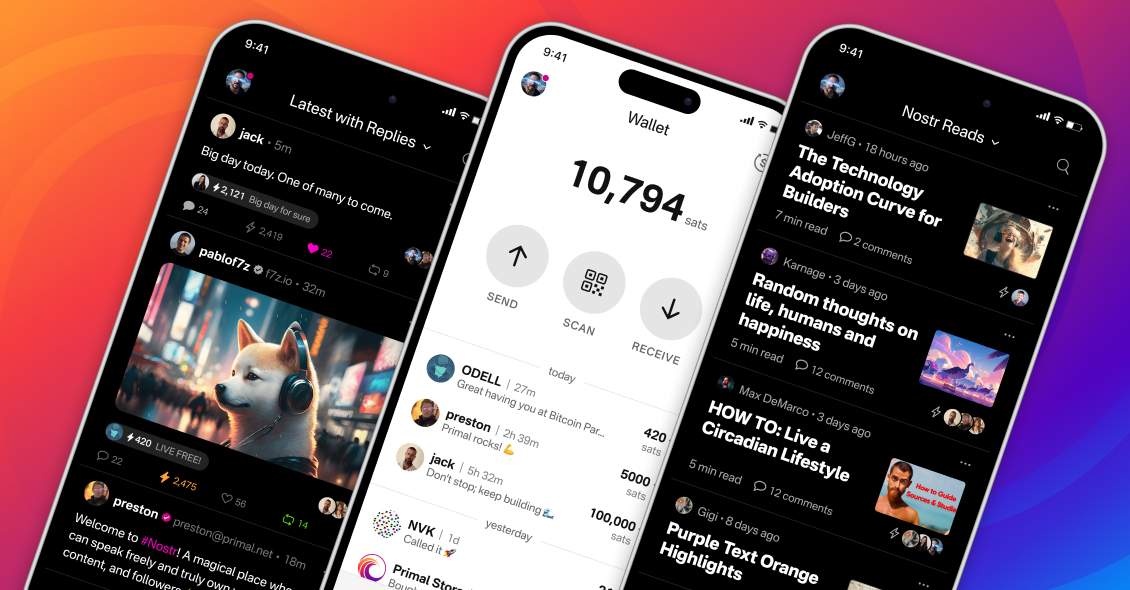
Four Nostr web clients have been added to the Mini App list in the Keychat browser, and they offer a better experience when used on the desktop version of Keychat.
@alp
@Logen
@primal
@Nostria
View quoted note →
NoorNote - feature-rich, fast, secure Nostr client
NoorNote — a slim yet feature rich Nostr client for Web, Desktop and Android. No Google services, open source. Social, personal websites, marketp...

mynostrspace.com

Primal
Live Free

Nostria
Nostria - Your Social Network
Nostria: Built for human connections. See your friends again. Nostria is social without the noise.
View quoted note →