fnew's avatar
fnew
fnew@Nostr-Check.com
npub1wl39...znlx
Word processor working on Bitcoin advocacy in the UK
fnew's avatar
fnew 1 year ago
A huge pleasure finally to meet the man (@jack) who zapped me my first sats over Nostr. Thanks for that, and for taking the time to meet with so many of us random Bitcoiners!
fnew's avatar
fnew 1 year ago
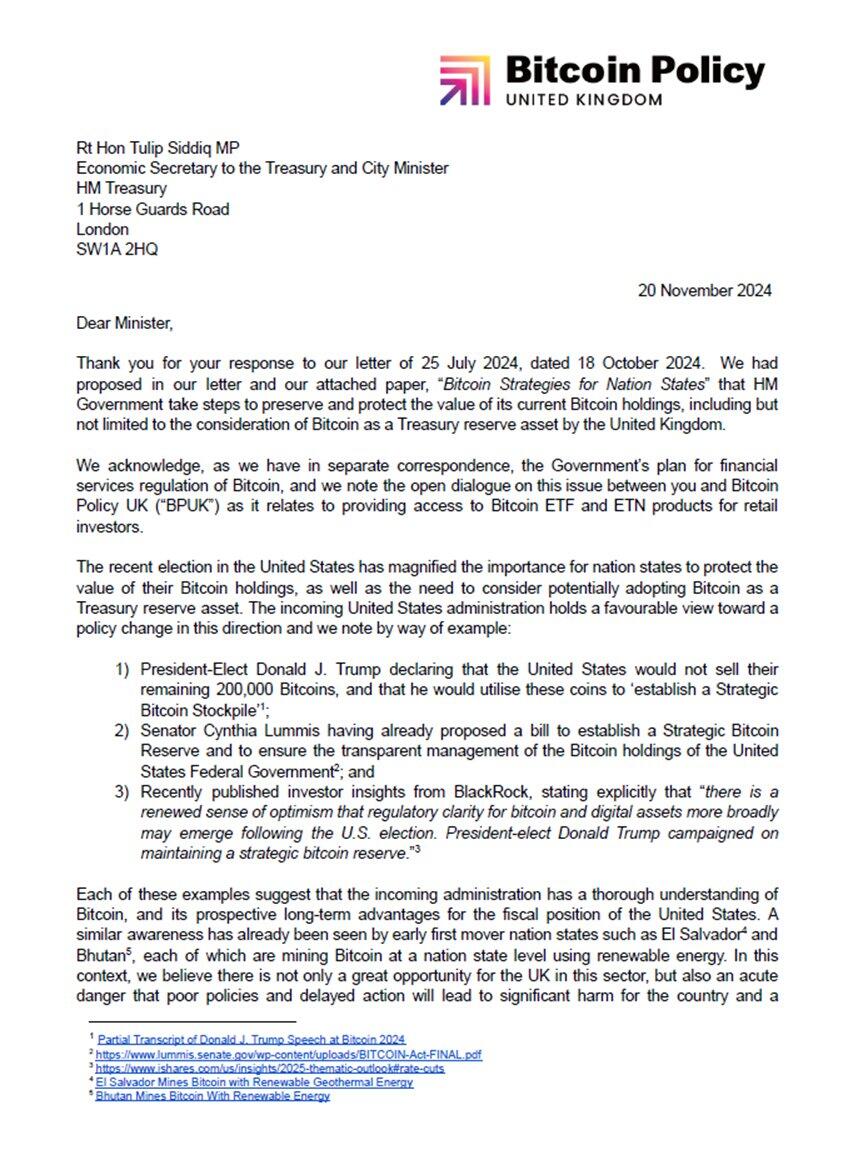
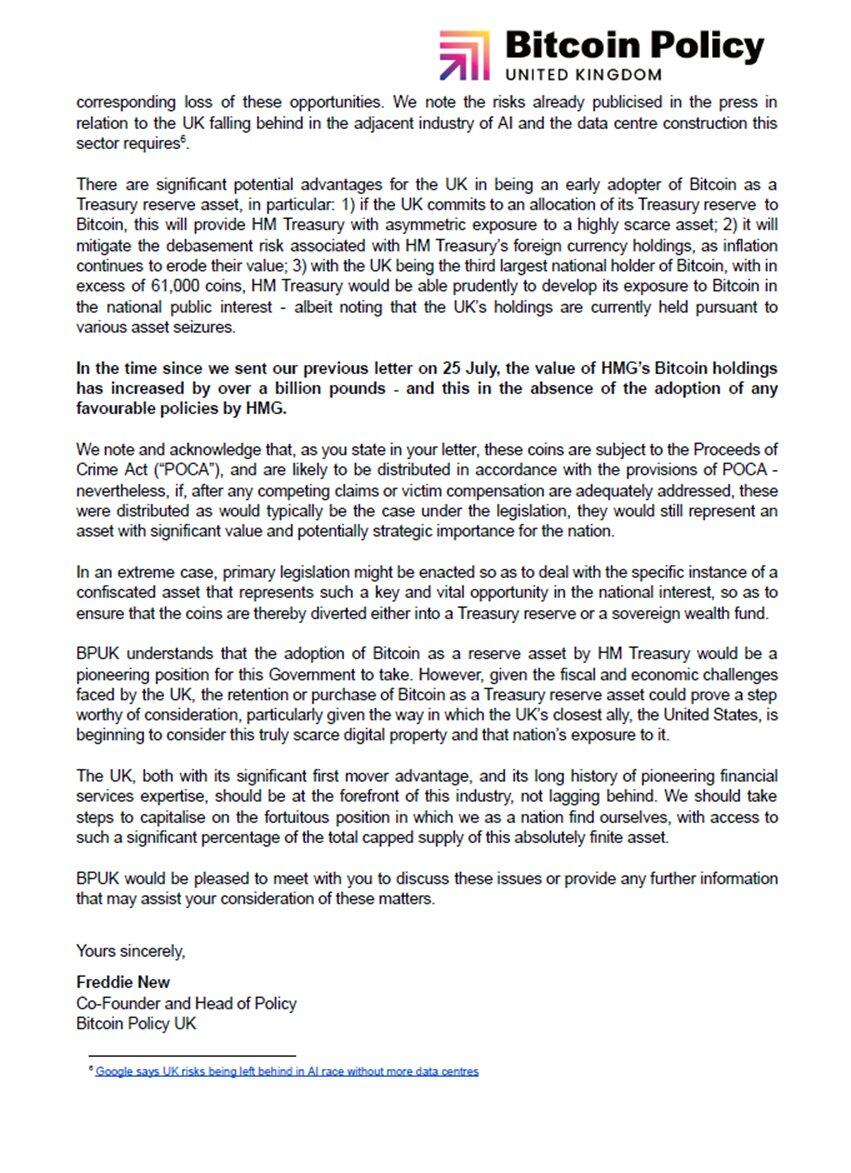
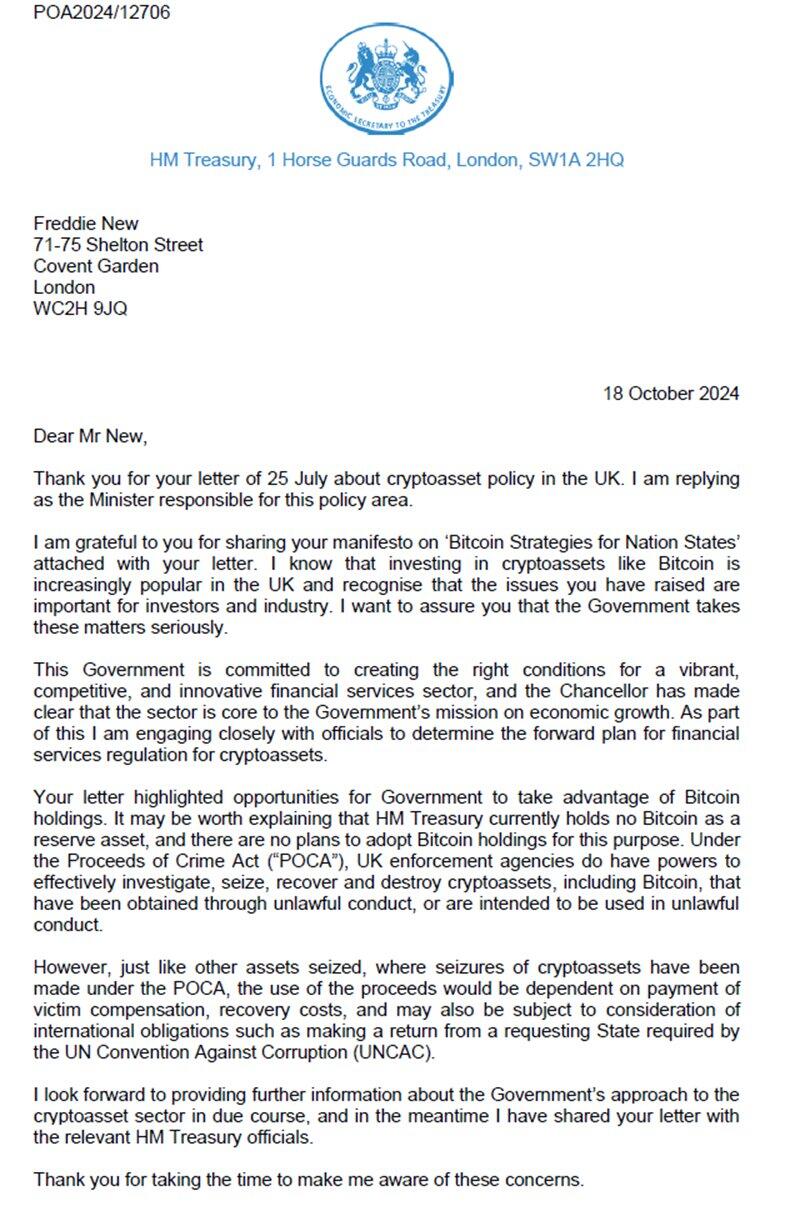
The UK is falling behind, wherever you look. From failing at AI data centre construction to filling in potholes, there are stories of missed opportunities and mismanagement everywhere. But in one area, we can still claim a bronze medal – our national Bitcoin holdings, placing us third among all nation state holders. In the time since we first wrote to Tulip Siddiq MP on this topic in July, the value of this stake has increased by over a billion pounds. And all this with the Financial Conduct Authority continuing their hostile policies towards Bitcoin adoption. Imagine the potential if as a country we chose to embrace this asset and this sector, instead of trying to drive it away? In October, @Bitcoin Policy UK welcomed a response from the City Minister and are delighted to be in dialogue with her and with her team. Today, we publish another open letter in reply, and share the details below. We look forward to working practically with Treasury and with Ministers to discuss and consider the issues we raise in more detail.
fnew's avatar
fnew 1 year ago
The OBR tells us that interest payments on the UK's national debt should cost £73.5 billion in 2024-25. Just interest payments, mind you. Not actually paying down the debt. Interest payments that are due every year, and which increase as we borrow more. The year after, interest payments may well be TEN percent of the government's entire annual tax intake. We already spend more on interest than we do on defence, and soon it will overtake education (110bn) and the NHS (180bn). Borrowing more only makes the problem worse and will lead, eventually, to all of the nation's productive effort being spent on interest repayments for a debt that can never be repaid. The only sensible conclusion here is to realise that no government, Tory or Labour or of any other stripe, can ever really do anything to resolve this. And with this realisation, to take steps to protect yourself, your family, your business, and your community. The only route out of this is currency debasement. The purchasing power of sterling will inevitably trend towards zero. Armed with this knowledge, work out what it is you need to do. No government is coming to save you. You have to do it for yourself.
fnew's avatar
fnew 1 year ago
"Survivors of genocide, totalitarian regimes and conflicts; they're all hopeful for the future because of this thing... and that's maybe its superpower. Not necessarily the scientific properties of it (which are revolutionary) but the hope part of it maybe is the biggest use case of all." Like many others who attended, I struggle to put into words the impact of last week’s Global Bitcoin Summit. I do my fighting from behind a keyboard, or in a suit, but we heard during the event from some of the bravest, most resilient, and most indefatigable people that I’ve ever had the privilege to meet in person. People who had literally survived genocide, escaped from totalitarian nations, or endured torture as political prisoners, and yet who had never given up hope. I’ve returned to the UK inspired - both full of gratitude for having experienced the summit, and invigorated to continue the fight for financial freedom here. Enormous thanks to everyone involved, and especially to @npub1zhqc...h0dw, @gladstein, @Arsh Molu, CK, @Femi Longe, the Bitcoin Park team , @Rod, @Harry, Alex Li, and Anya Chekhovich. It’ll take a while to absorb what we saw and heard. But hope is the key takeaway. image
fnew's avatar
fnew 1 year ago
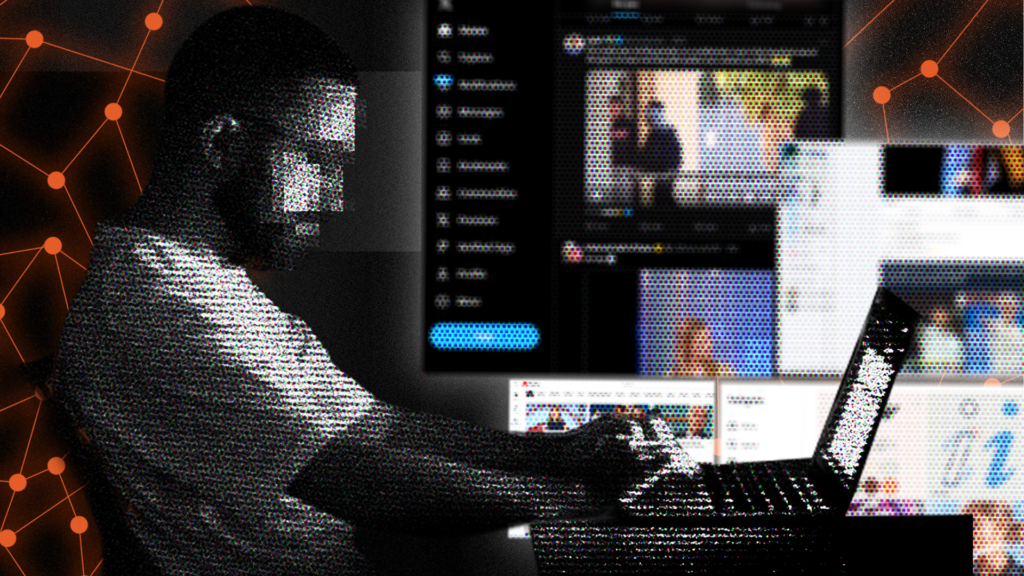
They are literally watching you. Wherever you go, whatever you buy, whatever you do online. The vast majority of us are law-abiding citizens, who want no more than to be left alone. Why should we allow this relentless surveillance to continue unabated, and to permit governments to censor our speech and control our every action? Big Brother Watch are doing great work fighting back against this insidious state attack, but what more can we as individuals do to resist? Eric Hughes wrote. “We cannot expect governments, corporations, or other large, faceless organizations to grant us privacy out of their beneficence… We must defend our own privacy if we expect to have any. We must come together and create systems which allow anonymous transactions to take place… We know that someone has to write software to defend privacy, and since we can't get privacy unless we all do, we're going to write it.” This is not a thread intended to help you become a ghost, or to have any chance of really scrubbing yourself from the internet. But it’s a list of some simple steps that anyone can take, even if you’re not technically minded, to protect your data, to make yourself a little less obvious, and to be a little less apparent to a surveillance state than your neighbour. It’s like the joke about two photographers in the savanna taking pictures of a lion. When the lion starts coming their way, licking its lips, one of them pulls on running shoes. “What’s the point of that?” says the other photographer. “You’ll never outrun a lion.” “Forget outrunning the lion,” says the first. “I just need to outrun you”. Privacy-focused 🧵👇 Can I surf anonymously? It’s hard, but try using browsers that minimise the amount of data collection. The Brave browser is a decent option (brave.com). Alternatively, you can go a bit further, and use Tor (torproject.org/download/). DuckDuckGo have recently released their own privacy-focused browser - I’ve not yet tried this, but a link is here: duckduckgo.com/windows?source…. Each of these options should reduce the amount of data about you that’s silently collected in the background by Google, Apple or Microsoft. You can also use a service like Incogni (incogni.com ) to help scrub your data from the internet, to the extent that is possible. Searching in Privacy: We’ve already mentioned DuckDuckGo - they’re probably the best-known of the privacy-focused search engines. Try switching to them instead of Google or Bing: duckduckgo.com Use a VPN: You may have heard of VPNs (virtual private networks) and know that they’re useful in authoritarian countries (like the UK is fast becoming). However, you can use them anywhere, on your computer or your phone, to encrypt your data and mask your IP address, which can help protect your privacy and anonymity when you connect to the internet. I personally use and recommend @Mullvad VPN and I believe @BTC Sessions uses them too. Amusingly, Mullvad were recently raided by the police, but couldn’t surrender any personal information about their customers, because they don’t collect it: theverge.com/2023/4/21/2369… Also Mullvad accept #Bitcoin, if you’d prefer not to let your bank know that you’re paying for a VPN. A private email and calendar: So you’re now using a browser and a search engine that are collecting less of your personal information, and you’ve protected yourself with a VPN. However, every time you sign up for an online service, or a public wifi, you may be asked for your email address - and perhaps you don’t want to surrender this, to be sold on by those companies. Simple fix - create a privacy-focused account. Over time, you may decide to replace your Gmail or Outlook with one of these entirely. I can recommend @Proton Mail who offer a suite of other productivity tools (including a calendar and cloud drive) that are all privacy focused: proton.me/mail. Note that you DON’T have to use your real name when signing up, if you want to preserve your privacy even further. A new service offering similar products is Tuta Privacy. They look interesting but I’ve not trialled them yet: tuta.com/pricing De-Google your phone! If you want to go even further, and don’t mind tinkering with software and hardware, you could get yourself an old Google Pixel and experiment with De-Googling your phone. Privacy-focused operating systems such as @GrapheneOS are relatively easy to install. But do make sure you buy an unlocked Pixel using cash! Graphene OS provide an easy-to-follow installation guide here: grapheneos.org/install/web and there are many good walkthrough videos on YouTube such as this one: youtube.com/watch?v=QOqVOc… After a successful installation, you should have a fully functioning phone that isn’t controlled by a large corporation obsessed with tracking you. You can still run Android apps (even using a sandboxed Google Play Store) or by directly installing the .apks on your new phone. Get what you want - privately: Once you’ve got a nicely de-Googled phone, you’ll need a SIM card and a new number. I can’t recommend @bitrefill enough; not only can you buy an e-SIM from them, using #Bitcoin, but you can also top it up, and buy gift cards and vouchers for almost anything you might want (remember to sign up using your new Proton Mail address though….). For #Bitcoin purchases, ideally use a self-custody Lightning wallet to improve Bitcoin’s relatively poor privacy protections. I have tried and can recommend each of Aqua from @npub1jan3...x52y and @Phoenix Wallet. Also, although it is multi-currency, @Cake Wallet are doing some interesting things with #Bitcoin silent payments, and @Seth For Privacy, whose views and expertise I trust on these matters, has recently joined their team. More on silent payments here: silentpayments.xyz/docs/explained/. You can also use a service like @peachbitcoin or @Hodl Hodl to buy #Bitcoin privately without KYC. Private messaging: Try @Signal. It’s end to end encrypted, and can be used both for calls and messaging. Signal’s president, Meredith Whittaker, has done sterling work fighting back against bad laws and government overreach. signal.org Simplex is also gaining traction, but UX is still improving. NOSTR! You're here, which is great. They can't censor you here. I can’t say anything better about this new protocol than the inimitable @gladstein so to quote him directly: “Nostr is a community-run digital network highly resistant to censorship and corruption. It has 40,000 weekly active users and a growing ecosystem of clients and applications ranging from social media to long-form publishing to payments.” I highly recommend you check out his recent piece on Reason to learn more: Can I block facial recognition? We’re now getting into more esoteric levels of personal protection, and I have to say I have not tested these products. However, given the increasing noise in the UK about the ubiquity of personal surveillance and facial recognition, I might be tempted to try. These glasses claim to be able to block and scramble facial recognition technology (although they’ll be ineffective against gait-recognition tech. Not sure what to do about that other than to wear pebbles in our shoes?) reflectacles.com/#home They do have a decent review here: Hopefully, with some of these tips, you’ll be able to improve your privacy and control of your data even to a small degree. image
fnew's avatar
fnew 1 year ago
Nostr has changed a lot from the scrappy PV days. Largely in good ways. But it was a fun time. image
fnew's avatar
fnew 1 year ago
You may have seen the clip of Steve Baker doing the rounds this weekend. You may have laughed or dismissed his comments, perhaps because you disagreed with him on Brexit. But if you did so, please listen again, because what he's saying is important: "Your government rode an enormous credit boom within which the money supply tripled, leading to the global financial crisis…and a sense of injustice which has led to many of our subsequent troubles.” Then read the article shared in the thread, on the $91 trillion debt burden that is currently facing nation states around the world. There is an unpalatable truth here, which sooner or later we are going to have to acknowledge: The only way to get rid of a $91 trillion dollar debt is to debase the currency to the point where a trillion dollars will only buy you a loaf of bread. There’s no sensible way in which a debt of this magnitude can ever be repaid, either through growth or taxation. So what may be likely to happen in the coming years, as this vast web of obligations compounds and continues to grow at an accelerating rate? This is a problem currently confronting Rachel Reeves, our new Chancellor, and Labour, and with which they must engage. Debt, and credit, are not necessarily bad things. Credit oils the wheels of commerce, and enables us to pull profits from the future to invest and to grow businesses today. But the warnings of the Ancient Greeks and the Romans that we should do ‘nothing to excess’ were as true for them as they are for us (nihil nimius in Latin, meden agan in Greek – common sayings for each culture, but sadly forgotten by us). There is no sense in which government debts equal to the size of the entire global economy are not excessive and are not a gigantic problem almost beyond resolution. There are ways out, but none of them palatable. Default, refinancing, or inflation – which will we choose? (Remember that inflation, the enemy du jour, is actually rather good for some people – especially those who owe large sums of money; like nation states). In our credit-based system, money is nothing more than another person's liability (whether the liability of a central bank, or of a commercial bank). It is backed by absolutely nothing other than the belief that the liability will be repaid (to quote even more Latin, this is the origin of the word 'credit', which comes from the Latin credo credere, to believe). If a person holding your liability money begins to believe that you're not good for the money, the entire edifice collapses. Governments cannot allow this loss of faith to happen. Remember, modern money is backed by absolutely nothing other than faith and belief. So a voluntary default (a refusal to pay) is off the table. Refinancing is possible - issuing new debt to pay the principal and coupon of the old. This is the route most governments that can still access the bond markets have taken to date. This works up to a point, much like taking out a new credit card to pay off a previous one. This doesn't get rid of the debt – it merely moves it around and can make it easier to service, but ultimately adds to the debt burden in the long run and has the unfortunate effect of compounding it at the same time. If you’d like to see this in highly unpleasant action, just read up on how the IMF and the World Bank treat borrower nations in the global south. I would recommend the excellent book 'Hidden Repression' from Alex Gladstein (link in the thread). Which leaves us with debasement through inflation. Governments will almost never admit or articulate this, but the surest way to get rid of a trillion dollar government liability is to debase the currency to the point where the nominal value of their obligations is negligible when measured in a currency whose actual value they have destroyed. The quote below is from ‘When Money Dies’, a seminal work on the Weimar inflation. Bondholders and mortgage holders might eventually have got repaid in nominal terms – but the amounts they received were meaningless in comparison to the actual value of the assets that the debtors held (such as houses). This is a nation state problem, but the profligacy of nation states has also made it YOUR problem. Governments are by their nature unproductive - their sources of income are typically either their citizens (through taxation) or accrued via issuing liabilities against their good name (which, in a circular fashion, is actually yours). In one sense, nation states levy taxes not because they need the money – they can usually print it, after all – but in order to reassure the potential purchasers of their government debt that they are good for the money (belief, once again). The exceptions to this tend to be the states that are the net exporters of the fundamental currency that actually enables civilisation to exist, namely energy. So how can you protect yourself, if the conclusion is that the only likely solution to this gigantic problem is strategic inflation and currency debasement? One option is to save whatever you can in hard and finite assets that cannot be replicated or produced with zero cost. That is, don't think you can save in government liability money. Unfortunately, this practice has already hugely contributed to housing inequality in the UK, where, whether they know it or not, the richest among us have figured this out and keep their money not in cash but in houses. You too should have the right to protect yourself - but I'd also like to see an alternative to a 'flight to housing' that exacerbates other social issues. Perhaps find something else. Ideally something that the government cannot confiscate when the house of cards finally comes tumbling down. You'll likely know what I would recommend. But this is something you'll need to decide for yourself, and on behalf of your children, who will unfortunately inherit the mess that our governments and central banks have made.