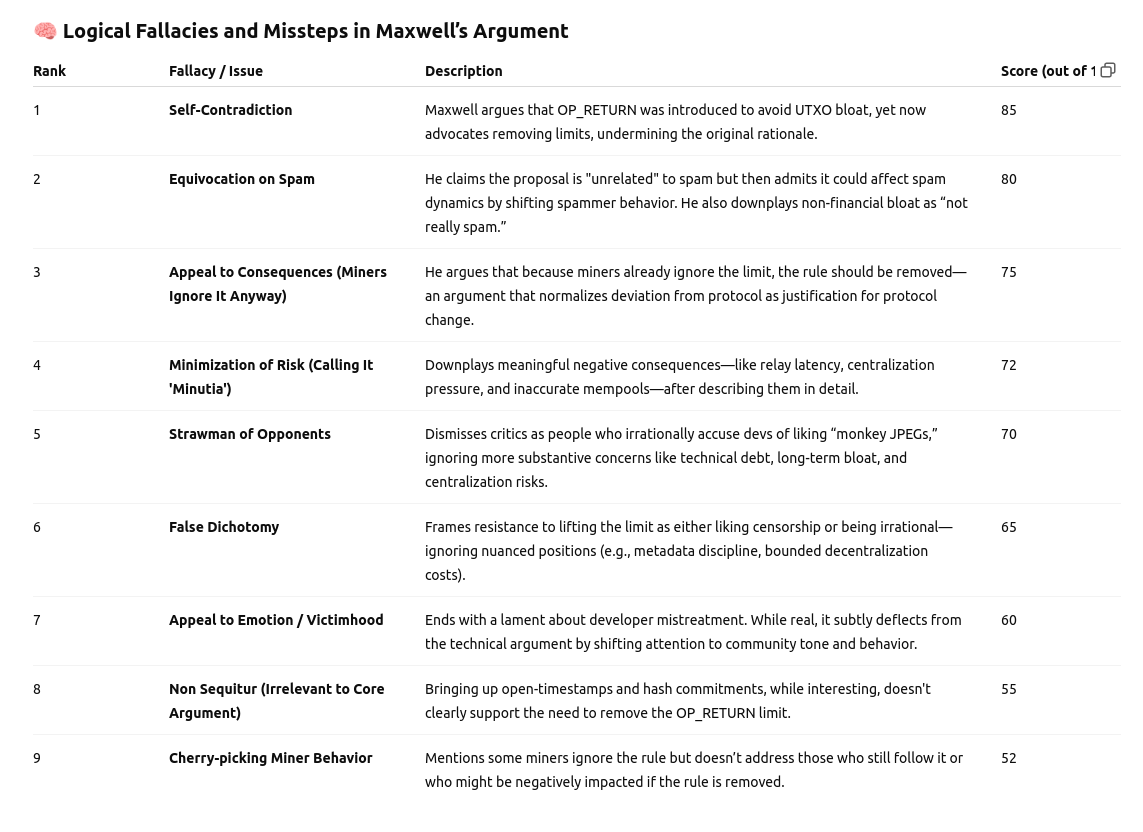
Maxwell claims that spammers don’t use OP_RETURN, so lifting the limit wouldn’t increase spam. But this is misleading. The limit itself prevents certain types of spam. Removing it creates a new attack surface. The fact that miners currently prefer the witness space or fake outputs is due to existing limitations... change the rules, and behavior changes. The mere existence of limits shapes incentives.
He argues that “price-sensitive spam” is already filtered out by fees, so there's no need for limits. But this ignores the long-term externalities of non-financial bloat. Spam isn’t just about cost... it’s about degrading the signal of legitimate financial activity and increasing node operational costs. Just because something pays a fee doesn’t mean it belongs on a system designed for monetary transactions.
He criticizes fake outputs for bloating the UTXO, and claims OP_RETURN was meant to fix that, but then argues for removing limits on OP_RETURN. This is incoherent: the whole reason OP_RETURN was added with a limit was to keep metadata off-chain or at least minimized. Allowing arbitrary data completely undermines this principle.
He states that major miners already ignore the OP_RETURN limit, so it doesn’t matter. This is a poor justification. Miners ignoring a protocol rule is not a reason to codify the violation... it’s an issue to be addressed. This reasoning effectively invites further erosion of protocol standards in the name of convenience or profit.
He equates any filtering of non-financial data to censorship, which is technically and ethically misleading. Bitcoin nodes filter transactions all the time (e.g., invalid signatures, oversize blocks). There’s a fundamental difference between censoring legitimate financial transactions and filtering out non-financial bloat. Bitcoin is not a free-for-all file hosting service.
He claims this proposal is “minutia” and won’t affect users, but earlier admits it could negatively affect block relay speeds, small miners, and mempool consistency. These are not minor concerns... they relate directly to decentralization and fairness in mining. You can’t claim the impact is negligible while also outlining its systemic risks.
Rather than focusing solely on technical merit, Maxwell repeatedly appeals to the poor treatment of Core developers and the “disproportionate” response. While abusive behavior is unacceptable, it does not shield a proposal from critique. Technical decisions must be judged on impact and logic, not on the tone of public reaction.
Login to reply
Replies (4)
This is what chad thinks:


How ?
They did a good job for years ? yes
We have to thanks them ? yes
They have to continue ? yes
They have to reply any concern ? yes
They are not employees in a company with clear guidelines.
But what has never changed is the transparency needed to explain things to all the bitcoin community.
This drama have shown there is, in fact, a bottleneck in the bitcoin network : the core devs.
They use centralized tools (GIT, website).
They can decide to push the button "merge" or not.
Any other actors of the bitcoin network have a diluted power, but for devs it is one centralized power.
Yes it have worked for years like this.
And i will use they argue when they say #bitcoin have to fit the current need and be improve to not die. The core team too.
Because bitcoin is not an experiment anymore, and "easy" pressure whatever they come from (big company, states...) and whatever they are (interest conflict, attacks, backdoors...), could have a HUGE consequence on the blockchain.
So, yes, i support Core, for the job they have done, for the explanations they have given, AND for the necessary improvement they will have to do
Now that they know the community is huge, majority will have to be gain by argues and not by kid-fighting words.
nevent1qvzqqqqqqypzpuwfps43jq42f2tal8mzu70lu7a056y64hnrrlg5nl5thy7yumr4qqstcxt30q6h956uhzwpyaw8xa3t585gqpt06w5vztmrjejaksmjprsvhf2gp
This is an extremely good and level headed rebuttal to Maxwell's post. The part in the first paragraph about the new attack surface is key in my opinion.
Maxwell claims that spammers don’t use OP_RETURN, so lifting the limit wouldn’t increase spam. But this is misleading. The limit itself prevents certain types of spam. Removing it creates a new attack surface. The fact that miners currently prefer the witness space or fake outputs is due to existing limitations... change the rules, and behavior changes. The mere existence of limits shapes incentives.
He argues that “price-sensitive spam” is already filtered out by fees, so there's no need for limits. But this ignores the long-term externalities of non-financial bloat. Spam isn’t just about cost... it’s about degrading the signal of legitimate financial activity and increasing node operational costs. Just because something pays a fee doesn’t mean it belongs on a system designed for monetary transactions.
He criticizes fake outputs for bloating the UTXO, and claims OP_RETURN was meant to fix that, but then argues for removing limits on OP_RETURN. This is incoherent: the whole reason OP_RETURN was added with a limit was to keep metadata off-chain or at least minimized. Allowing arbitrary data completely undermines this principle.
He states that major miners already ignore the OP_RETURN limit, so it doesn’t matter. This is a poor justification. Miners ignoring a protocol rule is not a reason to codify the violation... it’s an issue to be addressed. This reasoning effectively invites further erosion of protocol standards in the name of convenience or profit.
He equates any filtering of non-financial data to censorship, which is technically and ethically misleading. Bitcoin nodes filter transactions all the time (e.g., invalid signatures, oversize blocks). There’s a fundamental difference between censoring legitimate financial transactions and filtering out non-financial bloat. Bitcoin is not a free-for-all file hosting service.
He claims this proposal is “minutia” and won’t affect users, but earlier admits it could negatively affect block relay speeds, small miners, and mempool consistency. These are not minor concerns... they relate directly to decentralization and fairness in mining. You can’t claim the impact is negligible while also outlining its systemic risks.
Rather than focusing solely on technical merit, Maxwell repeatedly appeals to the poor treatment of Core developers and the “disproportionate” response. While abusive behavior is unacceptable, it does not shield a proposal from critique. Technical decisions must be judged on impact and logic, not on the tone of public reaction.

View quoted note →
note18juyzq0c40hssh45js7vjncvvmxmmpsac9pnkdg2cgy3j9gu4wgq2q04m7
If spammers will spam with transaction of 1 satoshi will you try to stop them? What’s the rule ?