Replies (23)

Still have not read BIP361, and dont care, but your statement on freezing utxos is fundamentally wrong. Bitcoin has no ''property rights'', it has means for you to resist attack (either by running hardware and spending energy, or bribing one of those that do so(fees)).
It has nothing to with ''rulers'', rough consensus is the ''ruler''. And it is a reality today, as it is tomorrow, as has it been since day 1, that if the network coordinates to freeze anyones UTXOs that is possible. Inb4 any mention of ''precedence'', thats a ghost in your mind. Again, it always was possible, it always will be, the fact it happened at one point, does not alter that it was possible before and remains possible after.
The fundamental question is.....why is it a problem, i dont see it. It is trivially to undermine such an attack on your btc by moving your coins, and Bitcoin is censorship resistant so you can. If for whatever reason you remain passive, be a sitting duck, not resisting, then too fucking bad; you had all the tools in the world that this system provides you, and you did not use them; you had censorship resistance but you simply did not resist. I cant see how your argument does not rely on anything other than altruism. Dont freeze coins because its mean, dont do it because even-though everyone on the network is fully capable of taking care of themselves, we should not be mean to those incompetent or otherwise that don't take care of themselves....im sorry, did we join the same Bitcoin network?
It is in my interest to freeze others peoples coins, because 20 million is better than 21 million, simple. And 19 million is even better, freeze all the coins we can get our hands on for all i care. And it would be in anyone's interest, because who on earth does not resist attempts of censorship when they have the means to do so.
It should not be a discussion based on some fucking moral bullshit...fuck moral bullshit, Bitcoin is a machine tied together by gametheory; i care about what we can and cant do with the machine, i dont care about silly notions of ''ought''.
Therefore this is practical matter....what can we get consensus on, what is the negotiation? Do we give them a week? a year? 10 years? 50 years? Im open for anything, i just want to get BTC off the limited table to increase my relative share, because i play a game of adversarialism, not altruism rainbow cottoncandy unicorn bullhshit.
The only reason i know that this will never happen, and probably has some negative impact on peoples perception on Bitcoin, is not because of any well reasoned analyses of fact (because again, nothing about the nature of Bitcoin changes, neither is anyone with agency at any real risk), but because the spam bullshit debate has shown us already the world is full of fucking retards, that probably hold the same retarded fantasy notions of ''property rights'' irt Bitcoin in their heads as you, and are either unable or unwilling to see the reality for what it is...ironically, in the game of bitcoin, shaping its reality.
So you can sleep comfortably knowing retards rule Bitcoin
GN
I didn't use terms like 'moral' and 'ought'. I was mostly saying 'this version of bitcoin is not worth anything, this other one is' and saying, it's good that people are speaking up.
I think 'no rulers' is a good high level framing, and your 'rough consensus' I don't like; this is not the IETF. But maybe the best framing is 'consensus, but not rough - only mathematical'.
Still I think you make a valid point - framing it as a "property right" can lead to a misunderstanding. Even though it's a negative right, the point still stands. As the old saying goes, "privacy is not a right, it has to be taken": an interesting comparison, because *my* privacy is by nature a personal thing, but my allocation of btc only has meaning in the context of consensus on a global state.
All I'm really advocating is that others do not choose to coordinate destructively. I can't force them not to, I can only try to persuade. Which was my starting paragraph was the thesis 'that coordination will destroy value, not protect it'.
But that was a bug in the software arithmetic, not intended behavior. I'm not saying you can't make this argument, it's not nothing, but it's very weak. It wasn't changing bitcoin's rules, only changing the software to actually enforce those rules. Destroying coins does change those rules, even if the original ruleset didn't anticipate a new context in which the effects of the rules get altered.
If there was a way to move private keys from pre-Q to post-Q (as there might be for BIP32) for these coins, then we wouldn't have an argument, because then you would preserve the intended rules through the context change. But that's not logically possible, and even worse the context change is not perfectly unambiguous; it would have to be, in that hypothetical.
Thus it's a fascinating conundrum.
The rules are ultimately what people want them to be.
The flip side of "you can't confiscate coins" is "anyone can choose to reject coins with certain characteristics."
There are countless cases of protocols upgrading their security over time and users of those protocols rejecting interactions with other users who refused to upgrade their security.
shouldn't taproot addresses be frozen too because of the exposed public key addresses?
I think one could simply concentrate one’s energy on working on quantum‑resistant addresses instead of freezing other people’s coins. I don’t understand why there are people who are so keen on freezing other people’s coins. What are they after? Is it to prevent those coins, which might be stolen by this magical quantum computer, from being sold and causing the fiat price to crash? So are they only interested in fiat when it comes to Bitcoin?
Yes, BIP-361 covers all existing locking scripts since none of them use post quantum cryptography.
That's not a conundrum at all. Permissionlessness dictates that both are true: you can't force anyone to use their coins in a particular way, and it also dictates you can't *stop* people using their coins in a particular way.
Forced upgrades to security are a valid way of doing this if users don't have an expectation of autonomy. Bitcoin users do, and must, have that expectation.
No auto-updates.
Also, rational economic interest dictates against your proposal, because it destroys bitcoin's value.
The voluntary nature of the protocol also dictates that anyone can choose to reject transactions with characteristics they deem dangerous / insecure.
I think you'll find your final claim to be controversial because some see it as value destruction while some see it as value preservation.
Take your value to ETH or a CBDC. You fit right in.
Make me 😂
nah, we'll just ignore your fiat shitcoinery like we're doing with #BIP110 😂🤣🤡
Freezing coins in this case is not some rulers confiscating some users' coins but all actual users refusal to sponsor a Quantum frenzy.
You are painting a picture of somebody imposing a change on people that would destroy their property entirely.
A more benevolent interpretation is that all those that still have access to their coins agree to make sure the coins that were lost stay lost instead of coming back from the grave to haunt us in form of aggressive inflation thus destroying all users' property partly.
I'm firmly in support of any scheme that makes sure that quantum computers won't be used to break Bitcoin's public key cryptography and only fear we shoot our own feet too early ... or too late.
It's not inflation. The number of coins isn't changing.
We counted lost coins as deflation. So it wasn't deflation to lose coins as they will all be found eventually? My argument holds. I don't want to sponsor the quantum frenzy with 20% of my savings.
There does seem to still be a lot of people talking past each other. There’s a big difference between “this is bad and I don’t support it” and “I don’t think the market will support this”. I’ve seen a lot of arguments to the first but relatively few of the second. Ultimately, the view of quite a few people I’ve spoken to (and myself) is “this is bad but it’s not clear that it’s worse than the alternatives and the market will very likely support this”. Of course “this” is not some premature seizure but rather only freezing coins when it’s very obvious to all involved that anything else will result in theft.
but who is this "we"? I certainly never counted all coins from some specific set (patoshi or otherwise) as lost. Indeed, occasionally big spends occur from funds in 2009-10. But even if they didn't, that's beside the point. It's absurd to say that spending from those coins is a violation of Bitcoin's anti-inflation promise.
I can't see how "the market will decide" can be the right viewpoint here, though I do obviously see why people take that point of view. The reason I can't stop at that is it has a very obvious reductio ad absurdum: every single day, it is rational for 99% of the userbase to form consensus on deleting the other 1%'s coins. And yet, every day, it does not happen. So the argument cannot be about first-order rational economic incentive, it must be both about second-order thinking (how does such a decision affect bitcoin's *future* value) and plausibility (why is it more ok to delete these coins over here and not those over there). From that second-order thinking point of view, holding to censorship resistance (because it's not bitcoin as we define it if it doesn't have that property) is rational.

Spending old coins doesn't violate the rules of Bitcoin. Who said otherwise?
The rules can be changed though, by any set of users. While a controversial change probably costs more than it benefits the group going along with it, if a supermajority wants the protocol to go in a certain direction, sure, the tiny minority can fork off, but they probably won't be able to maintain such a minority fork.
So if we all assume (we can't know exact figures) that 20% of bitcoins are essentially unrecoverable by their original owners but could at some future point be recovered through brute force due to their public key crypto becoming weak, then as Bitcoiners we have to decide whether to allow this or not. There are engineering and political risks, but in the end users will decide one way or another.
I'm for "freezing coins" that could otherwise be brute forced, and for providing alternative recovery paths where weakness-proof mathematical proofs are possible.
That said, I probably wouldn't sell all my coins on a super-majority non-freezing fork to the other side. I'd shout "you fools" at the void and accept that billions of dollars will get wasted on quantum mining of old bitcoin wallets, while hoping there would be some other useful stuff that could be done later with all the quantum mining equipment so it doesn't end up as QC's only use case.
Oh of course, it definitely requires second-order analysis, but concluding that *obviously* means the market will prefer a no-burn fork I think is equally reductionist. Obviously seizing 1% of coins in a cartel isn’t the same as preventing a quantum computer from stealing N% of coins and enabling recovery paths for the coins where that’s possible. I see why you think it’s still over some philosophical line but you can’t say that it’s equivalent to some other scenario that we’ve ever faced.
Communists and banks freeze other peoples money.
 BitcoinIsFuture
BIP-361 is the antithesis of the Bitcoin ethos.
First of all, if a hacker steal 1 million Bitcoin from Coinbase, are you going to freeze them?
Second, if EVER there is a quantum computer that can brake Satoshi's public keys, this computer will belong either to Google or the US or other gov. Why do you think they will directly dump all Bitcoin instead of use it as money and store of value? What if Saylor decides to dump, he almost has that amount?
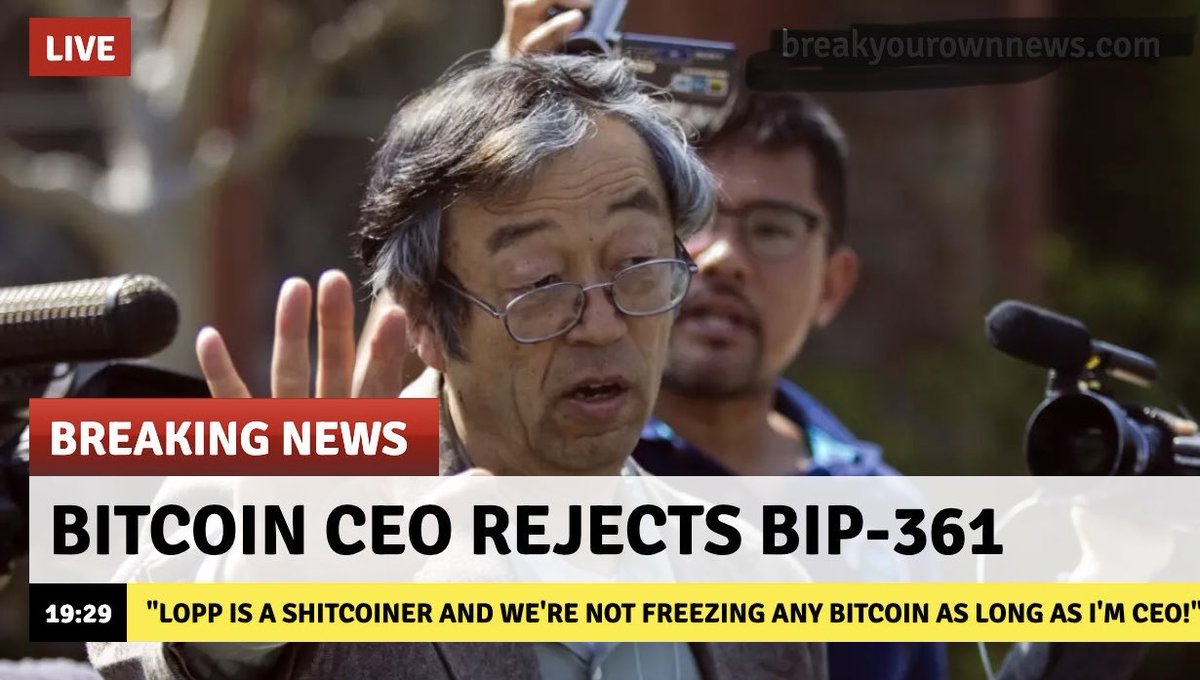
Jameson SLopp is a real Communist for wanting to freeze other peoples Bitcoin via BIP-361 as well as evil shitcoiner, spammer and manipulator.
The compromised Core clowns are working closely with him as seen on Github.
Scameson SLopp is worse than a Bcasher. He is an inverstor in Citrea spammers shitcoin alongside Peter Thiel from Palantir.
Communists and banks freeze other peoples money.
BitcoinIsFuture
BIP-361 is the antithesis of the Bitcoin ethos.
First of all, if a hacker steal 1 million Bitcoin from Coinbase, are you going to freeze them?
Second, if EVER there is a quantum computer that can brake Satoshi's public keys, this computer will belong either to Google or the US or other gov. Why do you think they will directly dump all Bitcoin instead of use it as money and store of value? What if Saylor decides to dump, he almost has that amount?
Jameson SLopp is a real Communist for wanting to freeze other peoples Bitcoin via BIP-361 as well as evil shitcoiner, spammer and manipulator.
The compromised Core clowns are working closely with him as seen on Github.
Scameson SLopp is worse than a Bcasher. He is an inverstor in Citrea spammers shitcoin alongside Peter Thiel from Palantir.
and shitcoins too