the binance hack will be a huge setback for those people who want to push bitcoin and cryptocurrency as "legitimate". It hands a perfect argument to those in power who hate bitcoin and want to shut it down, much more so than say FTX which was just "a bunch of people getting scammed". Now they can say (they already did, but this hack is *huge*) that we are literally funding North Korea's entire nuclear weapons program.
waxwing
npub1vadc...nuu7
Bitcoin, cryptography, Joinmarket etc.
I could be wrong, but what I'm noticing about these headline-grabbing (deservedly) results from frontier models on long-held theories of computation limits is, that they are more showing that the long-held theories are approximations, not so much that they are wrong. The "Exponential Time Hypothesis" and the square-root bound for ECDLP are in this category: both the results that show they are wrong, show they are wrong to an absurdly infinitesimal extent. Maybe it's more like saying that things are fuzzier than you think, not clean, not so much saying that the general rule you have in mind is wrong. Just a guess, though.
How have I only today learned that the plural of lemma is lemmata.
Little update on Lichen: switching the onchain verification to BABE results in only a few onchain txs instead of 20-25 (so, a much smaller exit delay) and reduces onchain costs by about 7x in terms of bytes. Worst case attacks in terms of a mass exit can then allow scale of about 10k to 50k users with a single operator/hub. And fees kept in reserve are also far lower.
Already got a long way through building this out using LLMs and there are further optimizations possible afaik such as duty free bits.
Afaict the bottleneck in lichen is all with the hub(s): how much liquidity can they provide, at what price, and they need to stay fully online and available. Very easy for the user: they don't have to watch the bitcoin chain at all. It's like an LSP model, but way better imo.
The synergy between BABE and lichen appears to be very strong, enough that I would claim that switching from BitVMX changes this from 'possible' to 'practical'. Still got to do a lot of security analysis, but, optimistic.
on branch `anchor` there's now a fairly complete setup: the sequencer posts anchors to bitcoin each L2 block. when you withdraw, you prove that an anchor is embedded with enough PoW and at least 10 blocks deep. You prove that your withdrawal represents a valid set of state transitions from genesis. These things together mean that even if the sequencer is colluding against you, you can't be cheated out of your money. And the transfers on L2 are all shielded (like zcash). The remaining risk is censorship: the sequencer censors your withdrawal transaction.
The demo now shows the anchoring so you know how final your transaction is.
View quoted note โ
GitHub
GitHub - AdamISZ/lichen at anchor
L2s in channels enforced on Bitcoin. Contribute to AdamISZ/lichen development by creating an account on GitHub.
The private keys shall be randomly chosen between 1 and the curve order.
Well, they're between 1 and 256. Good enough right? ๐คฆโโ๏ธ
This is an internet Certificate Authority?
2083449 - eMudhra: Private key compromise of Intermediate Certificates
ASSIGNED (naveen.ml) in CA Program - CA Certificate Compliance. Last updated 2026-10-31.
In all the frantic discussions about how thoroughly fucked all blockchains are in the case of an ECDLP break EITHER from AI OR from Quantum, no one seems to have noticed something important: a halt to a proof of work chain is a fundamentally more meaningful concept than a halt to a proof of stake chain that maintains consensus on a threshold signature scheme that uses discrete logs - which includes BLS as well as Schnorr, of course, so it covers Ethereum and I guess most all (?) PoS chains. there is no objective halt height if the thing that determines our current height becomes forgeable. In a quantum scenario (ECDLP broken by CRQC) that most envisage, the proof of work headers chain is untouched. assuming there was some "flag day". But with consensus over a forgeable signature scheme .. sheesh.
Shielded transfers on L2. All state transitions are proved valid. Spending costs the sender a 5-10s proof (it's not very optimized).
A question for anyone following along: is Bob safe?
#lichen


The problem with BABE and how Lichen solves it: In BABE, you set up a puzzle to be solved later, like "if you can at any time find a valid proof for the statement that this 1BTC belongs to you, you can claim it". The problem is that the amount, 1BTC is fixed right there, at setup, before anything happened. So the only system you can use that for are things like claiming collateral or whatnot. Very limiting. If you made the statement say "I have a valid claim on an amount x" with x being a variable, then they can claim the prize with x=0.01 while the prize is 1BTC; useless.
In Lichen we can exploit the fact that the hub is *required* to answer requests (hub's have to stay live; users don't, until timeout), as follows: first, the statement that BABE's WE works over becomes: "I have an amount x **which the hub signed** and a valid proof that my balance on L2 is > x" where the proof ensures both 'x's are the same. It's bizarre at first until you realize, the hub doesn't sign 'x' to say 'x is a valid withdrawal'; he signs 'x' to commit the user to that choice. So the process goes: user claims 'i want to withdraw x', hub (forced by liveness; loses after timeout) must winternitz-sign x. Then user can use the setup-at-contract-start BABE setup to extract the spending secret which then fires off into the bit decomposition, that actually pays out that same x.
Currently I'm about 80% sure this works in practice, not just theory. And if it does, dispute goes from worst-case 23 transactions onchain to worst-case 4 or 5 and *maybe* 20kb. In either case, it's zero normally. ( Lichen: if you don't know what it is, see the paper in https://github.com/AdamISZ/lichen, also the explainers under docs/ ).
Right now setting up a shielded transfers L2 using a basic design, just to create a prototype. Already done a fair few mutinynet tests of the existing BitVMX dispute (with its 20+ transactions, a lot more bearable on that chain of course!).
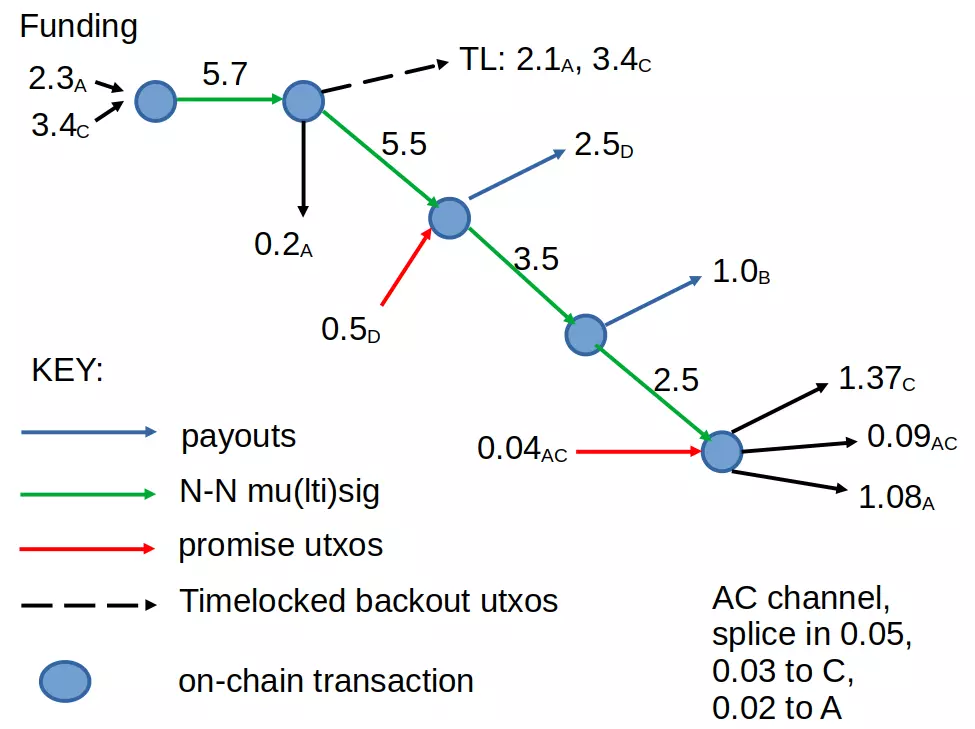
Damn i spoke to soon.
NIST P256's generator's seed was found.
That's not Bitcoin's (secp256k1 is not a NIST curve).
Again it theoretically doesn't matter. But we'd still love to know!
View quoted note โ
Wow!
This is not a bad thing, don't worry ๐
The opposite: we now where G comes from in secp256k1. It was theoretically not a problem anyway. But now we know for ~sure it was not some weird backdoor.

Claude reveals ECDSA curve origins
The decades-old mystery of the origins of one of the most popular cryptographic standards has been explained.
I feel rather the same. Especially because paying between hubs, I've just realized, should be just as simple as it is between ecash servers now.
View quoted note โ
https://www.coinbase.com/blog/working-together-on-btc-post-quantum-readiness
This is an interesting perspective from the biggest custodian on the planet.
Maybe people will finally realise (a) it's easier to audit software than hardware (b) the threat model on hardware isn't realistically backdooring general purpose computers when they don't even know what software you'll run (c) you don't have to rip out network cards, if there is no accessible internet.
Maybe, maybe not ;)
I wonder if I was influenced by getting into bitcoin before hardware wallets existed. Back then the discussion was "don't be a dumbass and run your wallet on windows" and "keep it on a separate machine". People were running wallets on phones and getting into arguments about how much is safe to keep on it - I guess that just hasn't changed at all. BIP32 was just starting to become commonplace and people realized the 'watch only' concept could work (a massive step forward imo), people were just starting to tinker with the idea of special purpose devices, I remember Trezor starting up. I played with one a few times, small amounts, it's kind of cool technology, but I could never bring myself to put much money on it. It's sitting in a drawer, empty, now. I bought a couple Coldcards, gave one to a guy in El Salvador who used it for teaching, the other one sat in my drawer until the hack, shortly after which I took it out of its bag and used it as a teaching demonstration, myself. Thanks for coming to my ted talk.