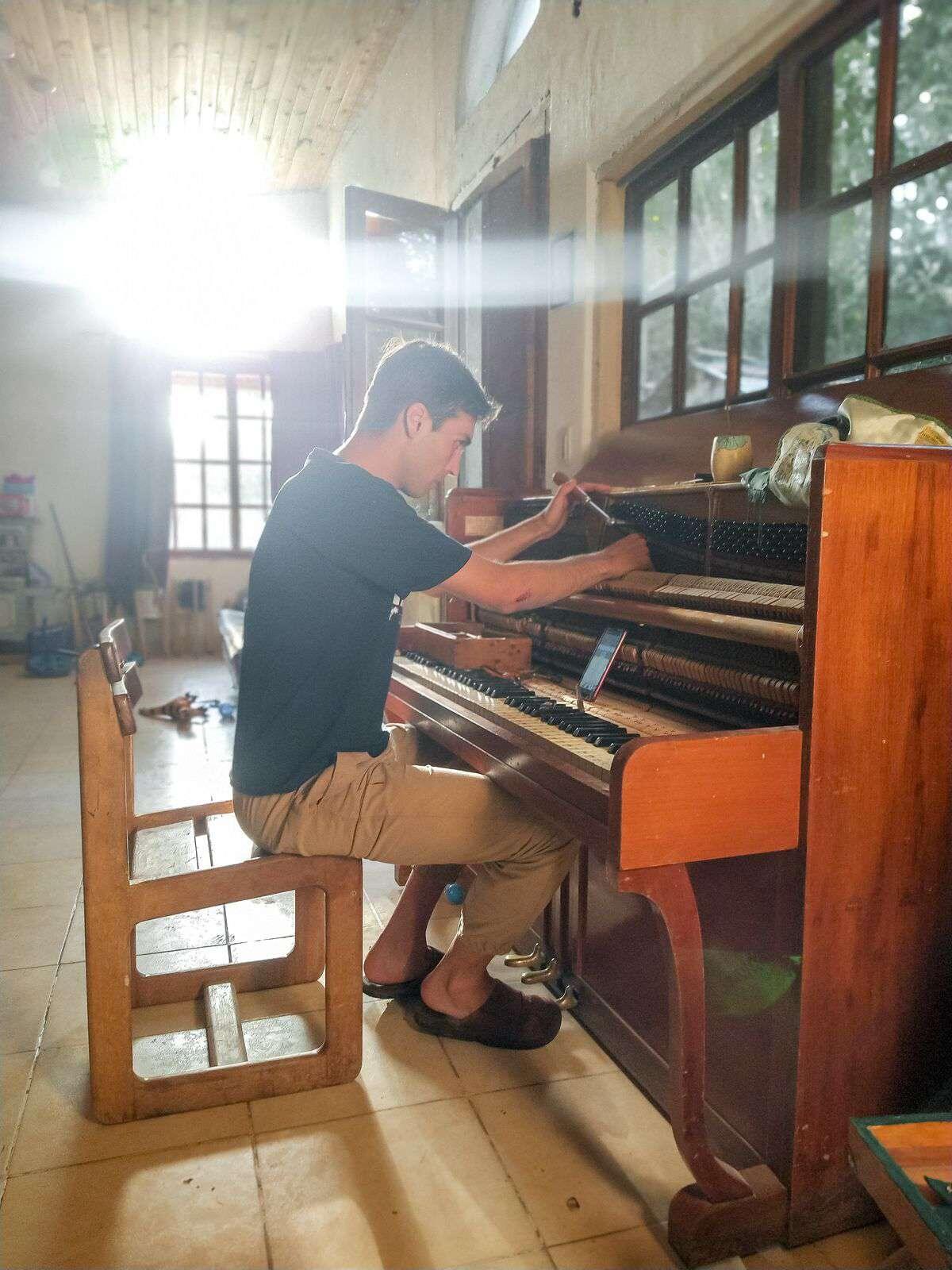
Well some more pictures about this project.
The top was so deformed that I had to brace it entirely.
Though I would have wanted to just glue the transversal bridge plate. It wasn't enough to really give the top a desired shape. So I brought it back to a functional form glueing the braces.
I didn't wanted to for a couple of reasons. But anyway, I did it.
One of the reasons is that the soundboard was 2,7 mm thick...
And that is a lot for my taste, but it's more than the standard. Industry covers potential loses, I guess. Because tops this thick will fail less, endure more, yet they can sound no better.
So, giving it braces implied even more rigidity and making it less responsive.
I had to shave some wood with a violinmaker scraper to make it thinner and more sensitive since it felt massive and dead. The top should be a sensible and responsive membrane (but not as thin to fail or deform with time).
That is also the reason why I didn't reinforced the soundhole. It showed no deformation in half a century or more and it's already thick.
Another reason is, it implied more work. (Not that I don't want to work) More work means more expensive for me, since I don't want to charge the client for something I didn't expect. Anyway, my own neuroticism.
Another reason is that I think the guitar will sound above it's former full potential. Will be something between an industrial guitar and an artisan guitar. And I cannot take credit. Not that I want the whole credit for it. It is just that I can feed the myth that those guitars are so good when they clearly aren't.
One typical solution for it is to attach a little paper saying "repaired by" so and so and the date. Anyway. Thoughts.
I did it anyway, and I would do it again and again because this crazy world deserves better sounding guitars always and in good hands. And it's my due service.
Details:
Hairdryer helps me warm the zones where I have to shape the wood again and gives me better timing with the hide glue.
A little thin shellac on the inside is healthy. Since the instrument will "breathe" at a more synchronous pace between the inside and the outside. Thus, time shall tell, deform itself at a slower rate.


