After the #ColdCard debacle, it is time to test some alternative air-gapped setups — did so with #MetroVault today. In this setup, the signing device is an old offline Android device. Even if the phone is ten years old, it is somehow easier to enter passwords and scan QR codes than with a dedicated hardware device ;-). There were some gaps in the documentation, and maybe an alternative export possibility for the signed transaction would be nice in case your desktop PC does not have a webcam.
Nice to see that F-Droid supports reproducible builds and publishes apps signed by the developers. That makes coexistence of F-Droid and Zapstore smoother for new apps, because paying attention to which store the app was originally installed from is confusing. #fdroid #zapstore
Do you have any thoughts about or recent experiences with #MetroVault ?
@Simon Dixon wrote in
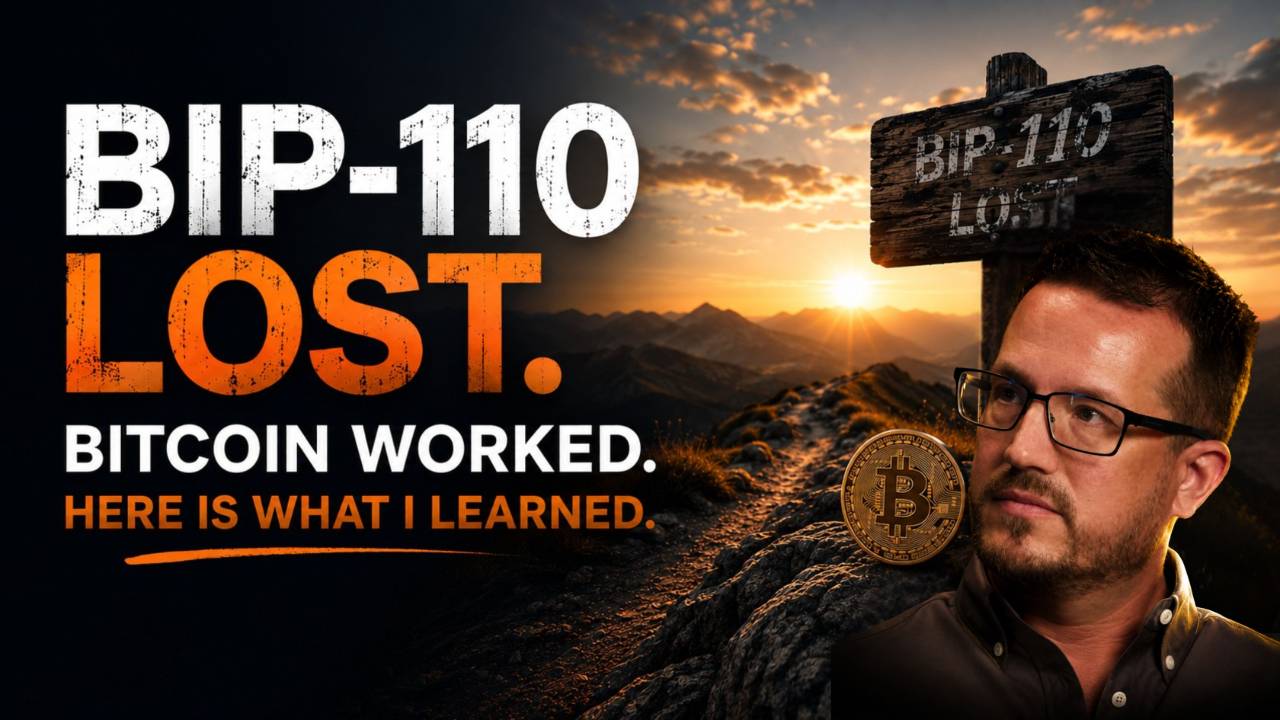
BIP-110 Lost. Bitcoin Worked: What I Learned | Simon Dixon
BIP-110 lost, but Bitcoin worked exactly as designed. Simon Dixon shares key lessons: why a node gives you sovereignty over authority, why changing...
"A substantial minority of node operators were sufficiently concerned about Bitcoin’s direction to change the software they ran." and an even larger share never updated to the latest version of Core. What about the them? Only looking at two camps is quite simplification.
If you use bitcoin as money at the moment, then you need a working network. However, a future hard fork will play out a stop-the-world scenario does not work in the meantime.
Sharding is a technique used for scaling large, distributed systems. Using it in bitcoin for garbage collection (GC) is therefore a valid way forward. #MonetaryNode
We can discuss any conspiracy that led to the current state of affairs in bitcoin, but remember that none of these perpetrators are omnipotent; plans fail or produce unintended consequences. For instance, the plandemic did not intend to kill the commercial real estate market and establish remote working permanently. There is still space to react and thwart some of their plans. They want to store spam and scams on the chain? So, we can restrict access to it. Therefore, ideas like #MonetaryNode and similar initiatives have to be investigated further.
In order to fight #BIP110, Mow had to sacrifice his Ω candle that will not show up anytime soon now. Well, you cannot have both, and his reputation is wrecked anyway ;-)
Bitcoiners are working on separating money from the state—while on the other side, opponents are working on separating bitcoin from the blockchain. Misusing the blockchain as a data store and managing bitcoin centrally in banking databases reflects exactly that. Wake up.
If #BIP110 really had been an attack on bitcoin, then I would have expected to see a green relief candle on the chart ;-)
The last battle has been lost, and it is sad to see that the anti-spam movement is now divided into two groups. One group wants to hard fork the chain, and the other wants to continue to defend the existing chain with the available means such as decentralized mining and filtering. The latter seems slower but more realistic, as it is almost impossible to overcome existing network effects. The situation in the bitcoin space may change rapidly, and bad actors may disqualify themselves. Mt. Gox, FTX, etc., are gone; the same may apply to Saylor & Co. With dying sponsors like Coinkite, their supported sinfluencers will disappear as well. In a couple of years, the situation may look different.
How can I collapse the sidebar in #Amethyst v1.13.1 in portrait mode on a tablet? Currently it stays open all the time and the bottom navigation bar is never shown. :-(
Spam filtering is not dead. #Knots 20260508 is currently being replaced by 20260507, as the stats show.
The mining landscape has shifted—e.g., the China mining ban—and may shift again. Furthermore, #DATUM did not die with #BIP110. The war for more decentralization is still on.
Unfortunately, this battle has been lost. Quo vadis bitcoin? Replicating the network effect with a fork would be almost impossible. So, is holding the status quo by running #Knots 29.3.0 20260507 (without #RDTS) the way forward in the meantime?
Do not listen to Saylor, but look at what he is actually doing. He sold over 1.6k bitcoins last week. Therefore, he seems to expect price volatility—either through a chaotic chain split or #BIP110 adoption—rather than smooth sailing with no storm. He basically admits that he has overestimated his influence and does not know what will happen next.
Over 4k Lightning channels have already been closed since the beginning of the month. So much for the "nothing will happen" narrative. One can only hope that mining pools are smarter than that and realize what choosing not to listen to the community means for the future. Therefore, avoid further disruption and adopt #BIP110.
For most people who can think for themselves, it should now be really obvious that the #ColdCard hack, the transformation of the blockchain into a data store, Saylor's bitcoin paper scheme, the lying sinfluencers, etc., are all attacks to capture bitcoin. Bitcoin will stall and then decline if the community does not act now and forces #BIP110 to activate.
Two times 21 is a nice number of #BIP110 blocks.
View quoted note →With the #ColdCard incident, the community has been fooled by trusting the experts. Do not repeat the same mistake by trusting them again regarding new use cases for bitcoin. Adopt #BIP110.
