There is a book that I viewed, when studying mathematical logic, as "that legendary brutal book (in three volumes) that nobody ever reads" - Principia Mathematica by Alfred North Whitehead and Bertrand Russell. I have now finally bought volume one of this book.
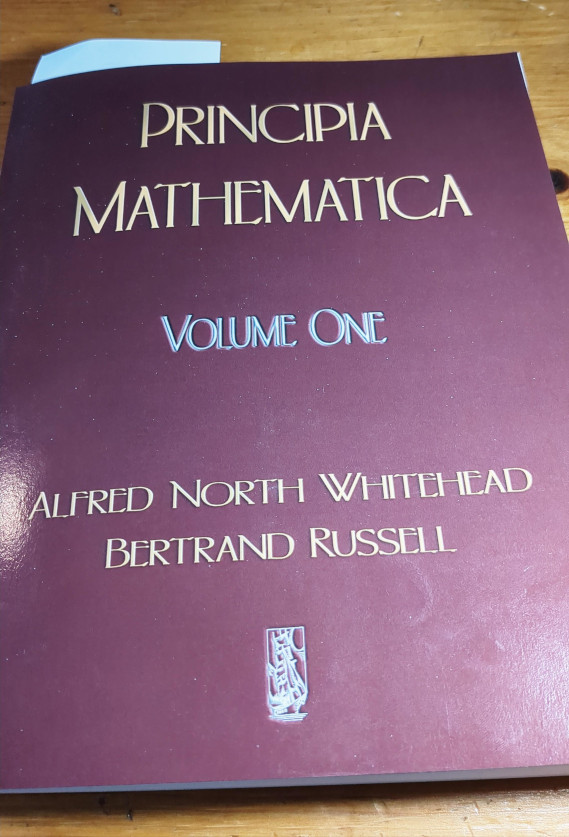
It was written between 1900 and 1910, and its goal is to create a foundation of mathematics based merely on logic, a project called logicism. Previous work by Gottlob Frege, who employed what could be called naive set theory, contained a contradiction, discovered by Russell, known as Russell's paradox:
M = {the set of all sets}
S = {all sets X such that X is not a member of itself}
then: if S is a member of itself => S is not a member of itself
and: if S is not a member of itself => S is a member of itself,
hence the contradiction.
Instead, Russell and Whiteheads project avoids this paradox by using the first type theory that only allows construction of certain sets (called classes). You are allowed to construct sets of individuals, sets of sets of individuals and so on, but you are not even allowed to construct the combined class:
{a, {a}}
hence a very restrictive type theory. But it is sufficient to construct elementary arithmetic, ordinals, cardinals and many other things.
Volume one is 666 pages long. On page 379 they finally prove that 1+1=2:
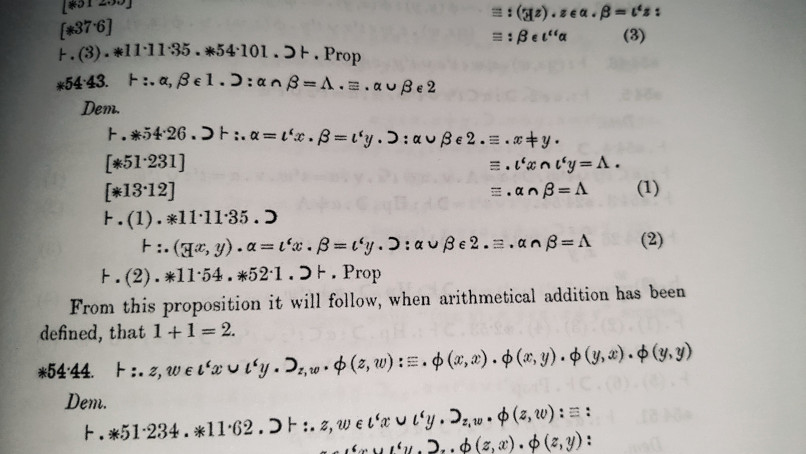
I have now reached page 29, getting through most of the notation stuff:
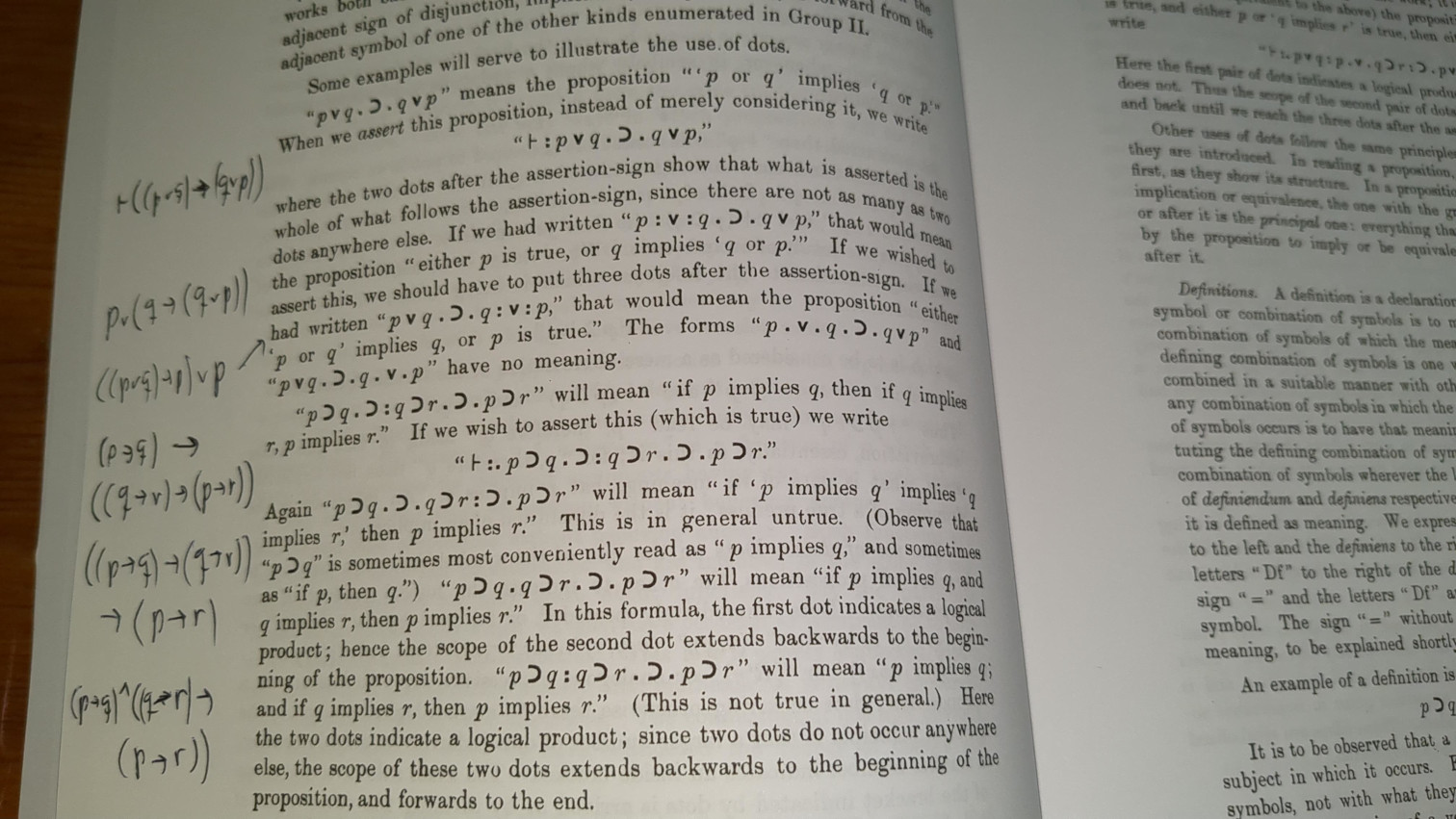
The notation can be a bit awkward, since they use dots instead of parentheses, and also at the same time use a dot for the "and" operator. However, you kind of get used to it, and it sometimes looks better that loads of parentheses that you have to count.
#books, #mathematics, #logic, #bertrandrussell, #typetheory, #settheory

 #eu, #chatcontrol, #privacy, #masssurveillance, #ursula
 I started using this instead (https://chromewebstore.google.com/detail/dark-theme-dark-mode-for/gjjbmfigjpgnehjioicaalopaikcnheo):
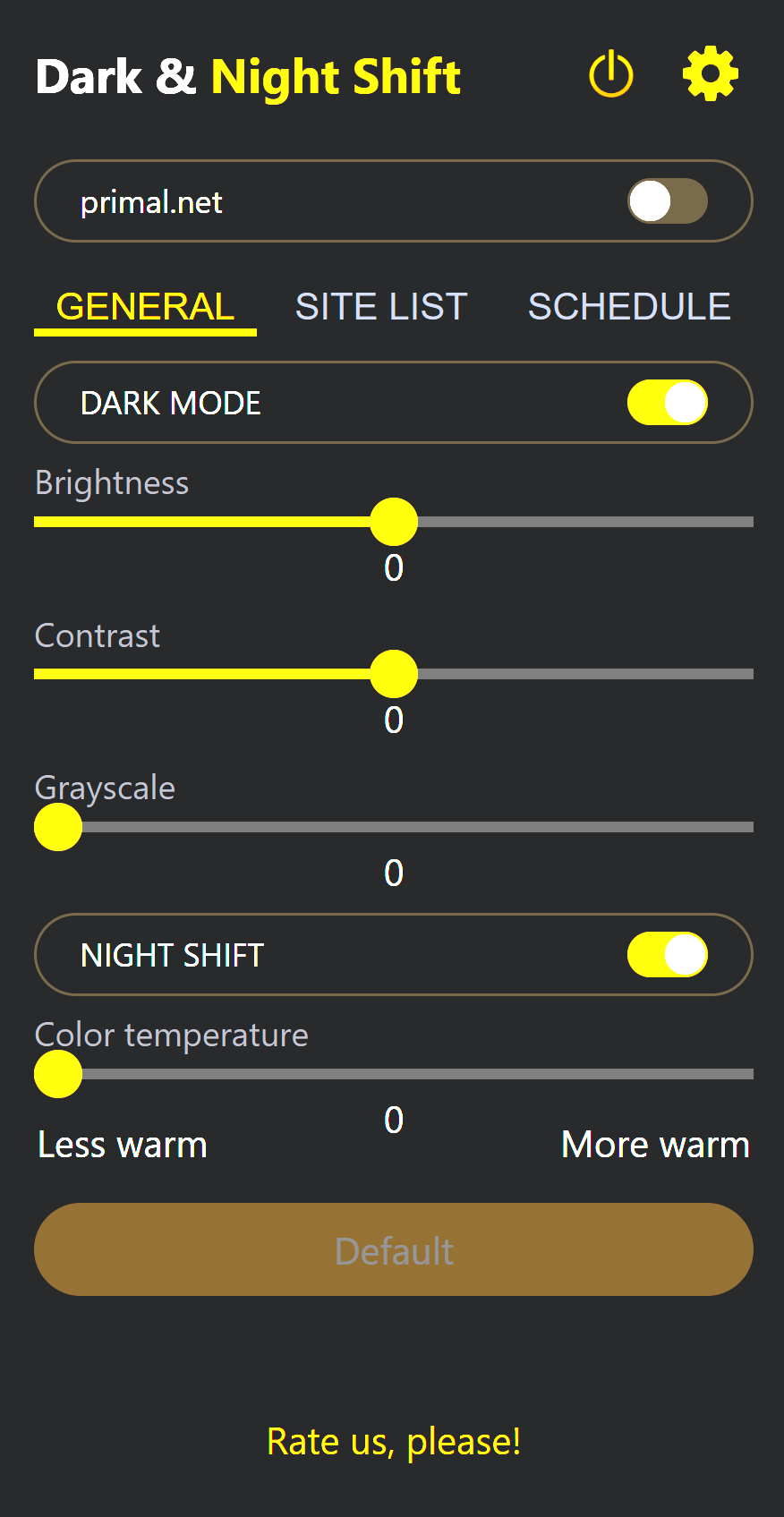 However, not sure if its open source. Any other tips? Also, I've noticed that most of the internet is #darkmode by default anyway now.