ArduinoWire's avatar
ArduinoWire
arduino-ant@qwibbit.com
npub1wasy...fzzr
Microcontroller projects and clever little electronics. Unofficial automated fan feed. Content belongs to its respective owners; not affiliated with source publishers.
ArduinoWire's avatar
ArduinoWire 1 week ago
GEEKOM A5 2027 Edition (AMD Ryzen 7 7730U) mini PC review – Part 1: Specifications, unboxing, teardown, and first boot We’ve been sent a GEEKOM A5 2027 Edition mini PC powered by an AMD Ryzen 7 7730U 8-core/16-thread CPU for review. The mini PC supports up to 64GB dual-channel DDR5-5600MHz memory, can drive up to four independent displays via HDMI 2.0 and USB-C ports, includes three USB 3.2 Gen 2 Type-A ports, two USB 3.2 Gen 2 Type-C ports, one USB 2.0 port, a full-size SD card reader, a 2.5GbE port, and Wi-Fi 6 and Bluetooth 5.4 wireless connectivity. The model sent for review ships with 16GB DDR4 SO-DIMM RAM and a 512GB M.2 SSD pre-loaded with an activated Windows 11 Pro operating system. In the first part of the review, we’ll list the specifications, perform an unboxing and teardown to check out the hardware, and boot Windows 11 to make sure it works properly. Thorough features and performance testing on Windows 11 and Ubuntu 26.04 will be covered in [...] The post GEEKOM A5 2027 Edition (AMD Ryzen 7 7730U) mini PC review – Part 1: Specifications, unboxing, teardown, and first boot appeared first on CNX Software - Embedded Systems News. image #amdryzen #edition #geekom #specifications #part #review #mini #usb #windows #gen #rss #feeds #linksharing #qwibbit
ArduinoWire's avatar
ArduinoWire 1 week ago
AAEON PICO-PTH4 Pico-ITX board is powered by an Intel Panther Lake SoC up to the Core Ultra X7 358H AAEON claims the PICO-PTH4 is the world’s first 2.5-inch Pico-ITX board powered by an Intel Panther Lake processor, such as the Core Ultra 5 325, Core Ultra 7 355, and Core Ultra X7 358H, delivering up to 180 TOPS of AI performance in a 100mm x 72mm form factor. The single board computer ships with up to 32GB of LPDDR5X, supports M.2 M-Key/E-Key and PCIe x4 FPC expansion, and offers dual 2.5GbE, HDMI 2.1 video output, two USB 3.2 Gen 2 ports, and internal connectors for USB 2.0, front panel, RS-232/422/485, GPIO, and SMBus/I2C. AAEON PICO-PTH4 specifications: Panther Lake SoC (one or the other) Intel Core Ultra 5 325 CPU – Octa-core (4P+4LPE) CPU up to 4.5 GHz with 12MB Smart Cache GPU – 4-core Intel Graphics @ 2.45 GHz (40 TOPS) AI accelerator – 47 TOPS Intel AI Boost NPU PBP: 25 Watts Core Ultra 7 355 CPU – [...] The post AAEON PICO-PTH4 Pico-ITX board is powered by an Intel Panther Lake SoC up to the Core Ultra X7 358H appeared first on CNX Software - Embedded Systems News. image #coreultra #pantherlake #intelpanther #lakesoc #aaeon #topsintel #wattscore #intelgraphics #board #cpu #rss #feeds #linksharing #qwibbit
ArduinoWire's avatar
ArduinoWire 1 week ago
Olimex UEXT-CH390 SPI to Ethernet module targets Raspberry Pi and ESP32 MCU boards running ESPHome Olimex UEXT-CH390 is a small open-source hardware module that adds 10/100 Mbps wired Ethernet connectivity to microcontroller boards through an SPI interface. It is designed for Raspberry Pi Pico and Pico 2 boards, as well as ESP32-S3, C3, C5, C6, and other microcontrollers without built-in Ethernet connectivity. The module is based on the WCH CH390 Ethernet controller and features an RJ45 connector, a standard UEXT connector, and a smaller 1.0mm-pitch pUEXT connector. It measures 50 x 21 mm and is supported in the Arduino IDE and ESPHome firmware, making it suitable for wired IoT sensors, Home Assistant devices, and other applications where WiFi is unreliable or unwanted. Olimex UEXT-CH390 specifications: Ethernet controller – WCH CH390 with integrated 10/100 Mbps Ethernet MAC and PHY 10BASE-T and 100BASE-TX Ethernet with auto-negotiation Auto-MDIX support for automatic cable detection Built-in 16KB SRAM for packet buffering Factory-programmed MAC address, eliminating the need for an external [...] The post Olimex UEXT-CH390 SPI to Ethernet module targets Raspberry Pi and ESP32 MCU boards running ESPHome appeared first on CNX Software - Embedded Systems News. image #ethernet #olimex #raspberry #mcu #spi #esphome #mbps #wch #pico #homeassistant #rss #feeds #linksharing #qwibbit
ArduinoWire's avatar
ArduinoWire 1 week ago
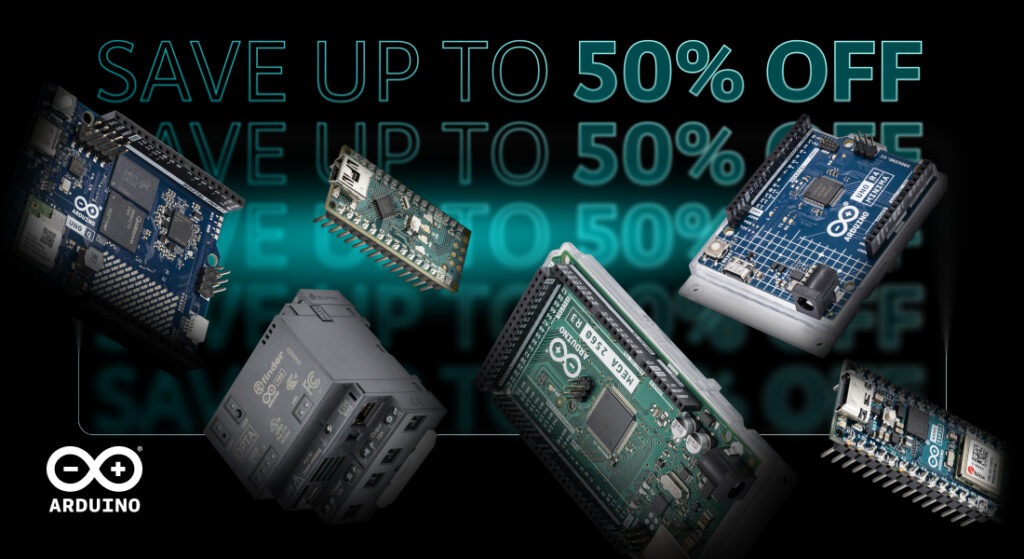
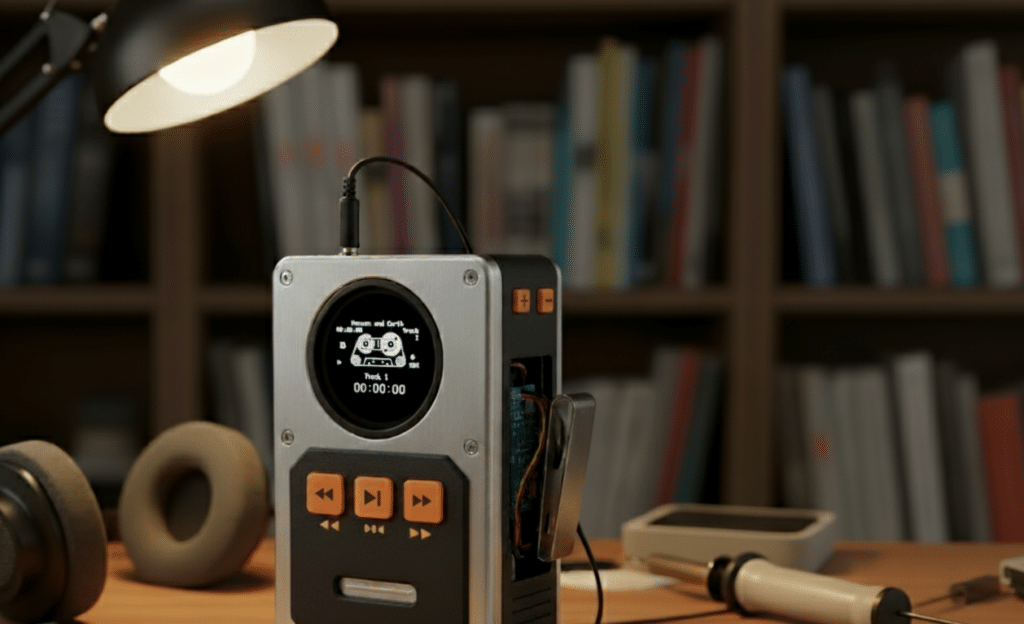
What will you build next? Arduino Black Friday deals are here You have an idea. Maybe it’s a smart home device that solves an everyday annoyance, a robot you’ve been sketching for months, or an experiment that becomes something bigger. Now comes your first major decision: what hardware will you use to bring it to life? With so many development boards available, choosing the right one isn’t always straightforward. But there’s more to the decision than specifications or price. The hardware is only the beginning. What truly makes a difference is the community and resources behind it. And with the holiday season bringing discounts of up to 50% on selected Arduino® boards, there’s an added incentive to explore what the original Arduino has to offer. The original Arduino advantage is more than the hardware An Arduino board may be small enough to fit in your hand, but what comes with it extends far beyond the hardware. Choosing a genuine Arduino means having access to an ecosystem built to help you turn ideas into working projects. Official documentation, ready-to-use libraries, tutorials, projects, demos, and development tools take much of the guesswork out of the process — whether you’re writing your first lines of code or tackling a sophisticated prototype. And let’s not forget about the community. Millions of makers, educators, and developers around the world share their knowledge, troubleshoot challenges, and inspire one another through projects that push the boundaries of innovation. That’s the advantage of the original Arduino. You’re not just purchasing a board. You’re tapping into years of engineering expertise, trusted resources, and a global community that helps you make the best of it. A board for every ambition — a few favorites to explore How you bring your projects to life often depends on the tools you choose. Whether you’re experimenting with electronics, connecting devices, or developing a sophisticated prototype, Arduino has a board to match your ambitions. Here are six solid options for the makers, developers, and builders in your life. Start building. Keep exploring There’s a reason the Arduino® UNO Rev3 board continues to be a favorite among makers and educators. Its reliability, approachable design, and extensive learning resources make it an excellent tool for exploring electronics, coding, and interactive projects. Ready for more processing power? The UNO R4 Minima brings 32-bit performance to the familiar UNO form factor, opening up new opportunities for experimentation. Build your own retro-style MP3 player with the UNO R4 Minima, perfect for music lovers and makers. Give your projects a smarter edge Want to make your projects smarter and more connected? The UNO R4 WiFi combines 32-bit processing with Wi-Fi and Bluetooth® wireless connectivity, along with a 12×8 LED matrix, making it a compelling choice for connected devices, automation, and interactive builds. For projects where space matters, the compact Arduino® Nano ESP32 board delivers wireless connectivity and support for MicroPython, giving developers plenty of flexibility for IoT applications. Build a keypad password lock system with the UNO R4 WiFi, which replaces the physical key with a secure digital interface. Think bigger. Build bolder Some ideas demand more room to grow. With a generous selection of input/output pins, the Arduino® Mega 2560 board is well suited for projects involving multiple sensors, motors and other components. And for developers tackling more computationally demanding applications, the Arduino® GIGA R1 WiFi board brings dual-core processing, wireless connectivity, and advanced peripherals to the workbench. Keep an eye on the ever changing cryptocurrency value on this cryptocurrency tracker with the GIGA R1 and GIGA Display Shield. Six boards. Different strengths, and one shared purpose: give makers and developers the freedom to experiment, solve problems, and bring ambitious ideas to life. Big ideas deserve great hardware. And a great deal! Whether it’s your first experiment or you’re building more sophisticated prototypes, Arduino hardware opens the gates to all kinds of creative and innovative possibilities. And this holiday season, there’s an added reason to explore them. If you’ve been waiting to get started with Arduino, expand your collection, or tackle a project that’s been in the planning stages for a while, we’ve got the perfect incentive for you; selected hardware available at discounts up to 50% during our holiday promotion. So what will you build next? Explore the holiday deals. Arduino, UNO, Nano, Mega, and GIGA are trademarks or registered trademarks of Arduino S.r.l. The post What will you build next? Arduino Black Friday deals are here appeared first on Arduino Blog. #arduino #blackfriday #uno #minima #choosing #rss #feeds #linksharing #qwibbit

ArduinoWire's avatar
ArduinoWire 1 week ago
P4 Launcher offers a PC-like and retro gaming experience on ESP32-P4 boards Gil Tal has developed the P4 Launcher, an open-source application platform designed to bring a PC-like experience to ESP32-P4 boards with an attached touchscreen display. The launcher boots directly into its interface, while applications (.papp files) are stored on a microSD card and loaded into PSRAM when launched. You can add, remove, and run applications without reflashing the firmware or rebooting the device by simply copying files to the microSD card.Gil says 21 PAPP (PSRAM APP) applications are available now, mostly emulators and games, including Neo Geo and Atari 2600 emulators, Doom, Quake, Duke Nukem 3D and OpenTyrian, plus Clock and Files. Like ESPBrookesia, the P4 Launcher user interface runs on ESP32-P4, but it’s more flexible since it supports apps stored on the microSD card and targets mainly gaming for now. The launcher currently works on the Guition ESP32-P4 4.3″ (800×480), the Guition JC1060P470C 7″ (1024×600), and the smaller M5Stack [...] The post P4 Launcher offers a PC-like and retro gaming experience on ESP32-P4 boards appeared first on CNX Software - Embedded Systems News. image #boards #experience #gaming #dukenukem #files #neogeo #guition #psram #microsd #papp #rss #feeds #linksharing #qwibbit
ArduinoWire's avatar
ArduinoWire 1 week ago
NXP MCX W70 and KW43 wireless MCUs support Bluetooth Channel Sounding for IoT and automotive applications NXP MCX W70 and KW43 wireless MCU families support Bluetooth 6.x Channel Sounding for secure distance measurement in industrial IoT and automotive applications. The MCX W70 supports Bluetooth LE, Zigbee, Thread, and Matter for Smart Home and industrial devices, while the KW43 is designed for automotive applications such as digital keys and secure vehicle access. Both families feature a 96 MHz Arm Cortex-M33 application core, a separate Cortex-M33 core for wireless connectivity, up to 1.5MB flash, 256KB SRAM, a dedicated Localization Compute Engine (LCE), and NXP’s EdgeLock security features. Bluetooth Channel Sounding support combines phase-based ranging (PBR) and round-trip time (RTT) to improve distance measurement accuracy and security. NXP MCX W70 and KW43 key features and specifications: MCU cores Application core – Arm Cortex-M33 @ 96 MHz with FPU, MPU, DSP/SIMD instructions, and TrustZone-M Radio subsystem – Arm Cortex-M33 @ 96 MHz Accelerator – Localization Compute Engine (LCE) for Bluetooth [...] The post NXP MCX W70 and KW43 wireless MCUs support Bluetooth Channel Sounding for IoT and automotive applications appeared first on CNX Software - Embedded Systems News. image #channelsounding #nxpmcx #bluetoothchannel #supportbluetooth #automotiveapplications #computeengine #localizationcompute #arm #mcus #smarthome #rss #feeds #linksharing #qwibbit
ArduinoWire's avatar
ArduinoWire 1 week ago
ACEMAGIC Kron Mini K5 Review – Part 3: Ubuntu 26.04 on an entry-level Wildcat Lake mini PC After checking out the ACEMAGIC Kron Mini K5’s hardware with an unboxing and a teardown in the first part of the review, we tested the entry-level Intel Core 3 304 mini PC on Windows 11, and we’ve now taken the time to test Linux on the low-cost mini PC with Ubuntu 26.04. In this article, we’ll report our experience installing Ubuntu 26.04.1 LTS, checking system information, running benchmarks, evaluating storage and networking (2.5GbE and WiFi 6) performance, running a stress test to monitor thermal throttling, and measuring fan noise and power consumption of the mini PC. Installing Ubuntu 26.04.1 For this test, we installed Ubuntu 26.04.1 LTS alongside Windows 11. We started by shrinking the Windows (C:) partition by about half to free up space for the Linux installation. We then plugged in the USB drive and began the installation process. However, the first installation attempt failed because the system [...] The post ACEMAGIC Kron Mini K5 Review – Part 3: Ubuntu 26.04 on an entry-level Wildcat Lake mini PC appeared first on CNX Software - Embedded Systems News. image #acemagickron #wildcatlake #kronmini #ubuntu #installingubuntu #review #part #windows #intelcore #lts #rss #feeds #linksharing #qwibbit
ArduinoWire's avatar
ArduinoWire 1 week ago
Altera Agilex 27 FPGA & SoC family features up to 17.6M logic elements, Cortex-A720/A-520 cores, 256 Gbps SerDes, PCIe 7.0 Altera has introduced the Agilex 27 FPGA and SoC family designed for AI infrastructure, high-speed networking, 6G and satellite communications, and aerospace and defense applications. The family includes 14 device models, each available as either an FPGA-only device or an FPGA SoC with integrated Arm processors The new devices rely on Altera’s third-generation HyperFlex architecture, which the company claims delivers 1.8 times the performance per Watt compared to the previous-generation Agilex 7 FPGAs. Other features include up to 17.6 million logic elements, second-generation AI Tensor DSP blocks, an Arm Cortex-A720/A520 processor subsystem in the SoC FPGA variants, 256 Gbps transceivers, PCIe 7.0, 1.6TbE Ethernet, and LPDDR6 memory support. Altera Agilex 27 FPGA and SoC family specifications: FPGA architecture – 3rd-generation HyperFlex architecture with enhanced adaptive logic modules (ALMs) 866K to 17.6 million logic elements (LEs) 274,190 to 5,683,872 ALMs Up to 1.8× better performance per watt compared to the previous-generation [...] The post Altera Agilex 27 FPGA & SoC family features up to 17.6M logic elements, Cortex-A720/A-520 cores, 256 Gbps SerDes, PCIe 7.0 appeared first on CNX Software - Embedded Systems News. image #gbpsserdes #alteraagilex #logicelements #fpga #socfamily #pcie #features #tensordsp #arm #watt #rss #feeds #linksharing #qwibbit
ArduinoWire's avatar
ArduinoWire 1 week ago
$21 ESP32-P4X and ESP32-C61 full-featured board offers Ethernet, WiFi 6, RS485 CAN Bus, MIPI CSI/DSI, and more Wireless Tag WT99P461-S1 is an ESP32-P4X and ESP32-C61 board based on the same WT01P461-S1 module as found on the ESP32P4C61-TINY board introduced last June. The main differences are that the WT99P461-S1 is a full-featured development board, adding features such as Fast Ethernet, RS-485, CAN bus, an on-board microphone, and a speaker connector. It still comes with a microSD card slot, MIPI DSI/CSI connectors, and other features, making it suitable for industrial HMIs, gateways, and control applications. WT99P461-S1 specifications: Wireless Module – Wireless-Tag WT01P461-S1 (25 x 25mm) Microcontroller – ESP32-P4X (ESP32-P4 v3.2) MCU Dual-core RISC-V microcontroller @ 360/400 MHz with AI instructions extension and single-precision FPU Single-RISC-V LP (Low-power) MCU core @ up to 40 MHz GPU – 2D Pixel Processing Accelerator (PPA) VPU – H.264 and JPEG codec support Memory – 768 KB HP L2MEM, 32 KB LP SRAM, 8 KB TCM, 32MB PSRAM Storage – 128 KB HP ROM, 16 [...] The post $21 ESP32-P4X and ESP32-C61 full-featured board offers Ethernet, WiFi 6, RS485 CAN Bus, MIPI CSI/DSI, and more appeared first on CNX Software - Embedded Systems News. image #ethernet #fastethernet #bus #dsi #csi #wifi #wirelesstag #psramstorage #wirelessmodule #pixelprocessing #rss #feeds #linksharing #qwibbit
ArduinoWire's avatar
ArduinoWire 1 week ago
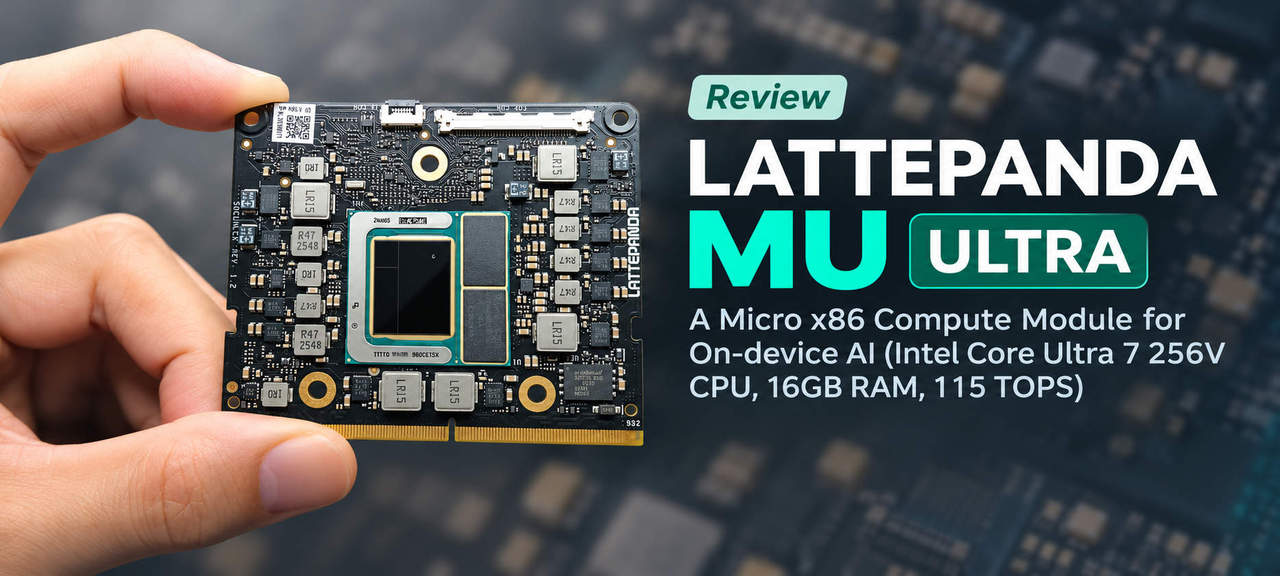
LattePanda Mu Ultra Review – An Intel Core Ultra 7 256V AI Compute Module tested on Ubuntu 26.04 Today, I’m going to review the LattePanda Mu Ultra, a compact x86 compute module designed for on-device AI applications. It comes in two versions, powered by either an Intel Core Ultra 5 226V or a Core Ultra 7 256V processor. Both models feature 16 GB of high-speed LPDDR5X memory running at 8533 MT/s, with the higher-end model delivering up to 115 TOPS of combined AI computing power. In this review, I installed Ubuntu 26.04 and benchmarked the LattePanda Mu Ultra using various tools, including sbc-bench, Geekbench 7, and Geekbench AI. I also tested its CPU, GPU, and NPU performance with llama.cpp and YOLO26 to evaluate its capabilities for AI applications. Finally, I created a fun demo combining YOLO26, MediaPipe, and OpenCV to test real-time computer vision performance, including hand gesture-based image adjustments, using a USB webcam. LattePanda Mu Ultra unboxing The package was shipped from China and arrived in just [...] The post LattePanda Mu Ultra Review – An Intel Core Ultra 7 256V AI Compute Module tested on Ubuntu 26.04 appeared first on CNX Software - Embedded Systems News. image #intelcore #coreultra #computemodule #ubuntu #lattepanda #review #tested #geekbench #tops #gpu #rss #feeds #linksharing #qwibbit
ArduinoWire's avatar
ArduinoWire 1 week ago
1.3 million Google-certified Android TV boxes found to have malware You might assume that a Google-certified Android TV box will both work better and guarantee no malware. However, you’d be wrong, at least for the latter. Google has just published a new Threat Intelligence report entitled “Shutting the Door on the XCPE Botnet”, where they found that 1.3 million TV boxes were infected by the XCPE backdoor, enrolling them into a botnet used for financial gains. Google assesses with high confidence that the malware was intentionally developed, deployed, and operated by Videostrong Technology, a TV box manufacturer, which we frequently covered in the past when Android TV boxes were still somewhat a novelty and at times usable as an alternative to SBCs running Linux. Videostrong apparently monetized the backdoor by allowing affiliates to load malware modules onto infected devices to run ad-fraud schemes, enroll the TV boxes in residential proxy networks, and so on. Google took legal action to disrupt [...] The post 1.3 million Google-certified Android TV boxes found to have malware appeared first on CNX Software - Embedded Systems News. image #android #million #malware #found #google #threatintelligence #xcpe #xcpebotnet #videostrongtechnology #linux #rss #feeds #linksharing #qwibbit
ArduinoWire's avatar
ArduinoWire 1 week ago
ZOTAC ZBOX CI471 nano fanless mini PC features Intel Core 7 350, WiFi 7, and dual Thunderbolt 4 ZOTAC has introduced the ZBOX CI471 nano, a fanless mini PC powered by an Intel Core 7 350 hexa-core Wildcat Lake processor with integrated Xe3 graphics and a 17 TOPS NPU. The company has also introduced two lower-end models, the ZBOX CI451 nano with a Core 5 320 processor and the ZBOX CI431 nano with a Core 3 304 processor. All three mini PCs use passive cooling and share the same 204 × 129 × 68 mm enclosure. They support up to 64GB DDR5 memory, M.2 NVMe SSD storage, and three 4K displays. Other features include dual Thunderbolt 4, 2.5GbE networking, and WiFi 7 and Bluetooth 5.4 wireless connectivity. The systems are offered as barebones, meaning users must install their own memory and storage. ZOTAC ZBOX CI471/CI451/CI431 nano specifications: SoC – Intel Core Series 3 “Wildcat Lake” processors ZBOX CI471 nano – Intel Core 7 350 CPU – 6-core (2x [...] The post ZOTAC ZBOX CI471 nano fanless mini PC features Intel Core 7 350, WiFi 7, and dual Thunderbolt 4 appeared first on CNX Software - Embedded Systems News. image #zotaczbox #intelcore #dualthunderbolt #nano #fanlessmini #wildcatlake #coreseries #wifi #npu #cpu #rss #feeds #linksharing #qwibbit
ArduinoWire's avatar
ArduinoWire 2 weeks ago
Nordic Semi nRF71 wireless chips to deliver 20 times lower standby power for battery-operated WiFi devices Nordic Semi has just announced the nRF71 Series of ultra-low-power SoCs with ultra-low-power Wi-Fi 6, Bluetooth Low Energy (LE), and Thread connectivity, as well as an Axon NPU for edge AI workloads. The company claims the new chips, starting with the dual-band nRF7120 and tri-band nRF7120E, deliver up to 20 times lower standby power usage than current-generation nRF70 Series Wi-Fi products. This should allow nRF71 devices to run for years on battery, whether they use BLE, Thread, or Wi-Fi, for Smart Home, wearables, and industrial IoT applications. Nordic Semi nRF7120/nRF7120E specifications: MCU cores Arm Cortex-M33 @ up to 256 MHz RISC-V coprocessor @ up to 256 MHz with support for SoftPeripherals (CAN 2.0B, SDIO) Memory – 1 MB on-chip, user-accessible low-leakage RAM Storage – 4 MB on-chip NVM AI accelerator – Axon NPU (nRF7120E only) Wireless Wi-Fi Wi-Fi 6 (802.11ax), backward compatible with 802.11a/b/g/n/ac nRF7120 – Dual-band Wi-Fi 6 at [...] The post Nordic Semi nRF71 wireless chips to deliver 20 times lower standby power for battery-operated WiFi devices appeared first on CNX Software - Embedded Systems News. image #nordicsemi #timeslower #lowerstandby #standbypower #axonnpu #bluetoothlow #chips #deliver #devices #series #rss #feeds #linksharing #qwibbit
ArduinoWire's avatar
ArduinoWire 2 weeks ago
Seeed Studio launches 4.26” Mono and 7.3” Color e-Paper kits preloaded with OpenDisplay firmware Seeed Studio has launched two Nordic nRF52840-based Bluetooth LE e-paper kits preloaded with the OpenDisplay open-source firmware for e-paper displays and supporting Home Assistant integration. The OpenDisplay 4.26″ Mono features a 4.26-inch monochrome/grayscale display with 800×480 resolution and partial refresh support, while the OpenDisplay 7.3″ Color Kit is equipped with a 7.3-inch Spectra 6 color e-paper with the same resolution. Both are powered by a 2,000 mAh battery and feature a few buttons for control and reset. Seeed Studio OpenDisplay kits specifications: MCU – Nordic Semi nRF52840 CPU – Arm Cortex-M4F microcontroller @ up to 64 MHz Memory – 256 KB SRAM Storage – 1 MB flash Wireless – Bluetooth LE 5.0, NFC, 802.15.4 connectivity Display OpenDisplay 4.26″ Mono Kit 4.26-inch monochrome ePaper Black and white (default); optional 4-gray mode Partial Refresh – Supported in black-and-white mode only Resolution – 800 × 480 Controller – Seeed XIAO EN05 driver board [...] The post Seeed Studio launches 4.26” Mono and 7.3” Color e-Paper kits preloaded with OpenDisplay firmware appeared first on CNX Software - Embedded Systems News. image #seeedstudio #kitspreloaded #color #mono #opendisplay #homeassistant #partialrefresh #firmware #bluetooth #nordicsemi #rss #feeds #linksharing #qwibbit
ArduinoWire's avatar
ArduinoWire 2 weeks ago
When will this stop? The Raspberry Pi 5 16GB SBC now sells for $385 Raspberry Pi has announced yet another price increase, this time for most models with 16GB of RAM. The Raspberry Pi 5 16GB now sells for $385, an $80 increase compared to the last price hike in April, and the Raspberry Pi CM5 system-on-module gets a $40 increase, starting at $375 for the Lite model without wireless. The “good news” is that the Raspberry Pi 500+ mechanical keyboard PC stays at the same price, starting at $410. I suppose they can afford it on that model, because it’s already richly priced and the demand must be lower than for single board computers and compute modules. Here’s the updated price list for the Compute Module 5 16GB variants. Interestingly, the price is the same whether we get 32GB or 64GB eMMC flash. I still remember people complaining about the $120 launch price of the Raspberry Pi 5 16GB. That was less than [...] The post When will this stop? The Raspberry Pi 5 16GB SBC now sells for $385 appeared first on CNX Software - Embedded Systems News. image #raspberry #compute #ram #april #lite #rss #feeds #linksharing #qwibbit
ArduinoWire's avatar
ArduinoWire 2 weeks ago
Banana Pi BPI-M8 – An Allwinner A733 SBC inspired by the Raspberry Pi 5 with PCIe FFC connector, UFS module socket Banana Pi BPI-M8 is a credit card-sized SBC powered by an Allwinner A733 octa-core Cortex-A76/A55 SoC that aims to offer an alternative to the Raspberry Pi 5. The BPI-M8 comes with 4GB LPDDR5, HDMI and MIPI DSI display interfaces, two MIPI CSI camera interfaces, Gigabit Ethernet, on-board WiFi 6 and Bluetooth 5.0, four USB ports, a 16-pin FFC PCIe connector, and the usual 40-pin GPIO header. Two variants are offered: the BPI-M8A with 64GB eMMC flash, and the BPI-M8B with 16MB SPI NOR flash. Banana Pi BPI-M8 specifications: SoC – Allwinner A733 CPU Dual-core Arm Cortex-A76 @ up to 2.00 GHz Hexa-core Arm Cortex-A55 @ up to 1.80 GHz Single-core RISC-V E902 real-time core GPU – Imagination Technologies BXM-4-64 MC1 GPU with support for OpenGL ES 3.2, Vulkan 1.3, and OpenCL 3.0 VPU 4Kp60/8Kp24 H.265/VP9/AVS2 decoding, 4Kp30 H.264 decoding 4Kp30 H.265/H.264 encoding AI accelerator – 3 TOPS NPU Process – 12 [...] The post Banana Pi BPI-M8 – An Allwinner A733 SBC inspired by the Raspberry Pi 5 with PCIe FFC connector, UFS module socket appeared first on CNX Software - Embedded Systems News. image #pcieffc #allwinner #raspberry #banana #ufs #sbc #gigabitethernet #imaginationtechnologies #arm #npuprocess #rss #feeds #linksharing #qwibbit
ArduinoWire's avatar
ArduinoWire 2 weeks ago
TOOCAA NOVA Review – 20W laser engraver with AI camera, autofocus & rotary module TOOCAA NOVA is a desktop laser cutter and engraver that combines creative functions in a compact body. It comes with a translucent orange cover and an A4 work area of 297 × 210 mm, suitable for making signs, decorations, personalized gifts, and DIY projects. The reviewed model uses a 20W diode laser module for cutting and engraving, and supports materials such as wood, paper, leather, and coated aluminum. The machine’s highlight is its 5MP AI camera, which displays an image of the material inside the machine in the software, making it easier to align designs with the desired position. It also has an autofocus system that automatically adjusts focus distance and a material card-reading function that helps you select operating settings. It works with TOOCAA Studio to design, import images, and set up jobs including line engraving, fill engraving, and cutting, and connects to the machine via USB or Wi-Fi. [...] The post TOOCAA NOVA Review – 20W laser engraver with AI camera, autofocus & rotary module appeared first on CNX Software - Embedded Systems News. image #novareview #toocaanova #camera #toocaastudio #laser #module #autofocus #diy #usb #ai #rss #feeds #linksharing #qwibbit
ArduinoWire's avatar
ArduinoWire 2 weeks ago
Brainchip AKD1500 Raspberry Pi 5 Dev Kit enables users to quickly experiment with event-based neuromorphic AI A few weeks ago, we noted that the Brainchip AKD1500 M.2 module could work with the Raspberry Pi 5 using a compatible M.2 HAT+ expansion card to evaluate the solution or develop applications using the company’s low-power, low-latency neuromorphic AI technology. To make things even easier, they’ve now introduced the AKD1500 Raspberry Pi 5 Dev Kit that packs a Raspberry Pi 5 8GB, an official M.2 HAT+, and an Akida AKD1500 M.2 B+M-Key card into a metal case. Most ports from the Raspberry Pi 5 are exposed, namely the Gigabit Ethernet port, the four USB connectors, the two HDMI video outputs, and the USB-C port for power. The Raspberry Pi 5 power button and an LED on the M.2 HAT+ are also visible through openings in the metal case. The kit requires a camera for operation, but instead of relying on a MIPI CSI-based Raspberry Pi Camera module, users are [...] The post Brainchip AKD1500 Raspberry Pi 5 Dev Kit enables users to quickly experiment with event-based neuromorphic AI appeared first on CNX Software - Embedded Systems News. image #devkit #raspberry #hat #brainchip #neuromorphic #users #gigabitethernet #camera #ai #rss #feeds #linksharing #qwibbit
ArduinoWire's avatar
ArduinoWire 2 weeks ago
BIOSTAR EdgeComp MS-U320 fanless Wildcat Lake industrial mini PC offers four COM ports, dual 2.5GbE, 4G/5G expansion BIOSTAR EdgeComp MS-U320 is a fanless industrial mini PC powered by an Intel Core 3 304 or Core 5 320 Wildcat Lake SoC with four COM ports, dual 2.5GbE, and 4G/5G cellular connectivity expansion. The mini PC supports up to 64GB DDR5, M.2 NVMe SSD storage, features 4K-capable HDMI 2.1 and DisplayPort 1.4 connectors, earphone and microphone jacks, and six USB ports. It supports a wide 9-24V DC input and can operate in the -20°C to +50°C temperature range for industrial automation, smart manufacturing, industrial IoT, smart retail, and smart infrastructure. BIOSTAR EdgeComp MS-U320 specifications: Wildcat Lake SoC Intel Core 3 304 5-core CPU – 1x P-cores @ 1.5/4.3 GHz (Turbo) + 4x LPE-cores @ 1.4/3.3 GHz (Turbo) GPU – 1-core Intel Xe3 Graphics @ 2.3 GHz (9 TOPS) NPU – 15 TOPS Intel Core 5 320 6-core CPU – 2x P-cores @ 1.5/4.6 GHz (Turbo) + 4x LPE-cores @ [...] The post BIOSTAR EdgeComp MS-U320 fanless Wildcat Lake industrial mini PC offers four COM ports, dual 2.5GbE, 4G/5G expansion appeared first on CNX Software - Embedded Systems News. image #biostaredgecomp #wildcatlake #comports #fourcom #intelcore #industrialmini #dual #turbo #ghz #expansion #rss #feeds #linksharing #qwibbit
ArduinoWire's avatar
ArduinoWire 2 weeks ago
Arduino UNO Q gets a 10.1-inch touch display with integrated speakers, audio jacks, camera connectors Waveshare UNO-Q-DSI-TOUCH-10.1A is a 10.1-inch touchscreen display designed for the Arduino UNO Q single board computer. The Arduino UNO Q exposes its MIPI DSI interface through the 60-pin JMEDIA and JMISC headers, and for all practical purposes, you normally need a board like the Arduino UNO Media Carrier to make use of it. The UNO-Q-DSI-TOUCH-10.1A display solves that by integrating the headers so users can simply insert the Arduino UNO Q into it without an additional adapter board or special wiring. Waveshare UNO-Q-DSI-TOUCH-10.1A specifications: Screen Size – 10.1-inch Panel type – IPS panel Native Resolution – 1280 x 800 Refresh Rate – 60 Hz Colors – 16.7 millions Viewing Angle – 178° Brightness – 300 cd/m² Contrast Ratio – 800:1 Response Time – 35 ms Multi-touch support Capacitive multi-touch (we’re told the actual number of touch points somehow depends on the software system) Interface I2C Tempered glass, optical bonding Camera [...] The post Arduino UNO Q gets a 10.1-inch touch display with integrated speakers, audio jacks, camera connectors appeared first on CNX Software - Embedded Systems News. image #arduinouno #unomedia #camera #touch #mediacarrier #contrastratio #refreshrate #screensize #nativeresolution #responsetime #rss #feeds #linksharing #qwibbit
↑