Bringin | The Complete ₿itcoin App's avatar
Bringin | The Complete ₿itcoin App
npub1krve...d3py
Bringin the Standard to 🇪🇺 From your stack to your supermarket - spend, stack & settle Bitcoin at ⚡ speed. Lightning • Self-Custody • NWC • IBAN • Cards.
Bringin | The Complete ₿itcoin App's avatar
Bringin 7 hours ago
Running business operations on bitcoin in Europe: the problems, and how Bringin Business Wallet solves them. 👇🏻 View quoted note →
Bringin | The Complete ₿itcoin App's avatar
Bringin 2 days ago
Introducing Bringin Business Wallet. Self-custody accounts EU businesses can actually run on. Pay suppliers, run payroll and receive payments without the hassle of the Travel Rule, with conversion between bitcoin and euros built in. How it works ↓
Bringin | The Complete ₿itcoin App's avatar
Bringin 3 days ago
ICYMI: If you're a business considering Bitcoin payments or curious about wallet security in AI-era, our upcoming community call is worth attending! Join us for engaging discussions and LIVE Q&A. 🗓️: Nov 25, 4PM CET RSVP: View quoted note →
Bringin | The Complete ₿itcoin App's avatar
Bringin 4 days ago
Bitcoin fell 27% in a month, a yearly low! But does timing actually matter? Calling the bottom is notoriously difficult, so rather than trying, it’s more useful to look at how a consistent strategy holds up in the worst case. Buying the exact top In November 2021, Bitcoin reached the peak of its last cycle. Over the following year, it fell 74%. Consider two strategies, both starting on the day of the peak with €6,000. The first strategy invests the full amount at once. Five years later, it is down about 9%. The second strategy invests €100 every month, from November 2021 to October 2026. That’s 60 purchases and the same €6,000 in total. Today it is worth about €8,070, up 34%. Same capital, same starting point, two strategies, very different outcomes. Why the second strategy worked Dollar-cost averaging works through the average purchase price. Buying through the 2022 bear market at lower prices brought the average cost down significantly. Starting at the peak, the DCA strategy ended up paying about a third less per bitcoin than the price it started at. The bear market, the worst outcome for the lump-sum strategy, became the most productive buying period for the DCA strategy. What DCA doesn’t do DCA doesn’t guarantee a profit. If the price falls and stays down, a regular buyer still loses money. In steadily rising markets, a lump-sum strategy has often come out ahead. What DCA does is remove timing from the decision. A poor entry point matters less, and volatility works in the strategy’s favour rather than against it. The hard part is consistency The strategy is simple. Sticking to it is not. Each month means logging into an exchange, transferring funds, placing the order and withdrawing to your own wallet. Skip a month because the news looks bad, and the strategy breaks down at exactly the moment it matters most. That’s the part worth automating. DCA with Bringin, set up once With Bringin Connect, your bank and your Bitcoin wallet are linked directly: Set up a monthly standing order from your bank to your Bringin IBAN. Each payment buys bitcoin automatically and sends it straight to your own wallet. There’s no exchange account and no monthly order to place. Your bank sees a regular euro transfer, and your bitcoin lands in a wallet where you hold the keys. Set it up once, and the strategy runs on its own. For the next 3 months, half the fees on every purchase (made with buy connections) are returned in euros to your Bringin account. It applies automatically, with no separate opt-in required. Use the code BUYTHEDIP if you are a new user to avail 50% fees back until 18 February P.S - This is educational content, not investment advice. Bitcoin’s price is volatile and can keep falling. Past performance is not a reliable indicator of future results. Only invest what you can afford to lose. image
Bringin | The Complete ₿itcoin App's avatar
Bringin 1 week ago
Hyperbitcoinization, one Currywurst at a time.
Bringin | The Complete ₿itcoin App's avatar
Bringin 1 week ago
A common misreading: the Travel Rule only applies above €1,000. In the EU, there is no minimum. If your customers pay into a custodial account, the provider must collect their details on every payment, even a €3 coffee. Above €1,000, it must also verify that the customer owns the wallet they paid from. Neither is practical at a checkout. Bringin Business takes a self-custody-first approach: customers pay straight into your own wallet, with no provider in between asking who they are. If your business accepts Bitcoin, or plans to, join the waitlist: View quoted note →
Bringin | The Complete ₿itcoin App's avatar
Bringin 1 week ago
Business Wallets & AI-Era Security In the upcoming community call we discuss how AI made phishing cheap, Bringin Business Wallet for companies operating with Bitcoin, and why your keys should never leave your device. 🗓️ Nov 25 · 4PM CET RSVP: image
Bringin | The Complete ₿itcoin App's avatar
Bringin 1 week ago
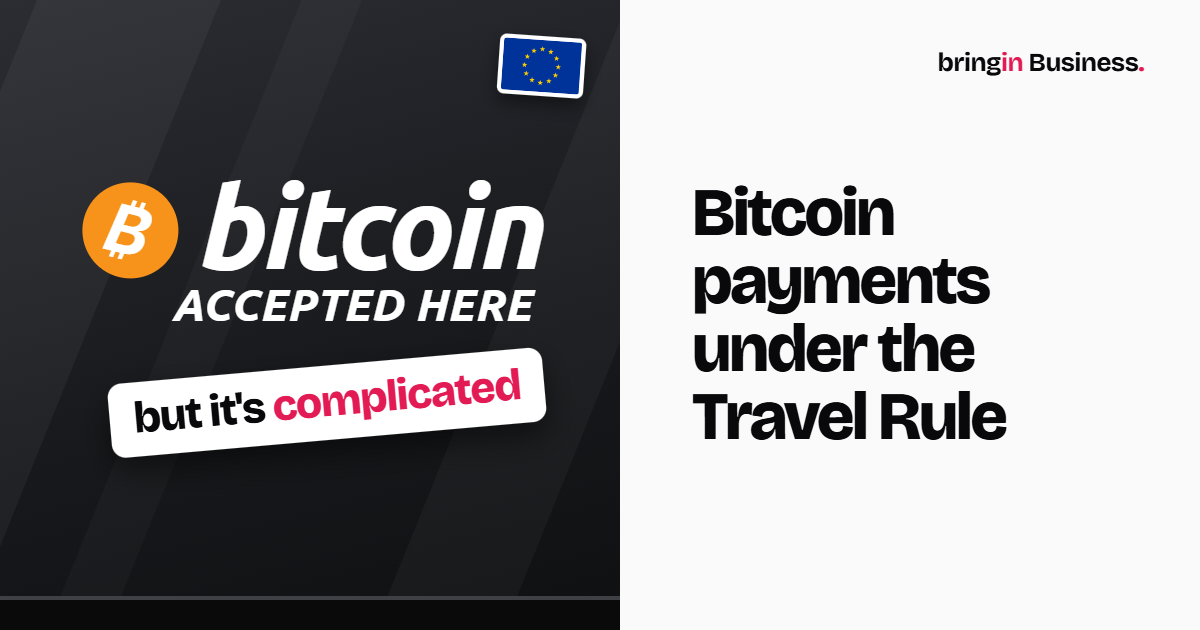
“Bitcoin accepted here.” got complicated for EU businesses this year. Imagine buying a loaf of bread and being asked for your name and where you live. That is how @Prashanth , founder of Bringin, describes accepting Bitcoin in Europe today. It isn’t an exaggeration. For a business taking Bitcoin through a custodial processor, it is a realistic checkout. Since 1 July 2026, accepting Bitcoin in Europe works differently for many businesses. A customer paying for a coffee can be asked for their name and country of residence before the payment clears This post explains how the Travel Rule reached the checkout, and how to accept Bitcoin without it. ━━━━━━━━━━ WHAT THE TRAVEL RULE DOES The EU’s Transfer of Funds Regulation has applied to crypto-asset transfers since 30 December 2024. It requires providers to attach information about the sender and recipient to every transfer. Two details matter: THERE IS NO MINIMUM The threshold for identity data between providers is €0. A €3 payment carries the same obligation as a €3 million one. IT BINDS PROVIDERS, NOT MERCHANTS Exchanges, custodial wallets and payment processors are regulated. The shop, consultant or online store accepting the payment is not. Since the MiCA transition ended on 1 July 2026, every provider serving EU clients has to be authorised and is supervised for this. The rules that existed on paper now apply in full. ━━━━━━━━━━ WHERE BUSINESSES FEEL IT If your payments arrive at a custodial provider, its obligations become your checkout experience. YOUR CUSTOMER IS ASKED WHO THEY ARE Your provider must obtain information about the sender. That can mean asking your customer for a name and country of residence. Fine for a B2B invoice. Not for a café. LIGHTNING HITS A €1,000 LIMIT Above €1,000 from a self-custody wallet, a provider must verify who owns the wallet. Lightning payments have no on-chain transaction ID, so many providers send no sender details with them. The receiving provider then treats them as self-custody payments, capped at €1,000 without extra verification. PAYMENTS GET HELD If information is missing, the provider can hold the payment, ask for the data or return it. The customer has paid. You haven’t been paid. One case this year made the point from the other side: someone received a zap to a custodial Lightning address and was asked to declare who had sent it. ━━━━━━━━━━ THE SECOND PROBLEM: GETTING TO EUROS Receiving Bitcoin is half the job. Businesses pay suppliers, salaries and tax in euros. Exchanges pay out from shared corporate accounts, so euros reach your bank from an IBAN that isn’t yours. To a bank, that is third-party funding, and it triggers questions, questionnaires and sometimes closures. One of our early business users put it this way: “Accepting payments from customers in Bitcoin comes easy. The trouble with regular banks comes when you need an off-ramp solution to also use the earned BTC.” ━━━━━━━━━━ WHAT WE BUILT The Travel Rule governs intermediaries. So the fix is to change which intermediaries sit in your payment flow, and where. SELF-CUSTODY FIRST Bitcoin is received into an Operational Wallet the business controls. A customer paying from their own wallet makes a wallet-to-wallet transfer with no provider in between: no details to collect, no €1,000 cap, nothing held. Operational Wallets are built on Turnkey’s secure enclaves, with every signature approved by passkey, a separate treasury, and role-based access so your accountant can see everything and move nothing. A DEDICATED IBAN IN YOUR COMPANY’S NAME When you need euros, Bitcoin moves from your wallet to your Bringin account and is sold. The Travel Rule is handled in the background, because your business is on both sides of the transfer and the wallet’s ownership is proven cryptographically. The euros then reach your bank from an IBAN in your own company’s name. It is not a payout from an exchange. It is a transfer between two accounts your business owns. ━━━━━━━━━━ WHAT THIS DOESN’T DO This is not a way around the Travel Rule or AML law. Where funds pass through a regulated provider, including Bringin, the rules apply in full. Your bank may still ask about larger transfers. What changes is where the regulated steps happen: between accounts you own, instead of at your customer’s checkout. The euro account and exchange are live today. Operational Wallets are rolling out to pilot businesses now. ━━━━━━━━━━ If your business accepts Bitcoin in Europe and has had a payment held, a customer asked for ID, or a Lightning limit hit, reply or DM. We want to hear how it shows up for you. The full article on the Travel Rule: Bringin Business is open, apply for access: image
Bringin | The Complete ₿itcoin App's avatar
Bringin 1 week ago
One account for all your Bitcoin needs. image
Bringin | The Complete ₿itcoin App's avatar
Bringin 1 month ago
Get paid in Bitcoin, Run your business in euros. With Bringin Business. ⚡️ image
Bringin | The Complete ₿itcoin App's avatar
Bringin 4 months ago
Bringin X @npub155m2...dcvg is a game changer for businesses in Europe. Self-custody isn't the hard part of Bitcoin payments. Auto-converting to euros without handing someone your keys is. Bringin fixes this gap. ⚡️ View quoted note →
Bringin | The Complete ₿itcoin App's avatar
Bringin 4 months ago
BTC from your Noah wallet ( @Second ) 👉🏻 EUR in your Revolut account with a Bringin lightning address in a jiffy! ⚡️
Bringin | The Complete ₿itcoin App's avatar
Bringin 4 months ago
Building, shipping, and letting the community do the talking is how Bringin has grown so far. ⚡️
Bringin | The Complete ₿itcoin App's avatar
Bringin 4 months ago
In our recent community call, @Prashanth explains Bringin's stance on MiCA and TFR 🔸 Our banking partner secured a CASP license - zero disruption to user experience 🔸 Also got an EMI license (same class as Revolut) 🔸 Travel rule now applies when buying/selling BTC We carry on with the clear mission of making Bitcoin to feel like and to be used as everyday money.
Bringin | The Complete ₿itcoin App's avatar
Bringin 4 months ago
Community Call #2 just wrapped 🎙️ We covered the new EU regulations, demoed how Auto Declaration feature works in the app, and shared what's next for Bringin. Highlights: 🔸Auto Declaration feature auto-clears sub-€1,000 transfers so the Bringin experience stays fast. ⚡ 🔸MiCA & the Travel Rule (live since July 1st) - self-custody stays outside it. 🔸Under €1,000, self-declare; over €1,000, verify (face scan or key signature). --- What's coming: 👉🏻Bringin for Business (corporate virtual IBANs, later this year) 👉🏻Hardware wallet support (Ledger, Trezor) 👉🏻Full Estonian IBANs, and 👉🏻Unilateral exits on Spark. --- Bringin Private for high-volume clients who want hands-on support. 🙌🏻 Here's a success story we're proud of: --- ICYMI, here's the recording of the second community call:
↑