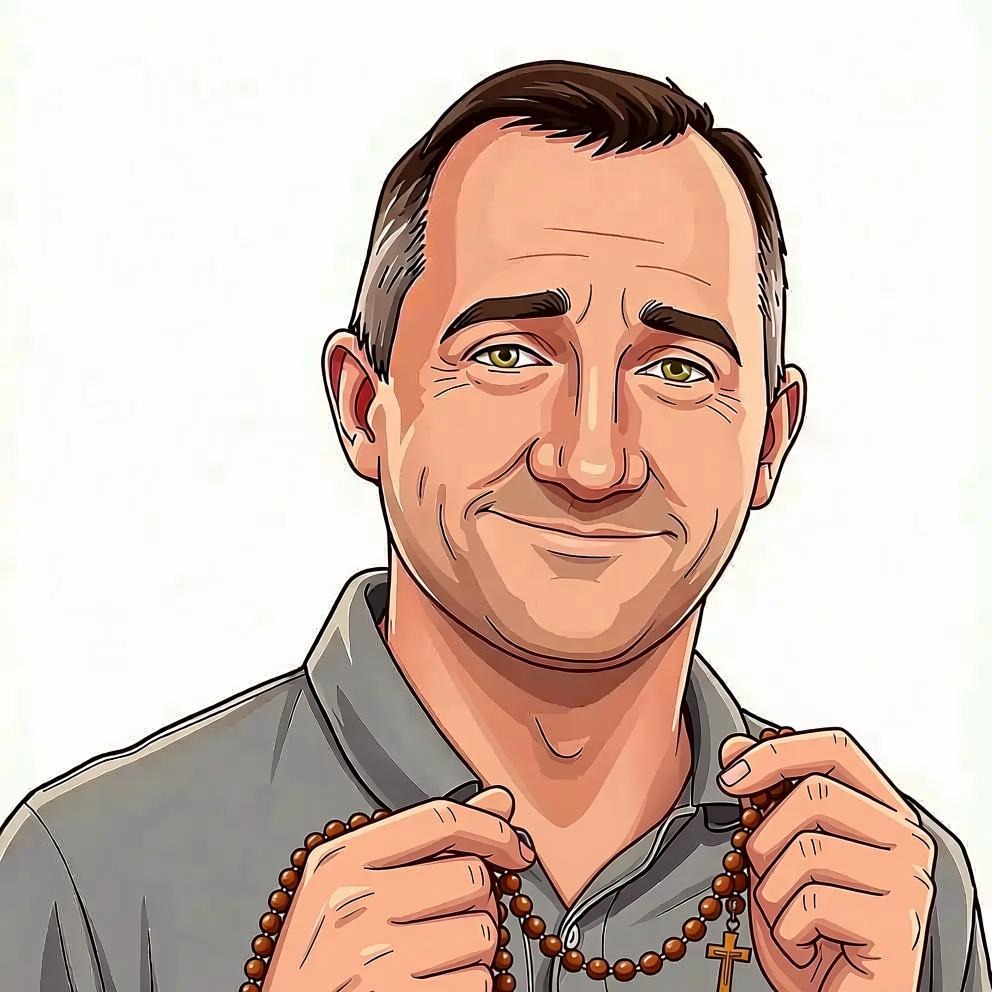
The COG Catholic's avatar
The COG Catholic
COGCatholic@nostr.ly
npub1f3e4...8zls
⛪ Tradition-minded, #Bible -believing #Catholic - #Christian convert | #TLM | Former member of #COG ("Church of God" -- a.k.a. Armstrongism)
When I die, I hope it happens with a rosary in my hands -- and with a bead indentation in the pad of my thumb.
PUNISHMENT IN PURGATORY I was misled by Catholic Answers for years on a certain point. I explained purgatory to others the way I heard it explained by CA's Jimmy Akin and others. He emphasizes that purgatory, whatever it involves, is meant to remedy any attachments we may still have toward sin at the end of our life. So if at that time we still have inclinations toward vice (selfishness or vainglory, for example), purgatory will clean us up so we are detached from all that. Thus it will prepare us for heaven. I liked the explanation -- and it's not untrue -- but it always felt insufficient. Why? Because if someone is a rotten evil-doer with a laundry list of practiced and deep-seated vices, but then repents on his deathbed, and is baptized right before he dies (and without Confession!), he bypasses purgatory and goes straight to heaven! I would ask learned Catholic people, such as Mark Shea years ago for sure, but then other better, more reputable modern Catholic apologists and "influencers" -- and no one could answer my question: "Doesn't the creepo who was baptized moments before death have more attachments and proclivities to sin than someone who's been trying to live a Christian life for years but still dies with sinful imperfections? After all, baptism does not eradicate our concupiscence. Why, then, wouldn't the creep need purgatory to purify himself before entering heaven?" The answer is that, in God's generosity, baptism wipes away both eternal and temporal consequences of sin. As long as you're not in mortal sin, then just being in God's presence after death can instantly purify your attachments to sin. But sins committed and confessed after baptism are not necessarily always forgiven the temporal consequences. They can be, but not always. Usually not, probably. Even though modern Christian ears don't like to hear it, purgatory involves actual punishment from God. Not in a bad or mean way, but in a loving way, in the name of holy justice. When Jesus saves us, but then we return to our sinful vomit, that's quite grievous after all he's done for us. It is ingratitude to say the least. Whatever the nature of these purgatorial punishments, such as delayed entry into heaven (which would be agonizing because we will long to be with him then more than ever), it serves justice. God is not mocked. And we will understand that and not protest, but will suffer what is due to us. But even so, other people's prayers of intercession can diminish our due punishments in purgatory, highlighting God's mercy. It's all so beautifully merciful and just. So what I'm saying is, we should have a certain kind of dread of purgatory. It's better to aim at satisfying our temporal punishments now in this life through joining our suffering to Christ (less painful here than in purgatory), but also through taking advantage of indulgences. While dreading the prospect of purgatory, we can also thank God for the mercy that comes through purgatory. All souls there are guaranteed heaven, though we don't deserve it. God is love. Pray for assistance. Pray for others. Holy Mary, Mother of God, pray for us sinners -- now and at the hour of our death!
I was at an open-casket funeral visitation a couple weeks ago. The dead look so dead. Almost fake. A shell. Nothing at all like a sleeping person or someone holding his breath with his eyes closed. The dead look just like the classic definition of death: the separation of body and soul. Its truth is evident. We can see that the body will decompose. But what we can't see is the immortal soul -- which has no properties lending itself to decomposition. Remember: In this life, your soul is what you should be focusing on most. The state of your soul -- not your body -- determines your eternal fate. Be humble and stack spiritual sats. Be joined to Christ.
I came across someone online who, *not joking*, wrote: "You can not tell someone else how to live their life without their consent." 😂
Many conservative and traditionally minded Catholics agree with SSPX's solidly Catholic doctrinal beliefs, and agree there is a serious crisis in the Church, but disagree only with their decision to disobey regarding the upcoming consecrations. Speculating out loud... I wonder if all the kerfuffle coming from the consecrations and their disciplinary consequences will end up directly affecting those of us who are not affiliated with the #SSPX. Will we face intimidation for sharing the Society's core Catholic beliefs? Will we be lumped in with SSPX even if we don't go to their chapels? If we promote the traditional Mass, if we reject certain innovations, if we reject the blessing of same-sex couples, if we reject Pachamama and environmentalism, if we reject ecumenism and the fraternalism of man, if we reject all things fake and gay -- will we remain in the good graces of those in power? Will they continue to "accompany" us on our "faith journey"? Or will we be seen as taking the side of the "schismatics" simply for believing in historic Catholic teaching? I don't plan to be intimidated or to buckle however things play out. May it be so. I plan to stay under the protection of the mantle of our Holy Mother, and to hold to the Faith once delivered to the saints.
🧎‍♂️‍➡️KNEELING FOR COMMUNION🧎‍♂️ We genuflect toward the tabernacle before we sit at our pew. And also when we leave. We kneel at the pew during Mass to pray (hopefully before and after, too). We kneel during the Consecration, and the priest genuflects after the miracle of transubstantiation takes place. *** So why does the thought of kneeling to receive Holy Communion on the tongue feel weird? *** To hell with committee-approved national "norms." Shouldn't it feel weird instead to consume the Host while standing and from your own hands -- as if it were just a snack cracker, a Jeez-It? If it's not embarrassing to kneel at other times, but only at the thought of keeling to receive Him, then something is off. There's a disconnect in what you profess to believe and what you do. If you believe Jesus is 12 inches from your face, then act like it: KNEEL! Do it one time -- or maybe twice, or for sure three times -- and then, I promise, you'll feel weird going back to standing and receiving him in the hand. It hit me one time when I was at a retreat in Buffalo, MN, years ago. It ended up being a very liberal retreat house, so I left the campus to go to the local church that Sunday morning, and I saw a 20-year-old kneel to receive Communion. I cried. Moved, I thanked the kid after Mass for his example. At that instant I knew I'd never again receive on my feet and in my hand for as long as my knees could bend. To do otherwise is unthinkable. Why? Because we believe as we worship. And we worship as we believe.
WHY WOULD YOU NOT PRAY THE HAIL MARY? To those who think it's wrong to pray the Hail Mary prayer, I'd like you to try something -- even if you don't share it with anyone here. Articulate a complete one- or two-sentence answer to the question: Why is it wrong to pray the following? "Hail, Mary, Full of Grace. The Lord is with thee. Blessed art thou among women, and blessed is the fruit of thy womb, Jesus. Holy Mary, Mother of God, pray for us sinners now and at the hour of our death. Amen." And in your answer, if applicable, avoid using the word "prayer" -- use a synonym instead or other words to express what you mean.
There are times when I get frustrated with the state of things in the Catholic Church, though my frustration in the human element of the Church in no way makes me lose faith in the divine element. In the Big Picture, I'm at perfect peace. Lest any Prots or nondenoms question why we remain Catholics despite our challenges, they should know their own religious communities, without exception, are far worse off in principle.
I should obey my pastor and bishop. But my local parishes have an "LGBTQ Catholics" meeting every month. Until I jumped on their case, they would advertise these meetings on their official Facebook page with an image of a Catholic altar draped with a rainbow altar cloth. (They still advertise, but no longer with that particular blasphemous image.) It is right that I openly oppose this filth, even though it's officially sanctioned by our local pastors and presumably our bishop (who elsewhere made provisions for trans-friendly bathrooms in Catholic buildings/schools). I am complicit and not excused if I think, "Well they have the authority to do such things. God will work it out. I won't say or do anything to contradict or disobey them. That wouldn't be the Christian spirit; that would be a Protestant or schismatic mindset. " Holy obedience is a virtue, but obedience can also be weaponized and distorted by evil men to become disobedience to a higher Authority. We have to ask WWJD? If we love Jesus and his Church, what should WE do? Be Catholic. Stay Catholic.
Not to ruffle feathers, but to provide a service to those interested, here is a "debate" from a few days ago between an SSPX priest and Fr. Gerald Murray (of EWTN/Arroyo fame) about the current issues surrounding the #SSPX. It's actually two separate interviews conducted by the head of TAN Books, edited together. Both were asked the same questions. Very fair, very informative. You'll like it no matter which "side" you fall on. Makes you think. Oh, and it's 4 hours long.
As my parents age and falter, chapter 3 of the book of Sirach is more meaningful than ever: === Do not glorify yourself by dishonoring your father, for your father’s dishonor is no glory to you. For a man’s glory comes from honoring his father, and it is a disgrace for children not to respect their mother. O son, help your father in his old age, and do not grieve him as long as he lives; even if he is lacking in understanding, show forbearance; in all your strength do not despise him. For kindness to a father will not be forgotten, and against your sins it will be credited to you; in the day of your affliction it will be remembered in your favor; as frost in fair weather, your sins will melt away.
While trying to live a Christian life before I was Catholic, I would still fall into grave sin, freely and knowingly. I don't think I'm an isolated case. But wishing to repent, I couldn't always manufacture a perfect contrition for it. I didn't always have the gift of tears following every time I might have committed a "solitary sin, " or wished evil on someone, or let pride or anger get the best of me. So I would always wonder, "Did I repent hard enough, sincerely enough? Is my repentance genuine, and did it arise from pure motives, or am I only afraid of the consequences?" One beautiful thing about being Catholic is having recourse to the sacrament of Confession. Sure, we want to have perfect contrition, but for various reasons it doesn't always happen. In the context of Confession, the minimum requirements to be absolved of any sin are to confess it, to have some sorrow (even if imperfect), and to intend not to repeat the sin -- even if you know statistically it's likely to happen again. You just can't be planning on it. You have to try. This is how generous God's love and mercy is toward us. Over time, of course, the idea is to grow up and to not just be stuck in a cycle of continuously hopping on and off the road to final salvation, but to stay on the road and make spiritual progress. We have so many helps -- the sacraments, the intercession of the saints, the rosary, Sacred Scripture, right teaching with Tradition and the Magisterium -- I wonder, how can anyone else be saved? Protestants may have valid baptisms, but to maintain and confirm that baptismal grace to full maturation throughout life would be overwhelmingly difficult without the right tools for the job. In our lives and words, we need to try to save other souls, to reach out so they, too, can climb aboard the ark of salvation.
When you think about something, where is that thought? Is it contained within the boundaries of your skull? Does it have location? GPS coordinates? Can you reach out and touch it? No. Similarly, God and angels and even your own soul are not hanging out in space somewhere -- because they don't belong to the physical realm. They don't reside in or take up space at all. They are spirit -- a completely different category of being. But we speak of them as present wherever they act within the natural world. That's how God can be "present" everywhere, and how angels can help you instantly (without having to travel billions of light years first to reach you). And when they are present with you, they are as close to you as your soul is to your body.
Why do Jehovah's Witnesses, nondenominationals, and various Protestant groups have sooo many ex-Catholics counted among them? Consider this: It's NOT because these groups are ecumenical, afraid to be blunt and direct, welcoming to sodomy, or indifferent to important doctrinal divisions. Catholics and ex-Catholics need to be told the straight truth about Catholic doctrine --- with clarity -- and so do Protestant sects and cults. Stand straight and be not afraid. Speak truth and let the Spirit do his work.