Surprising Revival: Gen Z Men & Highly Educated Lead Return To Religion
Surprising Revival: Gen Z Men & Highly Educated Lead Return To Religion

RealClearWire
Surprising Revival: Gen Z Men & Highly Educated Lead Return to Religion
The decline of religion remains a fundamental reality in most Western countries, particularly in Europe, where over 50% of those under age 40 do no...
,
The decline of religion remains a fundamental reality in most Western countries, particularly in

the Guardian
'Christianity as default is gone': the rise of a non-Christian Europe | Christianity | The Guardian
Figures show a majority of young adults in 12 countries have no faith, with Czechs least religious
those outside religious communities, have grown so large that their numbers rival those of Catholics and evangelical Protestants.

Yet, as we document in a new report for the Chapman Center for Demographics and Policy, there are signs that religion is enjoying more than a nascent revival. Data emerging from the 2020s suggest that we are witnessing a complex spiritual restructuring that intersects with economic mobility, demographic resilience, and a profound intellectual realignment.
For the first time in decades, Pew Research notes, in the U.S. at least, Christianity has

Pew Research Center
Decline of Christianity in the U.S. Has Slowed, May Have Leveled Off
After years of decline, the U.S. Christian share now shows signs of leveling off. The new Religious Landscape Study explores trends in identity, be...
as more people begin to see the efficacy, and the rewards, of religious faith and practice.
This fragile development is especially noteworthy as it exposes growing divides and fault lines in American politics and culture. Drawing on a vast array of longitudinal studies, interviews, and other sources, one startling finding in both America and abroad is that, contrary to past assertions, today the faithful are not poor and ignorant but increasingly from the educated upper middle class.
Even the cognitive elites are experiencing a growing trend to embrace religious activity. Indeed, in a rebuke of the aggressive
New Atheists, The | Internet Encyclopedia of Philosophy
of the early 2000s advanced by thought leaders such as Richard Dawkins and Christopher Hitchens, a counter-movement appears to be growing among scientists, philosophers, and public intellectuals who view religious tradition not as a delusion to be eradicated but as a sustainable civilizational operating system.
As our politics splinter along gender – with women increasingly forming the base for Democrats and men, for Republicans – it is men who are leading the return to church. Reversing a 25-year-long trend, men reported higher church attendance than women in 2025. This growing divide may continue to separate men and women, with grave implications at a time when rates of marriage and parenthood are declining.
Even in places where religion continues to decline, the remaining faithful are shifting away from more liberal faiths to those hewing closer to traditional values. For many, more orthodox sects provide existential security and create a sustainable sense of community.
As our report makes clear, the budding religious revival taking place in the U.S. reflects a global trend, especially strong in Africa, which is now the most demographically robust place on the planet.
The implications and promise of this trend cannot be overstated. Data show that religious communities function as potent engines of human capital accumulation, risk mitigation, and social capital. These mechanisms effectively propel adherents up the socioeconomic ladder.
There is considerable evidence that faith is again gaining adherents, even in Europe. Last year, for example, there was a

NCR
Record Number of Adult Baptisms in France Shows Surge Among Youth
France’s Catholic Church will welcome more than 10,384 adult catechumens at Easter this year, marking a 45% increase from 2024 figures, according...
by the Bible Society, the number of 18- to 24-year-olds saying they attended church at least monthly has jumped from 4% in 2018 to 16% today. Among young men, it’s increased 21%. Most of this growth is concentrated among Catholics and Pentecostals; the Bible Society suggests there are now more than 2 million more people attending church than in the last decade.
Spiritual Hunger
In the U.S., there are also signs of spreading <a href="
http://www.pewforum.org/2010/12/16/american-grace-how-religion-divides-and-unites-us/" rel="nofollow">spiritual hunger</a>, according to Pew. Relatively few “nones” identify as either atheist or agnostic but consider themselves spiritual outside organized faith. One recent survey showed
Gen Z Is Returning To Religion. Why? | ZeroHedge
ZeroHedge - On a long enough timeline, the survival rate for everyone drops to zero
.
This is particularly marked

HillFaith
QUICK TAKES: Survey Finds Growing Gen Z, Men Church Attendance, Bible Interest - HillFaith
(QUICK READ) — A recent survey of American churches conducted by the American Bible Society turned up more evidence that there is a spiritual sti...
at rates equal to or higher than their female peers. Many young men report feeling culturally dislocated or villainized by progressive secular discourse regarding masculinity. Traditional forms of Christianity, particularly Catholicism and Orthodoxy, offer a narrative of responsibility, sacrifice, and hierarchy that appeals to men seeking a defined role in a fluid world.
Public intellectuals like

NexGen
Jordan Peterson urges churches to welcome young men
Are you happy to receive good advice, whatever the source?
have played a crucial role in re-enchanting the Bible for a secular male audience. By framing biblical narratives as psychological maps for meaning rather than just metaphysical claims, they create an on-ramp for secular men to enter religious spaces. The internet has further facilitated this through the rise of digital orthodoxy, where the aesthetic of antiquity and rigorous discipline appeals to young men to the spiritual vacuity of modern life.
More surprising may be the nascent
Study examines religious beliefs of scientists - UB Reporter
gained traction for the view casting religion as a dangerous delusion. By 2025, this movement has largely exhausted itself, replaced by nuanced curiosity and, in some cases, a robust defense of religion among the epistemic elite.
Longitudinal research by sociologist
Study examines religious beliefs of scientists - UB Reporter
in eight regions, including the U.S., the U.K., Turkey, India, and Taiwan, reveals that scientists in Taiwan, Hong Kong, and India are often more religious than the general public. They view science and religion as overlapping or independent spheres, not enemies.
This perspective is emerging in the U.S. as well. Although still a distinct minority, younger scientists under the age of 35 are more likely to attend religious services than the older baby boomer cohort, suggesting that the rigid secularism of the academy is softening with the new generation. Even two decades ago, only 15% of scientists considered religion in conflict with science, while 70% did not see that conflict.
There are even signs of a revival in the technological heartland of secular America –
https://www.wsj.com/opinion/silicon-valleys-closet-christians-religious-diversity-startup-culture-tech-faith-google-church-secular-beliefs-atheist-catholic-culture-war-11644510973
has recently become more public in his embrace of Christianity, which he described as “ a religion of curiosity” and “greater enlightenment.”
Membership at

Our Lady of Peace Shrine and Church -
Our Lady of Peace Church and Shrine - Our Lady of Peace Shrine and Church
Our Lady of Peace is a Church and Shrine dedicated to the greater Glory of God and the salvation of souls. It is a place of prayer & pilgrimage wit...
in Santa Clara has risen to more than 3,000 families, according to Father Brian Dinkel, who said the Catholic church hears an estimated 50,000 confessions a year. “People who may be doing well also want something more,” notes Father Dinkel. “Our people work at Google and Apple, but there’s a real search for the truth beyond tech.”
Orthodoxy Flourishing
Even amidst a fledgling religious revival, mainline

The Spectator
religion Archives
Weekly magazine featuring the best British journalists, authors, critics and cartoonists, since 1828
of the population has dropped by two-thirds, the Disciples of Christ and United Church of Christ by even more. Lutherans and even Baptists have seen their share shrink by 50%.
More recently, traditional faiths, such as Greek Orthodoxy, have done particularly well. A survey of Orthodox churches around the country found that parishes saw a 78% increase in converts in 2022, compared with pre-pandemic levels in 2019. And while historically men and women converted in equal numbers, vastly more men have joined the church since 2020. The

The Gospel Coalition
Is Eastern Orthodoxy the Next Big Thing for Young Men?
What we see in the stats. What we can learn from the stories.
is 42, with 62% between 18 and 45. That’s significantly younger than other major traditions.
The appeal of Greek Orthodoxy, notes religious intellectual and convert Matt Mattingly, actually lies not in politics or race, but in ancient values. Mattingly, himself a convert, notes in conversations with recent American converts, “I have talked with, I would estimate, 100+ young men headed into Orthodoxy in the past decade or so. It is true that most are strong supporters of this ancient faith’s teachings on marriage, family, sexuality, and gender. Many of these single men are highly motivated to get married and start families. Yes, they are worried about trends in American life and many mainline pews.
Even more ascendant are

the world, with over 600 million adherents today and projected to reach one billion by 2050.
Similarly, among Jews,
Jewish Ideas Daily » Daily Features » Can Reform Judaism Get Its Mojo Back?
Jewish Ideas Daily is the premier aggregator and originator of Jewish ideas on the web.
.
Elite Marker
A central tenet of secularization theory was that higher education would inevitably lead to lower religiosity. This pattern still holds in Europe, but the 2022-2023 Cooperative Election Study, which included nearly 85,000 respondents, indicates a positive correlation between educational attainment and religious attendance in the United States. High school graduates report attending religious services weekly at a rate of approximately 23%, whereas graduate degree holders report attending weekly at a rate of approximately 30%.
This suggests that religion is becoming an elite marker in America.<a href="//CB6187CF-1E60-453C-BCA6-8509F4868B04#_edn1" rel="nofollow">[i]</a> Increasingly, at least in the U.S., religious affiliation has become a form of elite social behavior associated with stability, community leadership, and bourgeois respectability. Indeed, a deep dive into the data shows that, over the past 15 years, religiously engaged people have become more likely to be well-educated, while atheists are less so. Generally, the nones tend to be somewhat less schooled than their more religious counterparts.
These findings shatter the notion that religious people are generally less curious, less ambitious, and less intelligent than their non-believing counterparts.
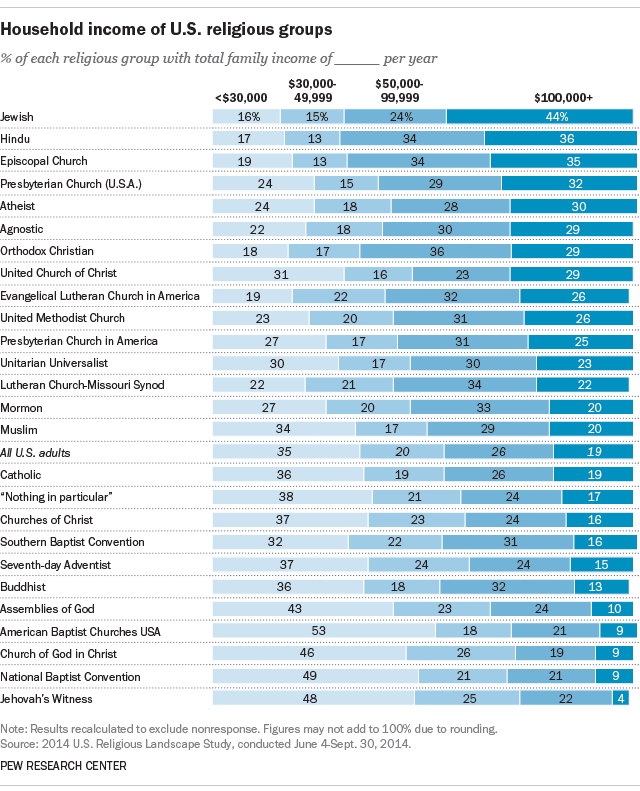
Pew Research Center
How income varies among U.S. religious groups
Members of some religious groups on average have a higher household income than others, and those in the richest groups tend to be highly educated.
such as Jews and Hindus, as well as Episcopalians, also outperform atheists and agnostics, while many others, such as Mormons, Lutherans, and other Protestant groups, do as well.
Nowhere is the efficacy of religion more obvious than among poorer Americans. Inner-city boys who attend religious school are twice as likely to graduate from college as their socio-economic counterparts in
https://www.wsj.com/articles/amid-the-pandemic-progress-in-catholic-schools-partnership-naep-report-card-math-reading-public-charter-black-hispanic-11666902117
notes Tulane sociologist Ilana Horwitz. Critical here, notes Horwitz, are the attributes of the religiously engaged, such as respect for elders and learning, with the deepest divergence felt among working- and middle-class children.
This may be one reason enrollment in private

Christian Schools Boom in a Revolt Against Curriculum and Pandemic Rules (Published 2021)
With public schools on the defensive, is this a blip or a ‘once-in-100-year moment for the growth of Christian education’?
, particularly during and after the pandemic, private schools, mostly religious, gained 300,000 new students between 2019 and 2023 while public schools lost 1.2 million.
That jump mirrors other migrations out of public school systems, including a doubling in the percentage of kids being homeschooled. In the 2019-20 school year, 6% of all American students,
Christian Schools Boom in a Revolt Against Curriculum and Pandemic Rules (Published 2021)
With public schools on the defensive, is this a blip or a ‘once-in-100-year moment for the growth of Christian education’?
g in such large states as Texas and Florida, has largely benefited religiously oriented schools.
Pathway to Success
One subtle effect, most importantly for the poor, is that religious institutions provide a connection to the more affluent. This is a critical factor for success as outlined in the “Social Capital Atlas” project led by Harvard economist Raj Chetty. Utilizing privacy-protected data from 21 billion Facebook friendships linked to tax records and census data, the report found the degree of social interaction between low-income and high-income individuals as the single strongest predictor of whether a poor child would rise out of poverty.

Harvard Gazette
How childhood friendships sway economic mobility
Big-data study by Raj Chetty and team shows who we interact with while growing up plays key role in upward mobility.
increases lifetime earnings by an average of 20%.
Chetty’s team found that poorer people associate more with the affluent at religious institutions than at secular institutions like high schools, colleges, and workplaces. A low-income individual attending a religious congregation is significantly more likely to form a
Social capital II: determinants of economic connectedness - PMC
Low levels of social interaction across class lines have generated widespread concern1–4 and are associated with worse outcomes, such as lower ra...
with a high-income congregant than they would be in a workplace, school, or neighborhood group.
Perhaps most critically, religion provides a sense of community and ties that are more tangible than those found online, at school, or in the workplace. For instance, just 10% of religious observants say they have

American Enterprise Institute - AEI
New Findings on Why Faith Is Still Good for the Nation
Those who are faithful have a greater number of social connections with others, more regularly speak with their friends, and report feeling more co...
; the number almost doubles for those who have no faith. For young families, in particular, the religious community offers a village in which to raise children in an era of atomized parenting. This functional utility is a major driver of individuals returning to church in their thirties.
The church,

What Caused the Negative World?
As I laid out back in 2017 and refined for my recent article in First Things, I divide the period from the 1960s to today into three phases disting...
was “not merely socially useful but as “part of a gospel obligation.”
<a href="///C:/Users/JoelKotkin/AppData/Local/Microsoft/Windows/INetCache/Content.Outlook/TLKLVI5K/deseret.com/2023/3/4/23617175/gen-z-faith-religious-nones-civic-life-voluntees-charity" rel="nofollow">Three-quarters</a> of those who attend church weekly give to the poor, compared with 41% of non-observants. Overall, 73% of all charitable contributions come from religious sources, while 60% of all beds for the homeless are from faith-based institutions.
Indeed, when
https://www.wsj.com/opinion/the-volunteerism-drought-725e37e3?gaa_at=eafs&gaa_n=AWEtsqeGWIDLqehDZTzYqFRwZLEUBoiEkOHOD385aOQfFUu2hqz6-oVMshxkw9dXWps%3D&gaa_ts=694c34a7&gaa_sig=NtJ0gmyHsLKydGCEK1eSdSdUmhThigLxVMouD6cr-OLFRbXu9qRebdoDzQvlfXUphwyPK9H6NzmQ7uM87eRjYA%3D%3D
reveals that half of religious Gen Zers report volunteering in the community often or very often, compared with 30% of slightly religious Gen Zers and just 21% of not religious Gen Zers.
In the end, our report finds that the growing evidence of religion’s basic utility, including its provision of a spiritual anchor, seems likely to grow, by offering a viable alternative to hyper-competition and individualism rife in secular-driven societies.
Tyler Durden | Zero Hedge
Zero Hedge
Wed, 02/18/2026 - 20:55
Surprising Revival: Gen Z Men & Highly Educated Lead Return To Religion | ZeroHedge
ZeroHedge - On a long enough timeline, the survival rate for everyone drops to zero

 a senior State Department official released additional evidence Tuesday in support of U.S. allegations that China conducted an underground nuclear test in June 2020, as global arms control frameworks unravel.
 Assistant Secretary of State Christopher Yeaw, while
to a Hudson Institute meeting, discussed data from a remote seismic station in Kazakhstan that recorded a magnitude 2.75 “explosion” approximately 450 miles from China’s Lop Nur test grounds on June 22, 2020.
“I’ve looked at additional data since then. There is very little possibility I would say that it is anything but an explosion, a singular explosion,” Yeaw said, underscoring that the data were not consistent with blasts from mining.
“It’s also entirely not consistent with an earthquake,” said Yeaw, a former intelligence analyst and defense official who holds a doctorate in nuclear engineering. “It is ... what you would expect with a nuclear explosive test.”
Yeaw argued that China tried to hide the event through decoupling, detonating the device in a spacious underground cavity to diminish seismic waves.
Under Secretary of State for Arms Control Thomas DiNanno earlier this month
Assistant Secretary of State Christopher Yeaw, while
to a Hudson Institute meeting, discussed data from a remote seismic station in Kazakhstan that recorded a magnitude 2.75 “explosion” approximately 450 miles from China’s Lop Nur test grounds on June 22, 2020.
“I’ve looked at additional data since then. There is very little possibility I would say that it is anything but an explosion, a singular explosion,” Yeaw said, underscoring that the data were not consistent with blasts from mining.
“It’s also entirely not consistent with an earthquake,” said Yeaw, a former intelligence analyst and defense official who holds a doctorate in nuclear engineering. “It is ... what you would expect with a nuclear explosive test.”
Yeaw argued that China tried to hide the event through decoupling, detonating the device in a spacious underground cavity to diminish seismic waves.
Under Secretary of State for Arms Control Thomas DiNanno earlier this month  China of performing such secretive nuclear arms tests and implementing measures to restrict seismic evidence.
“Today, I can reveal that the U.S. Government is aware that China has conducted nuclear explosive tests, including preparing for tests with designated yields in the hundreds of tons,” DiNanno said.
These claims back up Yeaw’s assertions of concealment tactics.
The Comprehensive Nuclear-Test-Ban Treaty Organization, which monitors global explosions, noted that available data do not allow for firm conclusions.
Executive Secretary Robert Floyd said in a statement that the seismic monitoring station in Kazakhstan captured “two very small seismic events” 12 seconds apart on June 22, 2020.
The organization’s network detects events equivalent to 551 tons (500 metric tons) of TNT or more, according to Floyd.
“These two events were far below that level,” Floyd said. “As a result, with this data alone, it is not possible to assess the cause of these events with confidence.”
China, a signatory to the 1996 Comprehensive Nuclear-Test-Ban Treaty but not a ratifier, rejected the initial U.S. accusation at an international conference this month. Beijing’s last acknowledged underground test occurred in 1996.
The United States, which also signed but did not ratify the treaty, is legally bound to its terms under international norms. America’s final underground test was in 1992, with subsequent reliance on sophisticated simulations and supercomputers for warhead maintenance.
President Donald Trump recently
China of performing such secretive nuclear arms tests and implementing measures to restrict seismic evidence.
“Today, I can reveal that the U.S. Government is aware that China has conducted nuclear explosive tests, including preparing for tests with designated yields in the hundreds of tons,” DiNanno said.
These claims back up Yeaw’s assertions of concealment tactics.
The Comprehensive Nuclear-Test-Ban Treaty Organization, which monitors global explosions, noted that available data do not allow for firm conclusions.
Executive Secretary Robert Floyd said in a statement that the seismic monitoring station in Kazakhstan captured “two very small seismic events” 12 seconds apart on June 22, 2020.
The organization’s network detects events equivalent to 551 tons (500 metric tons) of TNT or more, according to Floyd.
“These two events were far below that level,” Floyd said. “As a result, with this data alone, it is not possible to assess the cause of these events with confidence.”
China, a signatory to the 1996 Comprehensive Nuclear-Test-Ban Treaty but not a ratifier, rejected the initial U.S. accusation at an international conference this month. Beijing’s last acknowledged underground test occurred in 1996.
The United States, which also signed but did not ratify the treaty, is legally bound to its terms under international norms. America’s final underground test was in 1992, with subsequent reliance on sophisticated simulations and supercomputers for warhead maintenance.
President Donald Trump recently  Feb. 5.
China refused the invitation, arguing that its arsenal is far smaller than those of the United States and Russia. The Pentagon estimates China’s current operational warheads at more than 600. The stockpile is expected to exceed 1,000 by 2030.
The
Feb. 5.
China refused the invitation, arguing that its arsenal is far smaller than those of the United States and Russia. The Pentagon estimates China’s current operational warheads at more than 600. The stockpile is expected to exceed 1,000 by 2030.
The 
 Descalzi told the FT that Eni was in preliminary talks with a number of commodity trading houses, including Mercuria.
“It is not in our DNA. We are not very commercial,” Descalzi explained.
“So I thought to become commercial, we have to have a partnership to understand the business.”
“If we can offer physical hedging, that is a big advantage for them. We can complement each other,” the chief executive of the supermajor added, noting the amount of oil and gas that Eni produces should make it an attractive partner.
Despite oil trading being a major profit source for Big Oil, Shell, for one,
Descalzi told the FT that Eni was in preliminary talks with a number of commodity trading houses, including Mercuria.
“It is not in our DNA. We are not very commercial,” Descalzi explained.
“So I thought to become commercial, we have to have a partnership to understand the business.”
“If we can offer physical hedging, that is a big advantage for them. We can complement each other,” the chief executive of the supermajor added, noting the amount of oil and gas that Eni produces should make it an attractive partner.
Despite oil trading being a major profit source for Big Oil, Shell, for one, 
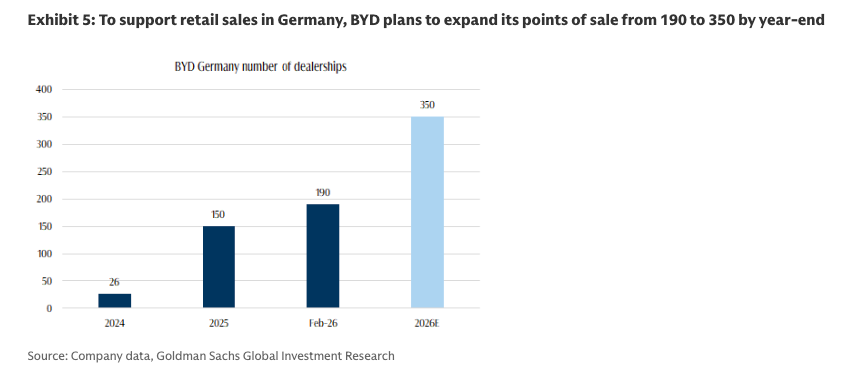
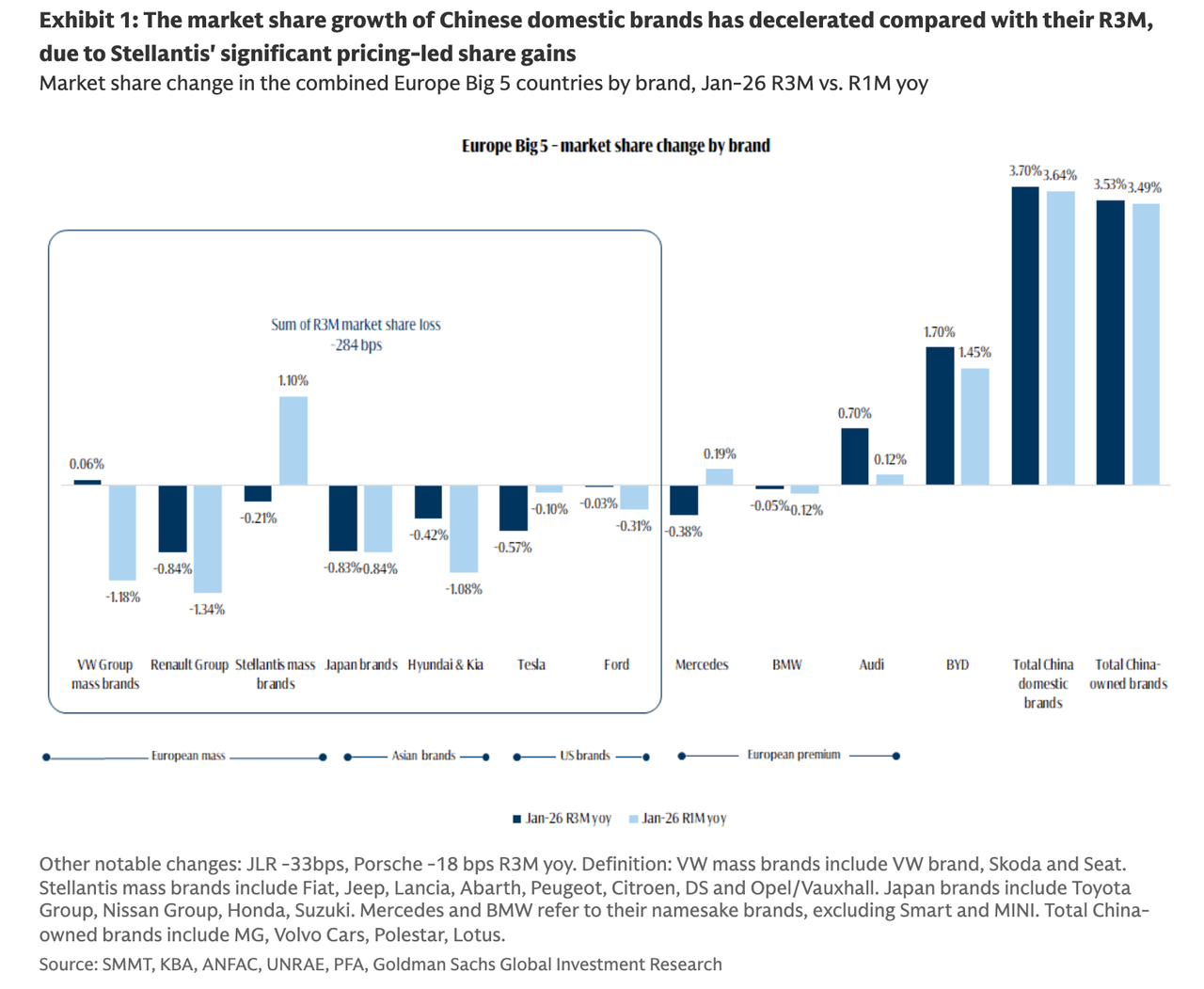 "Heading into 2026, we expect Chinese OEMs to further intensify their European expansion plans, e.g., BYD offering c.30% price discounts while aiming to double its volume in Germany this year," Frenes said.
 Here's the demand of Chinese and local car companies for January.
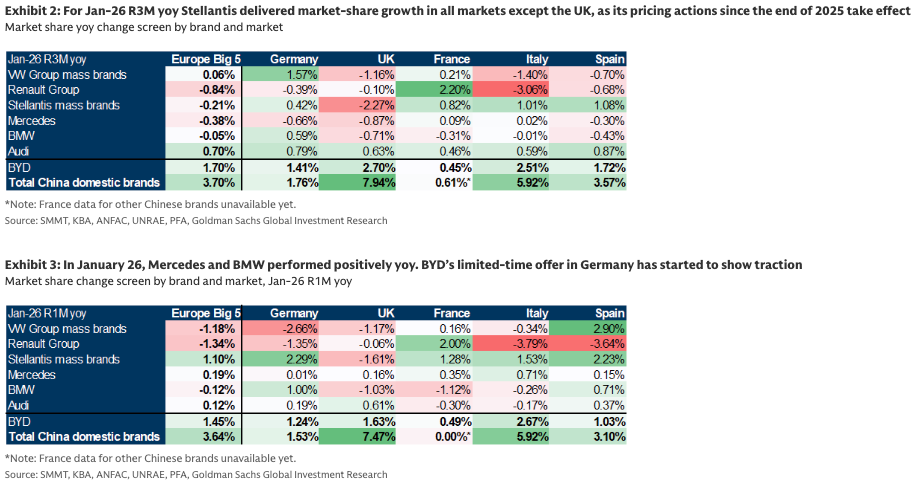 Where these Chinese car brands are invading Europe.
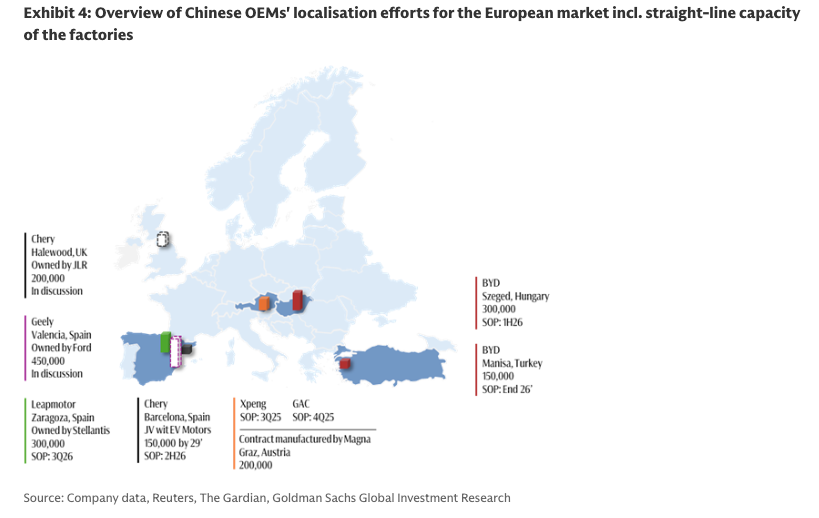 Frenes highlights several key developments of Chinese brand expansion across the bloc:
Chery & Jaguar Land Rover (JLR): Chery is reportedly exploring a manufacturing partnership with JLR that would leverage spare capacity at JLR's Halewood plant in the UK (link). The plant, which has an annual capacity of c.200,000 units, was significantly underutilized in the past few years. We estimate the average utilization rate at c.60%. This initiative would build on the existing Chery–JLR relationship, as the two companies have operated a manufacturing joint venture in China since 2012. Discussions reportedly involve the UK government and JLR leadership, and Chery has publicly highlighted the UK as a potential production base as part of its localization strategy. No definitive agreement has been announced.
Geely & Ford: Both companies are reportedly in advanced discussions for a partnership under which Geely would utilize Ford's manufacturing facilities in Valencia, Spain (link). We estimate the average ulilization rate of this factory to be at c.70% over the last 5 years. This approach is consistent with Geely's established strategy of partnering with other automakers, such as its existing deal with Renault to leverage their factories in South Korea and Brazil. No definitive agreement has been announced.
Uncertainty over reported suspension of BYD's Turkey plant: BYD has reportedly halted plans for its USD 1bn EV factory in Manisa, Turkey. Media cites that a dispute over core technology transfer requirements, along with parliamentary scrutiny, may have contributed to the investment being paused. The statement was rejected by the Turkish Trade Minister while the company has not issued any official confirmation.
BYD is planning for explosive demand across the bloc this year.
Frenes highlights several key developments of Chinese brand expansion across the bloc:
Chery & Jaguar Land Rover (JLR): Chery is reportedly exploring a manufacturing partnership with JLR that would leverage spare capacity at JLR's Halewood plant in the UK (link). The plant, which has an annual capacity of c.200,000 units, was significantly underutilized in the past few years. We estimate the average utilization rate at c.60%. This initiative would build on the existing Chery–JLR relationship, as the two companies have operated a manufacturing joint venture in China since 2012. Discussions reportedly involve the UK government and JLR leadership, and Chery has publicly highlighted the UK as a potential production base as part of its localization strategy. No definitive agreement has been announced.
Geely & Ford: Both companies are reportedly in advanced discussions for a partnership under which Geely would utilize Ford's manufacturing facilities in Valencia, Spain (link). We estimate the average ulilization rate of this factory to be at c.70% over the last 5 years. This approach is consistent with Geely's established strategy of partnering with other automakers, such as its existing deal with Renault to leverage their factories in South Korea and Brazil. No definitive agreement has been announced.
Uncertainty over reported suspension of BYD's Turkey plant: BYD has reportedly halted plans for its USD 1bn EV factory in Manisa, Turkey. Media cites that a dispute over core technology transfer requirements, along with parliamentary scrutiny, may have contributed to the investment being paused. The statement was rejected by the Turkish Trade Minister while the company has not issued any official confirmation.
BYD is planning for explosive demand across the bloc this year.
 Our assessment here is much deeper than just market share; the fact that Brussels is allowing this invasion to occur in the first place puts severe pressure on European OEMs and suppliers.
Anduril Industries founder Palmer Luckey outlined exactly this threat in a recent Joe Rogan podcast.
"If you let them (US car manufacturers) freely compete, like if you let them go toe to toe, China would be thrilled if they could subsidise their way into destroying the American automotive apparatus, partly for economic reasons. But there's another reason," Luckey said.
He continued, "How did the United States win World War II … Manufacturing – some of it was new factories, but most of it was taking over old factories."
"We took all of our farm implement factories, like John Deere and Caterpillar. They were building tanks and guns. We took all our automotive factories. We had them building aircraft, we had them building weapons, we had them building missiles," he said.
He said, "In fact, we even designed those weapons so they could be manufactured by those plants … We won because we had all of this automotive and other industrial capacity."
Luckey warned, "China would love to wipe out the American automotive industry, partly for economic reasons, because it also means we will never be able to fight a war against them. Imagine in America with like, we've lost a lot of manufacturing … If China could wipe out our industrial capacity entirely, they never need to worry about fighting a war with the US again because they know that we wouldn't be able to get back in the game fast enough to matter."
It's as if Brussels is allowing its own decline, whether by letting a flood of Chinese EVs pour onto European streets or by pursuing climate policies that have weakened reliable power generation and eroded core industrial capacity.
However, we do think the bloc is starting to recognize where this trajectory ends and, as the world fractures and the war in Eastern Europe grinds on. That reality was reflected last week, when industrial leaders
Our assessment here is much deeper than just market share; the fact that Brussels is allowing this invasion to occur in the first place puts severe pressure on European OEMs and suppliers.
Anduril Industries founder Palmer Luckey outlined exactly this threat in a recent Joe Rogan podcast.
"If you let them (US car manufacturers) freely compete, like if you let them go toe to toe, China would be thrilled if they could subsidise their way into destroying the American automotive apparatus, partly for economic reasons. But there's another reason," Luckey said.
He continued, "How did the United States win World War II … Manufacturing – some of it was new factories, but most of it was taking over old factories."
"We took all of our farm implement factories, like John Deere and Caterpillar. They were building tanks and guns. We took all our automotive factories. We had them building aircraft, we had them building weapons, we had them building missiles," he said.
He said, "In fact, we even designed those weapons so they could be manufactured by those plants … We won because we had all of this automotive and other industrial capacity."
Luckey warned, "China would love to wipe out the American automotive industry, partly for economic reasons, because it also means we will never be able to fight a war against them. Imagine in America with like, we've lost a lot of manufacturing … If China could wipe out our industrial capacity entirely, they never need to worry about fighting a war with the US again because they know that we wouldn't be able to get back in the game fast enough to matter."
It's as if Brussels is allowing its own decline, whether by letting a flood of Chinese EVs pour onto European streets or by pursuing climate policies that have weakened reliable power generation and eroded core industrial capacity.
However, we do think the bloc is starting to recognize where this trajectory ends and, as the world fractures and the war in Eastern Europe grinds on. That reality was reflected last week, when industrial leaders 
 The centerpiece of the Green manifesto is a commitment to provide refuge for those fleeing environmental degradation. Following the vote, the regional association signaled its intent to make Berlin a primary destination for these individuals. Notably, the city has a long-term housing crisis, with the government spending now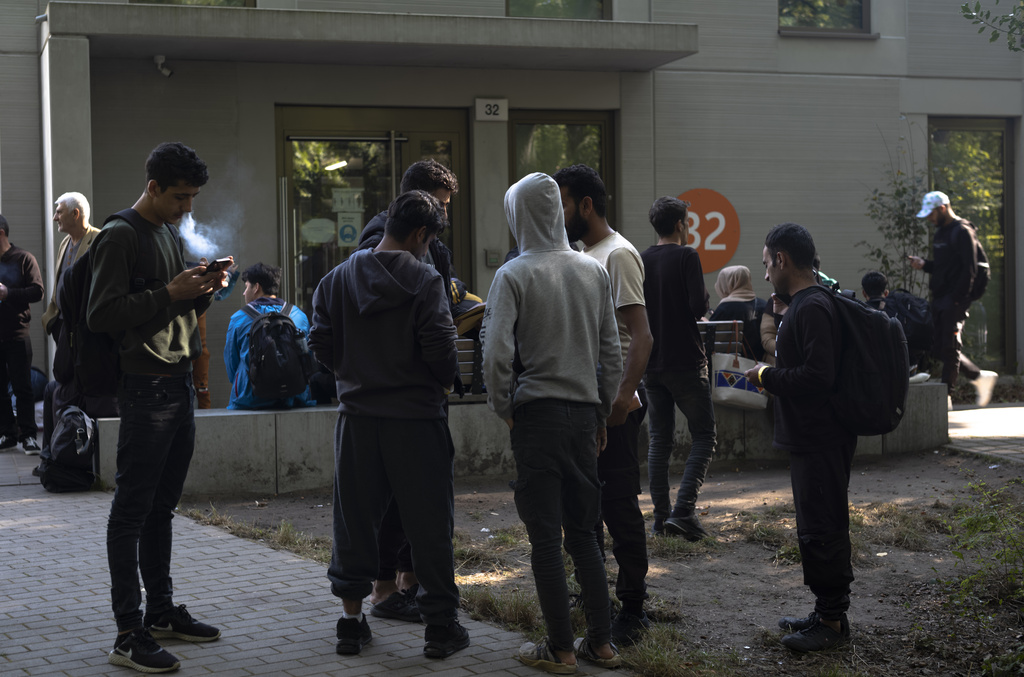







 Du Bin, 54, was formally arrested in November last year, according to people familiar with the matter who requested anonymity out of fear of reprisal. His case has been transferred to the procuratorate for examination and prosecution as of late January, the sources told The Epoch Times.
Du has been held at Shunyi Detention Center in Beijing since October, when he was taken by police from his residence, according to his sister and rights groups.
Authorities told his sister at the time that Du was detained under suspension for “picking quarrels and provoking trouble.” The vaguely worded charge is often used by the regime to target
Du Bin, 54, was formally arrested in November last year, according to people familiar with the matter who requested anonymity out of fear of reprisal. His case has been transferred to the procuratorate for examination and prosecution as of late January, the sources told The Epoch Times.
Du has been held at Shunyi Detention Center in Beijing since October, when he was taken by police from his residence, according to his sister and rights groups.
Authorities told his sister at the time that Du was detained under suspension for “picking quarrels and provoking trouble.” The vaguely worded charge is often used by the regime to target 


 In December 2020, days before his historical book “Red Terror: Lenin’s Communist Experiment” was set to be published in Taiwan, Du was


 Du is also a photographer who once contributed to international media outlets, including The New York Times. But he was forced to stop after authorities denied him a work permit over his books.
His work includes “Tiananmen Massacre,” which compiles firsthand accounts of the night of June 3–4, 1989, when CCP leaders
Du is also a photographer who once contributed to international media outlets, including The New York Times. But he was forced to stop after authorities denied him a work permit over his books.
His work includes “Tiananmen Massacre,” which compiles firsthand accounts of the night of June 3–4, 1989, when CCP leaders 
 Under the old system, foreign drivers holding only work permits could obtain commercial trucking licenses because Employment Authorization Documents don't indicate prior traffic violations, accidents, or license suspensions in other countries. States had no way to know whether an applicant had a clean record or a history of reckless driving before allowing them to operate an 80,000-pound vehicle.
The new rule formally codifies Duffy's emergency action from last September that ended the issuance of non-domiciled commercial driver's licenses to truckers with unverified driving histories. EADs will no longer be accepted as proof of eligibility. Applicants must instead present an unexpired foreign passport along with the appropriate Form I-94, which tracks a noncitizen's entry to and exit from the United States.
“Under the provisions, only foreign nationals holding temporary work visas, such as H‑2B, H‑1B, or temporary investor visas from treaty countries, known as E‑2 visas, may be eligible,”
Under the old system, foreign drivers holding only work permits could obtain commercial trucking licenses because Employment Authorization Documents don't indicate prior traffic violations, accidents, or license suspensions in other countries. States had no way to know whether an applicant had a clean record or a history of reckless driving before allowing them to operate an 80,000-pound vehicle.
The new rule formally codifies Duffy's emergency action from last September that ended the issuance of non-domiciled commercial driver's licenses to truckers with unverified driving histories. EADs will no longer be accepted as proof of eligibility. Applicants must instead present an unexpired foreign passport along with the appropriate Form I-94, which tracks a noncitizen's entry to and exit from the United States.
“Under the provisions, only foreign nationals holding temporary work visas, such as H‑2B, H‑1B, or temporary investor visas from treaty countries, known as E‑2 visas, may be eligible,”

 Water rights exceed water supply across much of the western United States. With many watersheds failing to deliver enough water for local needs, the suit is being watched by attorneys, state water managers, and federal agencies. It could potentially set a precedent in revising how states across the West regulate access to water.
The Nevada case, filed by the Walker River Paiute Tribe and Mineral County, may also present an opportunity for a win-win solution, in which nonprofits and government entities purchase private water rights from willing upstream sellers and dedicate them to downstream public benefit.
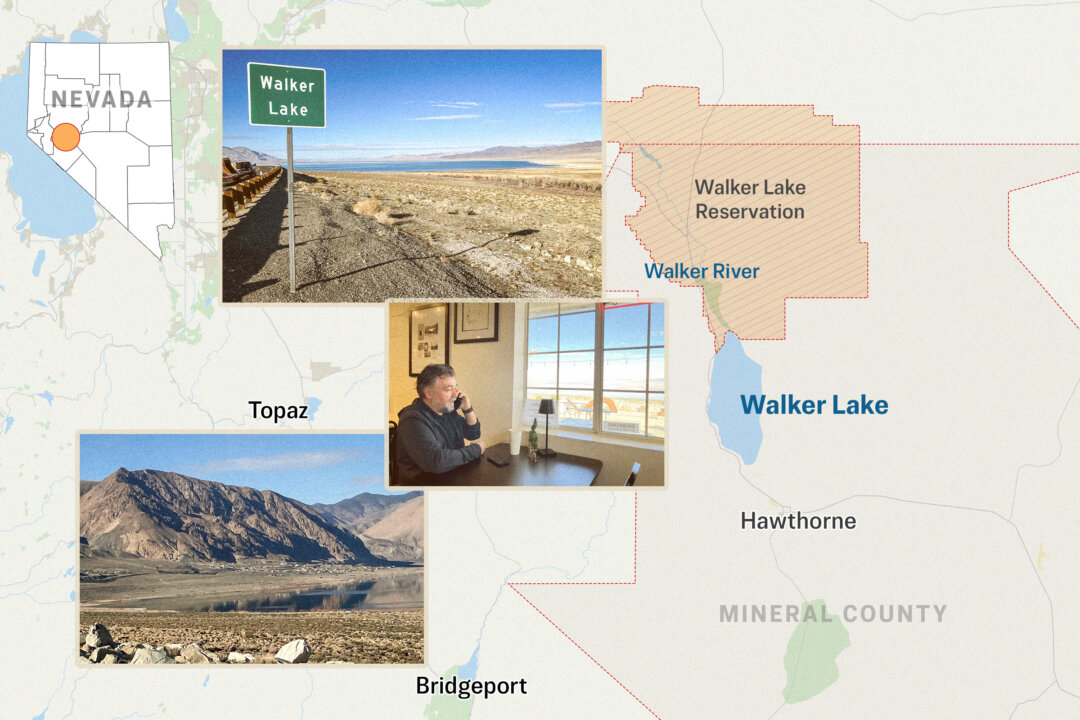
Without public-private intervention and the changes in state water law that the suit seeks, geologists and environmental experts agree the future is bleak for Walker Lake, a 13-mile long terminal lake about 75 miles southeast of Reno near the California state line in rural, sparsely populated Mineral County.
The lake is completely dependent on diminishing Sierra Nevada snowmelt runoff into the Walker River—runoff that, for decades now, has been almost entirely diverted for irrigation by upstream farmers and ranchers.
As a result, a desert oasis that once generated more than half of Mineral County’s economic activity through recreational pursuits such as fishing, migratory bird-watching, boating, and camping is now a lifeless “sludge pond,” while the town of Walker Lake faces an accelerating prospect of extinction.
“The last fish was caught in 2013 or 2015, I believe. When the fish died, the fishing died; boating, recreation, that all just disappeared,” Mineral County Commissioner Tony Ruse said.
“There were restaurants here. There were hotels here. There were businesses here. Now? All gone, just 300 residents struggling.”
A Mineral County native, Ruse returned in 2020 after working 34 years as a Switzerland-trained chef in Europe and Asia, including 20 years in South Korea, to open The Big Horn Crossing, a restaurant and convenience store in a shuttered bait shop. It’s now Walker Lake’s only remaining retail business.
“It was dead. There was nothing,” he told The Epoch Times. “We should be selling bait here. We should be selling fishing supplies. There should be boats parked in our driveway right now.”
Water rights exceed water supply across much of the western United States. With many watersheds failing to deliver enough water for local needs, the suit is being watched by attorneys, state water managers, and federal agencies. It could potentially set a precedent in revising how states across the West regulate access to water.
The Nevada case, filed by the Walker River Paiute Tribe and Mineral County, may also present an opportunity for a win-win solution, in which nonprofits and government entities purchase private water rights from willing upstream sellers and dedicate them to downstream public benefit.
Without public-private intervention and the changes in state water law that the suit seeks, geologists and environmental experts agree the future is bleak for Walker Lake, a 13-mile long terminal lake about 75 miles southeast of Reno near the California state line in rural, sparsely populated Mineral County.
The lake is completely dependent on diminishing Sierra Nevada snowmelt runoff into the Walker River—runoff that, for decades now, has been almost entirely diverted for irrigation by upstream farmers and ranchers.
As a result, a desert oasis that once generated more than half of Mineral County’s economic activity through recreational pursuits such as fishing, migratory bird-watching, boating, and camping is now a lifeless “sludge pond,” while the town of Walker Lake faces an accelerating prospect of extinction.
“The last fish was caught in 2013 or 2015, I believe. When the fish died, the fishing died; boating, recreation, that all just disappeared,” Mineral County Commissioner Tony Ruse said.
“There were restaurants here. There were hotels here. There were businesses here. Now? All gone, just 300 residents struggling.”
A Mineral County native, Ruse returned in 2020 after working 34 years as a Switzerland-trained chef in Europe and Asia, including 20 years in South Korea, to open The Big Horn Crossing, a restaurant and convenience store in a shuttered bait shop. It’s now Walker Lake’s only remaining retail business.
“It was dead. There was nothing,” he told The Epoch Times. “We should be selling bait here. We should be selling fishing supplies. There should be boats parked in our driveway right now.”


 (Top) Walker Lake has receded well beyond the sign on U.S. Route 95, in Mineral County, Nev., in January 2026. Decades ago, anglers could shorecast for fish that can no longer survive in the shrinking lake. (Bottom) Nevada’s Walker Lake, a 13-mile-long lake about 75 miles southeast of Reno near the California state line in rural Mineral County, was once more than 30 miles long and 160 feet higher than it is now, in Mineral County, Nev., in January 2026. John Haughey/The Epoch Times
But with mountain runoff unreliable for decades now, when upstream users divert their share, little to no water makes it to Walker Lake, leaving once-bustling waterfront businesses marooned as hulking shells far from a distant, receding shore.
The case, United States and Walker River Paiute Tribe v. Walker River Irrigation District, is not a new case, but ongoing litigation arising from a lawsuit filed in 1924.
It’s part of a flood of litigation stemming from Walker River allocations, going back to 1902, when rancher Henry Miller sued Thomas Rickey over water rights on the river.
A 1936 Walker River Decree
(Top) Walker Lake has receded well beyond the sign on U.S. Route 95, in Mineral County, Nev., in January 2026. Decades ago, anglers could shorecast for fish that can no longer survive in the shrinking lake. (Bottom) Nevada’s Walker Lake, a 13-mile-long lake about 75 miles southeast of Reno near the California state line in rural Mineral County, was once more than 30 miles long and 160 feet higher than it is now, in Mineral County, Nev., in January 2026. John Haughey/The Epoch Times
But with mountain runoff unreliable for decades now, when upstream users divert their share, little to no water makes it to Walker Lake, leaving once-bustling waterfront businesses marooned as hulking shells far from a distant, receding shore.
The case, United States and Walker River Paiute Tribe v. Walker River Irrigation District, is not a new case, but ongoing litigation arising from a lawsuit filed in 1924.
It’s part of a flood of litigation stemming from Walker River allocations, going back to 1902, when rancher Henry Miller sued Thomas Rickey over water rights on the river.
A 1936 Walker River Decree  The Supreme Court of Nevada building in Carson City, Nev., in this file photo. In 2020, the court determined that all Nevada waters will now be allocated under the public trust doctrine. Steven Frame/Shutterstock
The court directed Mineral County to recommend ways to restore the lake without reallocating water rights, and to work with the Walker Basin Conservancy, a nonprofit created in 2014 with federal funding initially secured by Sen. Harry Reid (D-Nev.) and the National Fish and Wildlife Foundation’s Walker Basin Restoration Program.
In 2021, Mineral County amended its 2015 complaint to intervene in the decades’-long parallel suit by the Walker River Paiute Tribe seeking to boost Walker River flows into a reservation reservoir and secure water rights for 167,460 acres added to the reservation since 1936.
The county’s complaint includes 24 “actions … necessary to restore and maintain Walker Lake’s public trust values.”
After years of procedural delays, including a requirement to individually serve more than 1,000 watershed landowners across the country, the case is set to proceed into discovery. A potential trial looms.
But an alternate “win-win” solution orchestrated by the Walker Basin Conservancy is gaining traction and could, perhaps, mitigate the need for a court-ordered resolution.
‘The Only Solution’
Since its creation, the conservancy has restored public access to 33 miles along the Walker River and purchased more than 13,700 acres of water rights, enough to restore about 60 percent of the river inflow biologists maintain is needed to restore the lake’s fishery.
Conservancy CEO Peter Stanton and Water Program Director Carlie Henneman did not return emails and repeated phone requests for comment about the program from The Epoch Times. Nor did the Nevada Department of Conservation and Natural Resources, Walker River Irrigation District attorney Gordon DePaoli, or Walker Basin Working Group’s Oregon-based legal advisers, Jamie Saul of the Wild & Scenic Law Center and Kevin Cassidy of Lewis & Clark Law School’s Earthrise Law Center.
Several attorneys representing different parties would only speak off-the-record, underscoring the contentious complexities of the case.
The Supreme Court of Nevada building in Carson City, Nev., in this file photo. In 2020, the court determined that all Nevada waters will now be allocated under the public trust doctrine. Steven Frame/Shutterstock
The court directed Mineral County to recommend ways to restore the lake without reallocating water rights, and to work with the Walker Basin Conservancy, a nonprofit created in 2014 with federal funding initially secured by Sen. Harry Reid (D-Nev.) and the National Fish and Wildlife Foundation’s Walker Basin Restoration Program.
In 2021, Mineral County amended its 2015 complaint to intervene in the decades’-long parallel suit by the Walker River Paiute Tribe seeking to boost Walker River flows into a reservation reservoir and secure water rights for 167,460 acres added to the reservation since 1936.
The county’s complaint includes 24 “actions … necessary to restore and maintain Walker Lake’s public trust values.”
After years of procedural delays, including a requirement to individually serve more than 1,000 watershed landowners across the country, the case is set to proceed into discovery. A potential trial looms.
But an alternate “win-win” solution orchestrated by the Walker Basin Conservancy is gaining traction and could, perhaps, mitigate the need for a court-ordered resolution.
‘The Only Solution’
Since its creation, the conservancy has restored public access to 33 miles along the Walker River and purchased more than 13,700 acres of water rights, enough to restore about 60 percent of the river inflow biologists maintain is needed to restore the lake’s fishery.
Conservancy CEO Peter Stanton and Water Program Director Carlie Henneman did not return emails and repeated phone requests for comment about the program from The Epoch Times. Nor did the Nevada Department of Conservation and Natural Resources, Walker River Irrigation District attorney Gordon DePaoli, or Walker Basin Working Group’s Oregon-based legal advisers, Jamie Saul of the Wild & Scenic Law Center and Kevin Cassidy of Lewis & Clark Law School’s Earthrise Law Center.
Several attorneys representing different parties would only speak off-the-record, underscoring the contentious complexities of the case.
 A sign of the Walker River Paiute Tribe in Shurz, Nev., on Oct. 16, 2024. Walker Lake retains water flowing east 100 miles from California’s Bridgeport and Topaz reservoirs through Nevada’s Smith and Mason valleys and the Walker River Paiute Tribe's reservation. Frederic J. Brown/AFP via Getty Images
Roderick E. Walston, an attorney with Best Best & Krieger in Walnut Creek, Calif., told The Epoch Times his clients above the Bridgeport Reservoir in California are apprehensive about Mineral County’s suit, which he said essentially demands the federal court to reallocate existing water rights under the public trust doctrine.
“Our response is basically that the Nevada Supreme Court resolved that issue four years ago,” he said.
Walston was a California deputy attorney general in 1983 and argued the Mono Lake case before the California Supreme Court. In that case, the state’s public trust doctrine was used to thwart Los Angeles from purchasing Mono Lake water rights that would have devastated the lake’s ecology and Sierra Nevada economies.
“So I argued both the case in California Supreme Court 40-something years ago and then also argued the case in the Nevada Supreme Court about four years ago,” he said.
Walston said the case could have “great impact” on water disputes in states that uphold the prior allocation doctrine. “This is an absolutely large case,” he said.
Meanwhile, Mineral County District Attorney Ryan McCormick, who assumed his post seven weeks ago, told The Epoch Times he’s playing catch-up in reading filings “from decades and decades of litigation.”
A sign of the Walker River Paiute Tribe in Shurz, Nev., on Oct. 16, 2024. Walker Lake retains water flowing east 100 miles from California’s Bridgeport and Topaz reservoirs through Nevada’s Smith and Mason valleys and the Walker River Paiute Tribe's reservation. Frederic J. Brown/AFP via Getty Images
Roderick E. Walston, an attorney with Best Best & Krieger in Walnut Creek, Calif., told The Epoch Times his clients above the Bridgeport Reservoir in California are apprehensive about Mineral County’s suit, which he said essentially demands the federal court to reallocate existing water rights under the public trust doctrine.
“Our response is basically that the Nevada Supreme Court resolved that issue four years ago,” he said.
Walston was a California deputy attorney general in 1983 and argued the Mono Lake case before the California Supreme Court. In that case, the state’s public trust doctrine was used to thwart Los Angeles from purchasing Mono Lake water rights that would have devastated the lake’s ecology and Sierra Nevada economies.
“So I argued both the case in California Supreme Court 40-something years ago and then also argued the case in the Nevada Supreme Court about four years ago,” he said.
Walston said the case could have “great impact” on water disputes in states that uphold the prior allocation doctrine. “This is an absolutely large case,” he said.
Meanwhile, Mineral County District Attorney Ryan McCormick, who assumed his post seven weeks ago, told The Epoch Times he’s playing catch-up in reading filings “from decades and decades of litigation.”
 A sign is pictured at Walker Lake in Hawthorne, Nev., on Oct. 16, 2024. According to the U.S. Geological Survey, Walker Lake’s water levels have declined more than 160 feet since 1882. Nearly 30 miles long in 1850, the lake is only 12 miles long today. Frederic J. Brown/AFP via Getty Images
“In a perfect world, if we get some specific performance and find a way to divert water back into the lake and have the levels rising again, that would be absolutely ideal,” he said, adding he isn’t privy to the reasoning behind all of the 24 actions assembled by the Walker Lake Working Group.
It’s a complicated case in a long-litigated watershed but the best resolution is simple, McCormick said. “With the best interests of Mineral County, Hawthorne, and Walker Lake in mind here, we would like the lake to be receiving fresh water again. It would be nice to see some economic development right now, right?”
But Walston said odds are slim the court will cast aside the state’s Supreme Court determination that existing water rights cannot be reallocated.
Working with the conservancy and other groups to purchase water rights from willing landowners at $3,000 to $4,000 per acre foot—an acre of one-foot deep water—is a win-win for all involved, he said.
“It’s the only solution, really. The Nevada Supreme Court has said you can’t just take water rights that have been adjudicated and take that water and put it into Walker Lake,” Walston said.
“But you can go to various water users and negotiate with them and buy their water rights. In that case, then you could reallocate.”
A sign is pictured at Walker Lake in Hawthorne, Nev., on Oct. 16, 2024. According to the U.S. Geological Survey, Walker Lake’s water levels have declined more than 160 feet since 1882. Nearly 30 miles long in 1850, the lake is only 12 miles long today. Frederic J. Brown/AFP via Getty Images
“In a perfect world, if we get some specific performance and find a way to divert water back into the lake and have the levels rising again, that would be absolutely ideal,” he said, adding he isn’t privy to the reasoning behind all of the 24 actions assembled by the Walker Lake Working Group.
It’s a complicated case in a long-litigated watershed but the best resolution is simple, McCormick said. “With the best interests of Mineral County, Hawthorne, and Walker Lake in mind here, we would like the lake to be receiving fresh water again. It would be nice to see some economic development right now, right?”
But Walston said odds are slim the court will cast aside the state’s Supreme Court determination that existing water rights cannot be reallocated.
Working with the conservancy and other groups to purchase water rights from willing landowners at $3,000 to $4,000 per acre foot—an acre of one-foot deep water—is a win-win for all involved, he said.
“It’s the only solution, really. The Nevada Supreme Court has said you can’t just take water rights that have been adjudicated and take that water and put it into Walker Lake,” Walston said.
“But you can go to various water users and negotiate with them and buy their water rights. In that case, then you could reallocate.”
 The Today Show sports presenter appeared to slur and stumble her way through her segment amid snowstorm, rambling incoherently before dramatically throwing herself to the ground to make snow angels.
Social media has lit up with speculation after popular Channel 9 sports and rugby league host Danika Mason appeared on morning television struggling to get her words out while covering the Winter Olympics in Italy.
📌 READ MORE:
The Today Show sports presenter appeared to slur and stumble her way through her segment amid snowstorm, rambling incoherently before dramatically throwing herself to the ground to make snow angels.
Social media has lit up with speculation after popular Channel 9 sports and rugby league host Danika Mason appeared on morning television struggling to get her words out while covering the Winter Olympics in Italy.
📌 READ MORE: 








 FCC Chairman Brendan Carr said Colbert could have aired his interview with Texas state Rep. James Talarico, a Democrat running for the U.S. Senate, if the late-night TV show he hosts complied with federal equal time rules by airing interviews with other Democrats vying for the seat.
“There was no censorship here at all,” Carr told reporters.
“Every single broadcaster in this country has an obligation to be responsible for the programming that they choose to air, and they’re responsible whether it complies with FCC rules or not, and it doesn’t, and those individual broadcasters are also going to have a potential liability.”
Talarico has alleged in posts on his X account that the FCC and the Trump administration had tried to censor the interview and barred him from appearing on Colbert’s program, although the interview was published online.
“The reason the Trump administration and their billionaire friends are trying to silence me and this movement is because they’re worried that we are going to flip Texas in November,” he said in a video, which was posted on X.
Aside from Talarico’s allegations of censorship, Colbert, who is set to leave “The Late Show” in May, also criticized CBS and the Trump administration during his program.
“Then I was told, in some uncertain terms, that not only could I not have him on, I could not mention me not having him on,” the “The Late Show” host said on Tuesday, adding that “because my network clearly doesn’t want us to talk about this, let’s talk about this.”
The interview with Talarico was uploaded to Colbert’s YouTube channel on Tuesday evening.
In statements to media outlets in response to Colbert’s claims, CBS denied that “The Late Show” was barred by the network from airing the Talarico interview and instead said that its lawyers advised the company that the broadcast could trigger the equal time rule.
“The show was provided legal guidance that the broadcast could trigger the FCC equal time rule for two other candidates, including Rep. Jasmine Crockett, and presented options for how the equal time for other candidates could be fulfilled,” CBS said in the statement.
It noted that the interview was published on the show’s YouTube channel instead.
The issue came just hours before early voting opened Tuesday in Texas’s primary elections, which feature hotly contested Senate nomination races in both parties.
Talarico’s main opponent in the primary is Crockett (D-Texas) and both have built national profiles through viral social media clips.
On the Republican side, four-term incumbent Sen. John Cornyn is facing the political fight of his career against Texas Attorney General Ken Paxton and Rep. Wesley Hunt (R-Texas).
In a notice last month, the FCC said that it is changing the rules exempting certain late-night and daytime talk shows from being mandated to provide equal airtime to opposing candidates.
“Importantly, the FCC has not been presented with any evidence that the interview portion of any late night or daytime television talk show program on air presently would qualify for the bona fide news exemption,” the FCC said on Jan. 21.
“Moreover, a program that is motivated by partisan purposes, for example, would not be entitled to an exemption under longstanding FCC precedent.”
The Epoch Times contacted the FCC for comment Wednesday.
FCC Chairman Brendan Carr said Colbert could have aired his interview with Texas state Rep. James Talarico, a Democrat running for the U.S. Senate, if the late-night TV show he hosts complied with federal equal time rules by airing interviews with other Democrats vying for the seat.
“There was no censorship here at all,” Carr told reporters.
“Every single broadcaster in this country has an obligation to be responsible for the programming that they choose to air, and they’re responsible whether it complies with FCC rules or not, and it doesn’t, and those individual broadcasters are also going to have a potential liability.”
Talarico has alleged in posts on his X account that the FCC and the Trump administration had tried to censor the interview and barred him from appearing on Colbert’s program, although the interview was published online.
“The reason the Trump administration and their billionaire friends are trying to silence me and this movement is because they’re worried that we are going to flip Texas in November,” he said in a video, which was posted on X.
Aside from Talarico’s allegations of censorship, Colbert, who is set to leave “The Late Show” in May, also criticized CBS and the Trump administration during his program.
“Then I was told, in some uncertain terms, that not only could I not have him on, I could not mention me not having him on,” the “The Late Show” host said on Tuesday, adding that “because my network clearly doesn’t want us to talk about this, let’s talk about this.”
The interview with Talarico was uploaded to Colbert’s YouTube channel on Tuesday evening.
In statements to media outlets in response to Colbert’s claims, CBS denied that “The Late Show” was barred by the network from airing the Talarico interview and instead said that its lawyers advised the company that the broadcast could trigger the equal time rule.
“The show was provided legal guidance that the broadcast could trigger the FCC equal time rule for two other candidates, including Rep. Jasmine Crockett, and presented options for how the equal time for other candidates could be fulfilled,” CBS said in the statement.
It noted that the interview was published on the show’s YouTube channel instead.
The issue came just hours before early voting opened Tuesday in Texas’s primary elections, which feature hotly contested Senate nomination races in both parties.
Talarico’s main opponent in the primary is Crockett (D-Texas) and both have built national profiles through viral social media clips.
On the Republican side, four-term incumbent Sen. John Cornyn is facing the political fight of his career against Texas Attorney General Ken Paxton and Rep. Wesley Hunt (R-Texas).
In a notice last month, the FCC said that it is changing the rules exempting certain late-night and daytime talk shows from being mandated to provide equal airtime to opposing candidates.
“Importantly, the FCC has not been presented with any evidence that the interview portion of any late night or daytime television talk show program on air presently would qualify for the bona fide news exemption,” the FCC said on Jan. 21.
“Moreover, a program that is motivated by partisan purposes, for example, would not be entitled to an exemption under longstanding FCC precedent.”
The Epoch Times contacted the FCC for comment Wednesday.
 Four rising humanoid robot startups - Unitree Robotics, Galbot, Noetix, and MagicLab - demonstrated their robots on state TV. In one show, a dozen Unitree humanoids performed sophisticated fight scenes.
China's humanoid robot industry is preparing for two major initial public offerings this year: AgiBot and Unitree.
As we've previously reported, these bots are beginning to push beyond scripted video stunts - such as shown in the video above - into real-world applications. The factory floors are now being invaded, then these bots will be battlefield-ready.
Related research and roadmap of what's ahead:
Four rising humanoid robot startups - Unitree Robotics, Galbot, Noetix, and MagicLab - demonstrated their robots on state TV. In one show, a dozen Unitree humanoids performed sophisticated fight scenes.
China's humanoid robot industry is preparing for two major initial public offerings this year: AgiBot and Unitree.
As we've previously reported, these bots are beginning to push beyond scripted video stunts - such as shown in the video above - into real-world applications. The factory floors are now being invaded, then these bots will be battlefield-ready.
Related research and roadmap of what's ahead:


 There are ways to lower your monthly mortgage by using recasting or refinancing. Each option works differently, so it’s important to understand how they compare.
Recasting a Mortgage
Mortgage recasting is when you make a lump-sum payment to your principal balance. Once done, your lender then calculates a new, lower monthly payment. Your interest rate stays the same.
For example, suppose you owe $250,000 on your mortgage and receive a $50,000 inheritance. If you use all of it to recast your mortgage, your lender will recalculate your monthly payments based on a $250,000 balance, lowering your monthly payment.
Refinancing a Mortgage
With refinancing a mortgage, you take out a new home loan and use it to pay off the outstanding balance of your existing mortgage. This is often done to secure a lower rate. Typically, the new rate results in a lower monthly payment and less overall cost.
Refinancing doesn’t require a lump sum payment toward the principal.
Costs of Recasting and Refinancing a Mortgage
According to Experian, both recasting and refinancing come with costs. For example, you will be charged an administrative fee for a mortgage recast. This typically runs a few hundred dollars, depending on the lender.
Mortgage refinancing has a different cost structure. Closing costs can total two to five percent of the loan amount.
Can All Types of Mortgages Be Recast or Refinanced?
Conventional loans can be recast, but according to PNC Insights, not all mortgage types are eligible. Government-backed loans, including those from the Federal Housing Administration, Veterans Affairs, and the U.S. Department of Agriculture, are not eligible for recast.
Conventional and government-backed mortgages are eligible for refinancing.
When Do Borrowers Refinance or Recast a Mortgage?
Refinancing, technically, gives you a new mortgage with new interest and terms. For example, if you have a 30-year mortgage, you can refinance to a 15-year mortgage or vice versa.
Most borrowers refinance to obtain a better interest rate or switch from an adjustable-rate to a fixed mortgage. They also may use it to switch equity to cash.
A mortgage recast uses cash to pay down some of the loan’s principal. It is often used when a borrower receives a large sum of money, such as a bonus or an inheritance.
According to PNC Insights, it can be used when a borrower purchases a house before selling the current one. When the previous home sells, the proceeds can be used to recast the new home’s mortgage.
However, the lender may require two months of on-time payments before authorizing a recast.
Advantages of a Mortgage Recast
There are several benefits of a mortgage recast. By reducing your principal, you lower your monthly payment without extending your loan term.
A recast mortgage is not a new loan. So, you will not need a credit check or home appraisal to apply.
If you’re already locked into a low interest rate, it’s a way to keep your current rate while lowering your monthly payment.
There usually are lower administrative fees associated with a recast mortgage. According to Alcova Mortgage, they typically fall between $150 and $500.
According to SoFi Learn, if you make a lump-sum payment to bring your loan down to 80 percent of the home’s value, you can request to stop paying the private mortgage insurance or have it automatically dropped when the value reaches 78 percent.
Disadvantages of a Mortgage Recast
According to Rocket Mortgage, there are cons to a mortgage recast. One disadvantage is that your lender may not allow a recast. You are also limited to a conventional loan, because government-backed loans don’t allow a mortgage recast.
The loan-repayment term is not shortened, either. Your payment goes down, but if you have a 30-year loan, you can’t change it to a 15-year or other-year loan.
Losing access to equity is a problem. Your contributed cash will be tied up in your home equity. This means you’ll need to refinance or apply for a home equity loan or home equity line of credit if you need access to your home’s equity.
Refinancing Mortgage Advantages
You have options when refinancing. The loan conditions can be changed. For example, you can shorten or lengthen your term, take a lower interest rate or refinance to a new loan.
Almost any loan qualifies for a refinance. It may be your only option if you want a lower payment and you have a government-backed loan.
You also have the option to choose a new lender if you’re not satisfied with the current one.
Refinancing Mortgage Disadvantages
Refinancing is a new loan and usually has more costs than a recast. Refinanced loans include origination fees, appraisal fees, and other closing costs.
The clock turns back with a refinanced loan. This means if you’re 15 years into a 30-year loan, if you finance for another 30-year loan, it starts over. You lost the 15 years you already paid for.
With refinancing, since it’s technically a new loan, you pay more in interest at the beginning of your loan. You don’t start paying on the principal until later in the term. This means you could end up paying more interest throughout the life of the loan.
Mortgage Recasting and Refinancing
A mortgage recast lowers your monthly payments and saves you money on long-term interest. But you tie up equity.
However, not everyone qualifies for a recast. If you have a government-backed loan, for example, you’ll need to refinance.
The Epoch Times copyright © 2026. The views and opinions expressed are those of the authors. They are meant for general informational purposes only and should not be construed or interpreted as a recommendation or solicitation. The Epoch Times does not provide investment, tax, legal, financial planning, estate planning, or any other personal finance advice. The Epoch Times and ZeroHedge hold no liability for the accuracy or timeliness of the information provided.
There are ways to lower your monthly mortgage by using recasting or refinancing. Each option works differently, so it’s important to understand how they compare.
Recasting a Mortgage
Mortgage recasting is when you make a lump-sum payment to your principal balance. Once done, your lender then calculates a new, lower monthly payment. Your interest rate stays the same.
For example, suppose you owe $250,000 on your mortgage and receive a $50,000 inheritance. If you use all of it to recast your mortgage, your lender will recalculate your monthly payments based on a $250,000 balance, lowering your monthly payment.
Refinancing a Mortgage
With refinancing a mortgage, you take out a new home loan and use it to pay off the outstanding balance of your existing mortgage. This is often done to secure a lower rate. Typically, the new rate results in a lower monthly payment and less overall cost.
Refinancing doesn’t require a lump sum payment toward the principal.
Costs of Recasting and Refinancing a Mortgage
According to Experian, both recasting and refinancing come with costs. For example, you will be charged an administrative fee for a mortgage recast. This typically runs a few hundred dollars, depending on the lender.
Mortgage refinancing has a different cost structure. Closing costs can total two to five percent of the loan amount.
Can All Types of Mortgages Be Recast or Refinanced?
Conventional loans can be recast, but according to PNC Insights, not all mortgage types are eligible. Government-backed loans, including those from the Federal Housing Administration, Veterans Affairs, and the U.S. Department of Agriculture, are not eligible for recast.
Conventional and government-backed mortgages are eligible for refinancing.
When Do Borrowers Refinance or Recast a Mortgage?
Refinancing, technically, gives you a new mortgage with new interest and terms. For example, if you have a 30-year mortgage, you can refinance to a 15-year mortgage or vice versa.
Most borrowers refinance to obtain a better interest rate or switch from an adjustable-rate to a fixed mortgage. They also may use it to switch equity to cash.
A mortgage recast uses cash to pay down some of the loan’s principal. It is often used when a borrower receives a large sum of money, such as a bonus or an inheritance.
According to PNC Insights, it can be used when a borrower purchases a house before selling the current one. When the previous home sells, the proceeds can be used to recast the new home’s mortgage.
However, the lender may require two months of on-time payments before authorizing a recast.
Advantages of a Mortgage Recast
There are several benefits of a mortgage recast. By reducing your principal, you lower your monthly payment without extending your loan term.
A recast mortgage is not a new loan. So, you will not need a credit check or home appraisal to apply.
If you’re already locked into a low interest rate, it’s a way to keep your current rate while lowering your monthly payment.
There usually are lower administrative fees associated with a recast mortgage. According to Alcova Mortgage, they typically fall between $150 and $500.
According to SoFi Learn, if you make a lump-sum payment to bring your loan down to 80 percent of the home’s value, you can request to stop paying the private mortgage insurance or have it automatically dropped when the value reaches 78 percent.
Disadvantages of a Mortgage Recast
According to Rocket Mortgage, there are cons to a mortgage recast. One disadvantage is that your lender may not allow a recast. You are also limited to a conventional loan, because government-backed loans don’t allow a mortgage recast.
The loan-repayment term is not shortened, either. Your payment goes down, but if you have a 30-year loan, you can’t change it to a 15-year or other-year loan.
Losing access to equity is a problem. Your contributed cash will be tied up in your home equity. This means you’ll need to refinance or apply for a home equity loan or home equity line of credit if you need access to your home’s equity.
Refinancing Mortgage Advantages
You have options when refinancing. The loan conditions can be changed. For example, you can shorten or lengthen your term, take a lower interest rate or refinance to a new loan.
Almost any loan qualifies for a refinance. It may be your only option if you want a lower payment and you have a government-backed loan.
You also have the option to choose a new lender if you’re not satisfied with the current one.
Refinancing Mortgage Disadvantages
Refinancing is a new loan and usually has more costs than a recast. Refinanced loans include origination fees, appraisal fees, and other closing costs.
The clock turns back with a refinanced loan. This means if you’re 15 years into a 30-year loan, if you finance for another 30-year loan, it starts over. You lost the 15 years you already paid for.
With refinancing, since it’s technically a new loan, you pay more in interest at the beginning of your loan. You don’t start paying on the principal until later in the term. This means you could end up paying more interest throughout the life of the loan.
Mortgage Recasting and Refinancing
A mortgage recast lowers your monthly payments and saves you money on long-term interest. But you tie up equity.
However, not everyone qualifies for a recast. If you have a government-backed loan, for example, you’ll need to refinance.
The Epoch Times copyright © 2026. The views and opinions expressed are those of the authors. They are meant for general informational purposes only and should not be construed or interpreted as a recommendation or solicitation. The Epoch Times does not provide investment, tax, legal, financial planning, estate planning, or any other personal finance advice. The Epoch Times and ZeroHedge hold no liability for the accuracy or timeliness of the information provided.
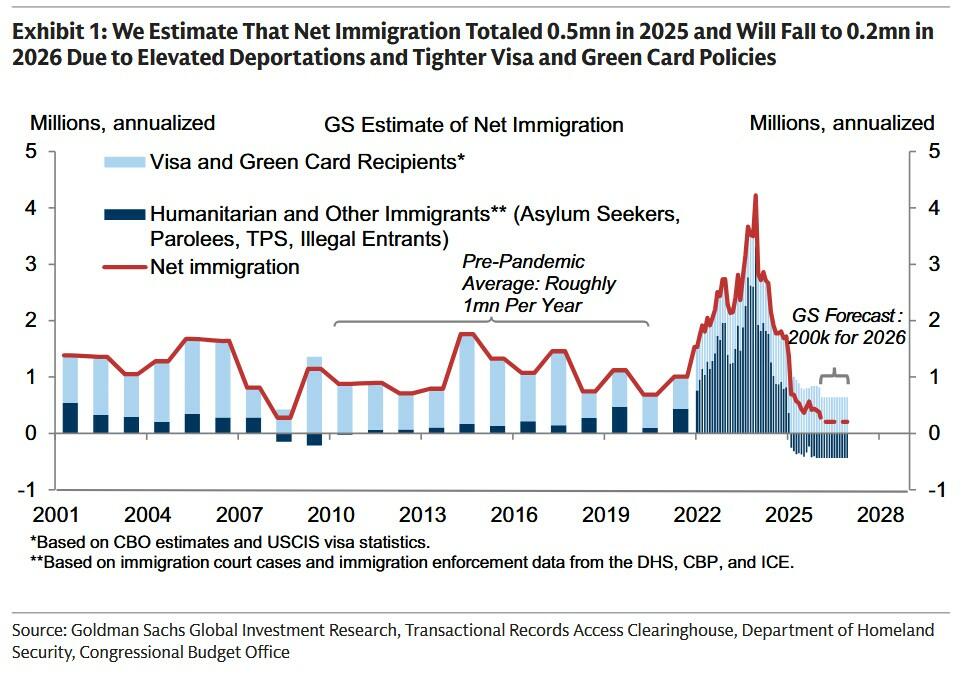
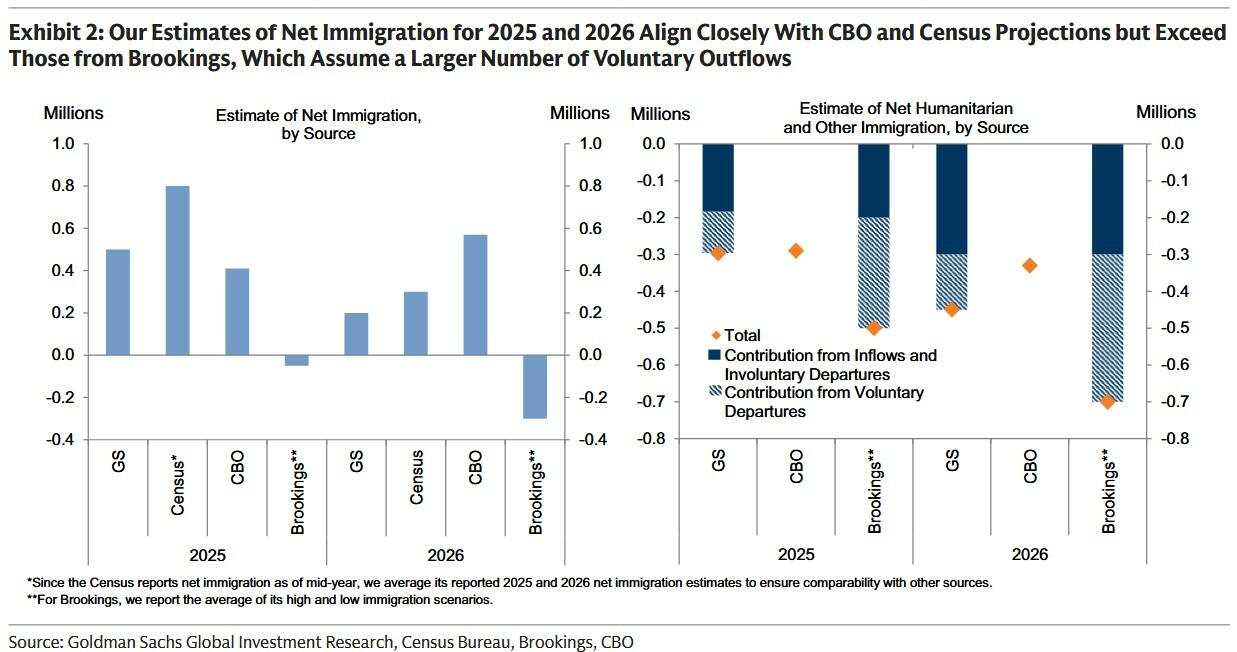
 After a flood of more than 10.8 million illegal immigrants (official figure) entered the United States under Biden, net immigration - both legal and illegal - has gone from roughly one million people per year in the 2010s to around 500,000 in 2025, with a further drop to just 200,000 projected by Goldman for 2026. This has sharply reduced labor-force growth and lowered the economy's "breakeven" pace of job creation, the bank opines.
 Here's Goldman vs. Brookings vs. the Congressional Budget Office on net immigration:
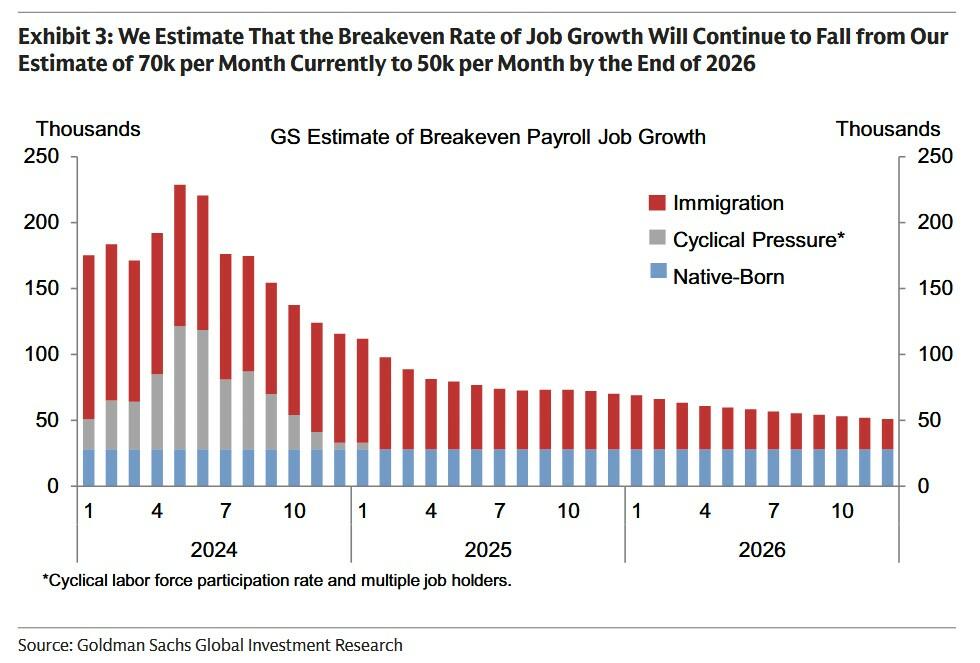
 Now, the US will only need around 50,000 new jobs per month by the end of this year to keep the unemployment rate from rising, down from roughly 70,000 today.
 At the same time, Goldman says labor demand still looks "shaky" because job growth is narrow and job openings are trending lower - with the main downside risk being a faster, more disruptive AI-driven adjustment that could tamp down hiring or raise job losses beyond current estimates.
Elevated deportations, tighter visa / green-card policies, a pause in immigrant visa processing that affects dozens of countries, and the loss of Temporary Protected Status for some groups, Goldman suggests there is additional downside risk to the workforce.
At the same time, Goldman says labor demand still looks "shaky" because job growth is narrow and job openings are trending lower - with the main downside risk being a faster, more disruptive AI-driven adjustment that could tamp down hiring or raise job losses beyond current estimates.
Elevated deportations, tighter visa / green-card policies, a pause in immigrant visa processing that affects dozens of countries, and the loss of Temporary Protected Status for some groups, Goldman suggests there is additional downside risk to the workforce.
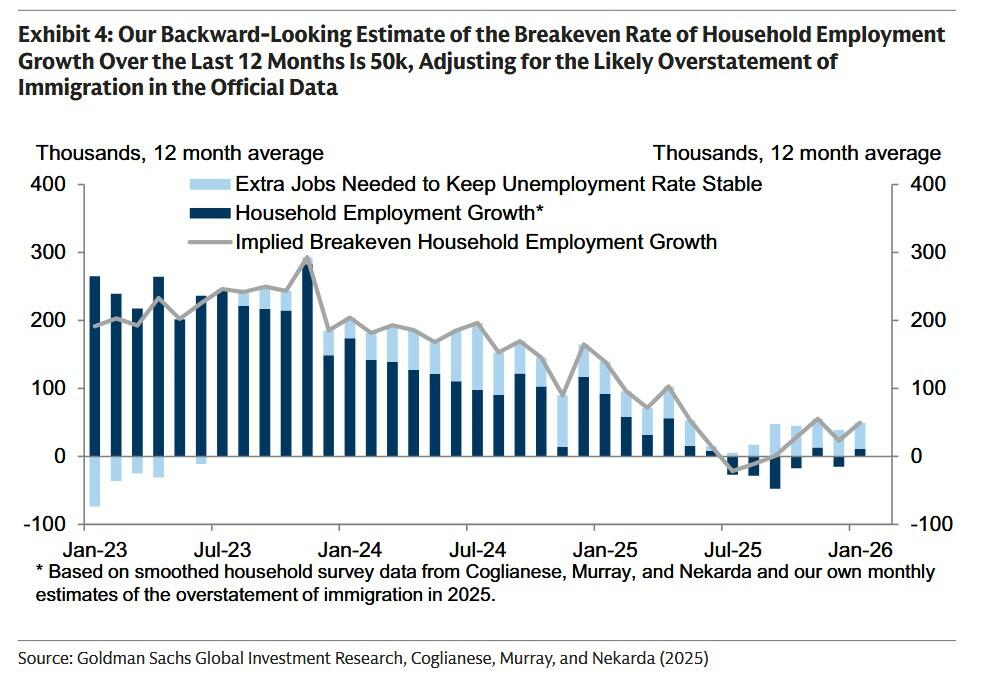 A shakier demand picture
Of course, new math on the labor supply doesn't mean the labor market is strong (duh)... In fact, Goldman describes demand as “shaky,” writing that job growth has become increasingly narrow - dominated by healthcare - and that job openings have continued to fall. Openings are now around seven million, below pre-pandemic levels and still declining.
A shakier demand picture
Of course, new math on the labor supply doesn't mean the labor market is strong (duh)... In fact, Goldman describes demand as “shaky,” writing that job growth has become increasingly narrow - dominated by healthcare - and that job openings have continued to fall. Openings are now around seven million, below pre-pandemic levels and still declining.
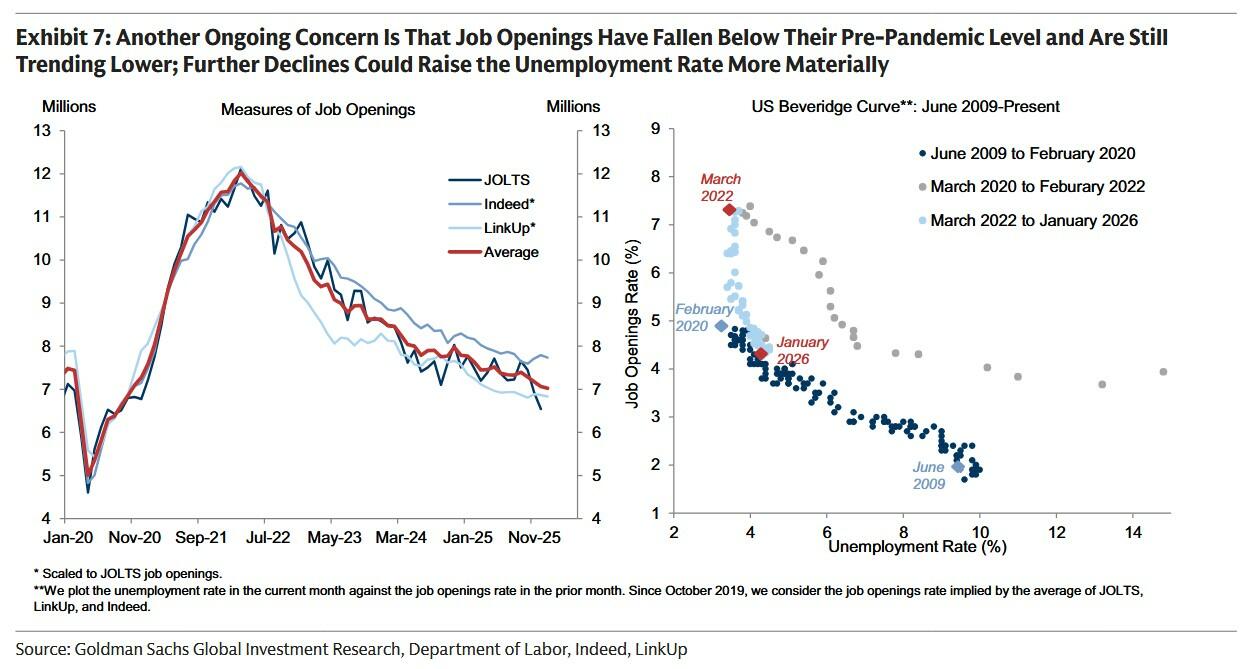 Because fewer new workers are entering the economy, hiring no longer needs to run as hot to prevent unemployment from drifting higher. “A small pickup is all that should be needed to sustain job growth at the breakeven pace,” according to the report, arguing that weaker-looking payroll numbers may increasingly mask a labor market that is merely treading water rather than deteriorating.
Official data from the Bureau of Labor Statistics show a similar trend, with job openings drifting toward the mid-six-million range late last year. A continued slide in openings, Goldman warns, would increase the risk that unemployment rises more meaningfully, even with slower labor-force growth.
There is also a risk that tighter immigration enforcement is pushing more workers into informal or off-the-books employment. If so, official payroll data could understate the true level of labor-market activity, complicating the Federal Reserve’s task of gauging economic momentum.
AI looms as the wildcard
Goldman sees artificial intelligence (AI) as the largest downside risk to the labor outlook - not because it has already triggered mass layoffs, but because it may restrain hiring at the margin. So far, the firm estimates that AI-related substitution has shaved only 5,000 to 10,000 jobs from monthly growth in the most exposed industries. But a faster or more disruptive deployment could weigh more heavily on demand.
...the main reason that we worry about downside risk to our baseline forecast that the labor market will stabilize going forward is the possibility of a faster and more disruptive deployment of artificial intelligence (AI). While plenty of recent anecdotes point to a potentially faster rate of adoption and corresponding job losses, it is hard to know how these will translate to macroeconomic outcomes. -Goldman
The bank shows that job growth has slowed and turned slightly negative in several subindustries where AI is most ready to deploy, while company-level anecdotes indicate that AI is already reducing the need for workers. The impact, while visible, remains 'moderate' so far.
Because fewer new workers are entering the economy, hiring no longer needs to run as hot to prevent unemployment from drifting higher. “A small pickup is all that should be needed to sustain job growth at the breakeven pace,” according to the report, arguing that weaker-looking payroll numbers may increasingly mask a labor market that is merely treading water rather than deteriorating.
Official data from the Bureau of Labor Statistics show a similar trend, with job openings drifting toward the mid-six-million range late last year. A continued slide in openings, Goldman warns, would increase the risk that unemployment rises more meaningfully, even with slower labor-force growth.
There is also a risk that tighter immigration enforcement is pushing more workers into informal or off-the-books employment. If so, official payroll data could understate the true level of labor-market activity, complicating the Federal Reserve’s task of gauging economic momentum.
AI looms as the wildcard
Goldman sees artificial intelligence (AI) as the largest downside risk to the labor outlook - not because it has already triggered mass layoffs, but because it may restrain hiring at the margin. So far, the firm estimates that AI-related substitution has shaved only 5,000 to 10,000 jobs from monthly growth in the most exposed industries. But a faster or more disruptive deployment could weigh more heavily on demand.
...the main reason that we worry about downside risk to our baseline forecast that the labor market will stabilize going forward is the possibility of a faster and more disruptive deployment of artificial intelligence (AI). While plenty of recent anecdotes point to a potentially faster rate of adoption and corresponding job losses, it is hard to know how these will translate to macroeconomic outcomes. -Goldman
The bank shows that job growth has slowed and turned slightly negative in several subindustries where AI is most ready to deploy, while company-level anecdotes indicate that AI is already reducing the need for workers. The impact, while visible, remains 'moderate' so far.
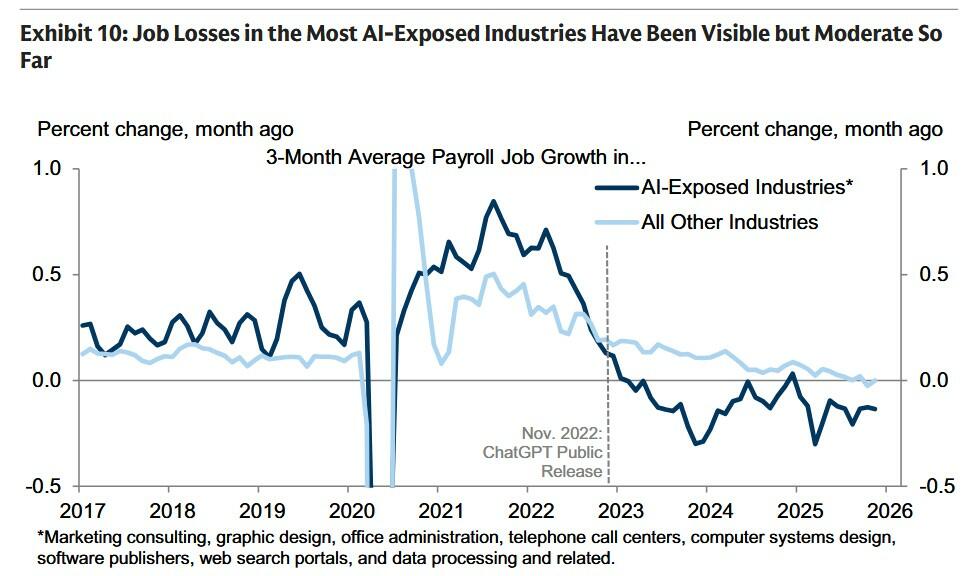 For now, the bank expects the unemployment rate to drift only modestly higher, toward 4.5%, while Goldman chief economist Jan Hatzius said in a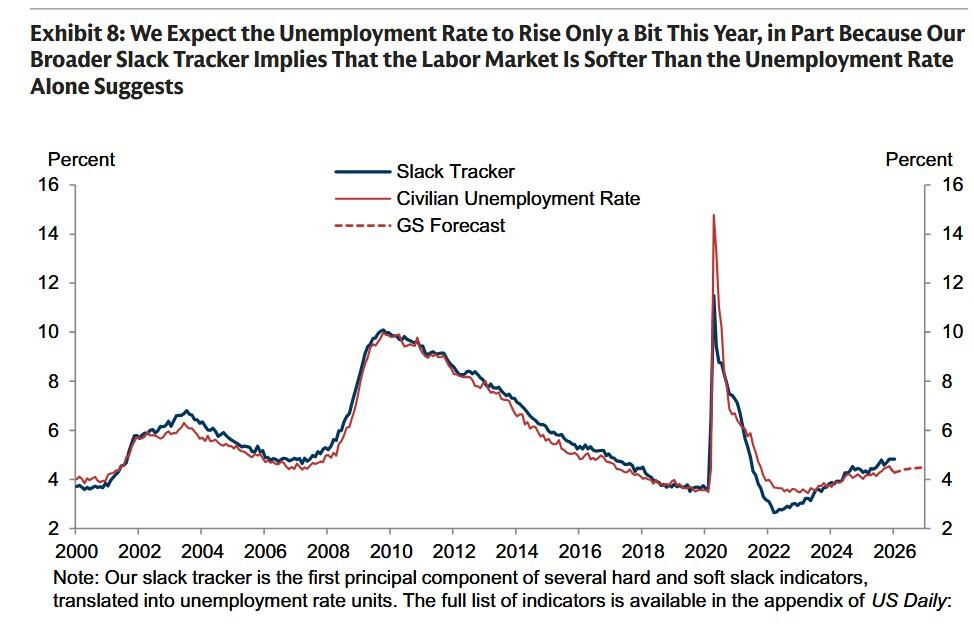
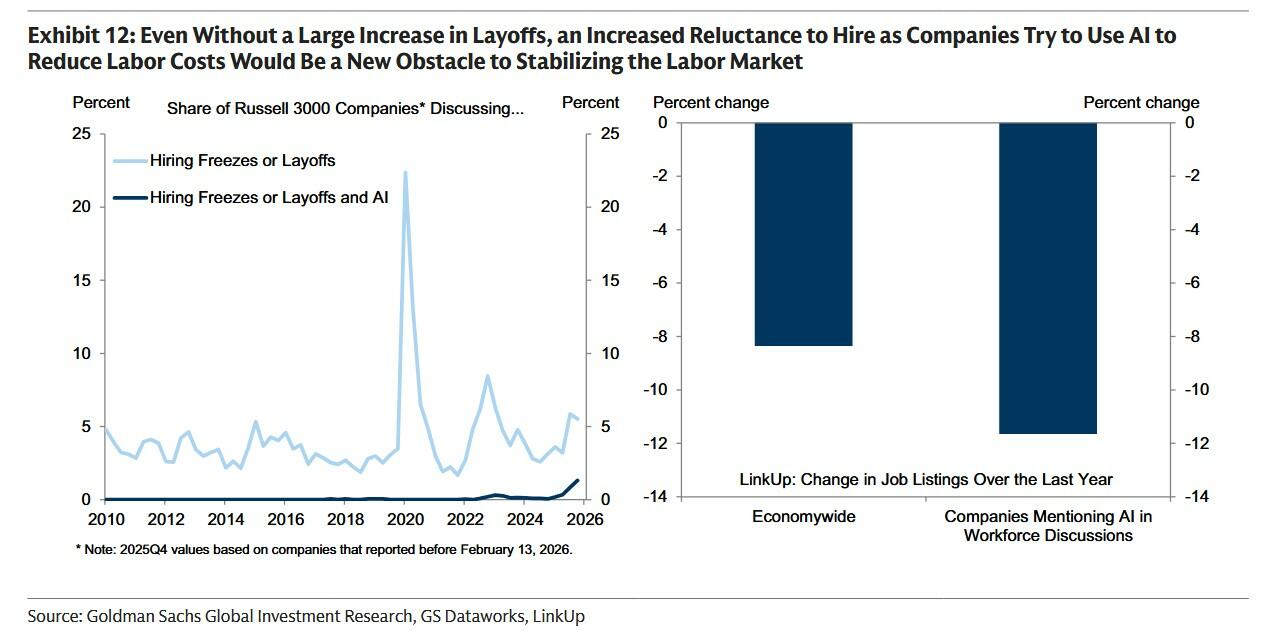


 In the face of increased pressure from U.S. sanctions, Iran and Russia have boosted their bilateral relations to strategic cooperation and Russian companies help develop oilfields in Iran.
“Within the framework of four contracts and in the field of development of oil and gas fields, we are jointly implementing the development of seven oil fields with Russian companies, and fortunately some of these projects have led to production, which is considered a valuable achievement,” Paknejad said on Wednesday, as
In the face of increased pressure from U.S. sanctions, Iran and Russia have boosted their bilateral relations to strategic cooperation and Russian companies help develop oilfields in Iran.
“Within the framework of four contracts and in the field of development of oil and gas fields, we are jointly implementing the development of seven oil fields with Russian companies, and fortunately some of these projects have led to production, which is considered a valuable achievement,” Paknejad said on Wednesday, as  One question is whether this is connected to the Pentagon's Iran-related build-up a little further to the east. WSJ notes on this, "The officials said the withdrawal was unrelated to the current U.S. deployment of naval and air forces in the Middle East for potential strikes against Iran if talks about that country’s nuclear program fail."
Another issue is the Kurds. The US for a decade trained and armed the Kurdish-dominated Syrian Democratic Forces (SDF), but now is cutting them lose. Kurdish leaders have warned of attacks by hardline Sunni militants under the new Damascus government.
"The Trump administration has decided that a U.S. military presence in Syria is no longer necessary, two U.S. officials said, because of the near-total disbandment of the Kurdish-led Syrian Democratic Forces, the main U.S. partner in countering Islamic State in Syria for the past decade," WSJ continues.
And yet US officials previously admitted to
One question is whether this is connected to the Pentagon's Iran-related build-up a little further to the east. WSJ notes on this, "The officials said the withdrawal was unrelated to the current U.S. deployment of naval and air forces in the Middle East for potential strikes against Iran if talks about that country’s nuclear program fail."
Another issue is the Kurds. The US for a decade trained and armed the Kurdish-dominated Syrian Democratic Forces (SDF), but now is cutting them lose. Kurdish leaders have warned of attacks by hardline Sunni militants under the new Damascus government.
"The Trump administration has decided that a U.S. military presence in Syria is no longer necessary, two U.S. officials said, because of the near-total disbandment of the Kurdish-led Syrian Democratic Forces, the main U.S. partner in countering Islamic State in Syria for the past decade," WSJ continues.
And yet US officials previously admitted to 
 Sibblies reimbursed himself a total of $35,519 from 2021 to 2024 using cash meant for a school club, without approval or supervision from anyone besides his own secretary, according to an audit obtained by
 Larry Aronstein, the district’s former interim superintendent, told Newsday that Sibblies was paying himself back for expenses he had laid out on behalf of the school. Sibblies told Newsday the steak and lobster meal was “school-related” but declined to answer other questions.
The school board appears unsatisfied with that explanation. They appointed legal counsel in November 2025 to investigate the audit’s findings, according to Newsday.
“We know what is personal and what is for the sake of students,” board trustee Jarod Morris told Newsday. “A steak and lobster dinner in Delaware is personal.”
Separately, auditors flagged other questionable expenses at the Wyandanch Free Union School District, including a jet ski rental in Bermuda. The school district was also missing records showing how much was spent on field trips and donated to clubs.
The audit was completed in early 2025 and made public last month.
Background: Sibblies likely could have afforded his luxury meal himself. He made $192,479 in 2024, according to payroll
Larry Aronstein, the district’s former interim superintendent, told Newsday that Sibblies was paying himself back for expenses he had laid out on behalf of the school. Sibblies told Newsday the steak and lobster meal was “school-related” but declined to answer other questions.
The school board appears unsatisfied with that explanation. They appointed legal counsel in November 2025 to investigate the audit’s findings, according to Newsday.
“We know what is personal and what is for the sake of students,” board trustee Jarod Morris told Newsday. “A steak and lobster dinner in Delaware is personal.”
Separately, auditors flagged other questionable expenses at the Wyandanch Free Union School District, including a jet ski rental in Bermuda. The school district was also missing records showing how much was spent on field trips and donated to clubs.
The audit was completed in early 2025 and made public last month.
Background: Sibblies likely could have afforded his luxury meal himself. He made $192,479 in 2024, according to payroll  The UK-based fund sent a letter to Toto's board asking for more disclosure over its advanced ceramics segment, which produces electrostatic chucks used in NAND manufacturing - specifically for a process called cryogenic etching. Toto's chuck technology uses ceramics designed to remain stable at very low temperatures, which can help firmly secure silicon wafers during chip production.
According to Palliser, Toto is "the most undervalued and overlooked AI memory beneficiary," and says that the Japanese company has a five-year competitive "moat" before other companies can catch up, adding that the advanced ceramics segment could deliver 30% or more revenue growth over the next few years, "driven by Nand upgrade cycle and stable replacement demand."
Palliser also says that Toto is doing a terrible job of explaining the importance of electrostatic chucks to shareholders, and too little of the company's planned investment was devoted to growing the highly profitable segment.
The activist investor began its involvement with Toto roughly six months ago and is a top-20 shareholder in the business, according to the Financial Times. The fund's other investments include holdings in property company Tokyo Tatemono, Keisei Electric Railway, which runs trains in Tokyo, and Japan Post Holdings.
The UK-based fund sent a letter to Toto's board asking for more disclosure over its advanced ceramics segment, which produces electrostatic chucks used in NAND manufacturing - specifically for a process called cryogenic etching. Toto's chuck technology uses ceramics designed to remain stable at very low temperatures, which can help firmly secure silicon wafers during chip production.
According to Palliser, Toto is "the most undervalued and overlooked AI memory beneficiary," and says that the Japanese company has a five-year competitive "moat" before other companies can catch up, adding that the advanced ceramics segment could deliver 30% or more revenue growth over the next few years, "driven by Nand upgrade cycle and stable replacement demand."
Palliser also says that Toto is doing a terrible job of explaining the importance of electrostatic chucks to shareholders, and too little of the company's planned investment was devoted to growing the highly profitable segment.
The activist investor began its involvement with Toto roughly six months ago and is a top-20 shareholder in the business, according to the Financial Times. The fund's other investments include holdings in property company Tokyo Tatemono, Keisei Electric Railway, which runs trains in Tokyo, and Japan Post Holdings.
 Palliser thinks Toto shares could rise over 55% if it expands its advanced ceramics business, sold cross-shareholdings, and used its $496 million (¥76bn) in net cash better.
Toto is best known for its heated toilet seats and "Washlet" bidet features, however Palliser says they've "quietly evolved from a traditional domestic sanitary ware champion into a rising powerhouse in advanced ceramics for semiconductor manufacturing."
Palliser thinks Toto shares could rise over 55% if it expands its advanced ceramics business, sold cross-shareholdings, and used its $496 million (¥76bn) in net cash better.
Toto is best known for its heated toilet seats and "Washlet" bidet features, however Palliser says they've "quietly evolved from a traditional domestic sanitary ware champion into a rising powerhouse in advanced ceramics for semiconductor manufacturing."
 Shares in the company have already risen over 60% in the past year.
In late January, Goldman
Shares in the company have already risen over 60% in the past year.
In late January, Goldman 

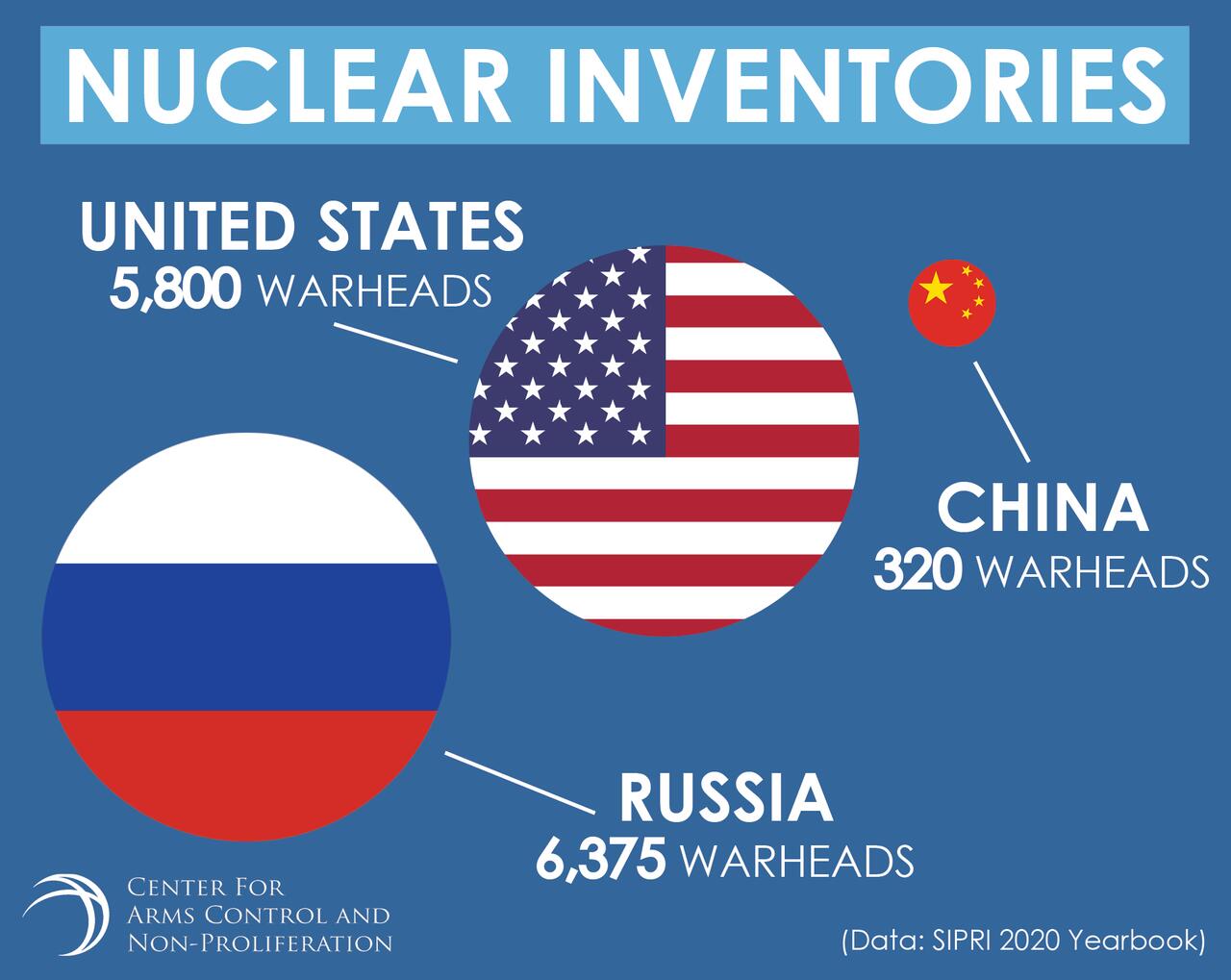 Yeaw went on to say President Trump was considering testing a nuclear weapon. The Assistant Secretary asserted the US was confident China had conducted nuclear weapons tests in recent years. Yeaw argued that the US was at an "intolerable disadvantage" if it was maintaining a nuclear test ban while other countries were testing weapons [hint, hint:
  GLP-1 starter dose NBRx trends (up to 2/6/2026)
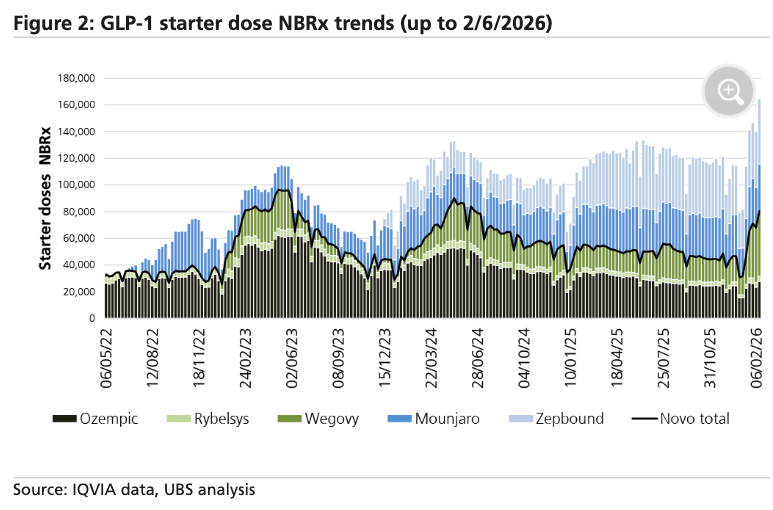 GLP-1 starter dose NBRx market share (up to 2/6/2026)
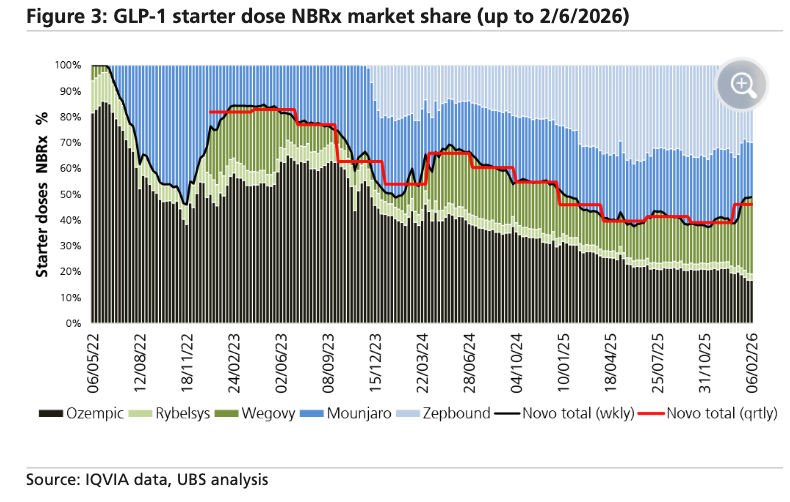 Obesity GLP-1 all doses Total Prescriptions (TRx, up to 2/6/2026)
 Weston concluded:
NBRx trends for Wegovy continue to look strong with an encouraging start to the Wegovy pill launch. The uptick in NBRx at the start of the year for Wegovy pen is also going in the right direction. Importantly, the high proportion of Wegovy NBRx pill to TRx and high proportion of Wegovy pill starter dose NBRx to total NBRx suggest that there is very little cannibalisation of Wegovy pen volumes through the pill launch. Further focus points later in the year will be Medicare coverage from July, high dose Wegovy (7.2mg) launch and competitive dynamics from LLY's orforglipron launch (UBSe April).
The latest GLP-1 headline came from Europe earlier on Tuesday, when the European Commission cleared Novo to use a higher 7.2 mg maintenance dose of Wegovy. This approval reinforces that even greater demand for semaglutide is inbound.
In markets, Novo shares in Copenhagen have been pummeled by market share losses to rival GLP-1 drugs, a public feud with Hims & Hers over copycat GLP-1 offerings, and a recently
Weston concluded:
NBRx trends for Wegovy continue to look strong with an encouraging start to the Wegovy pill launch. The uptick in NBRx at the start of the year for Wegovy pen is also going in the right direction. Importantly, the high proportion of Wegovy NBRx pill to TRx and high proportion of Wegovy pill starter dose NBRx to total NBRx suggest that there is very little cannibalisation of Wegovy pen volumes through the pill launch. Further focus points later in the year will be Medicare coverage from July, high dose Wegovy (7.2mg) launch and competitive dynamics from LLY's orforglipron launch (UBSe April).
The latest GLP-1 headline came from Europe earlier on Tuesday, when the European Commission cleared Novo to use a higher 7.2 mg maintenance dose of Wegovy. This approval reinforces that even greater demand for semaglutide is inbound.
In markets, Novo shares in Copenhagen have been pummeled by market share losses to rival GLP-1 drugs, a public feud with Hims & Hers over copycat GLP-1 offerings, and a recently  Meanwhile, Goldman analyst Faris Mourad previously told clients that "obesity drug narrative sentiment is on the rise" and "