
Revaluation Theory - 100 trillion dollar
As the 100s of trillion dollar ( may be around a quadrillion ) as per bank of international settlement there is around 700 trillion dollar worth derivatives which warren buffet pointed out as weapons of mass financial destruction
As the further inflation of dollar supply is likely to lead to inflation and hyperinflation
As the interest payment of dollar denominated debt will far exceed productivity
Every asset will have to revalued against things that are tangilble, countable, divisible, portable , durable and scarce like Gold, Silver , Bitcoin etc
Once the revaluation phase is over the holders of gold, silver and bitcoin are likely to be immensely wealthy and then the flow of real money will start again in the system. when the holders of bitcoin gold and silver will start to redistribute these items that goes up during revaluation
In this case Gold + Bitcoin + Silver Valuation should be somewhere around 80 to 100 trillion dollar ( Total Global Supply of Fiat Money )
READ MORE AT :
Medium
Dollar inflation — The opportunity of a lifetime ?
written by cryptofolyo@gmail.com | 29 Dec 2023
List of countries by number of millionaires - Wikipedia
As per the above link there are 56 million millioaires
only 1 million bitcoin accounts with more than 1 bitcoin
That means at least 55 million people may allocate 1 bitcoin into their portfolio in the coming few months of dollar hyper inflation
Medium
Dollar inflation — The opportunity of a lifetime ?
written by cryptofolyo@gmail.com | 29 Dec 2023
Only 900 bitcoins mined per day for 56 million people to compete and buy
If at least half of the 55 million millioinaires left behind is going to buy in the coming one year
Then they 27.5 million millionaires with 10% of their million or 100,000 USD allocated into bitcoin
That means 2750 billion allocation into buying 3,28,500 bitcoin mined the next one year.
That means bitcoin valuation can be 8.37 million USD per bitcoin ( 2750 billion divided by 328500 )

Generate a private key
Divide the private key into 3 shares using bitaddress.org - Split wallet method - ( I think Shamir's Secret Sharing method is used here )
Minimum share threshold needed to combine must be 2
This means if two out of the 3 shares of secret is available then the private key can be regenerated from any of the 2 out of 3 shares combined.
Share 1 = Bitcoin owners share
Share 2 = Community share
Share 3 = NOSTRKEY share
Make a specialised NOSTR Client to store and share the private key as described below.
This NOSTR client - Lets call it NOSTRKEY for now can generate a bitcoin private key and generate 3 shares for the key - NOSTRKEY client will have a NOSTR Private key and address.
In this NOSTR client the bitcoin owner can select any number of relatives/friends amongst his Multiple trusted people. Like it can be the spouse, nearest kins or friends.
Share 1 - One share of the key is kept with the owner himself or herself
Share 2 - One share of the key is kept with all the relatives/friends. This share is sent as a DM from the NOSTRKEY client to the friends and relatives etc and the share is encrypted using the friends NOSTR private key and send back as a DM to the NOSTRKEY client. So each of these
One share of the key is kept with the NOSTRKEY within NOSTR itself - The NOSTRKEY client encrypts the Share with its private key and send it as a DM to the Owner upon the key generation event.
The bitcoin owner can retrieve his private key from his own account at any time interacting with the NOSTRKEY client and combining share 1 and share 2
Suppose if the bitcoin owner lose his keys for any reason - Then he can request NOSTRKEY and any one of his friends/relatives to combine SHARE 2 and SHARE 3 to regenerate the Bitcoin Private Key
Suppose in the event of death of the owner one of the Friends or relative who is made the nominee can be transfered the bitcoin if the nominee makes a claim. In which case the SHARE 2 and SHARE 3 is combined to regenerate the private key. The nominees claim will have to be verified by 50% of the other friends and relatives added who are not nominees. So if there is one nominee and 2 friends added. then the nominee and one other friend should be making the claim
All the retrieval requests made by the friends or nominee is send to the the owner address and the regeneration event happens only after a delay of 7 days for the owner to cancel the retrieval request
The owner can retrieve the bitcoin instantly with SHARE 1 and SHARE 2
SHARE 3 can be used only with a 7 days delay on retrieval
PayPal Announcement - PyUSD stable coin from paypal integration with X ??? Is that what might be coming ???
How to promote the zapping ecosystem in SN
For each comment in this post - I zap 100

Stacker News
A zapping Experiment - 100 Zaps for each comments in this post \ stacker news
How to promote the zapping ecosystem For each comment in this post - I zap 100 Each commenter will invite someone close to them to stacker.news sha...
Each commenter will invite someone close to them to stacker.news sharing the above link.
Tell them they get their first 100 satoshis then and there as soon as they join stacker.news and comment here
Each person invited can come and comment here to receive their 100 zaps
To promote this experiment and make this post stay on top for months and years to come. Try to zap maximum for this post and make this the most zapped of all the posts for ever.
As the post popularity grows and more and more people join stacker.news the 100 zap can grow higher and higher
Lets see how many new people can be invited into stacker.news in this experiment
Lets see how high can the zapping go
Simple method to create a bitcoin wallet without internet
Step 1
Open
https://bitaddress.org
Step 2
Right click and save as to your desktop
Save as a html file in your downloads folder or any other folder
Step 3
Disconnect Internet
Step 4
Double click and open the saved HTML file in your downloads folder in any internet browser like chrome or firefox
The address will be something like this
file:///Users/yourusername/Downloads/bitaddress.org.html
Step 5
Randomly move mouse and use some random keystrokes and generate a bitcoin address
Step 6
Take a printout of the private key and the public key with the QR codes
Step 7
Store the printout in multiple locations
Step 8
Use the QR of the Public key to accept bitcoin to your address which was never connected to internet at all
Step 9
Import the old private key to a wallet like Electrum wallet which allows to import private key
Spend from that wallet.
Repeat Step 1 to Step 8 to transfer the remaining bitcoin to a newly generated wallet.
Dollar inflation — The opportunity of a lifetime ?
bit.ly/dollarhyperinflation
NOSTR based freelance job platform
Bitcoin, Gold, Silver and Ampleforth
A PATH TO BUILDING A FORTUNE IN AN ERA OF HYPERINFLATION
TLDR Summary: Dollar hyperinflation raises concerns about the global economy and the role of cryptocurrencies. Future projections suggest that cryptocurrencies may surpass the combined market capitalization of gold and silver, with bitcoin accounting for a significant portion. Stablecoins, including Ampleforth, are predicted to represent a fifth of bitcoin’s market capitalization. In this context, innovative projects like Ampleforth aim to provide an inflation-resistant stablecoin. These projects leverage Chainlink Oracle technology to adjust token supply based on external factors, ensuring stability amid market volatility. However, it is important to note that these projections are based on assumptions and estimations, subject to market fluctuations. The value distribution among assets is also expected to change, with gold, silver, bitcoin, and Ampleforth potentially experiencing significant increases. Nonetheless, these projections should be approached with caution as actual values may vary due to various factors and market dynamics.
Welcome to Cryptofolio’s Guide to Building a Fortune, where we explore the power of small investments and the journey towards wealth creation. In this empowering blog series, we unravel the secrets of accumulating riches one step at a time. Whether you are a beginner or seasoned investor, our series will equip you with valuable insights and strategies to make your money work for you.
Let’s begin by estimating the total global assets from various sources. According to Savalis research estimates, and taking into account data from the Bank of International Settlements on OTC derivatives, the dollar-denominated assets’ market capitalization is estimated to be $1,260 trillion.
Now, let’s delve into estimating the total money supply based on the properties of money discussed in a previous video. We consider gold, silver, bitcoin, and other cryptocurrencies as part of the money supply. The total money supply is estimated at $82.6 trillion. Breaking it down further, the total gold market capitalization is approximately $12.9 trillion, silver market capitalization is $1.3 trillion, and crypto market capitalization is $1.1 trillion. Therefore, there is roughly $97.9 trillion worth of money in circulation against a backdrop of $1,260 trillion worth of assets, including OTC derivatives.
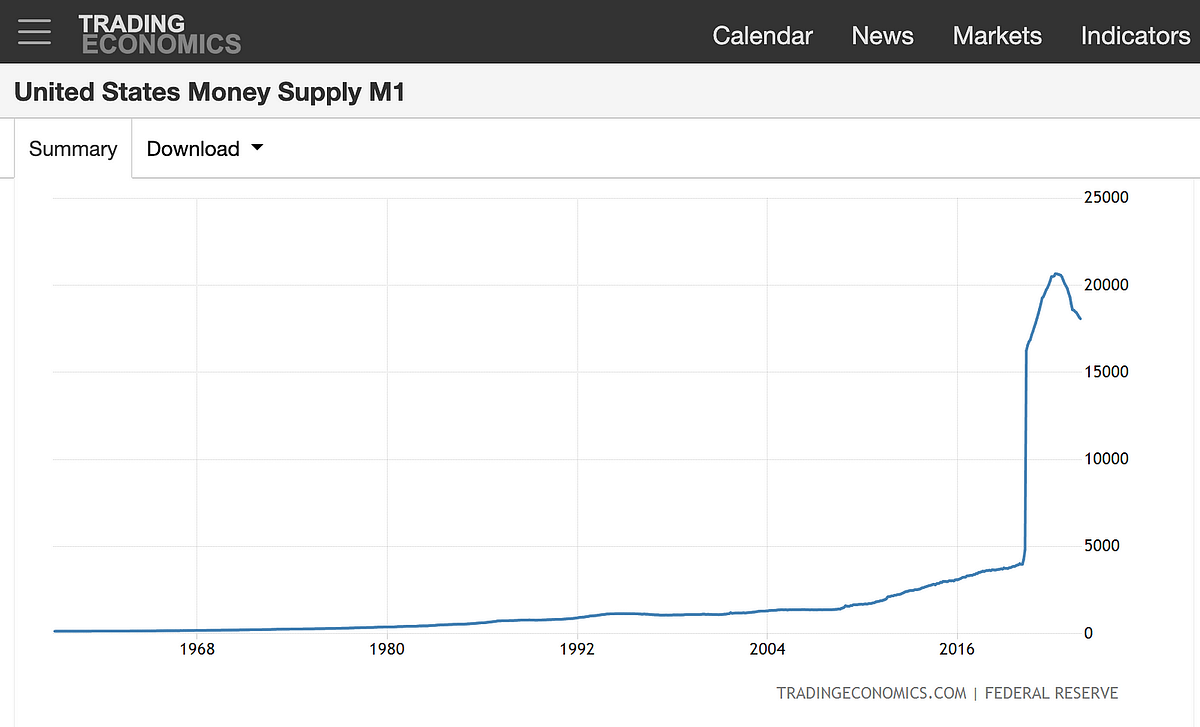
Now, let’s project the changes in the money supply following a potential dollar hyperinflation event. The chart depicting the dollar supply shows exponential growth. With increasing interest rates, the budget deficit will continue to expand, leading to a need for raising debt ceilings to meet the deficits. Consequently, the supply of dollars will have to keep increasing. This trajectory ultimately points towards hyperinflation, while bitcoin’s supply remains limited at 21 million coins.
As the supply of Dollar in the system is on a continuous rise Bitcoin emerges as a superior form of money in this scenario. As the supply of the US dollar continues to rise, concerns about inflation and the stability of traditional fiat currencies have heightened. In this scenario, Bitcoin, the pioneering cryptocurrency, emerges as a superior form of money. Its decentralized nature, limited supply, and potential to act as a hedge against inflation position it as an attractive alternative. If the dollar experiences hyperinflation, bitcoin may replace it as the natural global reserve currency. While the total money supply of $97.9 trillion may remain relatively unchanged, fiat currencies worldwide would likely suffer a significant loss in value. This implies that assets such as gold, silver, bitcoin, and other cryptocurrencies, including stablecoins, would need to be utilized for exchanging the remaining $1,260 trillion worth of assets. The market capitalization of fiat money could potentially decrease to approximately one-tenth of its current value, amounting to around $8.3 trillion in today’s terms. This substantial decline reflects the potential impact of hyperinflation on fiat currencies.
In a hypothetical scenario, the market capitalization of silver could potentially equal that of gold, based on their historical ratio of one-to-ten. As there is around 10 times silver than there is gold in terms of weight the market capitalisation of silver can approximately the same. The market capitalization of cryptocurrencies, especially bitcoin, may surpass or at least be equal to the combined market capitalization of gold and silver. This change is attributed to the superior portability and divisibility of cryptocurrencies compared to precious metals. Currently, bitcoin holds nearly 50% of the total cryptocurrency market capitalization, and this dominance trend may continue in the future. Additionally, stablecoins, such as USDT, Ampleforth, and others, are expected to maintain a significant portion of the market capitalization relative to bitcoin. As the values of bitcoin and other cryptocurrencies are prone to significant fluctuations, there is a growing demand for an inflation-resistant stablecoin that can provide stability in volatile markets for day-to-day transactions.
Among the emerging options for an inflation-resistant stablecoin, Ampleforth and Spot Cash are gaining attention. Ampleforth’s algorithmic stability, pegged to the value of 2,019 Dollar, positions it as a potential leader in the inflation-resistant stablecoin market, with a projected market capitalization capture of 50% of the Total Stable coin market. The Cantillon Effect, which refers to the uneven distribution of benefits and costs resulting from changes in the money supply, comes into play here. According to this effect, the injection of new money into an economy does not affect all individuals and sectors equally. The recipients of the new money, such as banks or government entities, tend to benefit from increased purchasing power before prices of goods and services adjust. As a result, they can acquire resources and assets at existing prices, potentially leading to wealth accumulation. Ampleforth’s unique approach aims to defy the traditional Cantillon Effect by offering an inflation-resistant stablecoin. Through adjusting its supply based on demand, Ampleforth seeks to maintain a stable purchasing power. This innovative approach provides individuals and businesses with a predictable and stable medium of exchange, potentially mitigating the wealth redistribution effects associated with central bank-issued currencies. However, the success of Ampleforth in defying the Cantillon Effect relies on market dynamics and broader economic factors.
In the early days of Bitcoin, Satoshi Nakamoto, the anonymous creator, was asked about the total amount of tokens that can be created and the possibility of adjusting the limit based on the adoption of the system. Satoshi responded that there is no central authority, like a central bank or the Federal Reserve, to adjust the money supply as the user population grows. If there was a desire to actively manage the money supply and peg it to something, it could have been programmed into the rules. This acknowledgment by Satoshi highlights the potential for a mechanism to adjust token supply based on external factors. The advent of Chainlink Oracle technology and subsequent projects like Ampleforth have introduced innovative solutions to address this need. Chainlink Oracle acts as a bridge between blockchain networks and real-world data, providing reliable and tamper-proof data feeds. By leveraging Chainlink Oracle, projects like Ampleforth have programmed rules to peg their token supply to the value of $2,019. This approach enables an inflation-resistant stablecoin that adjusts its supply based on the value of the reference currency, ensuring stability amid market volatility. Through smart contracts and the integration of external data sources, these projects offer a clever way to manage token supply and maintain a desired peg to an external value. This innovative approach fosters transparency and trust in the process, ensuring that the token supply remains aligned with the intended value peg.
Looking into future projections for the value distribution of assets, several premises are considered. Cryptocurrencies, including bitcoin, are expected to surpass the combined market capitalization of gold and silver. Gold and silver are assumed to have equal market capitalization. Fiat currencies are projected to decrease to approximately one-tenth of their current value. Bitcoin’s market capitalization is estimated to constitute half of the total cryptocurrency market capitalization. Stablecoins, including USDT and Ampleforth, are predicted to represent one-fifth of bitcoin’s market capitalization. These assumptions serve as the foundation for calculations and future projections of the value distribution among different assets. However, it is essential to note that these projections are based on assumptions and estimations, and actual values may vary in practice.
In the event of dollar hyperinflation, the projected redistributed money supply could take the following form: fiat money value may decrease to $8.26 trillion or one tenth of the current market cap, while gold and silver, assumed to have equal market capitalization, would reach approximately $22.41 trillion each. Cryptocurrencies, including bitcoin and other crypto assets, are projected to have a combined market capitalization of $44.82 trillion. Summing up the values of fiat money, gold, silver, and cryptocurrencies, the total money supply would amount to $97.9 trillion, which aligns with the current total money supply including fiat currencies, gold, silver, and cryptocurrencies. It is important to remember that these projections are based on assumptions and estimations, and the actual redistributed money supply may vary depending on various factors and market dynamics.
Considering the future market capitalization of cryptocurrencies after dollar hyperinflation, the combined market capitalization of all cryptocurrencies is projected to be $44.82 trillion. Within this figure, bitcoin is expected to account for half of the total cryptocurrency market capitalization, estimated at $22.41 trillion. Stablecoins, representing one-fifth of bitcoin’s market capitalization, are projected to contribute approximately $4.48 trillion. The remaining market capitalization of $17.93 trillion is allocated to other cryptocurrencies apart from bitcoin and stablecoins. These projections are subject to assumptions and estimations and may vary in actual scenarios. It is worth noting that around half of the projected market capitalization for cryptostable coins is likely to be attributed to an inflation-resistant stablecoin like Ampleforth or Spot cash. Given the volatility and uncertainty in the crypto market, the demand for inflation-resistant stablecoins offering price stability and inflation protection is anticipated to increase. However, these projections should be regarded as speculative and subject to market fluctuations.
Lastly, the future projected values of different assets. Based on the above assumptions Gold is expected to rise to $3,391 per ounce, silver to $396 per ounce, bitcoin to $1.16 million per bitcoin, and Ampleforth, represented by wrapped AMPL, to $224,000. These estimates reflect potential increases in value based on factors such as market demand, historical ratios, and the unique characteristics of each asset. However, it is crucial to remember that these projections are speculative and subject to market fluctuations.
In conclusion, the article explores the potential impact of dollar hyperinflation on the global economy and the role of cryptocurrencies in such a scenario. It presents calculations and projections based on assumptions and estimations, highlighting the potential value distribution among different assets. While these projections provide insights into possible outcomes, they should be approached with caution as the actual values may vary due to various factors and market dynamics. The emergence of innovative solutions, such as Ampleforth and Chainlink Oracle, offers new approaches to managing token supply and maintaining stability in the crypto market. As the future unfolds, it will be interesting to see how these projections align with the actual developments in the financial landscape.
View quoted note →
Imagine the possibility of clustering these highlights under various popular hashtags
View quoted note →
NOSTR is already better than twitter
Purple Text
Orange Highlights
And lightning tips
Content is the new king
https://bit.ly/ifcontent@jack
@fiatjaf
DAMUS banned on APPLE STORE
We need a custom built OS as well based out of android may be.
#NOSTROS
The inflation resistant Stable Coin
Target price for Bitcoin calculated to be 1.16 million USD
Target price for gold @ 3391
Target price for Silver @ 396
Target price for wrapped AMPL @ 224000
A Path to Building a Fortune in an Era of Hyperinflation
GOLD, SILVER, BITCOIN and AMPLEFORTH
Target price for Bitcoin calculated to be 1.16 million USD
Target price for gold @ 3391
Target price for Silver @ 396
Target price for wrapped AMPL @ 224000
TLDR Summary: Dollar hyperinflation raises concerns about the global economy and the role of cryptocurrencies. Future projections suggest that cryptocurrencies may surpass the combined market capitalization of gold and silver, with bitcoin accounting for a significant portion. Stablecoins, including Ampleforth, are predicted to represent a fifth of bitcoin's market capitalization. In this context, innovative projects like Ampleforth aim to provide an inflation-resistant stablecoin. These projects leverage Chainlink Oracle technology to adjust token supply based on external factors, ensuring stability amid market volatility. However, it is important to note that these projections are based on assumptions and estimations, subject to market fluctuations. The value distribution among assets is also expected to change, with gold, silver, bitcoin, and Ampleforth potentially experiencing significant increases. Nonetheless, these projections should be approached with caution as actual values may vary due to various factors and market dynamics.
Welcome to Cryptofolio's Guide to Building a Fortune, where we explore the power of small investments and the journey towards wealth creation. In this empowering blog series, we unravel the secrets of accumulating riches one step at a time. Whether you are a beginner or seasoned investor, our series will equip you with valuable insights and strategies to make your money work for you.
Let's begin by estimating the total global assets from various sources. According to Savalis research estimates, and taking into account data from the Bank of International Settlements on OTC derivatives, the dollar-denominated assets' market capitalization is estimated to be $1,260 trillion.
Now, let's delve into estimating the total money supply based on the properties of money discussed in a previous video. We consider gold, silver, bitcoin, and other cryptocurrencies as part of the money supply. The total money supply is estimated at $82.6 trillion. Breaking it down further, the total gold market capitalization is approximately $12.9 trillion, silver market capitalization is $1.3 trillion, and crypto market capitalization is $1.1 trillion. Therefore, there is roughly $97.9 trillion worth of money in circulation against a backdrop of $1,260 trillion worth of assets, including OTC derivatives.
Now, let's project the changes in the money supply following a potential dollar hyperinflation event. The chart depicting the dollar supply shows exponential growth. With increasing interest rates, the budget deficit will continue to expand, leading to a need for raising debt ceilings to meet the deficits. Consequently, the supply of dollars will have to keep increasing. This trajectory ultimately points towards hyperinflation, while bitcoin's supply remains limited at 21 million coins.
As the supply of Dollar in the system is on a continuous rise Bitcoin emerges as a superior form of money in this scenario. As the supply of the US dollar continues to rise, concerns about inflation and the stability of traditional fiat currencies have heightened. In this scenario, Bitcoin, the pioneering cryptocurrency, emerges as a superior form of money. Its decentralized nature, limited supply, and potential to act as a hedge against inflation position it as an attractive alternative. If the dollar experiences hyperinflation, bitcoin may replace it as the natural global reserve currency. While the total money supply of $97.9 trillion may remain relatively unchanged, fiat currencies worldwide would likely suffer a significant loss in value. This implies that assets such as gold, silver, bitcoin, and other cryptocurrencies, including stablecoins, would need to be utilized for exchanging the remaining $1,260 trillion worth of assets. The market capitalization of fiat money could potentially decrease to approximately one-tenth of its current value, amounting to around $8.3 trillion in today's terms. This substantial decline reflects the potential impact of hyperinflation on fiat currencies.
In a hypothetical scenario, the market capitalization of silver could potentially equal that of gold, based on their historical ratio of one-to-ten. As there is around 10 times silver than there is gold in terms of weight the market capitalisation of silver can approximately the same. The market capitalization of cryptocurrencies, especially bitcoin, may surpass or at least be equal to the combined market capitalization of gold and silver. This change is attributed to the superior portability and divisibility of cryptocurrencies compared to precious metals. Currently, bitcoin holds nearly 50% of the total cryptocurrency market capitalization, and this dominance trend may continue in the future. Additionally, stablecoins, such as USDT, Ampleforth, and others, are expected to maintain a significant portion of the market capitalization relative to bitcoin. As the values of bitcoin and other cryptocurrencies are prone to significant fluctuations, there is a growing demand for an inflation-resistant stablecoin that can provide stability in volatile markets for day-to-day transactions.
Among the emerging options for an inflation-resistant stablecoin, Ampleforth and Spot Cash are gaining attention. Ampleforth's algorithmic stability, pegged to the value of 2,019 Dollar, positions it as a potential leader in the inflation-resistant stablecoin market, with a projected market capitalization capture of 50% of the Total Stable coin market. The Cantillon Effect, which refers to the uneven distribution of benefits and costs resulting from changes in the money supply, comes into play here. According to this effect, the injection of new money into an economy does not affect all individuals and sectors equally. The recipients of the new money, such as banks or government entities, tend to benefit from increased purchasing power before prices of goods and services adjust. As a result, they can acquire resources and assets at existing prices, potentially leading to wealth accumulation. Ampleforth's unique approach aims to defy the traditional Cantillon Effect by offering an inflation-resistant stablecoin. Through adjusting its supply based on demand, Ampleforth seeks to maintain a stable purchasing power. This innovative approach provides individuals and businesses with a predictable and stable medium of exchange, potentially mitigating the wealth redistribution effects associated with central bank-issued currencies. However, the success of Ampleforth in defying the Cantillon Effect relies on market dynamics and broader economic factors.
In the early days of Bitcoin, Satoshi Nakamoto, the anonymous creator, was asked about the total amount of tokens that can be created and the possibility of adjusting the limit based on the adoption of the system. Satoshi responded that there is no central authority, like a central bank or the Federal Reserve, to adjust the money supply as the user population grows. If there was a desire to actively manage the money supply and peg it to something, it could have been programmed into the rules. This acknowledgment by Satoshi highlights the potential for a mechanism to adjust token supply based on external factors. The advent of Chainlink Oracle technology and subsequent projects like Ampleforth have introduced innovative solutions to address this need. Chainlink Oracle acts as a bridge between blockchain networks and real-world data, providing reliable and tamper-proof data feeds. By leveraging Chainlink Oracle, projects like Ampleforth have programmed rules to peg their token supply to the value of $2,019. This approach enables an inflation-resistant stablecoin that adjusts its supply based on the value of the reference currency, ensuring stability amid market volatility. Through smart contracts and the integration of external data sources, these projects offer a clever way to manage token supply and maintain a desired peg to an external value. This innovative approach fosters transparency and trust in the process, ensuring that the token supply remains aligned with the intended value peg.
Looking into future projections for the value distribution of assets, several premises are considered. Cryptocurrencies, including bitcoin, are expected to surpass the combined market capitalization of gold and silver. Gold and silver are assumed to have equal market capitalization. Fiat currencies are projected to decrease to approximately one-tenth of their current value. Bitcoin's market capitalization is estimated to constitute half of the total cryptocurrency market capitalization. Stablecoins, including USDT and Ampleforth, are predicted to represent one-fifth of bitcoin's market capitalization. These assumptions serve as the foundation for calculations and future projections of the value distribution among different assets. However, it is essential to note that these projections are based on assumptions and estimations, and actual values may vary in practice.
In the event of dollar hyperinflation, the projected redistributed money supply could take the following form: fiat money value may decrease to $8.26 trillion or one tenth of the current market cap, while gold and silver, assumed to have equal market capitalization, would reach approximately $22.41 trillion each. Cryptocurrencies, including bitcoin and other crypto assets, are projected to have a combined market capitalization of $44.82 trillion. Summing up the values of fiat money, gold, silver, and cryptocurrencies, the total money supply would amount to $97.9 trillion, which aligns with the current total money supply including fiat currencies, gold, silver, and cryptocurrencies. It is important to remember that these projections are based on assumptions and estimations, and the actual redistributed money supply may vary depending on various factors and market dynamics.
Considering the future market capitalization of cryptocurrencies after dollar hyperinflation, the combined market capitalization of all cryptocurrencies is projected to be $44.82 trillion. Within this figure, bitcoin is expected to account for half of the total cryptocurrency market capitalization, estimated at $22.41 trillion. Stablecoins, representing one-fifth of bitcoin's market capitalization, are projected to contribute approximately $4.48 trillion. The remaining market capitalization of $17.93 trillion is allocated to other cryptocurrencies apart from bitcoin and stablecoins. These projections are subject to assumptions and estimations and may vary in actual scenarios. It is worth noting that around half of the projected market capitalization for cryptostable coins is likely to be attributed to an inflation-resistant stablecoin like Ampleforth or Spot cash. Given the volatility and uncertainty in the crypto market, the demand for inflation-resistant stablecoins offering price stability and inflation protection is anticipated to increase. However, these projections should be regarded as speculative and subject to market fluctuations.
Lastly, the future projected values of different assets. Based on the above assumptions Gold is expected to rise to $3,391 per ounce, silver to $396 per ounce, bitcoin to $1.16 million per bitcoin, and Ampleforth, represented by wrapped AMPL, to $224,000. These estimates reflect potential increases in value based on factors such as market demand, historical ratios, and the unique characteristics of each asset. However, it is crucial to remember that these projections are speculative and subject to market fluctuations.
In conclusion, the article explores the potential impact of dollar hyperinflation on the global economy and the role of cryptocurrencies in such a scenario. It presents calculations and projections based on assumptions and estimations, highlighting the potential value distribution among different assets. While these projections provide insights into possible outcomes, they should be approached with caution as the actual values may vary due to various factors and market dynamics. The emergence of innovative solutions, such as Ampleforth and Chainlink Oracle, offers new approaches to managing token supply and maintaining stability in the crypto market. As the future unfolds, it will be interesting to see how these projections align with the actual developments in the financial landscape.
Calculating Bitcoin target to 1.16 million USD
@jac
@Dries
Why gold should be an important part of the portfolio
Gold, a precious metal that has captivated humanity for centuries, holds a special place in the world of investments. In today's digital age, where cryptocurrencies are gaining popularity, why should you consider adding gold to your portfolio? Let's explore the reasons why gold is an important asset to consider.
Tangible Security
Unlike cryptocurrencies, which exist solely in the digital realm and are vulnerable to hacking or technological failures, gold is a physical and tangible asset. Holding gold in your portfolio provides a level of security that digital assets cannot match. Regardless of technological advancements or potential cyber threats, gold remains a reliable store of value. Just in case bitcoin code is having a vulnerability. The rise in gold will help to cover the dip in crypto side of the portfolio.
Stability and Diversification
Financial markets can be volatile, with unpredictable fluctuations and uncertainties. During times of economic instability, gold tends to hold its value and often experiences an increase in demand. Adding gold to your portfolio can help diversify your investments and provide stability, especially during turbulent market conditions.
Safe Haven Asset
Geopolitical events, economic crises, and currency devaluations can significantly impact financial markets. In such times, gold has often served as a safe haven, providing a hedge against economic turmoil. Its historical track record as a reliable store of wealth has made it a sought-after asset during times of uncertainty.
Intrinsic Value
Gold's value extends beyond its investment potential. It has cultural and aesthetic value, making it a desirable metal for jewelry and artistic creations. The beauty and allure of gold make it a timeless asset that transcends financial considerations.
Limited Supply and Scarcity
Gold is a limited resource, making it inherently scarce. The supply of gold is finite, and its extraction is a complex and resource-intensive process. As global demand for gold continues to rise, especially in emerging markets, its scarcity contributes to its long-term value.
It's important to note that investing in gold should be approached with careful consideration and in consultation with a financial professional. Each individual's financial goals and risk tolerance may vary, and a diversified portfolio should take into account one's unique circumstances.
In conclusion, gold offers tangible security, stability, diversification, safe haven characteristics, intrinsic value, and scarcity, making it an important asset to consider for your investment portfolio. By adding gold to your portfolio, you can enhance your investment strategy and potentially mitigate risks associated with digital assets or economic uncertainties.
Note
This article is for informational purposes only and does not constitute financial advice. It is recommended to consult with a financial professional before making any investment decisions.