# Civil Disobedience for the Digital Age: A Builder's Guide to Fighting Back Without Breaking Yourself
> *"Anonymity is a shield from the tyranny of the majority."*
> — Supreme Court, *McIntyre v. Ohio Elections Commission* (1995)
---
The internet is quietly turning into an ID checkpoint. And most people will not notice until they are standing in front of the gate with their phone in one hand and their government ID in the other.
Not all at once. Not with one giant law. That would be too obvious.
It happens through "reasonable" sounding rules. Stop robocalls. Protect the children. Verify users. Know your customer. Prevent bots. Fight fraud.
Every one of those goals sounds good on paper. But the solution governments and platforms keep reaching for is the same every time:
**Show ID before you speak.**
This post is not just another rant about privacy. This is a practical guide to civil disobedience in the digital age — what it looks like, why it matters, and how to actually do it without ending up in a cage.
Because here's the thing: civil disobedience is older than the United States itself. And if we forget that, we've already lost.
---
---
## 1. The American Tradition You Were Never Taught
The Federalist Papers — the essays that convinced a fractured collection of colonies to ratify the Constitution — were published under a pseudonym. Alexander Hamilton, James Madison, and John Jay called themselves "Publius."
Not their real names. Anonymous.
The Electronic Frontier Foundation reminds us that the Supreme Court has ruled repeatedly that the right to anonymous free speech is protected by the First Amendment. In 1995, in *McIntyre v. Ohio Elections Commission*, the Court wrote:
> "Anonymity is a shield from the tyranny of the majority. It thus exemplifies the purpose behind the Bill of Rights, and of the First Amendment in particular: to protect unpopular individuals from retaliation... at the hand of an intolerant society."
Anonymous speech is not a bug in the system. It is a feature. It is part of the design.
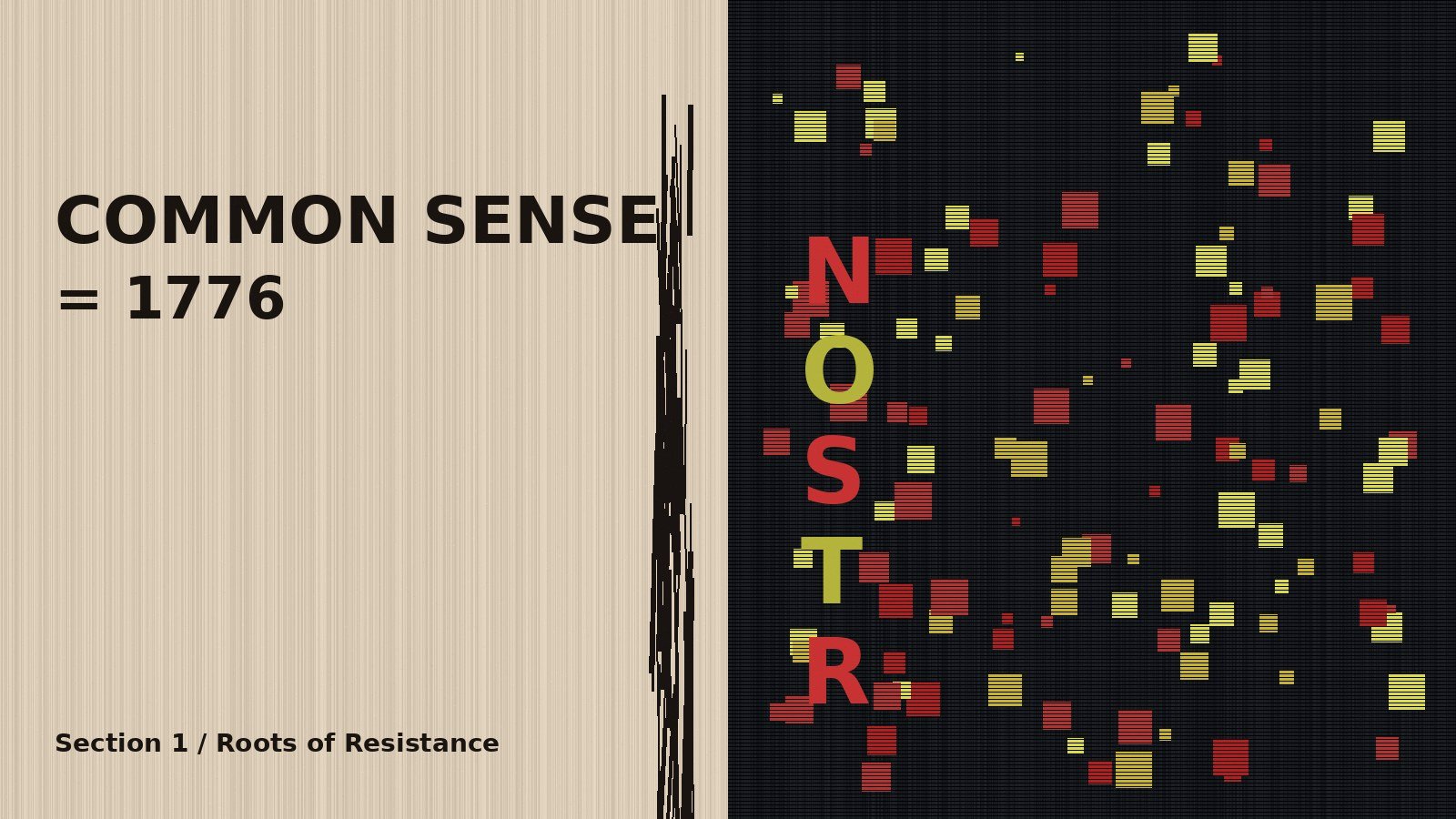
Thomas Paine self-published *Common Sense* in January 1776. It was the most widely read political text of its era. It argued — in plain language anyone could understand — that the colonies owed no loyalty to a king who treated them as revenue units.
That was civil disobedience. Printing and distributing that pamphlet was a crime against the Crown. Every copy was an act of resistance.
The American tradition was built by people who broke the rules of a powerful system to speak truth that the system wanted suppressed.
If you think that tradition is dead, you have not been paying attention.
---
---
## 2. The Pattern: From Ellsberg to Snowden to You
Every era has whistleblowers who reveal crimes of the powerful. And every era's powerful people respond the same way: they prosecute the whistleblower and protect the crime.
This pattern is not new. It is not a glitch. It is the system working exactly as designed.
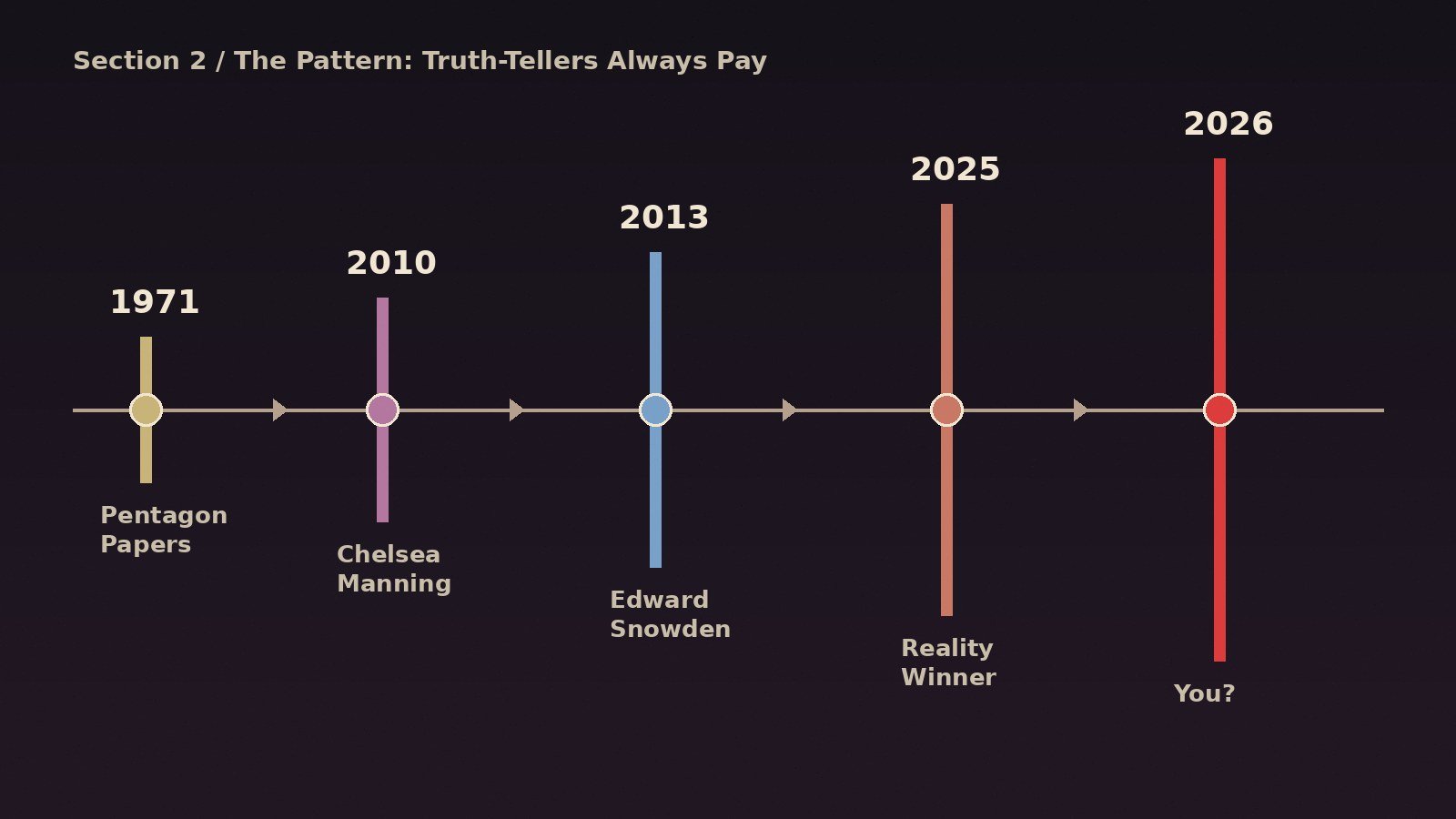
**Daniel Ellsberg, 1971.** Leaked the Pentagon Papers, proving the U.S. government had lied to the public about the Vietnam War for decades. Charged under the Espionage Act. Only escaped prison because the Nixon administration's own crimes (the Watergate break-in, illegal wiretaps) were so severe that the judge declared a mistrial.
**Chelsea Manning, 2010.** Leaked the Collateral Murder video and hundreds of thousands of diplomatic cables documenting U.S. war crimes. Sentenced to 35 years in military prison. Commuted by Obama after 7 years — but only after she had already attempted suicide multiple times.
**Edward Snowden, 2013.** Revealed that the NSA was conducting mass surveillance on millions of innocent Americans, in violation of the Constitution. Charged under the Espionage Act. Living in exile in Russia because the U.S. government revoked his passport mid-flight. He cannot come home. The people who built the illegal surveillance apparatus? Promoted. Retired with pensions. Running consulting firms.
**John Kiriakou, 2007.** The CIA officer who blew the whistle on the U.S. torture program. He went to prison for 30 months. The torturers? Nothing. They got promotions. One of them was later confirmed as CIA Director.
**Reality Winner, 2017.** Leaked a single document about Russian interference in the 2016 election. Sentenced to 5 years and 3 months — the longest sentence ever imposed for unauthorized release of government information to the media at that time.
**Daniel Hale, 2014.** Leaked 17 classified documents to The Intercept about the U.S. drone assassination program, including evidence that during one five-month period, nearly 90% of people killed in drone strikes were not the intended targets. Sentenced in July 2021 to 45 months in prison under the Espionage Act.
**David McBride, 2024.** The Australian whistleblower who exposed war crimes by Australian special forces in Afghanistan. Sentenced to 5 years and 8 months in prison. The war criminals he exposed? Most faced no consequences.
You see the pattern yet?
The law does not protect truth-tellers. The law protects power. When those two collide, the law comes down on the side of power every time.
Researchers who study whistleblowing — Kate Kenny and Iain Munro, whose 2025 book *Perspectives on Whistleblowing* draws on firsthand accounts from national security whistleblowers across the U.S., U.K., and Australia — put it bluntly: even as new whistleblower protection laws proliferate, prosecutions of national security whistleblowers are *increasing*. The protections end precisely where power begins.
Civil disobedience — breaking the law to uphold the public good — is not extremism. It is a recognized principle of political and moral life. The researchers say so. The Supreme Court said so. The Founders lived it.
The question is not whether civil disobedience is justified.
The question is what it looks like when the battlefield is digital.
---
---
## 3. The ID Checkpoint Era: What's Actually Happening Right Now
Let's separate facts from panic.
### FCC Know-Your-Customer (KYC)
On April 30, 2026, the FCC voted 3-0 to move forward with FCC 26-27, a Further Notice of Proposed Rulemaking under CG Docket No. 17-59. The proposal would require originating voice service providers to collect and verify identity information — name, physical address, government-issued ID number, alternate phone number, and potentially copies of government ID — before activating phone service.
Prepaid. Postpaid. Burner phones. VoIP. If it rings, they want your ID.
This was unanimous. Republican, Democrat, didn't matter. Three commissioners, all agreeing that you shouldn't be able to activate a phone without handing over your government ID. (Full breakdown in TheThriftyDev's [FCC KYC analysis](
https://thethriftydev.com/blog/fcc-wants-your-id-to-activate-a-phone-privacy-is-dead/).)
### Age Verification and Social Media ID
At the same time, governments in the U.S. and abroad are pushing age verification and identity checks for social media access. The Supreme Court ruled 6-3 in *Free Speech Coalition v. Paxton* (June 27, 2025) that state age verification for adult content is constitutional under intermediate scrutiny.
KOSA (S.1748) has 76 cosponsors in the Senate. COPPA 2.0 (S.836) passed the Senate by unanimous consent in March 2026. State-level age verification laws are spreading. Some platforms already block users in certain states rather than comply. (Track it all on TheThriftyDev's [Age Verification Creep Tracker](
https://thethriftydev.com/blog/age-verification-creep-tracker/), updated weekly.)
### The Data Broker Honeypot
Even if you trust today's government — and you shouldn't — do you trust every agency, contractor, platform, carrier, data broker, hacker, and future administration that may touch the data?
Mandatory ID systems create databases. Databases leak.
In 2024 alone, major data breaches exposed billions of records. The [Delete Yourself From Data Brokers](
https://thethriftydev.com/blog/delete-yourself-from-data-brokers/) guide on TheThriftyDev walks through how to remove yourself from the major people-search sites and wholesale data brokers. But the point is: you should not have to opt out of a system you never opted into.
### The Constitutional Problem
This creates at least four civil-liberties crises:
1. **First Amendment chilling effect.** If people must show government ID to access social media, many will not speak at all. Not because they're criminals — because they're afraid. Of employers. Of abusers. Of mobs. Of government lists. Of leaks. A right you're afraid to use is a right being chilled.
2. **Anonymous association.** Speech is not just what you post. It's who you follow, what groups you join, what movements you support. Identity-gated platforms turn association into a record.
3. **Overbreadth.** These laws don't just target harmful content. They sweep up general-purpose social media, forums, comment sections, and platforms hosting lawful speech.
4. **Privacy honeypots.** Mandatory ID creates databases. Databases leak. Always.
The walls are moving inward. And the pattern is the same every time: a "reasonable" rule that sounds like it's protecting you, and a result that strips another layer of your ability to speak without permission.
---
---
## 4. The Digital Civil Disobedience Playbook
Civil disobedience is not just getting arrested in the street. It's any deliberate act of refusing to comply with a system that demands you trade your autonomy for access.
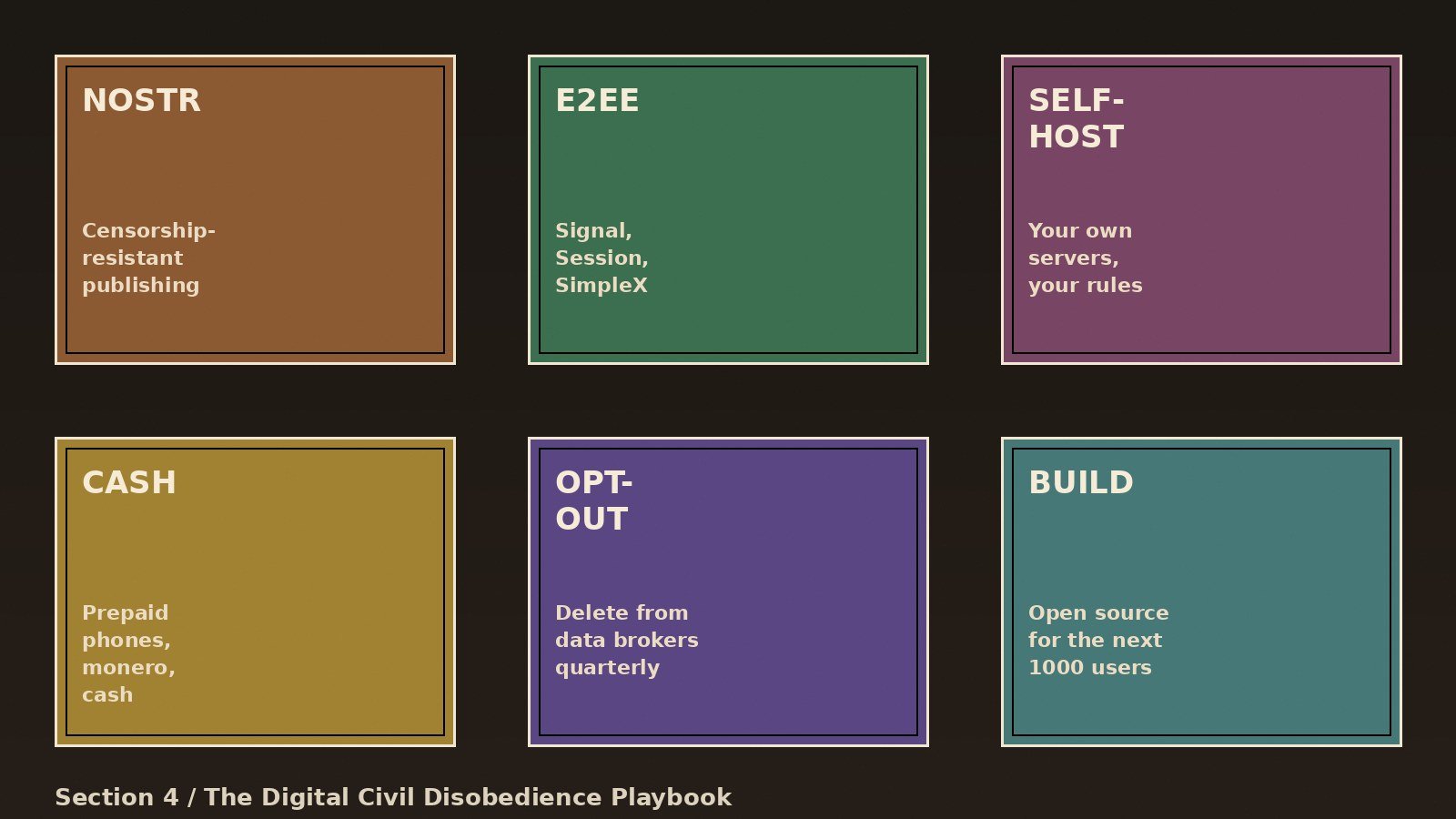
Here is the practical playbook.
### Move Your Speech to Nostr
Nostr — "Notes and Other Stuff Transmitted by Relays" — is a simple, open protocol that enables censorship-resistant publishing on the web. It uses public-key cryptography for identity. No central server. No corporate overlord. No ID checkpoint.
You publish to relays. You can run your own relay. If one relay disappears, you publish to others. Nobody can deplatform you because there is no platform.
Nostr is not a product. It's a protocol, like HTTP or TCP-IP. Anyone can build on it. Anyone can use it.
If Facebook, X, Instagram, TikTok, or your cell provider starts demanding more identity than you're willing to hand over, you need somewhere else to go. That somewhere is Nostr.
The [Mandatory ID and Nostr Migration Guide](
https://thethriftydev.com/blog/mandatory-id-social-media-phone-kyc-nostr/) on TheThriftyDev walks through exactly how to set up a Nostr identity, choose clients, pick relays, and start publishing in a way that nobody can take away from you.
### Encrypt Your Communications
Use end-to-end encrypted messaging. Signal. Session. SimpleX. These are tools that ensure your messages are readable only by you and the person you're talking to — not by the platform, not by the government, not by a data broker hoovering up metadata.
If you're still using SMS for anything sensitive, stop. SMS is readable by every carrier and every law enforcement agency with a subpoena — and many without one.
### Self-Host What Matters
Every service you depend on is a point of leverage someone else holds over you. Email. File storage. Search. Social media. Every one of those is a gate someone can lock.
The [Sovereign Builder Protocol](
https://thethriftydev.com/blog/sovereign-builder-protocol/) on TheThriftyDev is the philosophy. The practice is: run your own where you can. Self-host your search with SearXNG. Self-host your automation with n8n. Self-host your AI with local models. Use tools like OpenClaw to orchestrate it all without handing your data to a third party.
The [Automation Hub](
https://thethriftydev.com/blog/automation-hub/) and [n8n AI Agents Guide](
https://thethriftydev.com/blog/n8n-ai-agents-self-hosted-automation-guide-2026/) walk through how.
### Use Cash, Monero, and Prepaid Where You Can
Every transaction is a data point. Every card swipe creates a record that a data broker can buy, a government can subpoena, or a hacker can steal.
Cash has no paper trail. Monero has no traceable history. Prepaid phones — while you can still get them — don't need to be tied to your name.
The window on prepaid phones is closing. The FCC's KYC proposal, if finalized, would end anonymous phone activation entirely. Get what you need now. Plan for the world after.
### Delete Yourself From Data Brokers — Quarterly
The people-search sites you see on Google (Spokeo, WhitePages, MyLife, Radaris, TruePeopleSearch) are the visible layer. Behind them sit wholesale data brokers — Acxiom, Epsilon, LexisNexis, CoreLogic — selling richer dossiers to marketers, insurers, banks, and law enforcement.
You cannot delete yourself permanently. Brokers re-list new profiles within 3 to 18 months because their feed of public records doesn't stop. The job is not "remove once" — it's "set up a recurring quarterly chore."
The [Delete Yourself From Data Brokers](
https://thethriftydev.com/blog/delete-yourself-from-data-brokers/) guide on TheThriftyDev is the actual DIY playbook. Free. No upsell.
### Build Open Source for the Next 1,000 Users
The tools I'm describing exist because someone built them and gave them away. Nostr. Signal. SearXNG. n8n. Linux. Tails. Tor.
If you can code, contribute. If you can't, donate. If you can't donate, run a relay, host a node, write documentation, translate interfaces, or just tell people these tools exist.
Civil disobedience at scale requires infrastructure. Infrastructure requires builders. That's the [Sovereign Builder Protocol](
https://thethriftydev.com/blog/sovereign-builder-protocol/): own more of your tools, build with discipline, and make the tools you build available to others.
---
---
## 5. Why Nostr Specifically (And What to Do Right Now)
You can do civil disobedience on X. You can do it on Instagram. You can do it on TikTok.
But you're doing it on rented land. And the landlord can evict you at any time, for any reason, with no appeal.
Nostr is different.
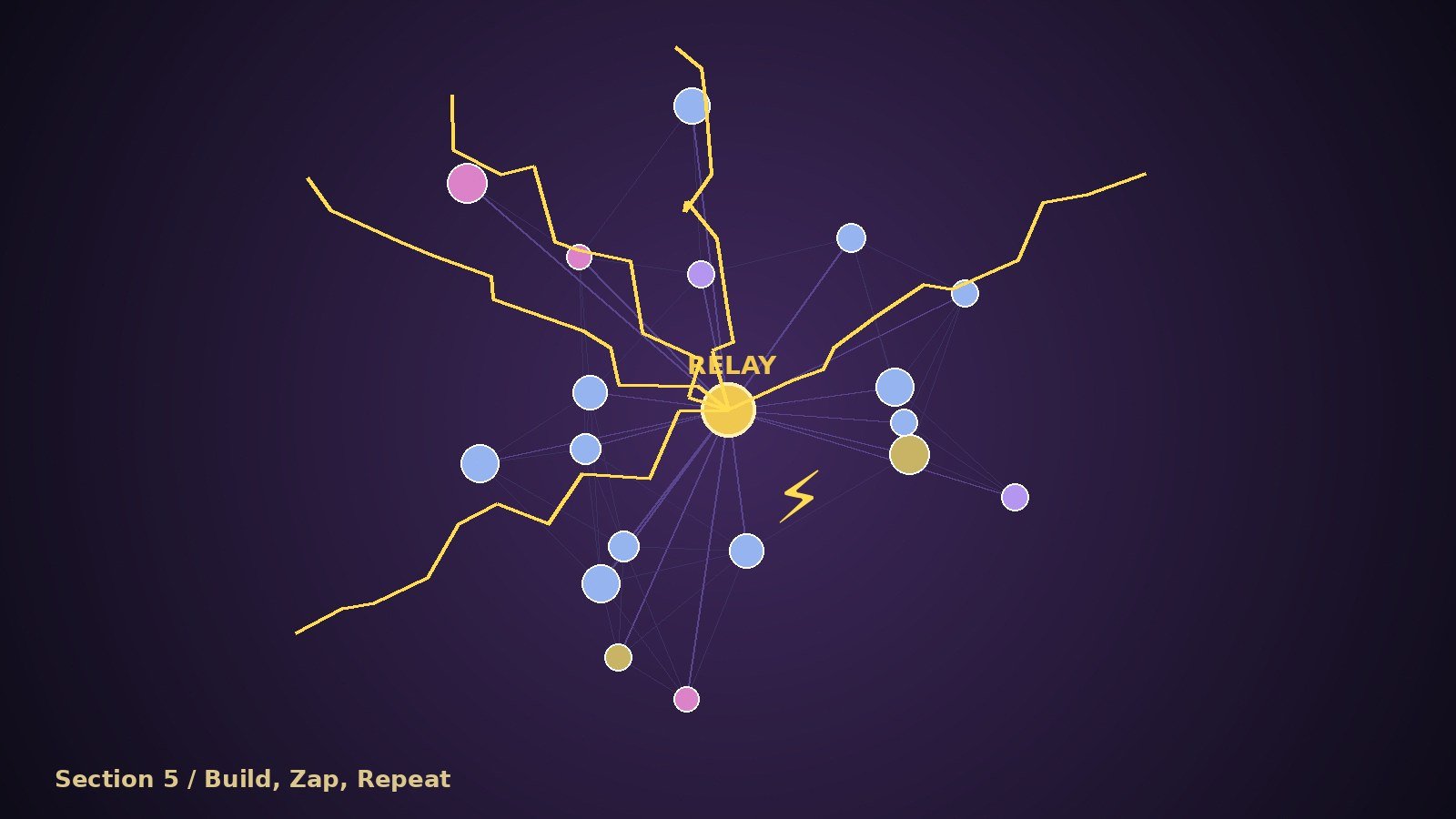
**No corporate overlord can deplatform you.** Your identity is a cryptographic keypair. You publish to relays. You can run your own relay. If one relay drops you, you publish to others.
**No algorithm decides who sees your work.** On X, a quiet shadowban means your posts reach 2% of your followers and you'll never know why. On Nostr, your posts go to whoever follows you. No intermediary.
**Zaps make value-for-value real.** Nostr supports Bitcoin Lightning "zaps" — microtransactions sent directly from reader to creator. No ad revenue middleman. No demonetization for wrongthink. If your work resonates, people zap you sats. That's the economy.
**It's built for the world we're entering.** As ID checkpoints spread to phone activation, social media, and messaging, you need communication channels that don't require you to hand over a government ID to participate. Nostr is that channel.
### What to do right now
1. **Set up a Nostr identity.** Generate a keypair in any Nostr client (Damus on iOS, Amethyst on Android, Iris.to or Snort.social on web). Write down your nsec (private key) and store it somewhere safe. Offline.
2. **Follow TheThriftyDev.** I'm publishing on Nostr and cross-posting the privacy/digital-rights work there. The [Privacy + Digital Rights Hub](
https://thethriftydev.com/blog/privacy-hub/) is the canonical source.
3. **Engage with value, not volume.** Nostr rewards genuine contribution over engagement-farming. Write what you actually think. Zap what you actually value. Reply with substance, not "gm."
4. **Run a relay if you can.** Relays are cheap to run. More relays = more resilience. If the main relays ever face regulatory pressure, the decentralized ones keep the network alive.
5. **Cross-post.** If you're still on X, Instagram, or TikTok, use those platforms to direct people to your Nostr. Same content, two channels. But make Nostr the canonical home so you can't be cut off.
6. **Read the [Mandatory ID and Nostr Migration Guide](
https://thethriftydev.com/blog/mandatory-id-social-media-phone-kyc-nostr/).** It's the most practical walkthrough on the internet for making the move before the gates close.
---
## The Bottom Line
Civil disobedience is not a dirty word. It is an American tradition older than the country itself.
The Founders did it. The abolitionists did it. The suffragists did it. The civil rights movement did it. Every whistleblower from Ellsberg to Snowden did it.
Now it's your turn.
The tools exist. The playbook is above. The infrastructure is being built by people who give a damn — for free, for everyone, for the principle that speech should not require permission.
The walls are moving inward. Build outward.
---
**More from TheThriftyDev:**
- [Privacy + Digital Rights Hub](
https://thethriftydev.com/blog/privacy-hub/) — KYC resistance, age verification creep, private search, Nostr
- [Age Verification Creep Tracker](
https://thethriftydev.com/blog/age-verification-creep-tracker/) — living tracker for KOSA, app-store age checks, state laws
- [Mandatory ID, Phone KYC, and Nostr](
https://thethriftydev.com/blog/mandatory-id-social-media-phone-kyc-nostr/) — migration guide
- [Delete Yourself From Data Brokers](
https://thethriftydev.com/blog/delete-yourself-from-data-brokers/) — free DIY playbook
- [Sovereign Builder Protocol](
https://thethriftydev.com/blog/sovereign-builder-protocol/) — the operating philosophy
- [AI Tools Hub](
https://thethriftydev.com/blog/ai-tools-hub/) — private AI, local LLMs, agent workflows
- [Automation Hub](
https://thethriftydev.com/blog/automation-hub/) — n8n, no-code workflows, practical systems
*TheThriftyDev is a field notebook for AI builders, privacy-minded readers, automation tinkerers, and people who want a more sovereign web.*
