
The first $100,000 can feel harder than the next because, early on, your contributions are doing almost all the visible work. A strong return on a small portfolio is still a small dollar amount, so steady saving can look like it isn't changing much.
As the balance grows, the same percentage return produces more dollars. At $100,000, an 8% year would add $8,000 before any new contribution. That isn't a promised return or a magic threshold. It's an illustration of when compounding can start to feel like a partner instead of background noise.
The frustrating part is that the habit has to survive long enough for the math to become noticeable. Constantly changing the plan because early progress looks slow interrupts the process that creates momentum.
Choose an amount you can contribute every payday without setting yourself up to quit. Automate it, keep earning and saving, and judge the plan over years rather than days. Your first job isn't to force a spectacular return. It's to build the base that gives future returns something meaningful to work on.
Start with $100,000: invest it in the S&P 500 for 30 years, or put 20% down on a $500,000 home. The headline outcomes look similar, but the paths are completely different.
At historical rates, the S&P 500 compounds that single investment at about 10.1%. Housing assumes 4.3% appreciation, a 6.35% mortgage, and 30 years of payments.
That's why housing can feel like a superior investment. Leverage amplifies the return on your down payment, while the mortgage forces you to keep adding capital. Your final equity reflects both the original $100,000 and decades of payments that reduce the debt.
Then add property taxes, insurance, maintenance, repairs, transaction costs, reduced liquidity, and geographic concentration. Those costs don't appear in a simple home-price chart.
I own my home and wouldn't choose otherwise. Autonomy, stability, and control over your living environment have real value. But those are lifestyle benefits, not proof that a home is always the best wealth-building asset.
Homeownership is one option, not a prerequisite for financial success. Compare the full capital commitment before deciding whether to buy, rent, or invest the difference.
Use the full 30-year comparison to evaluate your housing decision with cleaner math:

🏠 Homeward Bound
FIRE BTC Issue 61 - Is housing affordability really a crisis?
Scott Bessent’s economic-security argument rests on a simple constraint: the capacity you need in a crisis has to exist before the crisis. Factories, skilled workers, supplier networks, and inventories can look inefficient during calm periods, but they can’t be summoned overnight when a critical supply chain breaks.
The same logic applies to personal financial autonomy. A plan optimized only for the highest expected return or lowest visible cost can become fragile if it depends on one employer, one bank, one platform, or one custodian. Redundancy has a carrying cost. So does dependence when the system you rely on stops working.
Start with a dependency audit. Pick one financial function you can’t afford to lose—income, payments, liquidity, or access to bitcoin—and write down who controls it, what could interrupt it, and what backup you have today. Then improve the weakest link by one step.
Resilience isn’t the absence of efficiency. It’s the decision to preserve enough capacity and control that someone else’s failure doesn’t become your emergency.
I used to think FIRE was all-or-nothing. You're either financially free or you're not. After crossing that threshold, I realized this framing can keep you grinding after your savings start doing the heavy lifting.
A better model is the Stacking Sprint: four focused years of aggressive saving and bitcoin stacking, followed by intentional coasting. Four years lines up with bitcoin's halving cycle, is long enough to change your life, and is short enough to stay motivated.
The math changes as your stack grows. At $120,000 per bitcoin, moving from 0.1 BTC to 0.11 BTC takes $1,200. Moving from 1 BTC to 1.1 BTC takes $12,000. Going from 5 BTC to 5.5 BTC takes $60,000. The same 10% growth gets much harder, especially if bitcoin's price rises.
Front-load your effort while each contribution moves the needle most. Once you've built a strong base, let compounding carry more of the load and loosen your savings rate on purpose. Spend more on travel, hobbies, friends, or comfort without abandoning your FIRE plan.
FIRE teaches you how to save, but not how to spend. A defined sprint gives the hard part an endpoint so you can start living better before retirement.
See how the Stacking Sprint can move your transition from saving to spending forward:

🏃♂️💨 The Stacking Sprint
FIRE BTC #38 - Four years to financial freedom
Your FIRE plan can work perfectly on paper and still fail when you need access to your money.
FIRE planning focuses on savings, diversification, taxes, sequence risk, and withdrawals. But a sufficient balance doesn't guarantee control. If every asset sits behind a bank, broker, plan administrator, or custodian, each withdrawal still depends on an institution processing your request.
Usually, that arrangement works. This isn't a claim that the financial system is always hostile. The more ordinary risk is a transfer hold, compliance review, false fraud flag, trading restriction, or account closure arriving at the wrong moment. A low-probability access problem can still do real damage when your plan depends on timely access.
Self-custodied bitcoin addresses that specific gap. When you hold the keys, access to that portion of your wealth doesn't depend on a bank or broker granting permission. Bitcoin held through an exchange or ETF doesn't offer the same protection because a custodian remains in the middle.
You don't need to move your entire portfolio onto a hardware wallet. Start by mapping who controls access to each major asset, then decide whether keeping a deliberate portion outside the permissioned system improves your plan.
For years, the most expensive shoes I owned cost about $100.
Then I spent around $800 on a pair of Ferragamos. I loved them and could easily afford them, but the purchase still felt wasteful.
Years of saving had built one muscle. Buying the shoes forced me to flex another: using the money once I had enough.
FIRE gives us a clear playbook: save, invest, and let compounding work. But when the portfolio is doing most of the work, another invested dollar may add less to your life than using it while the opportunity still exists.
Ground that permission in a plan. Know how many years of expenses your portfolio could cover without growth. Keep the flexibility to earn more or cut expenses.
Then weigh financial risk against expiration risk. The money for a family trip may still exist in 20 years. This version of your family won't. Bitcoin makes every expense's opportunity cost visible, but bitcoin is money, and money is a tool.
If spending still feels wrong, start with a bounded $50 or $100 purchase you genuinely want. Notice what creates real enjoyment. Build the spending muscle with the same intention you used to build the saving muscle.
Protect the future, then use some of the freedom you built while you can:

The $800 Shoes That Changed How I Think About FIRE
FIRE BTC Issue #88 - Financial independence isn't complete until you can use the freedom you've built.
Buying shares in a bitcoin treasury company isn't the same as buying bitcoin. You're buying a corporate-finance vehicle built around bitcoin, and the wrapper can change your result.
Start with entry price. If the company trades above the value of its bitcoin holdings, bitcoin can rise while that premium compresses. If the company trades at a discount, closing that gap can add to your return. Either way, the stock has a second moving part beyond bitcoin's price.
Then look at the capital structure. Debt, preferred stock, and convertibles give other investors claims ahead of common shareholders. A long drawdown can let financing costs grind away at common equity, while restrictive debt or collateral terms can create something worse: forced bitcoin sales near the bottom. Good management may use the same tools to add bitcoin per share, but that outcome depends on execution rather than the asset alone.
So don't stop at “I’m bullish on bitcoin.” Before buying the stock, compare the company's market value with its bitcoin holdings. Then list every senior claim, its cost, and the conditions that could force a sale. If you can't explain how the wrapper behaves during a deep drawdown, you haven't finished analyzing the investment.
At some point, every serious bitcoiner asks the same practical question: how much bitcoin do I actually need?
“More” works as a meme. It doesn't work as a retirement plan. Your mortgage, groceries, insurance, taxes, healthcare, travel, and family obligations create a spending target that your assets eventually have to fund.
A rough Goalseek calculation starts with annual expenses, applies a bitcoin withdrawal rate, divides by the BTC price, and adjusts for how long bitcoin can compound before you need it. At $100,000 of annual spending and an 8% withdrawal lens, the starting dollar target is $1.25 million.
But your other assets change the answer. Stocks, cash, bonds, STRC, or rental income can cover the first retirement years while bitcoin stays untouched. That bridge gives bitcoin more time to compound and moves the target to the first year it actually has to pay your bills.
The FIRE BTC Compass connects those inputs through Goalseek to your current stack and savings pace. It shows the BTC target, projected goal year, and the additional bitcoin required to stop working sooner. The assumptions aren't guarantees, but they turn “enough” into a number you can react to.
So what BTC stack would let your current portfolio bridge you to the first bitcoin-funded year?
See how Goalseek turns your expenses, portfolio, and timeline into a usable BTC target:

🎯 Compass Pro Starts With Goalseek
FIRE BTC Issue #82 - The FIRE BTC Compass now turns your private numbers into a bitcoin retirement target.
Bitcoin made new all-time highs in 2025 and still finished the year slightly lower. Stocks and gold climbed while bitcoin languished, even as its regulatory environment, institutional access, and infrastructure improved. That outcome broke a lot of models.
A financial-independence plan will eventually meet a year that refuses to cooperate. If the plan assumes an asset must hit a certain price on schedule, volatility can push you into an emotional decision at exactly the wrong time. A probability-based plan gives you assumptions to inspect when price and fundamentals appear to diverge, without asking for blind conviction.
A disappointing return should trigger a review: Has the asset's role in your plan changed? Have the reasons you own it weakened? Did your time horizon, expenses, or need for liquidity change? If the answers are no, staying with the plan can be disciplined rather than stubborn. If the thesis broke, changing course is rational.
Start with one page. For each major asset, write down its job, the assumptions supporting it, the evidence that would invalidate your thesis, and what you'll do during a bad year. Then the market can challenge your model without making the decision for you.
Last August, I financed about $73,400 on a Lexus at 6.36% for 60 months. The payment was about $1,435.
One phone call to a local credit union cut the rate to 4.39% and the payment to $1,178. That freed $257 every month to buy bitcoin.
But I also reset the 49 months remaining on the old loan to a new 60-month term. The old payments would have totaled about $70,315. The refinance totals about $70,680—just $365 more, but spread over 11 additional payments.
With the same $1,435 monthly budget, I can now invest $257 for all 60 months instead of waiting 49 months and then investing $1,435 for the final 11. At a 0% return, keeping the old loan wins by $365. At a 10% annual return, investing earlier finishes about $3,247 ahead. At a 25% bitcoin planning assumption, it finishes about $10,741 ahead. Those are scenarios, not forecasts.
This works because the debt is fixed-rate, affordable, and backed by liquid assets I could use to pay it off. A lower payment alone proves nothing. Compare the APR, term, fees, total payments, and expected return. Then decide where the savings will actually go. The structure decides whether debt creates optionality or fragility.
See the full comparison and make the decision with real numbers:

🚗 One Phone Call. $257 More Bitcoin Every Month.
FIRE BTC Issue #87 - A real-world example of Aikido Finance—and why paying cash for your car isn't always the best move.
Bitcoin can be a household name and still be under-owned.
At a gathering of attorneys and wealth advisors serving ultra-wealthy families, every attendee had heard of bitcoin, yet 90% reported having no allocation. One room can't prove how every family office invests, but it exposes a useful distinction: awareness is not the same as adoption.
The gap often survives because bitcoin gets evaluated as an all-or-nothing bet. A portfolio decision is more practical. First ask what job the asset could do. In this case, the argument is a scarce store of value that can't be debased by issuing more units. Then ask what could break the thesis, including volatility, regulation, and your own time horizon. Only after that do you choose a position size that keeps the risk tolerable.
If you've dismissed bitcoin because everyone already knows about it, revisit the actual question. Don't ask whether you've heard of bitcoin. Ask whether you've assessed its role, risks, and appropriate size for your plan. That turns a vague feeling about being late into a decision you can defend.
A World Cup ticket has one price before the matchup is set and another after your country advances. The seat didn't improve. Attention concentrated on something scarce, certainty replaced uncertainty, and the crowd price arrived.
The mechanism reaches beyond soccer. We wait for a neighborhood to become popular, a career path to get validated, or an asset to receive institutional approval. Once the decision feels safer, we complain that the price moved. “Obvious” usually means the crowd has arrived.
The ticket isn't the full cost. It triggers flights, hotels, transportation, food, time off work, and the four-person multiplier if you're bringing the kids. The sticker price gets you in the door; the real cost follows you inside.
FIRE works by acting before flexibility feels urgent. You save and invest while the job still feels tolerable, because waiting until you need an escape plan leaves fewer options. Bitcoin presents a similar tradeoff: its scarcity existed before broad attention, but the market reprices it as awareness, access, and trust grow.
Being early to the wrong thing can lose money. Being late to the right thing has a cost too. Are you waiting for more information or for the emotional safety of being late with everyone else?
Read The Crowd Price:

⚽ The Crowd Price
FIRE BTC Issue #85 - The crowd price is what you pay for waiting until a decision feels safe.
“Bitcoin has no intrinsic value” usually means bitcoin has no future cash flows. That part is true. The mistake is treating cash flow as the only possible source of value.
A stock is a claim on a business, so expected cash flows are central to its valuation. Bitcoin is a different kind of object: a monetary network. Its case rests on the services and constraints the network provides—transparent supply rules, decentralized governance, proof-of-work security, and the ability to transfer, store, and audit ownership without relying on a single issuer. Value comes from demand for those properties and confidence that the network will remain useful.
That distinction doesn't make every bitcoin price reasonable. Monetary properties create potential demand; they don't prove future adoption or hand you a reliable price target.
So before deciding bitcoin has no value, classify the asset correctly. Don't ask what cash flows it will pay. Ask which monetary services the network provides, how durable those services are, and what level of adoption the current price assumes. The valuation is still difficult, but at least you're using questions that fit the asset.
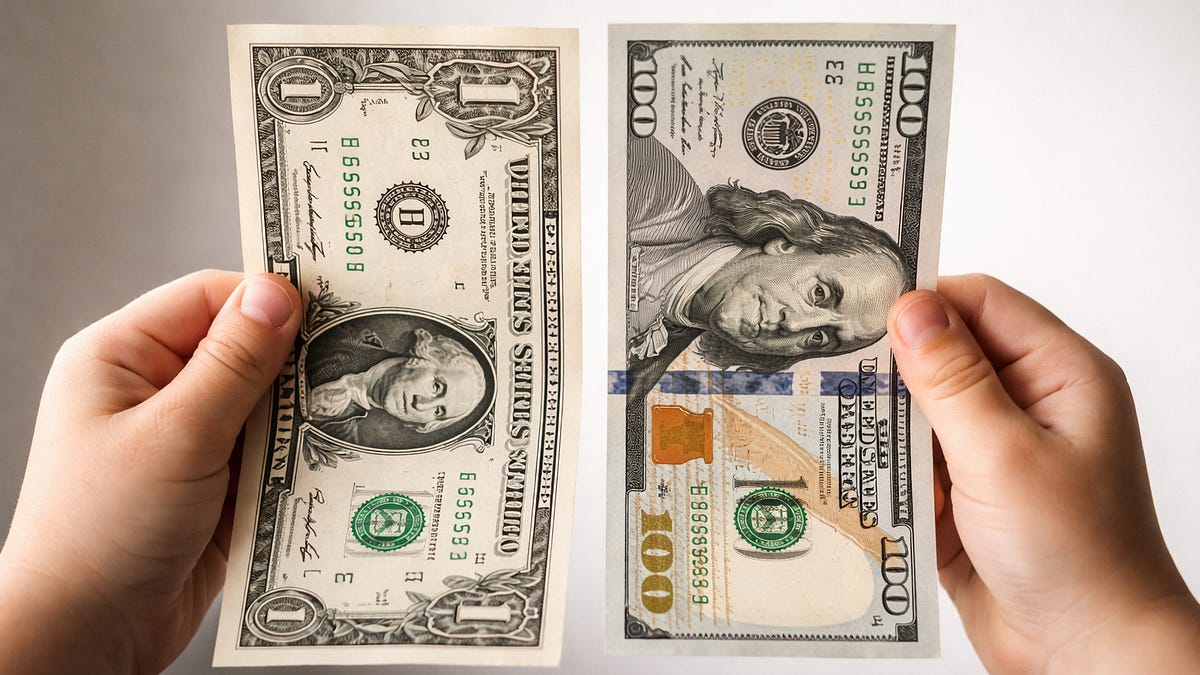
My kids recently looked at a $1 bill and a $100 bill side by side. Same paper. Same material. Only the printed numbers were different.
“Why is one worth more if they’re exactly the same?” they asked.
The answer is collective agreement. There’s no monetary value hiding in the paper. We accept that one number carries more purchasing power. Every form of money, including bitcoin, depends on that agreement.
Agreement alone isn’t enough to judge money. You also need to ask what constrains the system. Dollars have no hard supply limit. Political institutions manage their supply and can expand it in the next crisis.
Bitcoin has a hard cap of 21 million BTC enforced by thousands of independent nodes. Like chess, changing a core rule creates a different game. A node can run software that creates extra bitcoin, but the network rejects those invalid rules. Issuance also halves every four years until the final bitcoin is mined around 2140.
Both systems require belief. Only one makes scarcity a rule that no politician or central banker can change. For wealth preservation, bitcoin’s scarcity is enforced, not promised.
Read the full explanation and compare the rules behind your money:
📚 ELI-5
FIRE BTC Issue 62 - What kids see that adults ignore about money
Bitcoin's early critics had legitimate complaints. The network was inefficient, public by default, difficult to scale, and dependent on probabilistic rather than instant finality. Those weaknesses were real, but they weren't the whole design.
Bitcoin did something more polished digital-cash projects often couldn't: it kept operating without a company, sponsor, or funding round that had to survive. That changed its development path. The network didn't have to launch with every privacy, payments, storage, and usability problem solved. It could function first, attract participants, and improve over time.
Each stretch of survival didn't prove that every design choice was correct. It supplied evidence that the system could persist through technical, legal, and social pressure. That evidence could support confidence, which gave builders and users more reason to keep investing in the network.
When you evaluate bitcoin, technical elegance at a single point in time is only part of the picture. Ask whether the system can keep running without a central patron and whether its flaws can be improved without sacrificing that independence. An imperfect protocol that survives can become durable infrastructure. A perfect design that depends on a company staying alive may never get the chance.
Every morning since 2019, I’ve updated a spreadsheet with my bank accounts, bitcoin, stocks, and expenses.
The number that gave me clarity wasn’t net worth. It was my portfolio value divided by annual expenses. That multiple shows what my money can support—and how close I am to buying back my time.
That spreadsheet became the FIRE BTC Compass. Enter your annual expenses, bitcoin holdings, stocks, and income. It places you on the nine-level FIRE Spectrum, shows your milestones, and calculates how far you are from financial independence.
It also shows two targets. The traditional target uses the 4% rule: 25 times annual expenses. The BTC-adjusted target accounts for bitcoin’s different risk-reward profile and shows how a meaningful allocation changes the math. Saved snapshots track your portfolio against both targets over time.
The tool runs in your browser. There are no accounts, logins, cookies, or servers storing your financial information. Your data stays on your device because it’s nobody’s business but yours.
Net worth can rise without telling you what changed. A FIRE level, expense multiple, and visible target show where you stand and what to work toward next.
Turn your numbers into a FIRE plan:
🧭 Introducing the FIRE BTC Compass
A free tool to track your journey to financial independence
Financial independence can feel like a distant number, but the first useful input is sitting in your bank and credit card statements. You need to understand what your life actually costs.
Every recurring expense affects the plan twice. It leaves less income available to save and invest today, and it increases the portfolio value required to support your lifestyle later. That’s why intentional spending has more leverage than a generic budget exercise. You’re defining both your current savings capacity and the future your assets will need to fund.
Start with one month of spending. Review it line by line and separate what genuinely supports your life from what no longer deserves a recurring claim on your income. The goal isn’t to strip away everything you enjoy. It’s to make the tradeoff visible, choose deliberately, and set a savings rate you can sustain.
Once you know your expenses, financial independence stops being a vague ambition. You have a real input for your portfolio target and a practical way to start moving toward it.
I use AI tools every day, and I’m more convinced than ever they will transform the economy. Watching the AI trade outperform bitcoin is still hard to stomach. But a better trade isn’t automatically a better FIRE plan.
Railroads offer a warning. They transformed the economy, but overbuilding and bad financing helped trigger the Panic of 1873. The infrastructure survived and supported decades of growth. Investors in the wrong railroad, at the wrong price, with the wrong balance sheet could lose most or all of their money.
AI has the same physical problem. Data centers need chips, power, cooling, land, labor, and debt. Demand can keep rising while marginal projects fail and the next owner buys useful infrastructure at a discount. Identifying the winning technology still doesn’t tell you which security to own or what price to pay.
For FIRE, sequence matters. My Coast FIRE test is simple: can your portfolio grow to 25 times annual expenses within about five years without another contribution? If not, keep funding the core plan. If it can, cap speculative AI exposure at the amount you could lose without changing your FIRE date.
Use the full framework to decide whether AI exposure belongs in your plan:

🤖 AI Can Win and Still Crash
FIRE BTC Issue #86 - What the railroad boom explains about bitcoin's weakness and the AI investment cycle.
“Does it have intrinsic value?” sounds like a serious investing question, but it hides the decision you actually need to make.
Stocks, gold, real estate, and bitcoin aren’t valuable because value lives inside them as a fixed property. Investors value them for different kinds of utility and for what they expect other people will value in the future. A cash-flow model can inform that judgment, but it can’t turn the result into an objective property of the asset. Even the same house commands a different price in a different location.
For bitcoin, the useful questions are concrete: Does fixed supply protect against dilution? Does a global, digital network make value easier to transfer? Does holding your own keys reduce dependence on a counterparty? Those features won’t matter equally to everyone, and they don’t guarantee a particular price. They explain why the asset can be valuable to someone.
Before dismissing or buying any asset, replace “Does it have intrinsic value?” with “What utility does it provide, to whom, and what am I assuming about future demand?” That won’t eliminate speculation. It will make your speculation visible.
The standard FIRE plan assumes you’ll have 10–15 years of income to save aggressively, invest wisely, and let compounding do its work.
But your income is the fuel for that entire plan, and AI puts its useful life at risk. If your accumulation window is really 5–7 years instead of 15, debating small differences in index fund allocations misses the bigger problem.
I don’t know whether AI brings inflationary displacement, a deflationary shock, or a productivity miracle. All three point toward more government spending and money creation. AI also threatens both sides of the FIRE equation: your contributions and your portfolio assumptions.
That’s why I see bitcoin as a rational hedge across these scenarios. It has a fixed supply, no counterparty risk, no management team, and no employer dependency. I’m treating my earning window as potentially shorter, measuring progress in BTC as well as dollars, and building skills that complement AI instead of competing with it.
If AI takes longer than expected, I’ve still accumulated a scarce asset. If the window closes faster, waiting carries a much higher cost.
Read the full three-scenario stress test and decide whether your FIRE plan can survive a shorter earning window:
⏳ Your Biggest Asset Has an Expiration Date
FIRE BTC Issue #67 - AI is reshaping the economy. Here's what it means for your FIRE plan.