Trey's avatar
Trey
tshodl@nostrplebs.com
npub1m6y9...e2p9
Bitcoin + FIRE | Newsletter: firebtc.io | VP Sales @unchained
Trey's avatar
Trey 1 month ago
A New York Life survey found that nearly half of retirees age 62 to 70 wished they had retired earlier. On average, they wished they had left work about four years sooner. I get why that happens. At 60-plus, "one more year" can feel like the adult answer. Another paycheck, another year of contributions, one fewer year to fund. A basic 25x calculation may like the delay. But you're buying that comfort with years that aren't interchangeable. Early 60s health, energy, and flexibility are different from late 60s and early 70s. If you've already done the hard FIRE work, the next year at the office needs to earn its place in the plan. So run the right numbers. Spending, taxes, Roth conversion windows, withdrawal order, cash buffer, and the mix you own all belong in the decision. A bitcoin-heavy portfolio shouldn't be judged as if it's a plain 60/40, and volatility shouldn't be an excuse to ignore the upside in your plan. The question isn't whether more money would be nice. It would be. The question is whether the next year of work buys enough freedom to justify the year of freedom you give up. Read the full issue:

Trey's avatar
Trey 1 month ago
Traditional FIRE starts with a useful bargain: spend less than you earn, buy productive assets, and keep doing it until work becomes optional. That framework is one of the most useful finance ideas. It gives you a plan, a savings target, and a way to measure whether your time is still tied to a paycheck. The weak spot is the foundation underneath the spreadsheet. Most FIRE portfolios are built inside the fiat system. Dollars lose purchasing power. Tax rules change. Retirement accounts come with age restrictions, contribution limits, and withdrawal rules. Brokerages and banks work well in normal times, but they are still permissioned systems. Bitcoin adds a different tool to the plan. A self-custodied position gives you scarce, portable savings that can sit outside the institutions your index funds, real estate, and retirement accounts depend on. You can keep the parts of FIRE that work while adding an asset with asymmetric upside and direct control. If the point of FIRE is to buy back your time, the money you use should give you more freedom, not just a bigger account balance. Read the full piece:
Trey's avatar
Trey 1 month ago
The basic FIRE formula is simple. Live below your means, invest the difference, and build a portfolio large enough to cover your expenses. That framework is powerful, but it mostly measures independence in mathematical terms. Does the portfolio cover spending? Can the withdrawal rate survive? Are you diversified enough? Those are good questions. They are not the only questions. Another question is whether you can access the assets your plan depends on. Bank accounts, brokerage accounts, 401(k)s, fintech apps, and even custodied bitcoin all sit behind institutions that can delay transfers, halt activity, freeze accounts, block withdrawals, or force you into a review process. That does not mean the system is always hostile. It means access risk is real. Self-custodied bitcoin gives part of your FIRE plan a different risk profile. If you hold your own keys, that slice of wealth is not dependent on a bank, broker, exchange, or app continuing to grant permission. If financial independence is the goal, some capital should be independent in more than spreadsheet terms. Read the full piece:
Trey's avatar
Trey 1 month ago
Quantum FUD sounds technical enough to stop a serious person in his tracks. I saw this last year when an S&P 500 CEO kept returning to one blocker: what if quantum computers break bitcoin? That is a reasonable question. It is also a good example of why you have to separate headline risk from actual risk. Bitcoin uses signatures, not encryption. Nobody is decrypting your coins. The plausible quantum attack is narrower: a machine powerful enough to derive a private key from an exposed public key before the coins move. That matters for old addresses, reused addresses, and some newer address types. Modern SegWit addresses, single-use receive addresses, and moving coins from addresses you have already spent from reduce the acute exposure. The hardware gap is still huge. Public machines are around 1,000 physical qubits; Google's own estimate points to fewer than 500,000 for a bitcoin signature attack. Serious timelines cluster around the mid-2030s at earliest. I would treat it like any other FIRE tail risk: understand the exposure, reduce the easy mistakes, and keep the plan moving. Read the full piece:
Trey's avatar
Trey 1 month ago
FIRE BTC started as a simple attempt to write clearly about the intersection of bitcoin and financial independence. That intersection is still weirdly underserved. Traditional FIRE advice is useful, but it usually assumes the dollar-based investment world is the only serious game in town. Bitcoin writing is useful too, but it often skips the boring personal finance questions that determine whether someone can actually hold through volatility. The 2,000-reader mark mattered because it showed there are a lot of people trying to solve the same problem: how to build enough freedom to stop depending on a paycheck, while saving in money that cannot be printed away. Paid membership was the next step because serious work needs a foundation. More private discussion, more subscriber-only posts, more experiments, and a community of people who are thinking about time, money, family, risk, and sovereignty in public. That is the real signal. Bitcoin FIRE is not only an asset allocation. It is a different way to plan a life. Read the full piece:
Trey's avatar
Trey 1 month ago
The 4% rule is a useful starting point, not a guarantee. And it was built for a portfolio of stocks and bonds that doesn't look anything like what most of us hold. Bitcoin's drawdowns make stocks look tame. The 2017 cycle brought an 80% crash that took three years to recover, and the 2021 cycle dropped 76% over 28 months. The other factor is how you fund withdrawals. With a stock portfolio, dividends cover part of your spending automatically. With bitcoin, every dollar you need means selling. Bigger upside, bigger downside. The strategy needs to account for both. The blended portfolios perform better in the stress test because stocks get liquidated first, giving bitcoin time to recover. The non-bitcoin allocation is insurance, and like all insurance, it has a cost. So how do you decide how much insurance to carry? That depends on your risk tolerance, your timeline, and how close you are to actually needing to live off this portfolio. Bitcoin is the best asset for a FIRE approach to personal finance. But it does require a slightly different playbook. Read the full piece:
Trey's avatar
Trey 1 month ago
A common bitcoin criticism is that it has no intrinsic value, which sounds smart until you apply the same standard to everything else investors buy. A stock is not valuable because a spreadsheet says so. The spreadsheet is one person's estimate of future cash flows. Gold is not worth trillions because it makes jewelry and electronics possible. Real estate is not priced only by shelter, or the same house would cost roughly the same in Oklahoma as it does near the beach. When people say intrinsic value, they usually mean utility. The harder question is whether the utility matters to enough people. Bitcoin's utility is pretty simple. It has an absolutely fixed supply, it can move across the world without asking a bank for permission, and private keys give the holder direct control without counterparty risk. That does not make the price go up in a straight line, and it does not remove speculation. It means the market is valuing a new form of monetary utility, just like it values every other asset through human judgment about the future. Read the full piece:
Trey's avatar
Trey 1 month ago
El Salvador is a useful place to think about bitcoin because it takes the conversation out of the price chart and puts it into daily life. The country had a brutal reputation for a long time. Civil war, gang violence, and one of the highest murder rates in the world are not minor details. Then Bukele cracked down, the murder rate collapsed, investment started to show up, and in 2021 the country made bitcoin legal tender. When I visited Bitcoin Beach, the interesting part was how normal some of it felt. I paid for airport transport, food, drinks, souvenirs, and motorbike rentals with bitcoin. For the merchant, payment settles immediately and avoids the 3% card toll. For the traveler, it feels like cash without the bills and coins. It was also clearly early. Plenty of vendors still preferred dollars, and even a Wendy's with a bitcoin sign did not exactly make checkout seamless. That is probably the right lesson. Bitcoin's strongest product market fit is still saving, but global, liquid money becomes more useful when you actually move through the world. FIRE gives you more freedom to do that. Bitcoin gives you a better tool to carry with you. Read the full archive issue:
Trey's avatar
Trey 1 month ago
The 50-year mortgage idea got treated like proof that housing is broken, which is fair enough. A world where people need longer and longer loans to buy the same kind of house is not exactly a victory lap for the fiat system. But personal finance still happens inside the system we have, and the useful question is not whether a 50-year mortgage sounds morally pure. The useful question is what happens to your monthly cash flow if the payment drops and you actually invest the difference. In the example from this archive issue, a $400k mortgage at 6% falls from about $2,398/mo on a 30-year note to about $2,106/mo on a 50-year note. That frees up roughly $300/mo. If that gets spent, nothing magical happens. If it gets invested for decades, the compounding can overwhelm the slower home equity build. Mortgage payoff culture treats debt as the only risk, but illiquidity is a risk too. You cannot spend drywall in a job loss, and you cannot stack sats with money trapped in your walls. The better move is to use the tools available, run the numbers, and then decide. Read the full archive issue:
Trey's avatar
Trey 1 month ago
Golf works as a useful bitcoin analogy because nobody gets good at it by reading one thread, buying one club, or taking one lucky swing. You get better by putting in reps, making small adjustments, and learning how to keep the ball in play when conditions change. The point is to keep improving without letting ego turn a recoverable miss into a blow-up hole. Bitcoin asks for a similar kind of temperament. You need enough patience to learn why money matters, enough conviction to keep saving when the price gets uncomfortable, and enough humility to avoid the shortcuts that show up along the way. The biggest bitcoin mistakes usually don't come from failing to find the perfect entry price. They come from overswinging: trading too much, reaching for yield, trusting the wrong custodian, ignoring key management, or assuming you'll figure out inheritance later. For FIRE people, this is a useful frame. Financial independence doesn't require a heroic shot every year. It requires a plan you can execute for decades, with misses small enough that you can keep playing from the fairway. Read the archive piece here:
Trey's avatar
Trey 1 month ago
Gold was excellent money for a slower world. It was scarce, hard to fake, and nobody could create more of it because a committee decided the economy needed help. That made it a useful check on governments and banks for a very long time. But gold had a physical problem. As trade expanded, information moved faster, and commerce became global, final settlement could not stay tied to heavy metal sitting in vaults. The world needed money that could move at the speed of modern coordination, so fiat became the bridge. That bridge did its job, but it came with a cost. Fiat made money faster and more flexible, while handing creation of new money to central banks, governments, and commercial banks. Over time, that means savers get diluted, debt becomes the growth model, and long-term planning gets harder than it needs to be. This is why bitcoin belongs in the FIRE conversation. Financial independence depends on storing purchasing power across decades, not just earning a high income for a few good years. Bitcoin takes the scarce, rules-based discipline people wanted from gold and puts it into a digital form that can move globally without a vault, a bank, or a political promise. Read the full archive issue:
Trey's avatar
Trey 1 month ago
2025 was a useful stress test for any FIRE plan built around bitcoin. Coming into the year, I expected a much stronger price result. A move toward $250k would not have surprised me. Instead, bitcoin made all-time highs, chopped around, and finished slightly lower while stocks and gold moved much more cleanly. If your model needed price to cooperate on schedule, the year was annoying. Mine included. But that is exactly why the year-review piece is worth revisiting. The fundamentals improved while enthusiasm faded. Regulatory clarity improved, institutional access broadened, infrastructure got better, and adoption paths became easier to see. The price action did not reward any of that in a tidy way. That tension is useful for FIRE, because financial independence is built on probabilities, assumptions, and behavior under stress. The work is more than picking the right asset and waiting. It is knowing which parts of your plan still make sense when the market ignores your calendar. The main lesson from 2025 was simple: models are tools, not promises. When they break, you either learn from the miss or outsource your conviction to price. I wrote the 2025 year review as a guided tour through the FIRE BTC ideas that held up when price refused to cooperate:
Trey's avatar
Trey 1 month ago
Paying off a mortgage early feels responsible, which is why the argument is so sticky. You look at the payment, imagine it disappearing, and call that peace of mind. I get the appeal. Nobody likes owing money, and a paid-off house sounds like the cleanest possible version of adulting. But a fixed-rate mortgage is strange debt. Your payment is locked in for decades while dollars keep getting cheaper, your income and assets may rise, and the real burden of that loan slowly gets lighter. The bank gave you long-term leverage on an asset you were probably going to buy anyway, and the terms cannot be yanked away because markets had a bad Tuesday. The expensive part is what you give up. Extra principal payments earn whatever your mortgage rate is. That may be fine in isolation, but FIRE is about building a liquid asset base that can fund your life, cover bad years, and keep compounding while you still have choices. A paid-off house can lower a bill, but it cannot buy groceries unless you borrow against it or sell it. Bitcoin, stocks, and cash can be sold in pieces. That flexibility is security too. I wrote about why the mortgage payoff comfort story can make FIRE harder, especially when liquid assets and bitcoin are the better source of optionality:
Trey's avatar
Trey 1 month ago
Paying off a mortgage early feels responsible, which is why the argument is so sticky. You look at the payment, imagine it disappearing, and call that peace of mind. I get the appeal. Nobody likes owing money, and a paid-off house sounds like the cleanest possible version of adulting. But a fixed-rate mortgage is strange debt. Your payment is locked in for decades while dollars keep getting cheaper, your income and assets may rise, and the real burden of that loan slowly gets lighter. The bank gave you long-term leverage on an asset you were probably going to buy anyway, and the terms cannot be yanked away because markets had a bad Tuesday. The expensive part is what you give up. Extra principal payments earn whatever your mortgage rate is. That may be fine in isolation, but FIRE is about building a liquid asset base that can fund your life, cover bad years, and keep compounding while you still have choices. A paid-off house can lower a bill, but it cannot buy groceries unless you borrow against it or sell it. Bitcoin, stocks, and cash can be sold in pieces. That flexibility is security too. I wrote about why the mortgage payoff comfort story can make FIRE harder, especially when liquid assets and bitcoin are the better source of optionality:
Trey's avatar
Trey 1 month ago
I hate taxes enough to learn the rules. That may be the most FIRE sentence ever written. You spend years turning paychecks into assets, then one day the question changes from how much you can save to how much income you can create without handing a stupid amount of it back to the government. The tax code treats wages and long-term capital gains very differently. If you reach FIRE and stop earning W-2 income, you may be able to live on realized gains while staying inside the 0% long-term capital gains bracket, especially when the standard deduction is doing some work for you. This is not a reason to build your whole life around tax optimization. I still prefer a big-picture plan with enough wealth to be flexible instead of a fragile strategy that only works if every line of the tax code behaves. But FIRE people should understand the terrain. Bitcoin adds another wrinkle because it does not throw off dividends, does not force taxable distributions, and lets you choose when to realize gains. That kind of control matters when your income is no longer a paycheck. I wrote about the tax mechanics FIRE people should understand before living off investments:
Trey's avatar
Trey 1 month ago
If your retirement account needs a permission slip and a penalty schedule, it is not the same thing as financial freedom. That does not make the 401(k) useless. It is still one of the best tools in the fiat retirement system: tax advantages, high contribution limits, creditor protection, and often an employer match. If your company offers free money, take it. The mistake is pretending the 401(k) can carry the whole FIRE plan by itself. A giant balance you cannot touch until 59½ does not pay for your 40s or 50s without extra planning. Liquidity is part of the plan, not a footnote. Bitcoin changes the question again. If 401(k) plans start offering direct bitcoin access, a huge pool of automated payroll contributions begins meeting a fixed-supply asset every two weeks. That is not just another fund option. It is the retirement system learning bitcoin from the inside out: HR teams, plan providers, employees, advisors, and eventually households deciding they want real custody too. I broke down how I think about 401(k)s, liquidity, employer matches, and bitcoin access in the FIRE plan:
Trey's avatar
Trey 1 month ago
Bitcoin around $80k feels very different depending on when you bought. If you were stacking years ago, it still looks absurdly high. If you bought the ETF top, it feels like punishment. Same asset. Same network. Completely different psychology. That’s the part FIRE people need to respect. Volatility is not just a price chart problem. It is a behavior problem. Fundamentals improve while your portfolio looks worse. ETFs are live, corporate treasuries keep adding, nation states circle the asset, debt and deficits scream the thesis louder… and your screen can still be red. That gap is where conviction gets tested. Bull markets make everyone feel disciplined. Bearish stretches reveal whether you own bitcoin because you understand it, or because you expected a clean line up and to the right. For FIRE BTC, the question is not “did bitcoin go down this month?” The question is: are you still building the stack that gives your future self more options? If the answer is yes, the ugly days are not a distraction from the plan. They are part of the plan. Read the full piece here:
Trey's avatar
Trey 1 month ago
The first $100k changes how money feels. Before that, saving looks painfully linear. You cut expenses, add to the stack, check the account, and the number barely moves. At that stage, most of the progress has to come from new savings. Then the base gets big enough for compounding to become visible. A 5% move on $10,000 is dinner money. A 5% move on $100,000 is a used car. A 5% move on $1 million is a year of spending for a lot of households. That shift matters because FIRE is not just about discipline. Discipline gets the flywheel moving. Capital does the heavy lifting later. Bitcoin has the same shape. Early adoption is slow, awkward, and easy to dismiss. Then the network gets larger, liquidity improves, more serious capital can participate, and the asset becomes more useful because more people hold it. The lesson is simple: the grind is real, but it is not permanent. The early years feel like pushing a boulder. The later years feel like trying to keep up with it. Full piece:
Trey's avatar
Trey 1 month ago
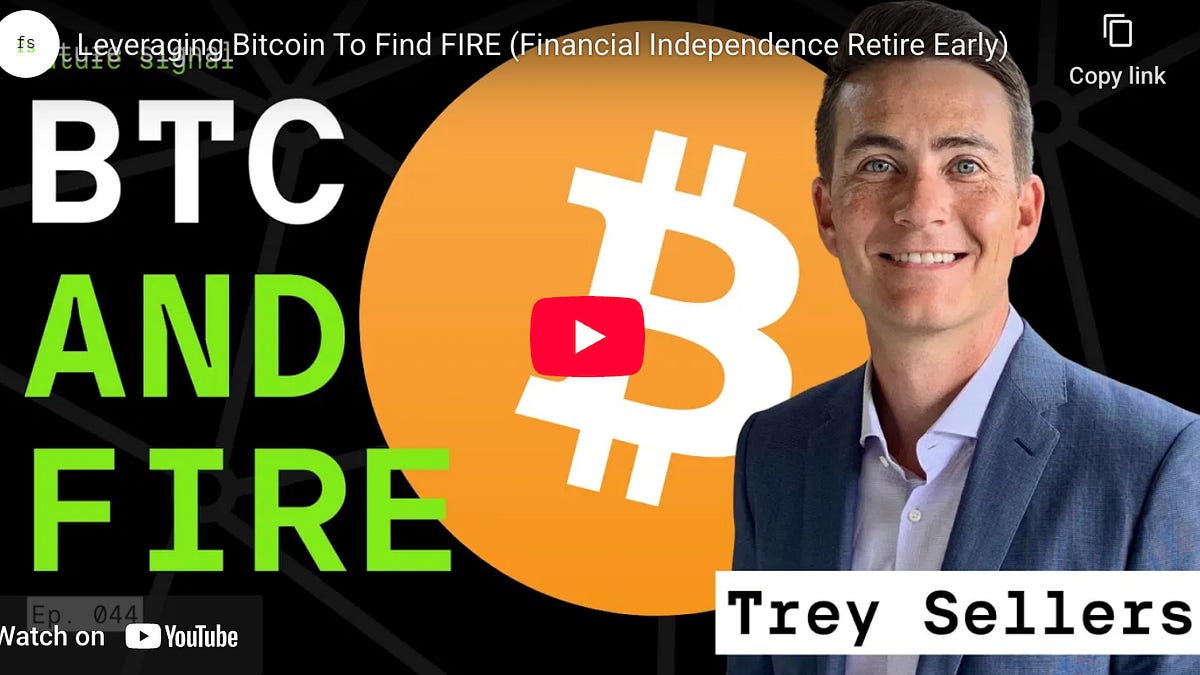
Your job title is less important than the machine your labor is building. That sounds obvious, but it changes how you think about work. The point of earning money is to convert effort into assets that can eventually support your life without needing another paycheck. Traditional FIRE gets this mostly right: spend less than you make, invest the gap, and let compounding do the heavy lifting. Bitcoin adds two things that standard FIRE usually leaves out. First, allocation should follow conviction. If you believe bitcoin has the best long-term return profile and the strongest sovereignty properties, your portfolio should reflect that instead of treating it like a tiny speculative side bet. Second, access matters. A portfolio made entirely of brokerage balances and retirement accounts still depends on intermediaries, rules, and permissioned rails. Self-custodied bitcoin gives you a form of wealth you can hold and move without asking anyone. Financial independence is stronger when your assets buy back your time and your money is actually under your control. This archive piece came from a Future Signal conversation on bitcoin, FIRE, sovereignty, and stacking with intent. Read it here:
Trey's avatar
Trey 1 month ago
Three podcast conversations forced me to explain FIRE + bitcoin from three different angles. That matters because the idea changes depending on who is asking. For the FIRE crowd, bitcoin is not just a volatile asset you bolt onto a spreadsheet. It is a savings technology that changes the timeline, the withdrawal plan, and the tradeoff between working longer and owning more time. For physicians and high-income professionals, the first breakthrough is realizing that optional work is even possible. Once that switch flips, spending, saving, career design, and custody all become part of the same financial operating system. For real estate investors, the question gets even sharper: why accept tenants, repairs, property taxes, transaction costs, and illiquidity if the goal is total return and freedom? Income sounds comforting, but total return is what compounds. Later, capital gains become your income. Different conversations. Same core point: FIRE is about buying your time back. Bitcoin is the tool that makes the math more interesting. This issue pulls together three FIRE + bitcoin podcast conversations and the arguments that kept coming up: