Trey's avatar
Trey
tshodl@nostrplebs.com
npub1m6y9...e2p9
Bitcoin + FIRE | Newsletter: firebtc.io | VP Sales @unchained
Trey's avatar
Trey 3 weeks ago
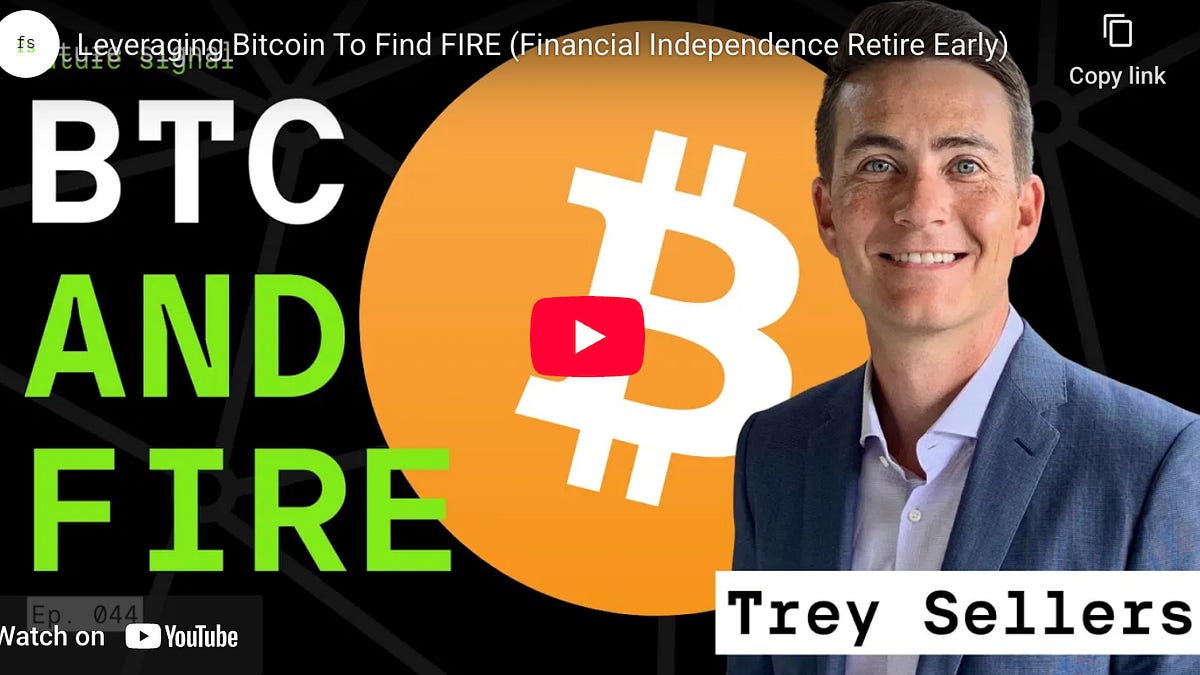
Your first 5 years of aggressive saving carry more weight than the next 15 combined. I walked through the math on the Future Signal podcast with Jarrett Carpenter. When you time-box a 4-5 year stacking sprint — cutting expenses with intention, automating bitcoin purchases, tracking your FI number weekly — you build a compounding machine that does the heavy lifting from that point forward. Every $1 cut from monthly spending drops your FI target by $300 at a 4% withdrawal rate. Funnel that into bitcoin while central banks keep expanding the money supply, and you're compounding on two axes: your accumulation rate and the asset's appreciation. Traditional FIRE planning also misses a critical pillar: sovereignty. Stocks and bonds are IOUs gated by intermediaries — SVB showed us that access risk isn't theoretical. Bitcoin in self-custody means no one stands between you and your wealth. I break all of this down in one of my FIRE BTC deep dives — sprint mechanics, sovereignty in practice, and how AI reshapes the path to FI. 🔥
Trey's avatar
Trey 3 weeks ago
Relay test from script - checking Primal indexing
Trey's avatar
Trey 3 weeks ago
Gold crossed $30 trillion in total value and the gold bugs came out swinging. Bitcoin is "useless," they said. Gold has real utility — electronics, jewelry, dentistry, space tech. They're right. And that's exactly the problem. When a monetary asset gets pulled toward industrial demand, its price stops reflecting monetary fundamentals. Silver prices move with iPhone production cycles. Gold prices fall when jewelry sales slump. That's not a feature of sound money — it's noise. A measuring stick that warps depending on how many circuit boards are being manufactured isn't a measuring stick anymore. There's also the supply problem. Higher prices incentivize more mining. New extraction expands supply and dilutes every existing holder. The 1850s gold rushes caused inflationary spikes even under the gold standard. This is the commodity trap — the very utility that drives demand also drives new production that undermines scarcity. Bitcoin was designed around exactly this insight. No industrial use. No jewelry demand. No ability to mine more of it when the price rises. The supply schedule is fixed regardless of what markets do. Its "uselessness" is a deliberate feature — it removes every mechanism by which scarcity could erode. You can't email gold. You can't split it for small payments. You can't settle across borders in seconds. Gold was the best monetary technology of the physical age. Bitcoin is what happens when you rebuild money from scratch for an age that runs on information. The gold bugs are gloating. Fair enough. But the argument they think they're making — that utility proves superiority — is actually the best case for why bitcoin wins long-term.
Trey's avatar
Trey 3 weeks ago
Test post - please ignore (will delete)
Trey's avatar
Trey 3 weeks ago
The FIRE movement has a word problem. We talk about "retirement" like it's the finish line. But ask anyone who actually got there — doing nothing gets old fast. There's only so much golf you can play before that lifestyle feels like another routine you need to escape. My friend Kane McGukin reframed it for me: don't retire — re-tire. Swap out your worn treads and drive toward work that fills you with purpose — the things you'd do even if nobody paid you. We created "retirement age" nearly a century ago alongside the 40-hour workweek. We've been running on those same tires while the world changed completely around us. FIRE was never about quitting work forever. It's about reaching the point where you choose your work instead of your work choosing you. Bitcoin accelerates that timeline, but the destination has always been freedom to do meaningful things — not freedom from doing anything at all. The goal is to re-tire: new treads, new road, real purpose. I break this down in FIRE BTC with a guest post from Kane.
Trey's avatar
Trey 0 months ago
The 4% rule costs you twice — once in taxes on every withdrawal, and again in lost compounding on the assets you liquidated. After a decade on trading floors, I watched institutions sidestep this by borrowing against appreciating assets instead of selling them. Bitcoin makes this strategy even sharper. Borrow against your BTC, get dollars for living expenses, and let the underlying asset keep compounding. If bitcoin appreciates faster than your interest rate, you come out ahead versus selling. But three things need to be locked in before you borrow: A plan for interest payments — whether from side income, portfolio dividends, or a portion carved from the loan proceeds upfront. A collateral buffer — never pledge your full stack. Start when 5% of your holdings covers the loan requirement, with another 5% in reserve for drawdowns. A custody arrangement you actually trust — BlockFi, Celsius, and Genesis proved what happens when you skip due diligence on your lender. I broke down the full math, collateral strategies, and counterparty risks in this week's FIRE BTC newsletter.
Trey's avatar
Trey 0 months ago
Could your bitcoin portfolio survive the next bear market? I just shipped a new tool inside the FIRE BTC Compass: the Bear Market Stress Test. It takes your actual portfolio and runs it through real historical bear markets — 2017-2018 and 2021-2022 — month by month. Then it calculates the maximum monthly withdrawal you could take and still survive all scenarios over 30 years. The answer might surprise you (in a good way). Try it free: calc.firebtc.io
Trey's avatar
Trey 0 months ago
Every time bitcoin hits a new high, my phone lights up. Same question every time: "Am I too late?" I've been buying bitcoin since 2014. I've bought at $400, at $20,000, at $60,000, and at $100,000. My DCA runs every week regardless of price — same as Michael Saylor, who has bought at nearly every price level on the chart. The anxiety around buying usually comes from treating it like a trade instead of a savings strategy. When you're building a FIRE portfolio, you're accumulating an asset over years — same approach you'd use with stocks. An automated DCA removes the emotional guesswork. You buy the highs, the lows, and everything in between. Over a multi-year horizon, the entry price on any single purchase barely registers. For a larger sum, my approach is simple: deploy half immediately, spread the other half over 8 weeks. You won't love the timing, but you'll always prefer it to sitting on your hands. Getting off zero is the hardest step. Once you take it, the rest is just consistency.
Trey's avatar
Trey 1 month ago
Every January, millions of people resolve to hit the gym and eat better. Almost none of them make a plan for their money — the one thing that actually determines whether they work until 65 or walk away at 45. Last year I put together 21 bitcoin + FIRE resolutions. Every single one still applies in 2026 — and a few are even more urgent now. Automate your DCA. Increase your bitcoin allocation. Upgrade to multisig if your stack has grown. Set up a succession plan so your family can actually access your bitcoin if something happens to you. A few of these might surprise you. One is about training yourself to spend money — a real challenge for FIRE people who've spent years optimizing savings. Another: hold zero dollars. If bitcoin is your primary savings vehicle, why keep a balance in something that loses purchasing power every year? Tools like Fold, Strike, and River make it practical to run your financial life entirely on bitcoin rails. 21 resolutions because 21 million is the cap. Pick the 5 that match where you are, execute them consistently, and finish 2026 in a fundamentally stronger position.
Trey's avatar
Trey 1 month ago
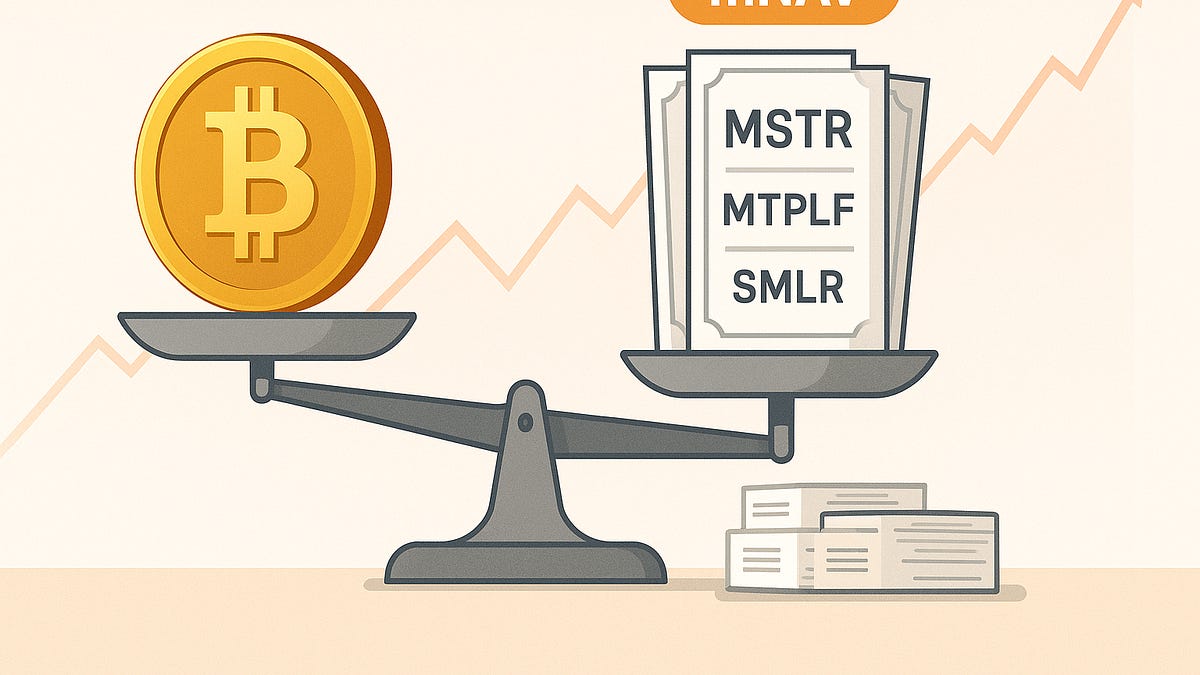
mNAV of 2.0 means you're paying $2 for every $1 of bitcoin on a company's balance sheet. That's the actual cost of buying bitcoin treasury stocks like Strategy or Metaplanet. You're not buying bitcoin exposure — you're buying a bet that the market keeps valuing the company at a premium to its BTC holdings. If bitcoin jumps 50% and the mNAV compresses from 2.0 to 1.5, your stock gains 12.5%. Bitcoin itself is up 50%. You underperformed holding the "leveraged" play. The leverage everyone gets excited about lives entirely in the premium. When mNAV expands, you ride both the BTC move and the multiple expansion. When it shrinks, you bleed value relative to spot — even in a bull market. BTC yield can soften the blow if the company grows bitcoin per share fast enough to offset compression. But that depends on management, dilution terms, and balance sheet discipline. These stocks aren't always a bad trade — sometimes they rip. But if you're buying without understanding the mNAV and what it means for your breakeven, you're flying blind. Know your premium. Or just stack sats.
Trey's avatar
Trey 1 month ago
The whole financial system is built on the assumption that people die. Retirement accounts designed for 20-to-30-year payouts. Mortality tables. Estate taxes. Social Security. Every institution assumes a hard stop at the end of your life. Biotech researchers talk about Longevity Escape Velocity — a point where medical advances extend life faster than time passes, making it possible to outrun death indefinitely. Whether or not that ever happens, it forces a useful reframe. Bitcoin is money that doesn't depend on a government lasting, a central bank maintaining credibility, or a corporate board staying solvent. If your timeline stretches across multiple centuries, you'll outlive most of the systems people are planning around today — and you'll need something more durable underneath. FIRE gets more important in that world, not less. Low time preference. Hard money. Independence from systems that can change the rules on you. The principles don't change. The horizon just gets longer. ---
Trey's avatar
Trey 1 month ago
Every time bitcoin runs, the DMs start. Friends, family, coworkers who've been watching from the sidelines finally deciding to make a move. The question is always the same: how do I actually do this? Stop trying to time it. You're almost certainly going to buy right before a 30% drop — that's just how it goes. And if you wait, the price runs another 30% and you're stuck with the regret of inaction. There's no clean entry. Here's the playbook I give everyone: Get off zero first. Even $100. The shift from "bitcoin observer" to "bitcoin owner" changes how you engage with it. You'll watch more closely, learn more, build conviction. Set up an automated DCA. Divert a slice of what you're already saving toward bitcoin each week or month. You'll buy the highs, the lows, and everything in between — exactly what Michael Saylor does. If you have a lump sum, buy half immediately and DCA the rest over 8 weeks. Gets you in the game while preserving flexibility to benefit from dips. No perfect entry point exists. But there is a formula that works.
Trey's avatar
Trey 1 month ago
Your brain runs on 20 watts and outperforms entire AI data centers drawing megawatts. The difference isn't power, it's architecture. Constraint-driven systems (the brain, bitcoin) evolve simple mechanisms that scale gracefully. Expansion-driven systems (AI clusters, fiat money) improve through brute force, more infrastructure, more bureaucracy, and more fragility. Bitcoin applies the same design principle nature discovered long ago: fixed rules, decentralized verification, no committees. The most capable systems aren't the ones with the most resources. They're the ones with the best constraints. ---
Trey's avatar
Trey 1 month ago
FIRE isn't an on/off switch. It's a spectrum, and you're probably further along than you think. The traditional framework gives you a handful of labels — Lean FIRE, Barista FIRE, Coast FIRE, Fat FIRE — but no logical order, no clear progression, no way to know where you actually stand. They emerged piecemeal, with blurry definitions and a lot of overlap. I wanted something cleaner, so I built the FIRE Spectrum: nine levels, each anchored to a single number — how much of your annual expenses your savings portfolio can currently support. At Level 4 (10-15x expenses), you can downshift work, take a lower-stress job, stop grinding just to keep the lights on. Level 6 means your future retirement is mathematically locked in, even if you never save another dollar. Level 7 is full FIRE — your current lifestyle funded indefinitely. The point of the spectrum is that you stop waiting for a finish line and start noticing the meaningful improvements you're already living. Each level up is real and tangible. Less stress, more choice, better options at every stage. Figure out your multiple. I walk through all nine levels and what each one unlocks in this week's issue.
Trey's avatar
Trey 1 month ago
Dividend stocks feel like free money. They're not. When a company pays a dividend, its stock price drops by the same amount on the ex-dividend date. The cash moves from the company's account to yours. Total return is unchanged — you've just received it in a less tax-efficient form, with the IRS taking a cut whether you reinvest or not. SCHD vs. VTI from the end of 2019 through December 2024: SCHD returned 69% total. VTI returned 93%. That 24-point gap compounds over a 15-20 year accumulation phase into years of extra saving required to reach your number. Bitcoin gets dunked on constantly for not paying a dividend. But bitcoin isn't a company — it doesn't have earnings to distribute. It's monetary. Its yield is purchasing power growth. Criticizing it for not paying dividends is like criticizing gold for not filing quarterly earnings reports. For anyone still in the accumulation phase, the goal is maximizing total return to reach financial independence faster. Dividends don't do that. They deliver returns in a less efficient package.
Trey's avatar
Trey 1 month ago
I set up a tiny bitcoin miner with my 9-year-old daughter on a Saturday afternoon. Posted a picture on X. Woke up to 1.4 million views. The device is a Bitaxe. Size of a light bulb, 15 watts, couple hundred bucks. Runs a real ASIC chip, the same kind in industrial mining warehouses, just way smaller. The odds of finding a block are about 1 in 5 million per day. Run it a year and that's 1 in 15,000. I'd need to run it 15,000 years to expect a hit. Solo miners do win though. One hit block 912,632 and took home 3.125 BTC. Not me. Yet. Bitcoin still lets anyone participate directly. No intermediary, no permission required. Just a miner, a power source, and curiosity. People are using mining heat for their homes, capturing flared gas for bitcoin, balancing power grids with hashrate. My daughter got it right away. She just wanted to know what "hashes per second" means.
Trey's avatar
Trey 1 month ago
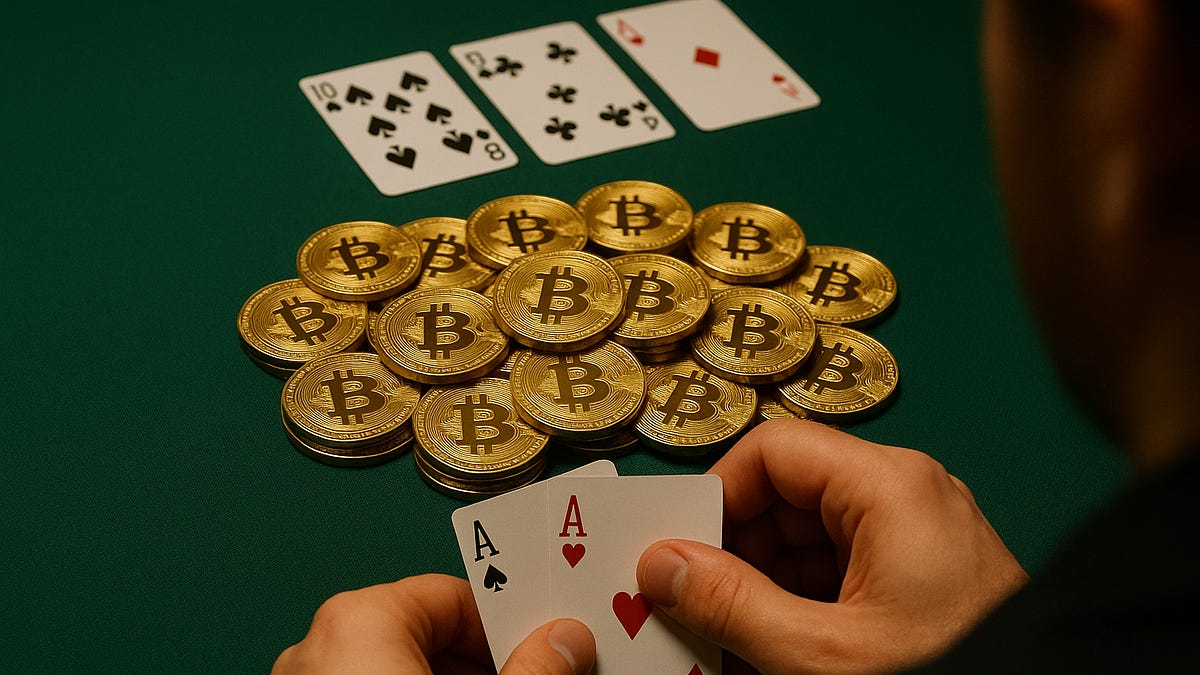
Say there's a 25% chance bitcoin hits $1M in 10 years and a 75% chance it goes nowhere. At ~$65K today, $1,000 buys you a 15x if it hits. Run the expected value: (25% x $15,400) + (75% x $0) = $3,850. You're paying $1 for nearly $4 in expected value. With deep skepticism already priced in. Expected Value Analysis is how poker players and professional investors make decisions under uncertainty. Every choice is a bet — the goal isn't winning every hand, it's making sure the payoff when you're right dramatically outweighs the loss when you're wrong. Apply it to bitcoin, real estate, career moves, portfolio allocation. The math clarifies everything.
Trey's avatar
Trey 1 month ago
In January 2018, Mr. Money Mustache — one of the godfathers of the FIRE movement — published a piece called "Why Bitcoin is Stupid." Bitcoin was trading around $14,000 at the time. I was late too. First heard about bitcoin in 2011 at $10. Bought a little in 2014. Didn't get serious until 2018. The opportunity cost of not paying attention earlier is staggering. Bitcoin looks dumb at first. Fixed supply. No CEO. No customer service. Doesn't care who you are or what your government thinks. You can't lobby it, inflate it, or shut it down. That's the whole point. Bitcoin is simple by design — no moving parts, no politics, no exceptions. It just runs. The FIRE community understood index fund DCA before anyone else. Same discipline, same time horizon, same conviction that compounding wins. The only difference is the asset. Skepticism has an expiration date. At some point it stops being prudent and starts being expensive. https://firebtc.io/p/why-bitcoin-is-stupid
Trey's avatar
Trey 1 month ago
Traditional FIRE says multiply your annual expenses by 25 to find your number. That's the 4% rule — save $2.5 million to spend $100k a year. Bitcoin changes the multiplier. If you assume a conservative 25% annual growth rate (compared to stocks at 10%), the math shifts dramatically. Instead of 25x your expenses, you need 12.5x. That $2.5 million target becomes $1.25 million. But here's where it gets interesting. That $1.25 million figure assumes you want to quit today. If you have time on your side, the target drops fast. Every 5 years of runway you're willing to work cuts your BTC goal by roughly a third. Need 14 BTC to retire right now? Wait 5 years and you need about 5. Wait 10 and you need 1.5. The formula: annual expenses × 12.5, divided by your assumed future BTC price. Apply the "Rule of 3" for every 5-year stretch you can wait. Sprint hard on stacking early, then let bitcoin's growth do the heavy lifting.