Trey's avatar
Trey
tshodl@nostrplebs.com
npub1m6y9...e2p9
Bitcoin + FIRE | Newsletter: firebtc.io | VP Sales @unchained
Trey's avatar
Trey 1 month ago
Traditional FIRE says multiply your annual expenses by 25 to find your number. That's the 4% rule — save $2.5 million to spend $100k a year. Bitcoin changes the multiplier. If you assume a conservative 25% annual growth rate (compared to stocks at 10%), the math shifts dramatically. Instead of 25x your expenses, you need 12.5x. That $2.5 million target becomes $1.25 million. But here's where it gets interesting. That $1.25 million figure assumes you want to quit today. If you have time on your side, the target drops fast. Every 5 years of runway you're willing to work cuts your BTC goal by roughly a third. Need 14 BTC to retire right now? Wait 5 years and you need about 5. Wait 10 and you need 1.5. The formula: annual expenses × 12.5, divided by your assumed future BTC price. Apply the "Rule of 3" for every 5-year stretch you can wait. Sprint hard on stacking early, then let bitcoin's growth do the heavy lifting.
Trey's avatar
Trey 1 month ago
The goal of FIRE isn't to stop working. It's to stop working for someone else. Kane McGukin of The Mesh Point wrote a guest piece for FIRE BTC built around a simple reframe: don't retire, re-tire — put on fresh treads and do work you actually want to do. "Retire" comes from the Old French for "to withdraw." That etymology is worth sitting with, because it reveals what most of us have unconsciously adopted as the goal: not freedom, but withdrawal from productive life. The aim of a 40-year career is to eventually cease. Kane has spent his career working with wealthy clients. Very few just stop when they reach retirement. They either arrive with a project already lined up, or take a short break and dive back in. The golf and the travel get old quickly. Then they need something real to work on. Humans are built for work — not wage labor, not performing for someone else's agenda, but building and creating and solving things that matter. The sovereign wealth crowd talks a lot about exit: exit the banking system, exit fiat, exit the permission layer. All correct. But exit isn't the destination — it's the door. What you walk through it toward is the actual question. Financial independence buys freedom from obligation. The work doesn't stop. It just finally becomes yours to choose.
Trey's avatar
Trey 1 month ago
Income-focused investing costs you more than you think. Every dividend, every rental check, every bond coupon comes at the expense of total return. You're getting paid to accept lower growth. The better approach: invest for total return, let compounding run, and sell down when you need it. Capital gains becomes your income. Real estate makes this concrete. Investors who've sold entire portfolios to buy bitcoin are calculating the tradeoff: trade tenants, leaky roofs, eminent domain, transaction costs, and property taxes for an asset that's portable, divisible, and has outperformed everything. "Why wouldn't I do that?" is a harder question to answer than it sounds. I went deep on this across three podcast appearances — with a long-time FIRE advocate, the Orange Pill Docs (two MDs teaching bitcoin to physicians), and a financial advisor who had Grok classify me as a "bitcoin evangelist." I'll take it. Links to all three episodes inside.
Trey's avatar
Trey 1 month ago
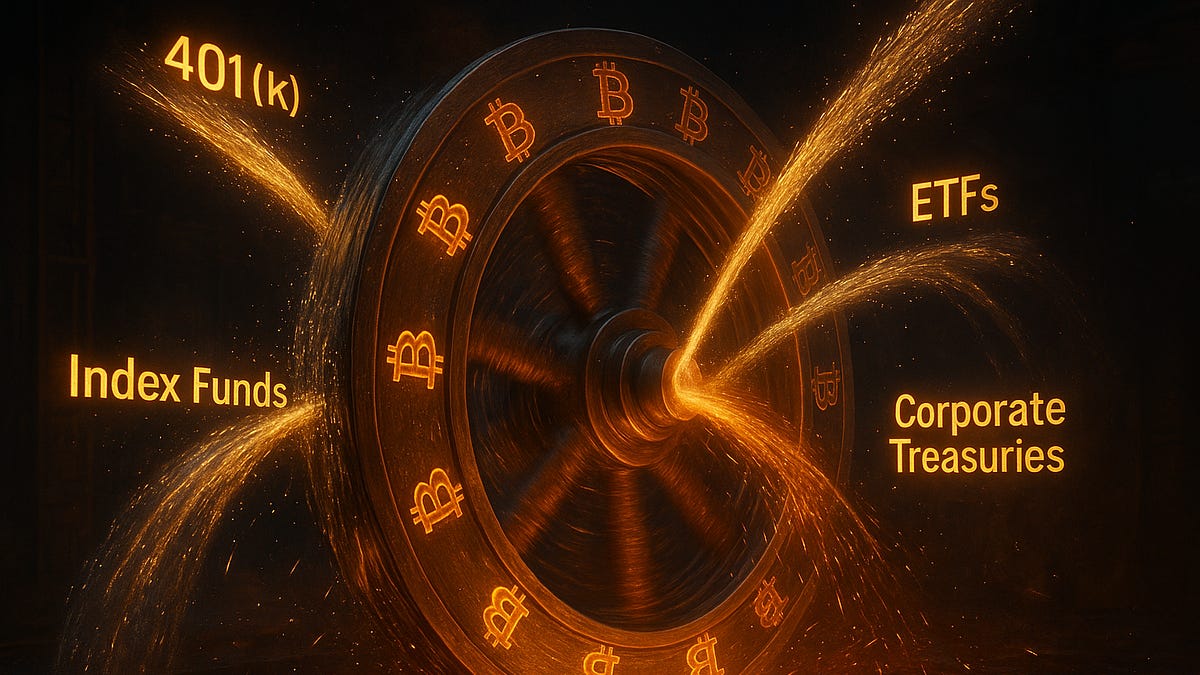
The FIRE community has spent years calling bitcoin speculation while dumping everything into VTI. Here's what they didn't notice: VTI now holds Strategy (MSTR), GameStop (with $500M in BTC), Block, Coinbase, and Tesla. Every company adding bitcoin to their balance sheet becomes part of the index. Every index investor automatically gets exposure. The self-reinforcing loop is already running. Companies buy bitcoin. Bitcoin appreciates. Those companies grow larger in the index. Passive flows push more capital into their stocks. They buy more bitcoin. Even Mr. Money Mustache—who wrote that bitcoin was "stupid"—now has a growing stake in it through his own portfolio. The FIRE orthodoxy is getting bitcoin exposure whether they acknowledge it or not. Bitcoin adoption used to require active choice. You had to seek it out, learn about it, set up an exchange, wire money. Every sat was bought with intention. Now millions have exposure without lifting a finger. 401(k)s are adding bitcoin options. ETFs provide a programmatic bid. Treasury companies accumulate for shareholders who can't buy directly. Passive ownership becomes a gateway to active ownership. When everyone has indirect exposure, they start caring about protecting that value. The incentives shift.
Trey's avatar
Trey 1 month ago
I just launched the FIRE BTC Compass. It's a free tool that shows you exactly where you stand on the path to financial independence — built for people who hold bitcoin. Most FIRE calculators assume 100% stocks and a 4% withdrawal rate. That's broken for bitcoiners. The Compass uses a BTC-adjusted target that accounts for bitcoin's asymmetric upside. If you hold bitcoin, your FIRE number is lower than you think. No account. No tracking. Your data never leaves your browser. Try it: calc.firebtc.io
Trey's avatar
Trey 1 month ago
The FIRE movement solved half the problem. Financial independence gives you control over your time—freedom from a boss, a schedule you didn't choose, work you resent. That part is real. But if your portfolio sits entirely in stocks and bonds, you're still asking permission to access your own wealth. SVB was a wake-up call. Solvent companies nearly couldn't make payroll on a weekend because the system broke. That's not a hypothetical; it happened to real businesses. Sovereignty has two layers: owning your time and owning your money. FIRE handles the first. Bitcoin handles the second. Without both, you're not truly independent—you're dependent on a financial system you only have permission to use. Allocation doesn't need to be all-or-nothing. Put bitcoin in at the percentage of your conviction. 50% confident it outperforms stocks over 20 years? Go 50/50. Let conviction and allocation grow together as you learn more. Layer in a focused 4-5 year stacking sprint and the math shifts significantly. The compounding machine you build in those early years carries most of the weight for the rest of your life. Front-load the intensity; the balance sheet takes over from there.
Trey's avatar
Trey 1 month ago
The "Bitcoin has no intrinsic value" critique shows up like clockwork when the price dips. Bitcoin critics proclaim it with confidence, as if stating it settles the debate. Here's the problem: nothing has intrinsic value. The entire concept is incoherent. Financial analysts define intrinsic value as an "objective" measure of what an asset is worth. Then in the next breath, they admit there's "no universal standard" for calculating it. Even their preferred method—discounted cash flow analysis—produces values that differ from market prices, which proves the calculation isn't inherent to the asset itself. What people call "intrinsic value" is really just utility. And utility is entirely subjective. A glass of water is priceless to someone dying of thirst in the desert, virtually worthless to someone at home with clean water on tap. The water's physical properties didn't change. Only the context and individual need changed. Same with a painting that fetches millions at auction—not because of the cost of canvas and paint, but because people perceive it as beautiful, historically significant, or a status symbol. Austrian economist Carl Menger put it plainly: "Value is a judgment economizing men make about the importance of the goods at their disposal for the maintenance of their lives and well-being. Hence value does not exist outside the consciousness of men." All value is subjective. It exists in our heads, not in the physical properties of assets. Gold bugs criticize Bitcoin's lack of intrinsic value while ignoring that gold's market value exceeds its industrial use value many times over. Real estate investors point to housing utility while ignoring that identical buildings sell for wildly different prices based on location. Stock investors run DCF models that produce values different from market prices, then claim those models reveal something inherent. Bitcoin provides clear utility to millions of people: an absolutely fixed supply that can't be debased by governments or banks, digital portability with self-clearing capabilities, and sovereign control of wealth without counterparty risk. The market values Bitcoin at multiple trillions today precisely because people recognize that utility. Critics who dismiss Bitcoin for lacking intrinsic value are arguing against a concept that doesn't exist. All financial assets—stocks, gold, real estate, Bitcoin—are speculative bets on future value based on perceived utility. Bitcoin is no different, except its utility is becoming clearer to more people every day.
Trey's avatar
Trey 1 month ago
I just got back from Mexico with Montezuma's Revenge. Overindulgence has consequences. Same thing happens in bitcoin bull markets. Price goes from $20k to $100k and suddenly you think you can outperform bitcoin itself. That's the margaritas talking. Three ways to give yourself financial diarrhea on your path to FIRE: **Buying bitcoin on leverage** — Exchanges offer 10:1, 20:1, even 100:1 leverage. Feels great when price is ripping. But your timing is guaranteed to be off, and you'll get liquidated. I've touched this stove before. **Timing the market** — Selling at tops and buying at bottoms sounds easy in a bull market. But missing the best 10 days of bitcoin price movement each year puts you in a losing position. Time in the market beats timing the market. **Trading other assets to get more bitcoin** — Mag Seven, memecoins, XRP, MSTR options. They all sound sexy until you end up with less bitcoin than you started with. The antidote? Stay humble. Stack sats. Stick to your plan.
Trey's avatar
Trey 2 months ago
Just like early 2025 when bitcoin dropped 30% from $109k to $78k, we're seeing it again. Bitcoin fell from $126k to $60k. Now sitting at $70k. People are freaking out, calling it the end of the cycle, predicting the next prolonged bear market. Same pattern. Different year. Bitcoin is volatile. Everyone knows this. Then when volatility actually happens, people act like it's the end of the world. A more constructive response is to step back, remember the bigger picture, and recognize the opportunity being presented. Markets hate uncertainty. When tariffs, inflation, deficit spending, and policy chaos dominate the headlines, investors rebalance. They sell risk assets and seek the "safety" of cash and treasuries. Bitcoin gets hit hardest because it's the only asset with 24/7/365 global liquidity—it can instantly discount economic news in real time while legacy markets are closed. But the fundamentals haven't changed. Fixed supply. No central authority that can inflate it away. Growing institutional adoption. Sovereign nations adding it to reserves. The world has woken up to the fact that bitcoin isn't going away. This type of volatility is common, but always short-term. The world is still figuring out how to value bitcoin, and its perfectly inelastic supply means the only outlet for reflecting changes in demand is price. FIRE isn't a get-rich-quick scheme. It's a get-wealthy-relatively-quickly plan. That means 5-10 years of disciplined saving and investing. Your job is to find the right balance of intentional spending and save the excess in assets that grow faster than your expenses. Day-to-day swings don't matter. Week-to-week gyrations don't matter. Even year-to-year volatility doesn't change the trajectory. Stick to the plan. Buy the dip. Keep building.
Trey's avatar
Trey 2 months ago
Every recurring expense you keep isn't just costing you the monthly payment—it's inflating your FIRE number by a 25x multiplier. Cut $800/month and you don't just save that cash. You instantly remove $240,000 from the portfolio you need to walk away from work. That's the 4% rule working in reverse: every $1 of annual spending eliminated reduces your target by $25. But that's only lever #1. The real acceleration happens when you redirect that freed-up $800/month into assets. Take it over 20 years: • At 10% (S&P 500): ~$605,000 • At 25% (bitcoin): ~$1,960,000+ You're not just shrinking the target. You're bringing the finish line closer while accelerating toward it at the same time. The gap between doing nothing and cutting-and-investing isn't marginal. It's an entirely different life. We underestimate the power of cutting expenses because each trim feels tiny on the front end. But every month you keep that expense is like strapping on a rucking backpack and pushing the finish line farther away. You're not just spending today's money. You're spending tomorrow's freedom.
Trey's avatar
Trey 2 months ago
Scott Adams understood something the FIRE community desperately needs to internalize: "Losers have goals. Winners have systems." If your goal is to hit $1 million in savings, you're "failing" every day until you reach it. Even at $999,000, you haven't achieved the goal. You're living in perpetual not-there-yet. But if your system is to automatically save 50% of every paycheck and stack sats weekly, you succeed every time you execute. The outcome takes care of itself. Goals create a state of continuous pre-success failure. Systems create daily wins. Your DCA is a system. Your automatic savings is a system. Your side hustle is a system. The FIRE number is just what naturally materializes when you run the system long enough. Adams also knew willpower is finite. You can't white-knuckle your way through 10-15 years of accumulation. You need systems that run on autopilot, that remove the need for constant decisions. His second genius insight was talent stacking. "I'm a rich and famous cartoonist who doesn't draw well." You don't need to be world-class at one thing. Be top 25% at multiple complementary skills. Pretty good income + pretty good savings discipline = powerful compounding. And Adams understood bitcoin better than most. He called it "one of the greatest pieces of persuasion the world's ever seen." By 2024, he was saying there's "no longer an argument for not having some bitcoin in a diversified portfolio." Scott Adams died in January at 68. His ideas about systems, persuasion, and leverage deserve to live on.
Trey's avatar
Trey 2 months ago
A friend showed me his bank account: $270,000 in cash. Earning exactly 0.00% interest. I asked what he's waiting for. He didn't have an answer. Cash doesn't preserve wealth — it guarantees you'll lose it. The dollar is designed to debase. Inflation isn't a bug in the system, it's the entire point. When your currency loses 3-7% of its purchasing power every year, holding it long-term isn't conservative. It's financial self-sabotage. You must earn your money twice: first through work, then again through investing. Because saving without risk won't secure your retirement. If you're holding more than 3-6 months of expenses in cash, you're not being cautious. You're actively destroying your purchasing power. So what are the options? High-yield savings (3.5-4.5%) slows the bleeding but you're still losing. Stocks (VTI, VOO) historically return 8-10%. Real estate requires leverage, maintenance, and dealing with tenants. Bitcoin offers the highest upside if you can handle the volatility. I told my friend what I'd do with $270k: convert it to Bitcoin by the end of the next business day. He thought I was crazy. Maybe. But we're at an inflection point. Any day, a nation-state could announce a major purchase and the price doubles. When that happens, I don't want cash burning a hole in my pocket.
Trey's avatar
Trey 2 months ago
Traditional FIRE is built on a solid foundation: cut expenses, boost savings, automate investments, let compounding work. It's a proven path to reclaim your time. But the entire strategy rests on assumptions. That inflation stays contained. That markets perform as expected. That you can access your wealth when needed. That the rules don't change. Your FIRE portfolio lives in permissioned environments. Brokerages. Tax-advantaged accounts. Real estate. All governed by systems you don't control. When the U.S. suspended required minimum distributions in 2020, it wasn't catastrophic. But it proved the point: governments rewrite rules under pressure. Your 401(k) only works if the system cooperates. Bitcoin removes this vulnerability. Self-custodied, borderless, immune to monetary debasement. You don't need permission from brokers, banks, or central planners to access your wealth. And the asymmetry changes the timeline. With a fixed supply of 21 million and rising global demand, bitcoin can cut your path to financial independence in half. Same discipline, faster results. You don't need to abandon traditional FIRE. But upgrading the foundation from permissioned to sovereign wealth makes the entire strategy more resilient—and potentially faster.
Trey's avatar
Trey 2 months ago
When you start working, your paycheck is everything. It's how you pay bills, fund your life, and build your first savings. But here's the shift most people never make: that savings portfolio should become your primary wealth engine, not your job. Think of your investments as your real side gig. It starts small, but compounds relentlessly. Each dollar you invest becomes a worker that never sleeps, building wealth while you focus on other things. The people who reach financial freedom aren't the ones with the highest salaries. They're the ones who flipped the script — who built their balance sheet until it outpaced their labor. There's a moment when your assets create more new wealth in a year than your job ever could. That's when your job becomes the side hustle. Real wealth comes from ownership, not just labor. Your balance sheet is your ownership stake in the future. If you use bitcoin as your core savings vehicle, this transition can happen even more powerfully. Bitcoin's hard-capped supply makes it a uniquely strong foundational asset for a personal balance sheet.
Trey's avatar
Trey 2 months ago
Your personal finance journey works exactly like Super Mario Bros. Early on, you're just collecting coins and trying not to get flattened. Bills and debt are like Goombas—easy to dodge if you don't make a wrong move. Inflation is Lakitu overhead, constantly adding pressure. Eventually you find power-ups. 401(k) matches, index funds, expense reduction—they help, but they don't last forever. One surprise hit and you're back to small Mario. The real problem is that the fiat game is rigged. Your savings melt in the background no matter how careful you are. Even if you dodge every enemy, you end up at Bowser's castle. Bowser isn't just inflation—he's the entire fiat system. The reason your savings melt, the rules change mid-level, your freedom is always in another castle. Most people spend their lives collecting coins and chasing temporary power-ups, only to get burned at the castle gates. But hidden in the level is a warp pipe. Bitcoin is that warp pipe. It doesn't just protect your savings—it takes you off the fiat map entirely. Your coins don't melt. Your freedom isn't pushed into another castle. You're in control of the game. FIRE gives you the map to reach the castle and some power-ups along the way. Bitcoin gives you the warp pipe and the Star Power to make you invincible. In the fiat game, the princess is always in another castle. With FIRE + bitcoin, you can finally save her.
Trey's avatar
Trey 2 months ago
FIRE gave me a way out—not just from work, but from a career without direction. After 12 years in Corporate America, I felt like a cog in a big wheel, a number in someone else's spreadsheet. The commute was tiresome, the office environment was stale, and the lack of flexibility left a lot to be desired. I felt stuck. The FIRE approach is straightforward: build a savings and investment portfolio large enough to sustain your desired lifestyle without having to work. It's possible to implement a simple plan to create lasting wealth that doesn't require a radical change in your career or taking extraordinary risk. The FIRE movement is about taking a fresh perspective and being intentional in crafting that plan for yourself to accelerate the timeline of reaching financial independence, thereby freeing yourself from being dependent on a paycheck. Three core building blocks make it happen: **1. Intentional spending and understanding expenses** Understanding your expenses, both now and what you expect them to be in the future, is the first element to tackle. House, cars, groceries, taxes, gym memberships, kids' activities, vacations—all of this should be understood at a line-item level. Be ruthlessly intentional about which expenses are necessary and which are wasteful. If an expense is wasteful, eliminate it immediately. If it's necessary, find ways to minimize it. **2. Pay yourself first - maximize your savings rate** No matter what you earn, you can always save some of it. Whether it's 5%, 10%, 20%, 50%, or more, that proportion of any money earned should be immediately moved to your savings portfolio. Automate this savings process and figure out how to live on the remaining amount. Think of yourself as the CEO and CFO for your own personal finance company. Your primary objective is to maximize retained earnings. Any extra value saved today is payment to your future self ten-fold. **3. Buy and hold good assets** You can't just hold dollars (or other fiat currency), because doing so will make you poorer, not wealthier. The cost of goods and services you use every day continually gets more expensive over time due to a combination of monetary debasement and government intervention in the marketplace. Housing, healthcare, education—categories we all must spend money on that continually get costlier. Because of this purchasing power erosion, you must store your wealth in something other than fiat currency. Most FIRE practitioners choose the stock market and/or real estate. I choose bitcoin. Buying good assets allows you to maintain, and even grow, your purchasing power over time. This savings portfolio will be used to sustain your retirement lifestyle, and it needs to grow large enough so that you won't run out of money when you are no longer working. Earn, save, stack, repeat. When you understand your expenses, pay yourself first, and start stacking assets, you're well on your way to financial independence.

Trey's avatar
Trey 2 months ago
Most FIRE practitioners default to VTI and call it a day. Stack index funds, wait 20 years, done. But there's a problem with that approach. You're accepting whatever return the market gives you, which means accepting whatever timeline the market dictates. I ran an 8-year backtest comparing VTI-only portfolios against portfolios with bitcoin allocations. $100/week split between VTI and BTC at different ratios: 0%, 1%, 5%, 10%, 25%, 50%, 75%, 100%. The results are striking. A 100% BTC allocation grew the portfolio almost 7x larger than 100% VTI. Even a 25% BTC allocation more than doubled the portfolio size compared to VTI-only. The multiplier effect: every 1% increase in BTC allocation added 9.61% to total returns. That's not a small difference. That's the difference between retiring at 45 vs 55. The tradeoff? Volatility. Bitcoin dropped 84%, 72%, 55%, and 77% during four major drawdowns in that period. But here's what matters: if you're consistently stacking sats through those drawdowns, you're buying more when it's cheap. Early in your FIRE journey, volatility is a feature, not a bug. Your goal is to stack as much as you can as fast as you can. Deep drawdowns just accelerate that process. VTI is a solid choice for saving. Bitcoin is a better one. The question isn't whether to allocate—it's how much you're comfortable with.
Trey's avatar
Trey 2 months ago
Financial independence without sovereignty is just math on a spreadsheet. You can hit 25x your annual expenses and still need permission to access your own wealth. That's not independence. I joined Shawn Yeager on The Trust Revolution to talk about what happens when individuals stop asking permission to control their own money. We covered the infinite reserve illusion, why Bitcoin is more tangible than your bank balance, and how self-custody flips the power dynamic with financial advisors. The FIRE community has the discipline to build wealth. But if you can't actually access it without gatekeepers, intermediaries, and "processing times," you're still dependent. Bitcoin closes that loop. No custodians. No counterparty risk. Just direct ownership of what you've built. The conversation went places most FIRE discussions avoid. We talked about how the modern banking system doesn't run on fractional reserves anymore—the reserves are infinite because they'll just print them. We talked about tangibility—your bank balance is just a spot on an amorphous ledger you don't control, while Bitcoin keys are actual ownership. And we talked about sovereignty starting at home, scaling through example. Watch the full conversation. ---
Trey's avatar
Trey 2 months ago
Most personal finance gurus tell you to eliminate all debt. Pay off your mortgage. Live debt-free. But they're ignoring how money actually works in a credit-based system. Dollars are created from new debt and destroyed when debt is extinguished. This creates continuous expansion in the money supply, which means debasement of both existing debt and existing money. The people who refinanced their mortgages at 3% in 2020 didn't just save on interest. They locked in a liability that became progressively cheaper to repay as inflation ran at 9%. Meanwhile, they freed up capital to invest in assets appreciating faster than their borrowing cost. This is "speculative attack" — a concept Pierre Rochard wrote about in 2014. Borrow in a weak currency to buy a stronger asset. When inflation runs higher than your interest rate, your debt gets easier to pay off while your assets appreciate. Consider two scenarios for buying a $500k house in 2020: Scenario 1: Pay cash. You own a $640k house today. Scenario 2: Put 20% down, take a 3% mortgage, invest the $400k you didn't spend. You own a $640k house PLUS whatever those investments returned. I call this "Aikido finance" — using the momentum of the fiat system instead of fighting against it. Yes, debt carries risk. You need stable income to cover payments. But if you have the discipline to pursue FIRE, you already have the discipline to manage strategic debt. The fiat system runs on credit expansion and debasement. Like it or not, those with access to credit and an understanding of how to use it have a distinct advantage. You can ignore that reality or you can use it to reach financial independence faster.