
Financial independence rarely arrives through one heroic decision. It is usually built by making the same kind of useful decision again and again.
Each time you spend intentionally, save, invest, or learn a skill, you do two things. You improve the numbers in your plan, and you give yourself evidence that you can keep following it. That second effect matters when early progress feels small or markets get volatile. Conviction built from action is harder to shake than enthusiasm built from a good week.
This doesn't mean every action works or that consistency guarantees a specific outcome. A reckless strategy repeated faithfully is still reckless. The aim is measured action aligned with a long-term plan: choices you can sustain without leverage, shortcuts, or constant prediction.
Over time, the distant goal becomes a set of familiar behaviors. Your savings grow, your judgment improves, and it becomes easier to stay the course through volatility. The transformation starts before your portfolio reaches its target: you're no longer waiting for financial freedom to happen. You're building the capacity to keep moving toward it.
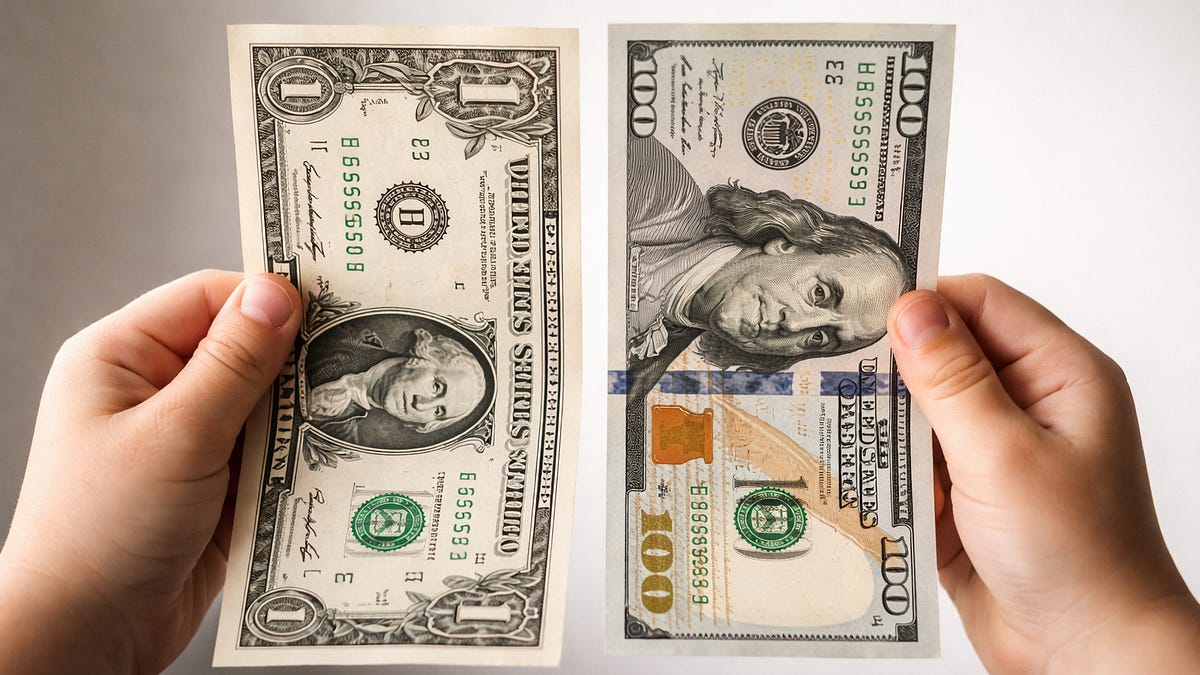
My kids compared a $1 bill with a $100 bill. Same paper. Same texture. Same material. The only physical difference was the printed number.
“Why is one worth more if they’re exactly the same?” they asked.
That simple question gets to the truth about money. The $100 bill has more purchasing power because we agree it does. There's no extra value in its paper or ink. Bitcoin's monetary value also depends on collective belief.
The important difference is what constrains the thing we've agreed to use. Dollars have no hard supply limit. Political institutions manage their supply, and their leaders can be influenced, threatened, or replaced.
Bitcoin has a hard cap of 21 million BTC enforced by consensus. Thousands of independent nodes validate the same rules and reject attempts to create more bitcoin. As with changing how pawns move in chess, you can create a different game, but you can't force everyone else to play it. Issuance halves about every four years until the final bitcoin is mined around 2140.
For wealth preservation, the question isn't whether money requires belief. It all does. The question is whether its scarcity is a political promise or an enforced rule.
Read 📚 ELI-5 and decide which kind of constraint you want behind your savings:
📚 ELI-5
FIRE BTC Issue 62 - What kids see that adults ignore about money
You don't have to believe reality is a simulation to borrow one useful idea from simulation theory: a difficult season can be treated as a quest instead of a verdict on your life.
A verdict feels final. A quest has an objective, constraints, skills you can build, and a next move. That shift won't make debt, a bad job, or a market drawdown disappear. It gives you a better way to respond because you stop asking why the whole situation is happening to you and start identifying the part you can influence.
This is especially useful when pursuing financial independence. The objective might be creating enough savings and investment income to control your time. Your constraints could include fixed expenses, a volatile portfolio, or limited income. Once those are visible, progress becomes less abstract: lower one recurring cost, learn one valuable skill, or build one more month of runway.
Pick one money or work problem that currently feels open-ended. Write down the objective, the main constraint, and the smallest useful move you can make this week. The metaphor earns its keep when it produces a better decision in the real world.
Last August, I financed about $73,400 on a Lexus at 6.36% for 60 months. The payment was about $1,435.
A local credit union refinanced the loan at 4.39%, dropping my payment to $1,178. That freed $257 every month to buy bitcoin.
But the lower payment came with a tradeoff: I reset the 49 months remaining on the old loan to a new 60-month term. The original payments would have totaled about $70,315. The refinance totals about $70,680, so I added 11 payments but only about $365 in scheduled outflow.
With the same $1,435 monthly budget, I can invest $257 for all 60 months instead of waiting 49 months and investing $1,435 for the final 11. At a 0% return, the old loan finishes $365 ahead. At a 10% annual return, investing earlier finishes about $3,247 ahead. At a 25% bitcoin planning assumption, it finishes about $10,741 ahead. Those are scenarios, not forecasts.
This only works because the debt is fixed-rate, affordable, and backed by liquid assets. A lower payment alone proves nothing. Compare the APR, term, fees, total payments, and what you'll actually do with the cash. The structure decides whether debt creates optionality or fragility.
See the full cash-flow comparison and run the decision with real numbers:

🚗 One Phone Call. $257 More Bitcoin Every Month.
FIRE BTC Issue #87 - A real-world example of Aikido Finance—and why paying cash for your car isn't always the best move.
The 4% rule was built for portfolios of stocks and bonds, not a portfolio with a large bitcoin allocation. That doesn't make it useless. It means the withdrawal rate can't be changed by looking at expected returns alone.
A higher long-term return could reduce the portfolio you need to fund your expenses. But bitcoin's volatility increases sequence-of-returns risk: a deep drawdown early in retirement can force you to sell more bitcoin when the price is low, leaving less to participate in a recovery.
So the first step isn't choosing 4% or 8%. It's writing down what you'll do during the first bad market after leaving full-time work. Which asset funds your spending? How far can you cut expenses? Would you take part-time income instead of selling into a drawdown?
A bitcoin retirement plan should be judged by how it handles a bad first few years, not only by the average return you expect over decades.
Back in March, I used a HELOC—not margin—to finance my STRC experiment. Using a $50,000 example with my economics: 511 shares at $97.69. For months, STRC stayed near $100, its 11.5% dividend kept arriving, and I turned the cash into bitcoin.
Then STRC traded as low as $82.53.
At $84.54, the example was worth $43,200. After $3,758 of distributions and about $2,260 of interest, the trade was down $5,222. The income softened the loss. It didn't erase it.
Friday looked like a leverage flush, not a credit event, but the failed bounce showed continued risk repricing. At $84.54, the $11.50 annual dividend produced a 13.60% market yield. That's compensation for risk, not free money.
Financing is why I'm still in the trade. Margin can turn a price drop into a deadline: the broker can demand collateral or sell. My variable-rate HELOC isn't marked daily against STRC. If the payment fits my cash flow, I have time to reassess.
Same asset, different financing, completely different risk. In a FIRE plan, leverage must survive a drawdown without threatening the base layer: liquidity, controlled expenses, and bitcoin in cold storage.
Read the full breakdown to pressure-test the debt, cash flow, and position size behind a leveraged income trade:

💥 My STRC Trade Exploded!
FIRE BTC Issue #83 - Or did it?
Railroads transformed the United States. They also destroyed plenty of investor capital along the way.
That history is useful when evaluating today's AI buildout. A technology can become indispensable while the companies financing its infrastructure overbuild capacity, take on too much debt, or pay prices that leave little room for error. Social value and investor return are related, but they aren't the same calculation.
The railroad boom had real demand behind it. It also had competitors racing to build ahead of demand, insiders extracting value, and borrowers depending on fresh financing. When the cycle turned, useful assets remained. Many original claims on those assets did not.
AI has different economics, so 1873 isn't a forecast. The durable lesson is narrower: being right about a technology's future doesn't make every investment tied to it attractive. Your return still depends on revenue, margins, financing, competition, and the price you pay.
Before buying an AI-linked investment, write down the assumptions required for an acceptable return. If the case only works when one company captures most of the market and capital stays cheap, you've identified the bet you're actually making.
When you're young, you usually have time and energy, but not much money. In your prime working years, you have energy and money, but no time. When you're older, time and money return, but your energy fades.
That's the great misalignment: the standard timeline rarely lets you enjoy all three at once. We spend our most capable years trading time for money, assuming we'll buy our freedom back decades later. But time doesn't compound. Once it's gone, it's gone, and the physical ability to climb mountains, chase toddlers, build a business, or explore a city doesn't wait for your retirement date.
FIRE rejects that timeline. The point isn't early retirement for its own sake. It's creating enough financial independence to choose how you spend your days while you still have the energy to enjoy them.
Bitcoin fits the same alignment. Time is embedded in every block, halving, and difficulty adjustment. Energy secures the network through proof-of-work. Its fixed supply resists the debasement of the money you've saved.
A retirement number alone can't fix a life built around someone else's pace. The goal is to make your time, energy, and money move in the same direction—toward a life you actually want.
Read how FIRE changes the timeline and bitcoin protects what you reclaim:

🌀 The Great Misalignment
FIRE BTC #34 - Bringing time, energy, and money together
Financial tracking has a point of diminishing returns because its job is to show whether your decisions are moving you toward financial independence, not eliminate uncertainty.
For a basic FIRE plan, a few numbers do most of the work. Your trailing 12-month expenses show what your lifestyle currently costs. If you use the 4% rule, multiplying that figure by 25 gives you a working FIRE target. Your investable portfolio shows how far you've come, and the trend over time tells you whether the gap is closing.
More detail can feel like more control, but tracking every purchase, loyalty point, possible tax scenario, or market metric won't necessarily change a decision. The same applies to bitcoin data: a transparent ledger and verifiable monetary policy are valuable, but watching every on-chain indicator doesn't tell you what happens next. Information becomes noise when it doesn't improve your actions.
Start with one monthly line: trailing 12-month expenses, your resulting FIRE target, and your current portfolio value. Watch the direction, then add another metric only if you can name the decision it will change.
Government bonds don't automatically protect your portfolio during a recession. That familiar risk-off relationship can break when fiscal stress and market leverage collide.
Luke Gromen lays out a conditional sequence: a slowdown reduces tax receipts while benefits and interest costs remain sticky. Governments issue more debt into a market where some foreign buyers need capital at home and some marginal buyers rely on leverage. If volatility forces those leveraged buyers to unwind, long-term yields can rise even while stocks fall. Higher yields then weaken the economy further and worsen the government's financing problem.
The likely response in Gromen's scenario is some form of yield suppression: central-bank purchases, changes in issuance, regulatory incentives, guarantees, or an explicit yield cap. That isn't inevitable. Domestic savings, lower inflation, fiscal reform, or stronger productivity could interrupt the loop.
Start by writing down the signals that would change your plan: weak bond auctions, rising rate volatility, stress in funding markets, and bonds falling alongside equities. Then decide how much liquidity you'd want before a forced liquidation and what evidence of intervention would justify putting it to work.
For England-Mexico at the Azteca, resale ticket prices rose about a third in three days, with some listings reaching $36,000. The stadium didn't change. The seats didn't get better. Mexico advanced, the matchup became certain, and the crowd arrived.
That's the crowd price: what you pay for waiting until a decision feels safe. Attention concentrates, scarcity becomes visible, urgency rises, and prices adjust. Before the matchup is set, you're buying uncertainty. Afterward, you're buying certainty alongside everyone else.
This pattern reaches far beyond soccer. If you wait until you hate your job to start building financial independence, your options have already narrowed. If you wait for institutional approval before taking bitcoin seriously, its fixed scarcity hasn't changed, but the demand competing for it has.
Early isn't automatically right. Cheap assets can deserve to be cheap, and obscure ideas can stay obscure forever. But when something is scarce, useful, and misunderstood, time is the early buyer's advantage. Emotion is the late buyer's tax.
Where are you waiting for the crowd to validate something you already suspect is true?
Read ⚽ The Crowd Price to see what waiting for certainty can cost:

⚽ The Crowd Price
FIRE BTC Issue #85 - The crowd price is what you pay for waiting until a decision feels safe.
One of the most useful FIRE shifts happens after the paycheck stops: the tax character of your cash flow can change.
W-2 wages are taxed as ordinary income and also face payroll taxes. A portfolio held for more than a year can produce long-term capital gains, which have their own federal tax brackets, including a 0% bracket for taxable income below the applicable threshold. You owe tax on the realized gain, not the full amount you sell. Qualified Roth withdrawals can add another source of spending without increasing taxable income.
That doesn't mean every retired household can live tax-free. Dividends and other income count, federal thresholds and deductions can change, and state taxes may still apply. Your spending level and mix of accounts determine what is possible.
Start with a one-year withdrawal map. List expected long-term gains, dividends, ordinary income, and qualified Roth withdrawals. Then compare the taxable total, after applicable deductions, with the current federal capital-gains brackets and your state's rules. The opportunity isn't a clever loophole. It's choosing where each dollar comes from before you sell.
“Just get to 1 BTC and you’ll be set.”
That’s a great meme. It isn’t a retirement plan.
A useful bitcoin stacking goal starts with the life you’re trying to fund. Calculate your annual expenses and the lifestyle you want after work becomes optional, then multiply by 12.5.
Why 12.5? The 4% rule uses 25 times annual expenses. My framework assumes bitcoin grows faster than stocks and uses an 8% withdrawal rate, cutting the dollar target in half. At $100,000 of annual expenses, that’s $1.25 million instead of $2.5 million.
Next, divide the target by the bitcoin price. At the article’s $87,000 snapshot, $1.25 million worked out to just over 14 BTC for immediate retirement.
Time changes the goal. With 5, 10, or 15 years, your assumed future price changes how many coins you need. At 25% annual growth, the target fell by roughly two-thirds every five years—the “rule of 3.”
That suggests a practical strategy: sprint toward a time-adjusted target, then let time and bitcoin’s growth do more of the work. The result depends on the 8% withdrawal and 25% growth assumptions. Make both explicit, and you have a plan based on your expenses and timeline—not somebody else’s round number.
Build your own stacking goal with the full framework:

🎯 Goalseek
FIRE BTC Issue 59 - How to calculate your BTC stacking goal
The fastest way to become disappointed with AI is to treat it like a vending machine: put in a prompt, press a button, and expect the correct answer to drop out.
AI doesn't work that way. Its output can change with the context, constraints, examples, role, or model you choose. A weak answer may mean the tool can't do the job, but it may also reveal that your request was vague, an assumption was missing, or you asked the wrong model. One result isn't enough to tell you which explanation is right.
That makes judgment more valuable, not less. AI makes it cheap to explore several directions, compare drafts, and revise your working theory. But abundant output only helps if you can notice what doesn't fit and decide what to test next. Using AI mechanically gives you more words. Using it experimentally can give you better decisions.
When your next output misses, don't immediately accept it or discard the tool. Name the specific failure. Then change one input—add context, tighten a constraint, supply an example, or switch models—and compare the result. One controlled revision will teach you more than hunting for a universal perfect prompt.
A $100 investment earning 10% grows to $110 after year one. Leave the full $110 invested, earn another 10%, and you finish year two with $121.
That extra $1 in year two is compounding at work: your return started earning its own return. At first, the difference feels almost pointless. Give it enough time, and the curve changes dramatically.
This is why FIRE is a low time preference game. You don't need one concentrated bet to make you rich overnight. You need a consistent gap between what you earn and spend, productive assets, and enough time for the returns to build on themselves.
The same force can work against you. An unpaid credit card balance compounds too, usually at a brutal interest rate. Compounding doesn't care whether it's growing your portfolio or your debt.
There are three basic levers: start earlier, save more, and improve your rate of return. You won't control every annual result, and past performance doesn't guarantee future performance. But you can control when you begin, how much fuel you add, and which assets you choose.
See how saving, return, and time work together to accelerate your path to financial independence:

📈 The Power of Compounding
FIRE BTC Issue #3 - The secret weapon behind FIRE
Voting gives you a say inside a system. Exit gives the system a reason to serve you.
A jurisdiction that can keep collecting from you after it raises costs, restricts choices, or delivers poor service gets weak feedback. When residents and capital can leave, bad policy carries a price: the tax base, talent, and investment can move elsewhere.
That doesn't make every exit easy or every small jurisdiction good. Moving has real costs, and switching options can be limited. But the ability to leave changes the relationship. Governance starts facing the same discipline any service provider faces: satisfy the people you serve or lose them.
Financial independence makes that option more credible. Cash reserves, portable income, liquid assets, and money you can hold without a custodian all reduce the price of saying no to an institution that no longer works for you.
Start with one dependency audit. Pick the institution with the most control over your income, money, or mobility. Write down what it can change without your consent, what leaving would cost, and one alternative you could build now. You don't need to leave today. You need to make exit possible before you need it.
If someone asks me privately how much bitcoin they need to retire, the first number I want isn't their bitcoin balance.
I want to know what their life costs.
“One bitcoin,” “6.15 bitcoin,” or 0.1 BTC can be motivating targets. But retirement is a coverage problem: can your accessible portfolio fund your expenses for as long as you need it to?
Start with three inputs. First, annual expenses. Spend $80,000 a year, and the traditional 25x baseline points to roughly $2 million. Spend $150,000, and it points to $3.75 million.
Second, your liquid investment portfolio—not your headline net worth. A $2 million net worth with $1.5 million tied up in home equity leaves only $500,000 available to fund retirement unless you sell or borrow against the house.
Third, your time horizon. If bitcoin needs to fund retirement today, you need a much larger stack than someone with 5, 10, or 15 years for bitcoin to compound.
Bitcoin's return profile, drawdowns, taxes, and withdrawal order all affect the plan, but they don't replace those inputs. Write them down, multiply annual expenses by 25 for a traditional baseline, subtract the liquid assets already available, then translate the remaining gap into a bitcoin target that reflects your runway.
Use the three inputs to build a bitcoin retirement target around your actual life:

🔢 The 3 Inputs Before Anyone Can Answer "How Much Bitcoin Do I Need?"
FIRE BTC Issue #78 - The answer starts with expenses, liquid assets, and your retirement timeline.
Mr. Money Mustache says bitcoin is like a lucky dice roll because it produces no income. He'd rather own a rental house or business that generates cash flow.
Fair enough. Cash-flowing assets can be great. But that's not how the FIRE strategy he recommends actually works. He tells readers to buy VTSAX, then relies on long-term appreciation and the 4% rule to fund retirement by gradually selling shares.
That's a savings strategy built on future price appreciation. Bitcoin belongs in the same comparison. Its value doesn't come from rent or dividends. It comes from growing demand against a fixed supply of 21 million and the ability to hold and transfer it without a bank or government changing the rules.
You can still decide stocks fit your plan better. But dismissing bitcoin as speculation while treating broad index funds as categorically different avoids the actual question: which asset has the stronger savings properties for your time horizon?
That question has consequences measured in working years. If someone had moved even 10% of their savings from stocks to bitcoin, how much sooner could financial independence have arrived?
Use the full comparison to decide whether bitcoin belongs beside index funds in your FIRE plan:

🤦♂️ Why Bitcoin is Stupid (Revisited)
FIRE BTC #48 - Mr. Money Mustache doubles down
The first $100,000 invested is a powerful milestone, but it isn't a magic retirement number. Its value comes from what happens next: your capital has time to earn returns, then those returns can earn returns too.
The familiar example is $100,000 growing at 10% a year for 30 years. The ending balance is about $1.74 million, even without another contribution. That's useful arithmetic, not a forecast. A steady 10% return isn't guaranteed, and the example leaves out inflation, taxes, fees, volatility, and your future spending.
The practical lesson is still strong. Early on, most progress comes from what you save. Once you've built a meaningful invested base, compounding can carry more of the load. Starting earlier gives that base more time to work.
If you're building yours, schedule one automatic investment for the day after each paycheck. Pick an amount you can sustain, then increase it when your income or margin improves. The milestone may be $100,000, but the first move is making the next contribution happen without another decision.
The first $100,000 can feel harder than the next because, early on, your contributions are doing almost all the visible work. A strong return on a small portfolio is still a small dollar amount, so steady saving can look like it isn't changing much.
As the balance grows, the same percentage return produces more dollars. At $100,000, an 8% year would add $8,000 before any new contribution. That isn't a promised return or a magic threshold. It's an illustration of when compounding can start to feel like a partner instead of background noise.
The frustrating part is that the habit has to survive long enough for the math to become noticeable. Constantly changing the plan because early progress looks slow interrupts the process that creates momentum.
Choose an amount you can contribute every payday without setting yourself up to quit. Automate it, keep earning and saving, and judge the plan over years rather than days. Your first job isn't to force a spectacular return. It's to build the base that gives future returns something meaningful to work on.