
I guess there are no days off. The latest in ECB CBDC marketing is a Christmas post from president Christine Lagarde.
To be honest, I would have preferred coal, but here we are... so let me put down the eggnog and break down what's happening here.  As she noted, the EU Governing Council has given the green light for the digital euro (the ECB's CBDC). In short, the Council said that the digital euro should work both online and offline, have holding limits, allow a "high degree of privacy" while still being AML/KYC compliant, and be free for consumers to use.
This green light from the council does not mean, however, that the digital euro will be launched. Now it's up to the European Parliament to weigh in.
Sadly, though, this process might appear democratic from the outside, but it's really just a formality. It's unlikely that Parliament will alter the course.
As @Efrat Fenigson noted on X, the ECB is just waiting for the Parliament's rubber stamp to move forward.
As she noted, the EU Governing Council has given the green light for the digital euro (the ECB's CBDC). In short, the Council said that the digital euro should work both online and offline, have holding limits, allow a "high degree of privacy" while still being AML/KYC compliant, and be free for consumers to use.
This green light from the council does not mean, however, that the digital euro will be launched. Now it's up to the European Parliament to weigh in.
Sadly, though, this process might appear democratic from the outside, but it's really just a formality. It's unlikely that Parliament will alter the course.
As @Efrat Fenigson noted on X, the ECB is just waiting for the Parliament's rubber stamp to move forward.
 As CBDC marketing ramps up, it's important to be vigiliant (even on holidays).
As I've noted repeatedly, the ECB's marketing campaign borders on false advertising when it comes to claims about competition and freedom.
https://www.cato.org/blog/digital-euro-isnt-about-freedom
2026 is going to be an eventful year on the CBDC front. And as always, you can find out everything you need to know in the @npub17xvf...c9as CBDC Tracker.
As CBDC marketing ramps up, it's important to be vigiliant (even on holidays).
As I've noted repeatedly, the ECB's marketing campaign borders on false advertising when it comes to claims about competition and freedom.
https://www.cato.org/blog/digital-euro-isnt-about-freedom
2026 is going to be an eventful year on the CBDC front. And as always, you can find out everything you need to know in the @npub17xvf...c9as CBDC Tracker.
As she noted, the EU Governing Council has given the green light for the digital euro (the ECB's CBDC). In short, the Council said that the digital euro should work both online and offline, have holding limits, allow a "high degree of privacy" while still being AML/KYC compliant, and be free for consumers to use.
This green light from the council does not mean, however, that the digital euro will be launched. Now it's up to the European Parliament to weigh in.
Sadly, though, this process might appear democratic from the outside, but it's really just a formality. It's unlikely that Parliament will alter the course.
As @Efrat Fenigson noted on X, the ECB is just waiting for the Parliament's rubber stamp to move forward.
As CBDC marketing ramps up, it's important to be vigiliant (even on holidays).
As I've noted repeatedly, the ECB's marketing campaign borders on false advertising when it comes to claims about competition and freedom.
https://www.cato.org/blog/digital-euro-isnt-about-freedom
2026 is going to be an eventful year on the CBDC front. And as always, you can find out everything you need to know in the @npub17xvf...c9as CBDC Tracker.
CBDC Tracker
A CBDC is a digital national currency. In the case of the United States, a CBDC would be a digital form of the U.S. dollar whereas, in Nigeria, the...


 Initial adoption was stuck at just 0.5 percent. The central bank lowered the requirements for access and introduced discounts in response, but people still preferred cash over the CBDC.
With adoption still struggling, Central Bank of Nigeria deputy governor Kingsley Obiora said that all the eNaira needs is a “a little push from the government.”
That's when the central bank suddenly announced it was taking cash out of circulation. After lines turned to protests and then riots, the central bank described the eNaira as a "success" after adoption went from 0.5% to 6%.
Initial adoption was stuck at just 0.5 percent. The central bank lowered the requirements for access and introduced discounts in response, but people still preferred cash over the CBDC.
With adoption still struggling, Central Bank of Nigeria deputy governor Kingsley Obiora said that all the eNaira needs is a “a little push from the government.”
That's when the central bank suddenly announced it was taking cash out of circulation. After lines turned to protests and then riots, the central bank described the eNaira as a "success" after adoption went from 0.5% to 6%. 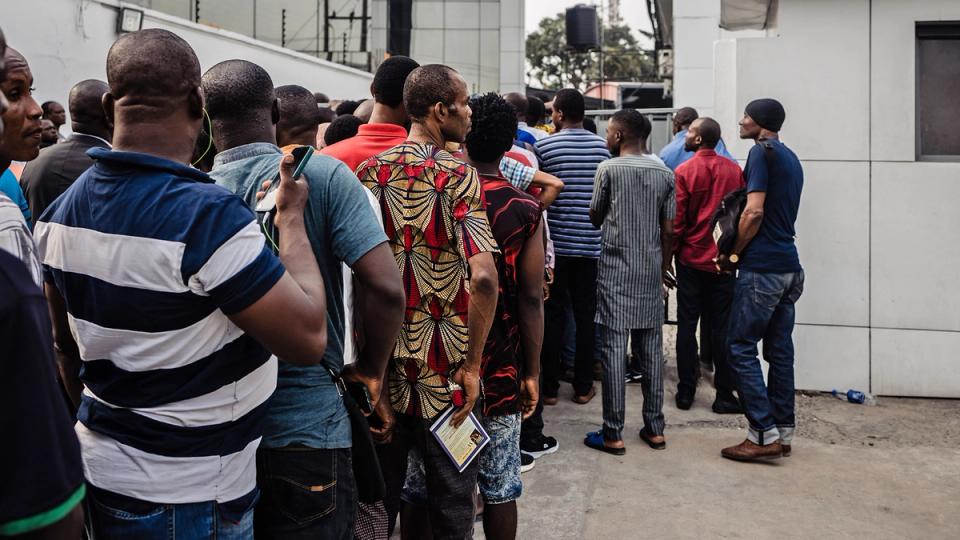


 The Banque Centrale de Tunisie had an early start in 2019 when rumors spread that it launched a CBDC, but the central bank quickly denied these claims. It did, however, launch a CBDC pilot in collaboration with the Banque de France in 2021 to test cross-border transactions.
 The Bank of Ghana also got its start in 2019. It ran a pilot in 2022 and planned to go live in 2023, but it delayed those plans due to the high inflation experienced at the time. The central bank continues to be active in the space, but the timeline is unclear.
 Tomorrow, I'll spotlight the only launched CBDC in Africa. However, if you can't wait... you can find out who it is in the
  The Bank of Namibia began its research in 2020 and eventually received assistance from the IMF on at least three different occasions. However, in 2024, the IMF “did not find a strong case for issuing a [retail CBDC] at the moment."
 The Central Bank of Kenya had a bit of a late start in 2022, but it has repeatedly found that CBDCs are a solution in search of a problem. The central bank said many of Kenya's problems "cannot be solved with CBDCs" and that launching a CBDC is not "a compelling priority."
 Curious to learn more? You can find more information in the HRF
CBDC Tracker. And tomorrow, I'll spotlight the pilot projects.
Curious to learn more? You can find more information in the HRF
CBDC Tracker. And tomorrow, I'll spotlight the pilot projects. 


