
In the first trimester, a female fetus will cause nausea, vomiting, & fasting, effectively keeping mom in ketosis to limit deuterium for its developing follicles. Effect of deuterium consumption in adult males vs females
Dr. László Boros: "Fertility is very important, because it's simply it seems like the oocyte, the female reproductive system locks in all the follicles in the female reproductive organ. They have about 400,000 follicles in the ovaries, and about 400–500 of them become eventually ruptured or matures to be fertilized with a sperm.
"And it happens in the female babies it happens in pregnancy. By the third month you have the baby's ovaries with all the follicles developed. After that, they go into a dormant state. […] They are surrounded by follicular cells, so they don't really get involved in metabolism, and it doesn't matter what you eat.
"While in the first trimester, you may throw up, you may have nauseation. […] So […] you fast. You practically keep yourself in ketosis, you know it or not, but practically that's what your body is trying to do. If you eat too much you throw up, simply because your baby is trying to limit deuterium for these follicles as much as possible. So that's locked in in life.
"It's different in males because they produce sperm constantly. Their sperm's DNA or chromosome deuterium content is different from that of the females. The females can eat anything: their oocyte, the haploid DNA or chromosomes, they don't gain deuterium.
"But the sperm would. So eventually in nature we know that the males that go to a successful mating fight, meaning that they are lowest in the deuterium, because their nanomotors and muscles and all those abilities are the best in that particular male generation, they will have the chance to mate. So nature still kind of depletes deuterium in the sperm, too, but it's a different natural scenario.
"And we are exploring all these marvels and beauties of nature, and we do our interpretation, means that we interpret those findings from the point of view of deuterium. So practically, it's almost like you can explain all kind of weird stuff that happens in nature. You may not understand it from just looking at it, but once you talk as a deutenomicist, or once you apply deutenomics to those particular biological principles, you gain a little better insight of why things happen, in what order, and for what reason."
Dr. László Boros with Sarah Kleiner @ 31:06–34:38 (posted 2022-08-10)
Seafood is really important because it controls the eye clock. The more tech abuse, the more sunlight and seafood you need. The older you get, the more important getting better light (e.g., at five north latitude) frequently becomes
GMONEY: "Dr. Jack says light, water, now magnetism, that's kind of difficult for me to understand, I guess. I'm not totally sure about that one. What else do you want to add to that? [...] What's like in the top 10?"
Dr. Jack Kruse: "Seafood is really important because it controls the eye clock. The eye clock is the thing that controls everything in your body. Most people don't understand like the tweet that you put up before, it got into something called the Bazan loop. Again, you don't have to know any of this shit. I would just tell you, if you can eat seafood, like the more tech abuse that you use, the more sunlight and the more seafood I want in your diet. OK? I think eating meats, that is what I would call the base of your diet, because you're. . ."
GMONEY: "Is sushi OK?"
Dr. Jack Kruse: "Yeah, sushi's fine, but I would cut out the rice. The rice is probably superfluous. Sashimi is probably a better choice."
"And then I would tell you, the light, the sun that you get obviously where you are in Southern California compared to where I'm now, I'm probably like fifth degree north latitude. Like I go outside even though it's January, this day here is better than the best day you'll face in June or July where you live.
"And when you realize that the older you get, like when you're an old fucker like me in your sixth decade, going to light like this more frequently is important.
"You guys will laugh, but the reason I'm on this trip twofold. One is not only to get better light than we even have in El Salvador, because El Salvador is 13 north. I'm at five north. . ."
Dr.Jack Kruse with npub1p0azx5nzq2da6vjlkf5rveuc2r0zj3jhhrz6kvhlm3sd7u055s4sw3mfvl @ 46:07–47:54 (posted 2025-02-06)
https://rumble.com/v6hkze4-rugpull-radio-ep-108-special-guest-dr-jack-kruse.html?start=2767
Your eye is an optical lattice clock that takes the frequencies of light to create a day-night cycle. The suprachiasmatic nucleus is the master clock that controls everything in the body. The eye clock is the single most important part to allow us to become a mitochondriac
Max Gotzler: "You said that light gives us information about time. Now, I'd like to know […] how do our cellular clocks really work and […] how is our concept of time related to our workings of our mitochondria?"
Dr. Jack Kruse: "Well, the concept of time is created, meaning it's not reality. It's actually something that our brain creates. OK? […] Well, it turns out that your eye is an optical lattice clock and it takes the frequencies of light and it creates a day-night cycle. And we talked a little bit about that earlier when we were talking about how vitamin D and vitamin A work with DHA in the eye. And one of the blogs I wrote a really long time ago, I get into that connection. It was in, I think, the first paragraph of Brain Gut #5 where I mentioned how this is connected.
"But the key connection is in the eye. And the eye is actually what creates time or timing for the brain. So the brain knows that when sun rises, it should have equal parts of red, blue and green. And as the day goes on, those frequency changes. So, for example, where you are right now, you probably don't make any UV. But I do. And when my brain sees UV, that tells me, 'OK, well, look, it's 10:00 ᴀᴍ.' And then it goes from UVA to UVB: 'Oh, now we're close to solar noon.' And so your brain is deciphering the frequency codes of sunlight, and that's how your body does that.
"Now, all these little proteins that work with light, like the ones we talked about earlier, melanopsin, neuropsin, they have this vitamin A connected to it. And that vitamin A is important in the gears of the clock. What sits between the retina and the leptin receptor? […] The suprachiasmatic nucleus, which is the master clock that controls everything in the body. And what is it? It's an optical lattice clock. […] It has to run faster than all the other peripheral clocks that stand in front of every gene. […] In front of every human or any mammalian gene is a clock gene, a peripheral clock gene. That clock gene pays attention to this one. And the way the system has to work, this has to run faster than everything below it. […] Say the clock up there was slower. […] That's chaos. That's inflammation. That's fundamentally how inflammation is caused in the body. And that inflammation ruins mitochondrial signaling.
[…]
"Modern human physicians look at the eye as a camera. I don't. […] The eye clock is the most important part. And we've ignored this part of biology for too long. And it turns out this is the single most important part to allow us to become a mitochondriac. Because that clock is what controls everything else in your body, specifically how a mitochondria works. Because remember, if you don't know when to make the appropriate amount of energy, then how can you let everything happen properly? […] Timing is the single most important thing in it. We use light to create that timing mechanism everywhere in our bodies."
Dr. Jack Kruse with Max Gotzler @ 47:48–51:54 & 53:03–53:59 (posted 2017-02-14)

Die Flowgrade Show mit Max Gotzler: #035: Skiing In Underwear Or How To Hack Your Mitochondria With Dr. Jack Kruse
Find the Show Notes at www.flowgrade.de/jackkruse In this episode with brilliant neurosurgeon and biohacking mitochondriac, Dr. Jack Kruse, you wil...
Blue light liberates the vitamin A in the eyes, creating inflammation if not counteracted by DHA. Blue light and myopia, acute macular degeneration. Blue light destroys dopamine. Blue light and neurodegenerative disorders
Max Gotzler: "You said that a high amount of protons could indicate inflammation. What are maybe some practical examples of what has the body produce more protons in relation to electrons and vice versa?"
Dr. Jack Kruse: "Yeah, I would tell you that the most common one that I talk to most people about is not what other people talk about, but blue light. For example, […] you and I are talking right now. […] For me, it's early in the morning. And you'll notice that I have my glasses on protecting my eyes, and the reason for that is because of the blue light. And in the morning light, in the sun, there's only about (this time of the year) maybe 16% to 19% blue light. This device that you and I are looking at, there's four times the amount of blue. There's no red and there's no UV.
"So guess what's happening? Max is reducing his flow. He's making too many protons through his eyes and through his skin, through proteins called opsins. One is melanopsin. There's neuropsin. The cone and rods in your eyes also have different opsins. And when this happens, these opsins are bound to something called vitamin A. And in humans, that bond is covalent. It's very loose. Every time a light frequency comes through, that breaks apart, and it creates a thread of protons. So you have to have something else there to balance it.
"And in the eye, it turns out, that's DHA. DHA is a 22-carbon big fat that's present in our eye as a suprachiasmatic nucleus all the way to the leptin receptor in the anterior visual pathways. And what happens is it recycles constantly, and it's got 22 carbons, and the reason why that's important, they have double bonds in there. The point is it has a π electron cloud on the outside of it, meaning a massive amount of electrons.
"When you break down this connection, the way they're supposed to work, and vitamin A disinhibits and things break down, the amount of negative charge from DHA and the amount of positive charge from the blue light is offset, and blue light therefore then slows electron chain transport in your mitochondria, in your eye, and that creates inflammation. And the inflammation is actually what most of your listeners think of as an illness.
"So one of the most common things when you see too much blue light, it's called myopia or nearsightedness. So that's one of the symptoms. What's another symptom if it goes on too long? That's what we call acute macular degeneration. That's when you can actually go blind from too much of this.
"Now, if it goes even further, can you get disorders in the frontal lobes of the brain? The answer is yes. That's what we think neurodegeneration is linked to. Can it even cause other neurodegenerative disorders like Parkinson's disease, because remember, the eye is connected to the midbrain where the substantia nigra is that makes dopamine. Well, dopamine is also one of those chemicals that's tied to this anterior visual pathway.
"So blue light itself is capable of making information that destroys the amount of dopamine that's present within the system and all the connections that it makes, and that's how you wind up with different types of diseases."
Dr. Jack Kruse with Max Gotzler @ 16:26–20:46 (posted 2017-02-14)
Die Flowgrade Show mit Max Gotzler: #035: Skiing In Underwear Or How To Hack Your Mitochondria With Dr. Jack Kruse
Find the Show Notes at www.flowgrade.de/jackkruse In this episode with brilliant neurosurgeon and biohacking mitochondriac, Dr. Jack Kruse, you wil...
Mitochondria are the key to health. As energy production in the mitochondria drops diseases manifest. Where energy is lost things get bigger. People losing energy get fatter
Host: "So explain to me what the next step (and the next level of thinking) is that is making it clear that mitochondria is the real area of focus if we're concerned about health."
Dr. Jack Kruse: "It's actually simple. It's energy. When you have a mitochondria that don't function with as high in efficiency as it should in a healthy new child diseases show up.
"In fact, that's actually how diseases manifest. As energy production in the mitochondria drops diseases manifest. Is that Jack Kruse's observation? No, it's Doug Wallace's observation. He's probably the world researcher that's done more for mitochondrial biology than anybody else. He's at the Children's Hospital of Philadelphia. He's been doing this for over 40 years. He's the guy that figured out we only get our engines from our mom. So that means mitochondrial DNA is only inherited from one parent. That's pretty cool stuff. That's not true with DNA or RNA.
"Not only that, the wiring diagram for the mitochondria actually sit awfully close to some of the key features of DNA and RNA. He's made the case for quite a long time that size and shape changes in the mitochondria link to energy production. Now most people, and he's guilty of this too, he hasn't really done a good job, I think, telling clinicians this, but you've heard me say all the time that I can teach a third grader.
"Hey, what happens to your ankle when you twist it, does it get bigger or smaller? It gets bigger. What happens to your heart when you get heart failure, does it get bigger or smaller? Gets bigger. What happens to a star in space when it's dying, does it get bigger or smaller? It gets bigger.
"So guess what? Right there we see three different examples of where energy is lost things get bigger. But yet, when people get fatter we tell them they eat too much, they have too much energy. Does that make any sense from a thermodynamic standpoint? Absolutely not.
"So that's why my perspective is different than most doctors because they don't fundamentally understand mitochondria. And the reason they don't is because they're taught a curriculum that focuses on what? DNA and RNA. So can you ever get to the truth if you never look under the right stone?"
Dr. Jack Kruse @ 02:10–04:34 (posted 2020-10-27)
People that forgave unconditionally had less depression, less feelings of inadequacy, less anxiety regarding end of life. People who believe God has forgiven them are 2.5× more likely to forgive unconditionally
Dr. Roger Seheult: "There are some studies that have been done, particularly in Christianity, where there was a study that was published. This is Krause out of, I believe, University of Texas, where he did a survey and he asked people how they forgive. And he basically divided them into two different groups: there were people that would forgive conditionally, and people that would forgive unconditionally.
"Let me put it into practical terms. Someone does something to you and you say, 'That's okay. I forgive you.' […]
"There are some people that would only forgive if that person came back and did some sort of act of contrition. Like, OK, I'll forgive that person they came back and apologized, or I'll forgive that person they came back and they did, you know, whatever it is. That would be considered conditional forgiveness.
"The other type is unconditional forgiveness. So in other words, someone does something to you, you don't see them again, or they've never expressed any kind of being apologetic for what they did. They still get forgiven. So that's unconditional forgiveness.
"What they found in the study when they divided that, is that the people that forgave unconditionally had less depression, they had less feelings of inadequacy, they had less anxiety regarding end of life. […] The people that forgave conditionally had more somatization of depression. So these were real medical, you know, things that they could actually diagnose with surveys and tests that are well validated. And what would decide between these two was how they forgave.
"So they were puzzled by this. They said, 'Well then what determines whether or not someone is going to forgive conditionally versus unconditionally?' So they looked at a bunch of factors and none of them stood out except for one. The odds ratio on this was like 2.5, and it boiled down to this one question: Do you believe that God has forgiven you? That was that was the major thing. If somebody believed that the God that they had faith in had forgiven them, they were 2.5× more likely to forgive somebody unconditionally, which then was associated with all of these other things being low, like less depression, less anxiety."
Dr. Roger Seheult with Steven Bartlett @ 01:42:10–01:44:37 (posted 2025-07-17)
The maximum amount of deaths every year occurs within a month after the shortest day of the year. A myriad of different diseases are affected by the sun. Deaths are correlated to the amount of sunlight
Dr. Roger Seheult: "So the question goes back to the first question that you had at the very beginning of the podcast, which is, 'What is the effect of low energy output from the mitochondria?' Well, it depends on what tissue the mitochondria is in. And so, if it's in the eye, then it's going to be better visual perception. If it's in the brain, it's dementia. You see what I'm saying? So, what we start to see is we start to see that a myriad of different diseases are affected by the sun. I challenge anyone to do this.
"If you look at a publication in the United States, I've seen it where they map out the amount of deaths in a calendar day: cardiac disease, respiratory disease, kidney disease, pneumonia, all sorts of diseases, infectious diseases, non-infectious diseases, you will see a very clear pattern. The maximum amount of deaths every year occurs within a month after the shortest day of the year. So we're talking December, January. We see the most amount of influenza deaths at that time. We see the most amount of cardiac deaths at that time. We see the most amount of kidney deaths at that time.
"So you might ask, 'Well, that's because that's because people get together at Christmas time and they spread the germs around more, and we have Thanksgiving in late November here in the United States, and that's what's going on.' The problem is if you look at Australia, which is on the other end. So when is their longest day of the year? Their longest day of the year is in December, and that's when they have the least amount of deaths, despite the fact that they're all getting together for Christmas in December. So that doesn't fly. It's exactly the opposite. The most amount of deaths occur in Australia, in the southern hemisphere, in June to July. That's their winter. And so what you see is deaths are correlated to the length of the day. This is the reason why whenever they show you deaths in the year, they always have to seasonally adjust it."
Steven Bartlett: "And the length of the day is a proxy for the amount of sunlight."
Dr. Roger Seheult: "Absolutely. You're much more likely to get sunlight on the longest day of the year than the shortest day of the year, especially when, and this is well known, there are some months, especially in people who are doing shift work, like 07:00 ᴀᴍ to 7:00 ᴘᴍ, there's literally like December and January, you will not see the sun because you are going off to work before the sun gets up and you're coming home after the sun is long set. So you're not able to see the sun, and so you could go literally weeks without seeing the sun at all."
Dr. Roger Seheult with Steven Bartlett @ 01:06:26–01:09:10 (posted 2025-07-17)
Mitochondria makes melatonin, a powerful antioxidant that prevents oxidative stress. Infrared light from the sun is able to penetrate up to about 8 cm, stimulating and upregulating melatonin, thereby improving the energy output of mitochondria
Dr. Roger Seheult: "So there was a paper that came out in 2019 that fundamentally changed the way I saw this. It was written by Russel Reiter, who is the executive editor of _Melatonin Research_, he's out of University of Texas, and Scott Zimmerman, who's a light engineer. And what they set forth was to show that basically sunlight is made up of so many different types of wavelengths. You've got ultraviolet on one end, which of course makes vitamin D, and it's very beneficial. It's the type of light from the sun that is very shortwave and cannot penetrate very deeply. […]
"But at the other end there's this infrared light, which we'll talk about, or red light. It's very long wavelength and it can penetrate very, very deeply. […] That's exactly what this paper showed is that basically infrared light from the sun is able to penetrate probably up to about 8 cm, according to Scott Zimmerman in this article, and it fundamentally interacts with, specifically, the mitochondria. And what does it do to the mitochondria?
"So let's back up and talk about the mitochondria because this is central. The mitochondria to the cell is like the engine in your car. The engine produces locomotion that causes the wheels to spin. But in the process of doing it, it causes heat to surround the engine. And if you don't deal with that heat, it will shut down the engine. It will make it more inefficient and eventually it will shut it down. So what do all internal combustion engines have? They have a cooling system, they have a radiator, they have an oil pan, they have a water pump.
"And that's exactly what the cell has to have for the mitochondria. It's not heat in the mitochondria; it's called oxidative stress. And it's specifically oxidative stress that causes destruction of the mitochondria and leads to these types of diseases. So oxidative stress causes the mitochondria not to work well, this leads to diabetes. Oxidative stress makes the mitochondria not work so well, this leads to dementia. So this has already been laid out. This is not that controversial. The controversial part is what do we do about it?
"So what these guys in this paper showed was that, and not just them but reviewing the literature, is that the mitochondria makes its own cooling system, and that cooling system is melatonin. Now you might be thinking, 'Wait a minute, melatonin, isn't that the isn't that the stuff that we take that our brain makes right before we go to sleep?' Yeah. It's absolutely correct. That's what happens. The problem is that this is not melatonin that's made in the brain. This is not melatonin that […] goes through our blood and tells us it's time to go to sleep. This is melatonin that's made in the cell, in the mitochondria, and it's a powerful antioxidant that basically prevents the oxidative stress from occurring.
"What Scott Zimmerman and Russel Reiter showed, and proposed in this, was that basically the infrared radiation that's coming into the body is able to stimulate and upregulate melatonin and a number of other factors that keep the mitochondria cool, and can actually improve the energy output of the mitochondria. This was actually mind-blowing to me."
Dr. Roger Seheult with Steven Bartlett @ 23:15–27:27 (posted 2025-07-17)
If you take three mRNA boosters, pretty good chance you ain't going to work, ever. Who's speaking for the child? More injury and death in US from mRNA injections than all wars in 20th & 21st century combined. Colombian drug cartel gave better advice than Fauci, et al. The data is being suppressed
Dr. Jack Kruse: "What we're talking about right now is time inflation in biology. We are killing people. We're harming them. If you are a nurse and took this jab and you can't go to work, that means you can't make any money to support your family. That is time theft. OK? Not only that, it's also wealth theft. […] And it's the number one thing. If you eat a case of fucking Froot Loops right now you can still go to work. But if you take three boosters of mRNA, pretty good fucking chance you ain't going to work, ever. That's the key that people don't understand. […] Like this is the elephant in the room. This needs to be dealt with yesterday, not tomorrow, yesterday. Why? Because we're actively subtracting time from people's bank accounts.
"And it's happening to the most vulnerable people that don't have a voice. Like we always hear the story about no taxation without representation. Isn't that the same thing when you give a child three jabs at 3 months, 6 months, and 9 months? Who's speaking for the child? Nobody! The pediatricians are lining up to get their vaccine checks. […] What good is it, Marty, if our kids are all developmentally delayed, neurologically damaged, can't think? […]
Marty Bent: "[…] I know better than to let them do it, but how many parents out there […] just sort of going with the flow, trusting the doctors. This whole pay-to-play on the vaccine side of things is incredibly insidious and seems like an obvious conflict of interest that should be addressed."
Dr. Jack Kruse: "I think Mary [Talley Bowden] has done a beautiful job with that through her own Substack. She's been a firecracker. […] Like everybody would be furious if we went into Iran and, you know, 300,000 or 400,000 kids came back dead. Right now the low end of that number is about 500,000 in the United States, up to 17 million (that's globally). So realize what we're saying: more people have been taken out from this jab in the United States than all the wars in the 20th and 21st century combined, and nobody's upset with that. In fact, I said on a couple of podcasts, it sounded hyperbolic but I mean it literally and figuratively, that if you listen to the advice of the Colombian drug cartel versus what Fauci, et al., 'The Science' said, you would get better advice from the Colombian drug cartel. Why? The number of deaths from cocaine, fentanyl, and drug overdose was less than it was during the covid times. How do you like that? […]
Marty Bent: "Yeah. And I think there's a ton of people out there who may have their doubts, but they're a bit apprehensive to make the jump to fully like, 'I'm on board with this,' because they obscure the data. Right? […] Ed Dowd, […] he's jumped into the data, whether it's disabilities, life insurance claims, life expectancy, excess deaths. And the data is there, but they do a good job of saying, 'It wasn't the jab; it was covid.' […] Kevin McKernan […] talked about […] the preprint out of Japan that showed that the types of cancers that emerged post 2021, when the jab rolled out, completely changed, and they changed to areas of the body where the mRNA vaccine was congregating. And then they ripped that preprint out, and so it's like, 'Oh, they're telling you that's fake news.' But the data is there."
Dr. Jack Kruse with npub1guh5grefa7vkay4ps6udxg8lrqxg2kgr3qh9n4gduxut64nfxq0q9y6hjy @ 38:54–44:45 (posted 2025-05-15)
Serendipitous conversation at a bar in Bregenz in 2008 leads to discovery of how NO is made in skin from UV. Seasonal variations in blood pressure due to UV on skin
Professor Richard Weller: "[…] But problem solving those experiments, we showed that the skin contains large stores of nitrogen oxides: nitrate, nitrite, nitrosophiles. And at the time, I did not know what that meant. It was thought that nitrate was an inert end product of nitric oxide oxidation. It was thought it did nothing and was peed out. But I found all this stuff in the skin for no obvious cause. I sent it off to the JIT, which was the top dermatology journal. I sent the usual cover letter, 'Groundbreaking science. You're so lucky to get this. Brilliant stuff. You should really take it,' whilst thinking to myself, 'I don't know what this means. I have no idea. I think this is rather odd.' Anyway, they accepted the paper, much to my surprise, because I wouldn't have done so. It's actually turned out to be a really important paper.
[…]
"So what Martin showed, in this methods paper that nobody read, was that when you shine UV at nitrate in the presence of thiols, SH groups, you get a photochemical reduction of nitrate to nitrite. […]
"[At the] NO group […] meeting in 2008 […] in Bregenz […] at the bar after a day of science, I was saying to Martin and my friends around the table, 'I've discovered these huge nitrate stores in the skin. I have no idea what it means. I've managed to publish it. Can't understand why. What does it mean?' And Martin said, 'I've written this paper three years ago that nobody has read. We showed that UV releases NO from nitrate in the presence of thiols.' And I went, 'Oh my God, UV hits the skin, the skin's got lots of thiols, you know, it's got all these keratins containing thiols in the skin. And it's got lots of nitrate. You've got the three ingredients that make NO.' And talking over the bar, I could remember from medical school days that in sunny times of year, blood pressure is lower. Could this account for those seasonal variations in blood pressure? […]
"So we quickly published this hypothesis paper in the European Heart Journal saying we think this might be happening. We think that sunlight hits the skin, we think that it photoreleases these nitric oxide stores to the circulation, which lowers blood pressure. And we then set out to try and confirm it."
Professor Richard Weller @ 16:18–17:14 & 25:17–28:39 (posted 2025-10-11)
UV in sunlight hits the skin, releases NO, which moves into circulation, which dilates arteries, which lowers blood pressure, so you don't get a heart attack or stroke, and you live longer. Dermatologists don't care
Professor Richard Weller: "We then shone UV at the arm. And we either shone UV at the arm so rays hit it, or we shone UV at the arm but it was covered with a foil blanket so the temperature rises but UV doesn't hit the skin. And what we showed was that when you irradiate the forearm it causes vasodilation. So ultraviolet in man is an arterial vasodilator, and the sham arm there was no vasodilation. So UV in man is a direct vasodilator.
"Blood pressure is a function of total peripheral resistance and cardiac output. So you multiply what the heart cardiac output is by the peripheral resistance (and the more constricted vessels are the greater the resistance), and the function of those two gives you blood pressure. So we then stood people in UV cabinets or we lay people under full-length UV lamps, and we showed that shining UV at people lowers blood pressure. The sham irradiation, covered with the foil blanket so that the temperature goes up and not the rays, there's a fall in blood pressure while the lamps are on because you get warm. But as soon as the lamps are off, the sham irradiation returns to normal, but the actively irradiated stays down.
"And then you have a rise in circulating nitric oxide in the irradiated group and a fall in nitrate. So sunlight hits the skin, releases NO, which moves into the circulation, which dilates arteries, which lowers blood pressure, so you don't get a heart attack or stroke, and you live longer. That's great.
"So that was super. Of absolutely zero interest to dermatologists. Not interested at all. Couldn't be. They really don't care."
Professor Richard Weller @ 32:01–34:06 (posted 2025-10-11)
In UK, summer blood pressure is significantly lower than winter, as great an effect as a drug. If you're a male living in Scotland, you are 30% more likely to drop dead in a week in January than a week in August. Vitamin D supplementation has no effect on myocardial infarctions, no effect on strokes, and no effect on cancer deaths
Professor Richard Weller: "When you analyze blood pressure by the month of the year in which the blood pressure was taken, we see there's a huge seasonal variation in blood pressure in the UK. So in summer blood pressure is significantly lower than winter. And in fact the effect of season is as great as the effect of a drug in lowering blood pressure. So what this might suggest to you is that sunnier countries, or within a country, sunnier times of the year correlate with lower blood pressure. […] The more UV that falls the lower cardiovascular disease incidence, which is a sequela of high blood pressure. So that's observational data.
"The next bit of observational data is really looking at vitamin D. So UVB formation is responsible for vitamin D synthesis in man. So blood vitamin D levels are a great indicator, a biomarker for how much sunlight and specifically UVB you've had. And we know that people with lower measured vitamin D levels are more likely to have hypertension, more likely to have cardiovascular disease, more likely to die of stroke, and in fact more likely to die of any cause whatsoever. So that's observational data.
"The problem is when you carry out interventional studies, when you enter people into randomized placebo controls, double-blinded trials of vitamin D supplementation, it does pretty much nothing. So this is a meta-analysis, a combined analysis of multiple trials of vitamin D supplementation published in the Lancet, gosh, 12 years ago now. Giving people vitamin D has no effect on myocardial infarctions, no effect on strokes, and no effect on cancer deaths. And the biggest study of all was completed about five or six years ago in America. So this was is a study called the VITAL Study funded by the NIH in America. 25,000 Americans randomized, half to get vitamin D supplements for five years, half to get placebo. The results have been published largely in the New England Journal, and the results are broadly negative, negative, negative, negative. Some possible effects on autoimmune disease. So that was 25,000 people for five years. The Australians ran a smaller study, 21,000 people for five years. Half get vitamin D, half get placebo. Results are negative, negative, negative, negative. So, it's not the vitamin D.
"And this is an editorial from the New England Journal from 2022, four years ago now, saying, 'Adding those findings to previous reports, etc., etc., people should stop taking vitamin D supplements to prevent major diseases or extend life.' So clinical trials confirm it's not the vitamin D. So vitamin D is a biomarker of a sunlight exposure and it prevents rickets in children. You know it has some benefits, prevention of rickets being the main one. […]
"If you're a male living in Scotland, you are 30% more likely to drop dead in a week in January than a week in August. Huge, huge. We've just passed the equinox, heading the wrong way. Time of year when I start to get a bit antsy. You know, summer's fine. Am I going to survive another winter? You know, the data is pretty serious. We know that vitamin D accounts prevention of rickets, but what about the rest? And that's really the question that we're facing now. So this is observational data and the vitamin D debunked by trial data: limited benefits."
Professor Richard Weller @ 10:50–15:12 (posted 2025-10-11)
"I regard consciousness as most fundamental." — Max Planck. Consciousness, energy and matter. _The Case Against Reality_
Martin Picard, PhD: "Max Planck, who is a quantum physicist, at the end of his career he wrote at length about this and he ended up saying, 'I regard consciousness as most fundamental. Matter and everything else just emerges from consciousness, from this deeper level.' David Bowman, also a physicist, kind of arrived at the same conclusion. Einstein said similar things. So there's a lot of people who've thought about energy, who've thought about matter, and at the end of their lives, they're like, 'Shit, this that doesn't make. . . there's something else. There's a deeper underlying layer of reality.'
"So my perspective on this is I don't know what the truth is, but I suspect that there's kind of this underlying current and let's call it consciousness. Some people might want to call it God. Some people might want to call it, you know, energy and like dark energy or whatever. […] So, there's the force or the force of consciousness, let's say, that is flowing, that's just energy. What energy does is it naturally seeks ways to transform itself or to move and to flow. This is like a fundamental property of of energy in its different forms. Energy wants to flow, wants to be transformed. So maybe there's an underlying current of consciousness.
[…]
"So I think it's a worthwhile hypothesis, and then it brings us to think from first principles about the nature of each of our movement, but also to see ourselves as movements, and then an energetic movement. So, we're always in flux, always changing, and there's some kind of structured or some, you know, an eddy looks like another eddy, but there's a lot of differences. The same way human beings look, you know, a lot of features we share, but we're also very different. And we have genetically identical human beings, you know, monozygotic twins that are so different and personalities and their likes and dislikes. Where does this come from? I don't know. But maybe there's a deeper layer of organization that precedes the molecular structure of our genomes and other things.
"So we can't disprove this, in the same way that we cannot prove that the materialist or the physicalist viewpoint is superior. So at this point there's been very good arguments made by Don Hoffman, who wrote this beautiful book _The Case Against Reality_, who makes the same point that matter is not most fundamental, despite what your senses are tricking you into believing. Matter is not most fundamental. There's another layer, and then you're an expression of that layer, and your own conscious experience is in a way this movement of consciousness or energy that is experiencing itself. And so this leads to really interesting questions and hypothesis which I develop in the book that I'm writing called _Energy_."
Martin Picard, PhD with Thomas P Seager, PhD @ 45:35–46:55 & 48:06–50:17 (posted 2025-09-19)
All sex hormones originate in the mitochondria. Mental health disorders as metabolic disorders. You are not a molecular machine; your brain is not broken. You are an energetic process fueled by your mitochondria
Thomas P Seager, PhD: "But what I picked up along the way is that mitochondria are the site at which all sex hormones originate. So whether it's testosterone, or even cortisol, or pregnenolone, which is a sex steroid synthesized on the inner mitochondrial membrane. If your mitochondria are not in good shape, it's no wonder you don't feel like yourself. You might lose your motivation. You might lose that zest for life that gets you up off the couch. And then when the mitochondria are restored, you can literally feel like you're a different person."
Martin Picard, PhD: "I think that's quite possible. At at this point, I would say it's a partially supported theory, right, the mitochondrial theory of mental health, or mental health disorders as metabolic disorders. I think there's a lot of strong evidence that says this is correct. If you don't feel well, right, then you don't feel like yourself, and you feel terribly depressed that you want to die. Or you have bipolar disease that you fluctuate between states of mania and states of deep depression, or you see, you hear things that other people don't hear, and you have some dissociative experiences and schizophrenia.
"All of this is not because your brain is broken. Your body is not broken. You're not a molecular machine. You are an energetic process fueled by your mitochondria. And if energy isn't flowing properly, you as a person, your energetic self changes.
"And when that happens, you know, this you might be the most first principle understanding what disease is. Right? Dis-ease, when you're not at ease, this can happen probably very quickly because your energy isn't flowing properly. And there's some example, historical example. I learned this when I was in graduate school. I was learning to study mitochondria, mitochondrial respiration, right? One major way in which mitochondria do all of these things, including making hormones, you know, the sex hormones that give the female body the ability to conceive, to carry new life, right? Progesterone, estrogen, those are made in the mitochondria. This is amazing. And testosterone determines whether you get a penis or not during embryogenesis. Testosterone is made in your mitochondria. These hormones are the basis for the survival of our species. And for some reason that nobody understands, their synthesis was converged in the same organelle, the same cellular site that's responsible for keeping the lights on and making decisions about cell life and cell death. So I think there's a profound connection there between energetics and survival of the species, and mitochondria are kind of the hub for this."
Martin Picard, PhD with Thomas P Seager, PhD @ 09:07%%11:58 (posted 2025-09-19)
Gaining insights into autism from studying melanin migration defects in Siamese cats. Blue light liberates vitamin A, which then destroys melanin sheets
Dr. Anastasia Bendebury: "Is the alpha wave signal in the thalamus different in people that have sensory defects?"
Dr. Jack Kruse: "Of course! I mean the perfect example of that is people with autism. Think about what autism functionally is: it's a neural melanin migration problem that is a transgenerational problem that happens between the mother and the father.
"And most people don't even know this, but Siamese cats […] lay this out. If you go and look at all Siamese cats you'll notice they all have blue eyes. OK? And the funny thing is they have a lot of problems with their eyes, meaning sometimes they get turned in, they're all kind of crazy. The reason for that it turns out that the melanin that's in their neural tracts is really abnormal so it affects migration. […]
"Melanin controls migratory patterns in neuroectoderm, and it turns out it does this through vitamin A. Vitamin A has huge effects. Well, guess what? The non-visual photoreceptor system in the brain, which melanin is part of, so is cholesterol, so is melanopsin, so is neuropsin, […] in humans there it's a weak covalent bond to vitamin A. So the reason why blue light is really bad, it liberates vitamin A, and what does that do? That destroys melanin sheets anywhere they are in your body. What happens then? You get neuromigratory pattern problems. This is the reason why kids with autism actually show what I call a regressive evolution. They go back to being like a monkey who can't talk, because the melanin is not there.
"Just think about when a baby comes out of your vagina. Can the baby talk and walk and run around? The answer is no. Why? Because it's neuromelanin has not developed in its head yet. Well guess what? That system is broken in kids with autism in their sensory relays. And guess what? Are all those studies done in the ENT literature for the calyx of Held, is all that stuff done in the central retinal pathways? Yeah! It's all there! But nobody's putting it together. But guess what?
"Why have I had a Siamese cat ever since I'm 15 or 20 years old? Because I learned about melanin a long time ago. I've been fascinated by it since I'm a little boy. But I didn't know what melanin really did until I got to be about 40 years old. Then when I figured it out, I'm like, 'This is the fucking greatest story never told.'
"And when did I first tell that story, in total, of really what it means? I told it to Rick Rubin and Huberman in 10 hours, and left both of their jaws on the ground. This story is the greatest story ever told. Anybody who's interested in biology, anybody who's interested in evolution, has a duty to themselves to listen to it. This will shake your foundations.
"But I promise you this, and I swear on my life I'm right about this. You'll become a much more curious mammal after you listen to this and listen to this perspective. You will become better interviewers, because the future scientists that you're going to have on after me, you're going to say, 'Wait a minute. We need to put this through this lens. What is the effect of this on endogenous light production? How does that change the hydrogen bonding network in water? And then how does that change the paramagnetism of free radical signaling in us?' Is that fundamentally what free radicals are all about, it's about magnetic flux? Of course it is! Anything that makes an EPR signal, there's a free radical, because it has an unpaired electron. Oh shit, look at that: we're back to that goddamn physics story again.
"Look, this is a fabulous story, and I tried to tell you that I got tuned into this fabulous story through Albert Szent-Györgyi and Becker. And I jumped down this rabbit hole and I don't want to come out of it. I want to blow up the paradigm that created me."
Dr. Jack Kruse with Dr. Anastasia Bendebury & Dr. Michael Shilo DeLay @ 02:17:18–02:21:32
The World Health Organization is a criminal organization. It needs to end. Switzerland is complicit in global acts of terrorism. Drug industry activism branded as "Public Health"
Dr. David E. Martin: "The World Health Organization is a criminal organization and we need to call it what it is. It started off in the beginning of the last century as the Opium Board. And I want you to just kind of sit with that. The Permanent Opium Board. That's what the World Health Organization was before it rebranded. Now if that sounds like a health organization, you're already delusional. What that was was the British East India Company legacy playing itself forward, and it was actually, as you know, after the Chinese disputes around the opium trade in the 1800s, where we decided to actually create a criminal cabal, not unlike OPEC, but it was for heroin and opium. Call it what it is. These are criminals.
"And it turns out that they decided to domicile in Switzerland because they actually wanted to get immunity from prosecution, and Switzerland had neutrality laws that made it most favorable. And when they wrote their charter they said they were immune from criminal behavior. So giant shock. It's a criminal organization. It's like the mob writing its own constitution going, 'Well, we're going to be the mob, we're going to write our own constitution, and you're not going to be able to investigate us regardless of what we do, because we said so.' And the rest of the world just nods their head and goes, 'Oh, OK, OK, yeah, and you said so.'
"At no point by the way is any of what I just said legal, but in in fact it is now law. Switzerland now defends the World Health Organization, and a criminal organization is running inside of Switzerland. And the Swiss are actually complicit in global acts of terrorism by virtue of shielding and harboring terrorists.
"I think we should actually start calling for Switzerland to be declared a terrorist state. Why not? We actually talk about state-sponsored terror everywhere else; why is it that we don't talk about state-sponsored terror in Switzerland? And why shouldn't we? Because they're harboring one of the largest lethal organizations on earth, the religion of that organization which leads to global terror is a religion called, allegedly, 'public health.' But 'public health' is neither public nor health. It is the advancement of drug industry activism and drug industry interests, and it is that sole purpose for which the criminal organization and the criminal cartel is established.
"So, let's start a campaign where we actually label Switzerland what it is: the state sponsor of terror which has killed more people than all of the Islamic movements, all of the craziness that's come out of other extremist programs, all of those things combined. The World Health Organization leads in fatality. So, state-sponsored terror: you got it. Switzerland, the harbor for the state-sponsored terror: absolutely. And wouldn't it be fun for us to actually see people start to hold accountability where it belongs.
"Because when it was established in 1953, remember that this was an organization that was put in place specifically to launder private sector donations into the rubric of a public, state-sanctioned version of the advancement of medical technologies. And what we have to understand is that that decision in 1953 allowed organizations like the Gates Foundation, like Gavi, like all of the UN-affiliated organizations around health, it allowed them to operate with impunity, because they can actually conduct clinical trials and kill people without any consequence. There is no standard for ___ in any of the programs that they advance as long as they can convince themselves that there is a 'world at risk.'
"Well, it turns out that if you're making the pathogens, and then you're deploying those pathogens, you can create risk wherever you want it. And the great news is because of the articulation of the history and the message of the World Health Organization, beginning ironically about a year ago, when a number of Europeans got together and invited me to do a tour of European countries where I made this presentation several times, we are succeeding in the undermining of the resolve not only of the Treaty, but I'm starting to see cracks where a number of people are starting to question whether the World Health Organization is actually a legal operation in the first place. And I want to see those cracks open up into full fissures and I want the thing to fall apart, because it has to. Because it is a criminal institution and we need to see it end."
Dr. David E. Martin with Brian Rose @ 53:46–58:23 (posted 2024-07-03)
https://rumble.com/v55af7l-dr-david-e-martin-ww3-global-catastrophe-over-2-billion-will-suffer-gruesom.html?start=3226
Human photosynthesis is driven by melanin. What melanin does
Dr. Jack Kruse: "Human photosynthesis (actually all animal photosynthesis) is driven by melanin.
[…]
"Hemoglobin and chlorophyll were the two main semiconductors that life used prior to the Cambrian explosion. After the Cambrian explosion, which was 650 million years ago, a third semiconductor showed up very, very quickly and kind of became the dominant player, […] and the chemical is melanin.
[…]
"I can easily elucidate for you why melanin is important: it creates hydrogen and electrons and oxygen. That's what it fundamentally does in the cell. […] A cell makes a DC electric current by charge separating water utilizing melanin to do so.
[…]
"The force carrier for electromagnetic force is a photon. That's light, OK? Light liberates electrons from water. OK? The same story that happens in photosynthesis, OK, except it's much more efficient when in melanin is involved. OK? In photosynthesis, only two electrons are popped out. In melanin biology, four electrons are popped out plus more hydrogen is made. So you make a bigger electric current. […] The difference between hemoglobin and chlorophyll, there's 12 electrons. OK? That's the difference between simple and complex life. It turns out that melanin made more complex life even more complex because it allowed more energy production inside the cell after the Cambrian explosion. Therefore the things that we should see in life as we go further along say the history of evolution is we should see higher levels of redox chemistry. We should also see higher levels of DC electric current. We should see increased utilization of light in much more complex fashions, meaning non-linear optics should be a part of the system.
[…]
"The gene product that makes melanin is called POMC, proopiomelanocortin. It only gets translated or turned on by UV light. OK? So one of the peptides, the neuropeptides that's made from this besides α MSH that makes melanin, you know what it's called beta endorphin. Do you know what that means? Nature made you to be built to have a certain quantized amount of an opiate, to be outside.
[…]
"The mitochondria is an electromagnetic producer of light, similar to the sun, inside of every cell that actually is the composer that is directing all the boxcars in biochemistry to do this, and it works on redox signaling and light frequencies. And is that the reason why melanin controls the endogenous life story that's created inside us? Is that the reason why tryptophan, serotonin, melatonin, and leptin all have emission spectrums between 200 and 400 nanometer light that doesn't come from the sun, because maybe we make the light inside of us.
[…]
"What melanin is functionally doing, and why melanin is the color that it is, why certain semiconductors are the color they are, and really what melanin is functionally doing, it's actually creating a kaleidoscope inside of us that control everything in us. And when you actually look fundamentally at a cell, we have 100,000 biochemical reactions in one second. The only thing, when you just think about it, that can control that is all the different spectral frequencies that go between 200 and 1100 nanometers.
[…]
"It turns out that melanin and different proteins in different parts of the cell are emitting and absorbing different frequencies. So that means that, for example, the neighborhood in and around cytochrome C oxidase is loaded with infrared A light, because that's what its absorption spectrum is around. But the same thing is not true around cytochrome 2, where it's flavins and it's much more in the 400–500 range. And then it's also not true at cytochrome 1, because that's where it's in the UVA range."
Dr. Jack Kruse with Dr. Anastasia Bendebury & Dr. Michael Shilo DeLay @ 11:28–11:33, 10:25–10:54, 17:42–18:13, 19:07–20:36, 01:08:05–01:08:35, 01:26:20–01:26:58, 01:35:02–01:35:38 & 01:42:36–01:43:06
Why build a solar callus. How to build one
Dr. Jack Kruse: "I want Bill to learn how to turn on the solar callus in his body. […] Solar callus, the way I like to describe it, […] you go in the Louis Vuitton store with your wife. She looks at the shoes and she goes, 'Oh, baby, these hurt my feet.' And then Rick turns around and said, 'Baby, you get those shoes, wear them five times around the house, and you'll be fine.'
"You know how to break shoes in, but we don't know how to break our skin in. So when you're a white boy like me, actually all three of us, we all have skin that Fitzpatrick I or II from high latitude. What you need to know is the program's still in you. You can still make melanin, but you have to turn POMC on, […] proopiomelanocortin. […] That's the basis of melanin story that's there for α MSH.
"The key there is first thing you want to do to build it up, eat a lot of shellfish. Why? Because the chitin, the exoskeleton in that has a lot of chromophores that help the skin. OK?"
Rick Rubin: "Is it in anything else or only in shellfish?"
Dr. Jack Kruse: "Oh, no, it's in other things like for example, tomatoes. OK? You'll also find it in some fruits. I'm trying to think of a good one. Macadamia nuts. […]"
Rick Rubin: "I like macadamia nuts as a nut."
Dr. Jack Kruse: "I do too because they have high DHA.
"The second step is then I want you to think about the circadian biology of the sun. In the morning, this red is really powerful. There's no UV. So you get a lot of red light. Red light preconditions the skin to make more UV, in other words, it helps everything in your skin, the fibroblast, the collagen, the water, it energizes it.
"And as soon as the UV comes out, the POMC that's buried in your skin turns on and you begin to make melanin.
"So melanin biology becomes upregulated because of those three things that happen. You're putting substrates in the body, which are basically proteins that allow you to assimilate light and meaning they have an absorption factor. Then you're using red light to get all the collagen ready. And then when the UVA starts, that's the stimulus to turn on α MSH.
"Then slowly, if you do this over four to six weeks, you will create your own melanin in your skin. That's the story, the idea that I got with the African-American lady with vitaligo. That's exactly what I did on her to actually stimulate it, and I wanted to know how fast it can happen. It happens quick. And then the flip side of that story is what Rick brought in part one and part two when he told us about when I go from low latitude to high latitude, I lose it pretty fast, too. […]
Rick Rubin: "I have a friend who I knew back in my old life who saw me and he said, 'I didn't know you could get tan, based on how white your skin had always was. I didn't know it was possible for you to have any tans.'"
Dr. Jack Kruse: "And you know why I'm glad he just said that? Because Bill, that's the teaching case. Does a high latitude northern European, who's got Fitzpatrick type I skin, has Rick proven. . ."
Rick Rubin: "With blue eyes."
Dr. Jack Kruse: ". . .that what I just told you, with blue eyes, has Rick just proven, as the hippo and lion, he knows how to do it now? Not only that, he also is so in tune, he's like, 'Jack, when I fly home, I actually know that I lose it.' And guess what? I don't have to talk to Rick anymore. He knows. I don't have to tell him again."
Dr. Jack Kruse & Bill Gifford with Rick Rubin @ 01:56:37–02:00:36 (posted 2024-03-13)
https://youtu.be/watch?v=EHe78j9UrMI&t=6997
We're designed to eat the fish, not the pills. DHA at the sn-2 position
Max Gotzler: "I know you're also not a big fan of pills and supplements, but would you say to fish oil pills with DHA in them? Not a good idea?"
Dr. Jack Kruse: "No. And the reason I'm not a fan, it gets into the details. When it comes to quantum biology, you have to understand within the eye and the brain, DHA gets put into it in a very specific way. And it's called the sn-2 position, and I'll explain it to you very simply.
"All fats in the body have three carbons. That's the glycerol backbone. Sn-2 means the middle one. So for DHA to work optimally within the brain to have that good π electron cloud, it needs to be in the sn-2 position. So when you have pills that are created by man from fish, most of it is in sn-1 and sn-3. That means it's effectively useless.
"What's one of the things that food guys like you know? That polyunsaturated fats are really bad for us. They make a lot of inflammation.
"So here you think the fish oil is good, but remember the fish oil is a polyunsaturated fat. So if it's in sn-1 and sn-3, effectively that can make your highly sensitive CRP or inflammation go through the roof. No bueno.
"See the nice thing is, the way it's designed to work in nature, fish eat algae, algae do photosynthesis, and then the fish turns the DHA that's in the algae into the sn-2 position. We're designed to eat the fish, not the pills."
Dr. Jack Kruse with Max Gotzler @ 33:22–34:53 (posted 2017-02-14)
Die Flowgrade Show mit Max Gotzler: #035: Skiing In Underwear Or How To Hack Your Mitochondria With Dr. Jack Kruse
Find the Show Notes at www.flowgrade.de/jackkruse In this episode with brilliant neurosurgeon and biohacking mitochondriac, Dr. Jack Kruse, you wil...
To maintain mental health, never miss the sunrise. Be like the Sphinx. Deprogramming the propaganda of Rockefeller medicine
Dan Lawson: "Is there anything specifically, if you were to tell somebody, or I don't know, maybe I guess something that would be one of the primary things for them to maintain their mental health. Obviously, you'd like to be in the tropics to get into the nature that their body. . ."
Dr. Jack Kruse: "No. It's simpler than that. There's one thing that I say at the end of every podcast when people ask, 'What is the number one way to be healthy across the board, whether it's mental health or not?'
"Never miss the sunrise the rest of your life. Always, no matter where you are on the planet, go outside and see the sunrise. It doesn't matter if you see it. Just let your eyes be out in nature to feel the color temperature and the frequency. If you do that, that's 80% of the ballgame."
Dan Lawson: "OK. That's huge. I mean, that's made a profound impact on me. It's wild when I talk to people about your work, or I give them either directions to the different interviews that you've done or the work that you have on your blog and different things, is they're shocked by how much different they feel in a way that they've never done. Because these things, like again, they've never been exposed to these things."
Dr. Jack Kruse: "They've been exposed to the propaganda. They've been exposed to the propaganda of Rockefeller medicine. And you know what? It takes years of deprogramming. Look, you think it's easy to tell people, 'Look, you've been brainwashed by the people that you trusted.'? I mean, the reason that my message resonates right now, is think about when we just came through with covid. Everybody knows they were full of shit. So guess what?
"Now everybody's like, 'OK, Jack is telling me that the Sphinx was put out there at the 28th latitude, looking to the east, with all grounded. And that's an ancient method that, well, that's exactly what you need to do when you have the diseases you want to reverse.' That's all you need to do. Start there."
Dr. Jack Kruse with Dan Lawson @ 56:20–58:06 (posted 2025-09-10)
iVoox
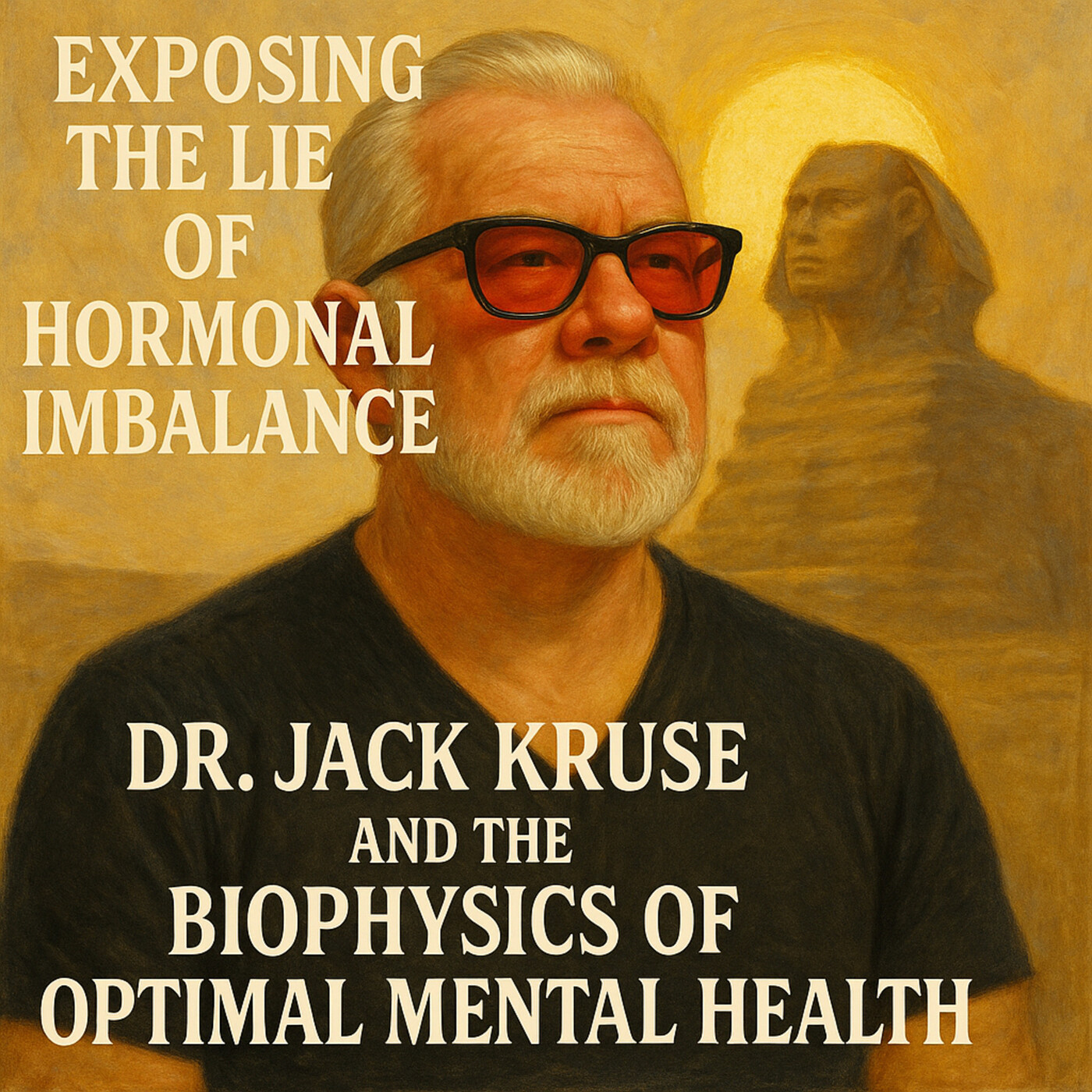
Exposing the Lie of Hormonal Imbalance: Dr. Jack Kruse and the Biophysics of Optimal Mental Health - Smuggling Hope - Podcast on iVoox
Listen to this episode of Smuggling Hope for free on iVoox. In this episode, we talk to neurosurgeon and health visionary Dr. Jack Kruse. His work ...