
Aurelius
npub1jvfn...ay5j
The United States has added four Tron blockchain wallets linked to Iran’s central bank to its sanctions list. The move came after a ceasefire agreement between the United States and Iran broke down, followed by the resumption of airstrikes and drone attacks.
The wallets had received more than $165 million in stablecoins. Tether has frozen approximately $131 million in USDT, although some of the funds had been transferred before the freeze. Including the $344 million frozen in April, Tether has frozen roughly $475 million linked to Iran’s central bank.
According to Elliptic, Iran’s central bank has accumulated at least $507 million in USDT and uses stablecoins to support the country’s currency, the rial. Chainalysis said the four wallets had received funds from an institutional liquidity provider and an Asia-based payment processor.
The latest action expands existing sanctions rather than imposing new ones. Iran’s central bank has been subject to U.S. counterterrorism sanctions since 2019 for supporting the Islamic Revolutionary Guard Corps-Qods Force and Hezbollah.
The sanctioned wallet addresses will be screened by exchanges, custodians, and compliance firms. The frozen USDT remains visible on the blockchain, but the wallets can no longer transfer or redeem the tokens. However, the freeze does not amount to a seizure, and the funds remain in wallets controlled by Iran’s central bank.
The U.S. Treasury Department’s Office of Foreign Assets Control (OFAC) added four TRON addresses linked to Iran’s central bank to its sanctions list. Tether subsequently froze approximately $131 million worth of USDT held in those addresses.
TXGHxdYbGy574z5hBu4LNzq9NzjZQ9bhUf
TJdgB1k6ot3f2nLuZug6D8eD3HavTmzmSK
TAhwhFv3JpK39Nc2m8W5LPCcoTisutiRfp
TFQbqaNbmq2xsVor2NbufLkYZvxFC9wC7k
Tether Official Statement: "Tether Supports Freeze of More Than $344 Million in USD₮ in Coordination with OFAC and U.S. Law Enforcement," April 23, 2026, amount frozen exceeded $344 million USDT.
Tether Official Statement: "Tether Acknowledged by U.S. Authorities for Freezing $1.6M Connected to Terrorism Financing," July 24, 2025, amount frozen approximately $1.6 million USDT.
U.S. Department of Justice Official Document: "Largest Ever Seizure of Funds Related to Crypto Confidence Scams," June 18, 2025, involving and applying for the seizure of over $225.3 million in cryptocurrency, including USDT-related funds.
In April 2026, Tether coordinated with relevant U.S. law-enforcement and regulatory agencies to freeze approximately $344 million in USDT held across two addresses.
In January 2026, Tether froze five wallets on the Tron network, involving approximately $182 million in USDT.
In 2025, there was also an action involving the freezing of approximately $112 million in USDT across 112 addresses. In addition, blockchain analysis indicated that between 2023 and 2025, Tether froze approximately $3.29 billion in total, involving thousands of addresses.
It is important to distinguish between “freezing,” “confiscation,” and “burning.”
Tether’s official announcement: “Tether Supports Freeze of More Than $344 Million in USD₮ in Coordination with OFAC and U.S. Law Enforcement.” The announcement was published on April 23, 2026. It stated that Tether coordinated with the U.S. Office of Foreign Assets Control (OFAC) and U.S. law-enforcement agencies to freeze more than $344 million in USDT across two addresses. It also stated that the addresses were believed to be associated with illegal activity, sanctions evasion, or criminal networks. The page explained that the purpose of the freeze was to prevent the funds from being moved.
Tether’s official announcement: “Tether Acknowledged by U.S. Authorities for Freezing $1.6M Connected to Terrorism Financing.” The announcement was published on July 24, 2025. It stated that Tether assisted U.S. law-enforcement agencies in freezing and reissuing approximately $1.6 million in USDT. The funds were associated with wallets linked to Buy Cash Money and Transfer Company. The announcement also mentioned that Tether had previously assisted in freezing funds connected to Garantex, the Bybit hack, and other law-enforcement cases.
Tether’s official statement: “Tether Supports Freeze of More Than $344 Million in USD₮ in Coordination with OFAC and U.S. Law Enforcement,” published on April 23, 2026, involving more than $344 million in frozen USDT.
Tether’s official statement: “Tether Acknowledged by U.S. Authorities for Freezing $1.6M Connected to Terrorism Financing,” published on July 24, 2025, involving approximately $1.6 million in frozen USDT.
U.S. Department of Justice official document: “Largest Ever Seizure of Funds Related to Crypto Confidence Scams,” published on June 18, 2025. It involved a civil forfeiture action concerning more than $225.3 million in cryptocurrency, including funds related to USDT.
USDT can be frozen because its smart contract is centrally administered and controlled by Tether, with administrator privileges.
When a transfer is processed, the contract checks whether the sending or receiving address is on a blacklist. If Tether adds an address to the blacklist, the contract rejects transfer requests involving that address. The balance may still remain visible on the blockchain, but the address can no longer transfer the USDT through the contract.
To improve dullness, dark spots, and uneven skin tone, the most important things are not layering many “brightening ingredients” at once, but applying sunscreen consistently, reducing irritation, and choosing one or two ingredients that suit your skin for long-term use.
1. The Basic Principles of Skin Brightening
Skin darkening and dark spots are usually related to ultraviolet exposure, inflammation, hormonal changes, acne marks, and the production and transfer of melanin. Common brightening ingredients generally work in several ways.
First, they reduce melanin production, such as arbutin, kojic acid, phenylethyl resorcinol, and vitamin C.
Second, they reduce the transfer of melanin from melanocytes to keratinocytes, such as niacinamide.
Third, they improve inflammatory signals and indirectly reduce pigment formation, such as tranexamic acid.
Fourth, they accelerate skin cell turnover, allowing existing pigmentation to gradually shed, such as alpha hydroxy acids, salicylic acid, and retinoids.
Fifth, they reduce ultraviolet-induced irritation and recurring pigmentation. In other words, sunscreen is essential.
2. Common Brightening Ingredients
Arbutin
Arbutin includes alpha-arbutin and beta-arbutin. It mainly reduces melanin production by inhibiting tyrosinase. Alpha-arbutin is generally considered to have stronger activity, while beta-arbutin is more commonly found in products.
Its advantage is that it is relatively low-irritation. It can be used to improve dullness, acne marks, and mild uneven pigmentation. However, it is generally a mild, supportive ingredient. Results require consistent use over several weeks to several months, so it is not suitable for anyone expecting significant lightening within a few days.
Usage recommendation: It can be used in the morning or evening, together with moisturizer and sunscreen. If your skin is sensitive, start with a low frequency. When choosing a product, pay attention to reputable brands and stable formulations, because arbutin raw materials may require control of hydroquinone impurities. The European Scientific Committee on Consumer Safety has conducted safety assessments of alpha-arbutin and specified safety concentrations for face creams and body lotions, showing that proper formulation and raw-material quality are important.
Tranexamic Acid
Tranexamic acid, also called tranexamic acid or aminomethylbenzoic acid, mainly works by inhibiting inflammation and plasmin-related signals, thereby reducing stimulation of melanocytes. It may be particularly suitable for melasma, post-inflammatory hyperpigmentation, and recurring dark spots.
Topical tranexamic acid is generally safer than oral tranexamic acid. Skincare products commonly contain approximately 2% to 5%, but the actual formulation, penetration, and stability of different products can affect their results. Topical tranexamic acid can be used in the morning and evening, and it can also serve as a long-term maintenance ingredient.
Special attention is needed because oral tranexamic acid is a medication and should not be taken without medical guidance. It may increase the risk of blood clots, especially in people with a history of thrombosis, coagulation disorders, those taking estrogen-containing medications, or those with a relevant family history. Consult a doctor first in these situations.
Niacinamide
Niacinamide is a form of vitamin B3. It mainly reduces the transfer of melanin to keratinocytes. It also has certain oil-control, skin-barrier-supporting, and anti-inflammatory effects.
Common concentrations range from 2% to 5%. For most people, 2% to 5% is already sufficient; a higher concentration is not necessarily better. Products containing 10% or more are not guaranteed to be more effective and may be more likely to cause stinging, redness, itching, and acne-like irritation, especially in people with sensitive skin.
Usage recommendation: Niacinamide is generally easy to combine with moisturizers, sunscreen, tranexamic acid, and arbutin. If it causes obvious redness, reduce the frequency of use or switch to a lower-concentration product.
Vitamin C and Its Derivatives
Vitamin C provides antioxidant benefits, helps reduce melanin formation, and can improve dullness. Common forms include pure vitamin C, also known as ascorbic acid, as well as derivatives such as ascorbyl glucoside, magnesium ascorbyl phosphate, and 3-O-ethyl ascorbic acid.
Pure vitamin C generally has a more direct effect, but it is less stable and is easily affected by light, air, and temperature. It is also more likely to cause stinging. Derivatives are usually gentler and more stable, but their conversion efficiency into active vitamin C may vary.
Usage recommendation: Morning use is common, followed by sunscreen. People with sensitive skin may choose a vitamin C derivative rather than starting with a high concentration of pure vitamin C. Different regions have different regulations and recommended concentrations for various vitamin C derivatives, so do not simply buy a high-concentration product based on online recommendations.
Kojic Acid
Kojic acid can inhibit tyrosinase and is mainly used to improve dark spots and dullness. Its disadvantages include concerns about stability and irritation. Some people may experience redness, stinging, or dryness after using it.
When using kojic acid, it is not advisable to combine it with multiple acids, strong retinoids, or high-concentration pure vitamin C at the same time. For sensitive skin, it is not the first choice. Niacinamide, arbutin, or tranexamic acid may be preferable.
Phenylethyl Resorcinol
Phenylethyl resorcinol, also commonly known as 377, has relatively strong tyrosinase-inhibiting properties and is often used for localized dark spots, acne marks, and uneven skin tone.
Compared with arbutin, it is more of a “stronger” brightening ingredient, but it also requires greater attention to irritation. It is recommended to start by using it every other day rather than combining it immediately with alpha hydroxy acids, salicylic acid, retinol, or similar ingredients. According to relevant information from China, the permitted concentration of phenylethyl resorcinol in cosmetics is 0.5%.
Licorice-Derived Ingredients
Licorice extract, glabridin, and similar ingredients generally have anti-inflammatory, antioxidant, and melanin-production-inhibiting properties. They may be suitable for dullness, acne marks, and skin that is prone to redness.
However, “licorice extract” is a broad term. The specific active ingredients and concentrations can vary considerably between products, so the name alone cannot determine how effective a product will be.
Hydroquinone
Hydroquinone is a relatively powerful pigment-lightening ingredient, but it has stronger medicinal properties. Improper use may cause irritation, contact dermatitis, or abnormal pigmentation. Long-term misuse may also lead to exogenous ochronosis.
Self-directed long-term use is not recommended, and products purchased from unknown sources should be avoided. For stubborn melasma, clearly defined dark spots, or pigmentation that repeatedly worsens, it is best to have a dermatologist determine whether hydroquinone is appropriate.
3. Other Common Skincare Ingredients
Moisturizing Ingredients
Glycerin, hyaluronic acid, panthenol, urea, amino acids, betaine, and trehalose mainly attract and retain moisture.
Ceramides, cholesterol, fatty acids, and squalane are more focused on repairing and supporting the skin barrier. When the skin barrier is unstable, moisturizing and repairing the skin is usually more important than immediately using high-concentration brightening products or exfoliating acids.
Anti-Aging Ingredients
Retinol, retinal, and prescription retinoids can promote skin-cell turnover, improve fine lines and acne, and also help improve hyperpigmentation. However, they can easily cause dryness, peeling, stinging, and sudden sensitivity.
Retinol should be used at night. Start once or twice a week, applying a pea-sized amount to the entire face, and gradually increase the frequency. Use sunscreen during the day while using it. When first starting, it is not advisable to use it together with alpha hydroxy acids, salicylic acid, or high-concentration pure vitamin C.
Peptides are mainly used for anti-wrinkle care and supportive skin repair. They are generally low-irritation, but the evidence and effects vary among different peptides. Not all products labeled as containing “peptides” should be considered powerful anti-aging treatments.
Acne and Oil-Control Ingredients
Salicylic acid can unclog pores and reduce blackheads and closed comedones. It is commonly used by people with oily or acne-prone skin. Usually, it is best to start with low-frequency use and apply it to a small area.
Benzoyl peroxide is mainly used for inflammatory acne. Its ability to kill Cutibacterium acnes is well established, but it may cause dryness and irritation, and it can bleach clothing.
Azelaic acid can improve acne, post-inflammatory hyperpigmentation, and uneven skin tone. It is generally gentler than many strong acids, although it may still cause stinging or dryness at the beginning.
Soothing Ingredients
Panthenol, allantoin, madecassoside, bisabolol, oat extract, dipotassium glycyrrhizate, and similar ingredients are often used to soothe redness and support skin repair.
However, “soothing” does not mean that an ingredient can treat an allergic reaction. If you experience persistent redness, swelling, itching, oozing, or significant peeling, stop using irritating products and seek medical care if necessary.
4. Practical Brightening Skincare Combinations
Basic routine, suitable for most people:
In the morning, use a gentle cleanser, followed by moisturizer. Choose one of the following: niacinamide, arbutin, a vitamin C derivative, or tranexamic acid. Finish with sunscreen.
In the evening, use a gentle cleanser, followed by one of the following: tranexamic acid, arbutin, or niacinamide. Finish with a moisturizer.
Advanced routine, suitable for people with good skin tolerance:
In the morning, use vitamin C or a vitamin C derivative, followed by moisturizer and sunscreen.
In the evening, use tranexamic acid, arbutin, or niacinamide. On one or two separate nights each week, use a low-concentration acid or retinol, but do not layer all of them together on the same night.
For acne marks:
In the morning, prioritize sunscreen. You may choose niacinamide or a vitamin C derivative.
In the evening, you may choose azelaic acid, tranexamic acid, or low-concentration niacinamide. If there is still significant active acne, control the inflammation first; otherwise, new acne marks will continue to develop.
For sensitive skin:
Start with a gentle cleanser, moisturizer, and sunscreen. After keeping your skin stable for one to two weeks, add low-concentration niacinamide, arbutin, or tranexamic acid.
Do not start with high-concentration acids, pure vitamin C, retinol, 377, or multiple brightening serums layered together.
5. The Correct Order for Using Brightening Products
The general order is cleanser, hydrating products, treatment serum, lotion or cream, and sunscreen.
If you are using multiple treatment products, arrange them according to the principle of moving from gentler to more irritating products and from watery textures to creams. In practice, there is no need to pursue a complicated order. It is more important to reduce duplicate ingredients and irritation.
For example, you can use niacinamide or vitamin C in the morning and tranexamic acid or arbutin in the evening. There is no need to layer four or five brightening serums in both the morning and evening.
6. The Most Important Precautions
Sunscreen is the core of skin brightening. Apply a sufficient amount of broad-spectrum sunscreen every day. During outdoor activities, also use a sun hat, umbrella, or mask for additional protection. If you use brightening serums without sunscreen, the results are usually unstable.
Patch-test new products first. Apply a small amount behind the ear or along the jawline, and observe continuously for one to two days. If there is no obvious redness, swelling, itching, or stinging, you can then apply the product to your face.
Introduce only one new ingredient at a time. This makes it easier to determine which product is effective or which product is causing irritation.
If you experience obvious stinging, persistent redness, peeling, swelling, or itching, stop using treatment products first and keep only gentle cleansing, moisturizing, and sunscreen. If symptoms are severe or repeatedly fail to improve, seek medical care.
During pregnancy, when trying to conceive, or while breastfeeding, do not use hydroquinone, prescription retinoids, or oral tranexamic acid without medical guidance. Niacinamide, moisturizing ingredients, and sunscreen are generally more suitable as basic skincare, but the specific formulation and your personal situation still need to be considered.
If a dark spot has an irregular border, grows noticeably within a short period, suddenly changes color, bleeds, or forms a scab, or if there is no improvement after three months of regular skincare, do not rely only on brightening serums. See a dermatologist for an examination.
The simplest and safest approach is to use sunscreen plus one gentle brightening ingredient in the morning, and moisturizer plus another gentle brightening ingredient in the evening. Continue for eight to twelve weeks, then adjust according to your skin’s tolerance and the results. Arbutin is suitable for a gentle approach, tranexamic acid is more suitable for pigmentation and a tendency toward melasma, niacinamide is useful for combining brightening with skin-barrier support, vitamin C is suitable for antioxidant protection and improving dullness, while acids and retinoids require a gradual introduction.
Electrum Multisignature Wallet Creation Process:
1. Each participant creates a wallet separately in Electrum and generates their own 24-word seed phrase. The seed phrase can also be generated separately using the following code:
make_seed(nbits=256, language="english", seed_type="segwit")
Please keep the seed phrase safe and do not share it with anyone. Each participant should then export their wallet’s master public key (xpub) and exchange it with the other participants. Share only the xpub; do not share the seed phrase or private key.
2. After collecting the xpubs of all three participants, create a multisignature wallet in Electrum, for example, a 2-of-3 wallet. Add your own private key and the other two participants’ xpubs.
3. After completing the setup, securely back up the multisignature wallet file and use an address generated by this wallet to receive funds.
4. When spending funds, at least two participants must sign the transaction using their respective private keys before the transaction can be broadcast to the blockchain network.
Tor 🧅: three layers of onion encryption → the entry (guard) node sees my real IP and the chosen circuit 🌐, but doesn’t know where I’m going; the middle relay only forwards between the two layers, seeing neither IP nor destination 🎭; the exit node strips the last layer and sends the request to the target, so it can see the target address and any unencrypted content (if it isn’t HTTPS), and it only sees the IP of the preceding Tor node, so it can’t tell who I am 🚫👤. As long as no one controls both the entry and exit nodes or has global traffic monitoring, Tor provides relatively strong anonymity 🎯.
VPN 🔐: I have a single encrypted tunnel with the VPN server, which can see my real IP, the target IP/domain I’m accessing, and any unencrypted traffic (unless it’s HTTPS), and it can log timestamps and traffic size 📊. “No‑log” is just a business claim; technically the VPN server always has the ability to observe all of that information. For simple encrypted transmission and IP masking, choose a VPN; for more distributed anonymity protection, choose Tor 🌟.

Please start the self-destructing message feature in your end-to-end encrypted software. 🔥
We don’t need a history. 🗑️
Self-destructing messages are just as important 🔥. Encryption can protect data, but some data is only needed for temporary processing and should be deleted once it has served its purpose 🗑️. It doesn’t need to be stored indefinitely. However, some technology companies prefer to retain user data for long periods of time, which increases the risk of leaks and misuse ⚠️. That’s why self-destructing messages are essential: they reduce unnecessary data retention and provide better protection for user privacy 🔒.
More precisely, it should be revised as follows:
1. First, create a wallet for yourself in Electrum by selecting “Create a new seed.” You can generate your own 24-word seed phrase by running the following code separately:
make_seed(nbits=256, language="english", seed_type="segwit")
Store the seed phrase securely. Then export the master public key corresponding to your wallet, namely the xpub, and send it to the other two people.
2. The other two people should each create their own wallets using their own 24-word seed phrases. They should then export and send their respective wallet master public keys, namely their xpubs, to you.
3. After you have received both xpubs, create a multisignature wallet in Electrum, for example, a 2-of-3 wallet. Enter the wallet containing your private keys along with the other two people’s xpubs, complete the setup, and securely save the resulting multisig wallet file. This wallet will contain your private keys and the other two people’s master public keys. In the future, use the multisig addresses to receive funds. When spending funds, the required number of signatures, according to the configuration you selected, must be provided by the corresponding participants before the transaction can be broadcast.
1. First, create a wallet for yourself in Electrum, choose to create a new seed, generate your own 24-word seed, and store it safely. Then export that wallet’s master public key, the xpub, and send it to the other two people.
2. The other two people should each create their own wallets with their own 24-word seed phrases, and then send you their respective xpubs.
3. Once you have all three xpubs, create a new multisig wallet in Electrum, for example 2-of-3, enter all three xpubs, and finish creating it. Save the multisig wallet file properly. After that, use this multisig address for receiving funds, and when spending, the required number of signers you set must each provide their signatures before the transaction can be broadcast.
First, create a wallet for yourself in Electrum, choose to create a new seed, generate your own 24-word seed and store it safely. Then export that wallet’s master public key, the xpub, and send it to the other two people. Each of the other two people should also create their own wallets with their own 24-word seed phrases, then send you their respective xpubs. Once you have all three xpubs, create a new multisig wallet in Electrum, for example 2-of-3, enter all three xpubs, and finish creating it. Save the multisig wallet file properly. After that, use this multisig address for receiving funds, and when spending, the required number of signers you set must each provide their signatures before the transaction can be broadcast.
Use multisignature technology whenever possible instead of relying on a single signature. Write down your seed phrase and private keys on paper for safekeeping, and never enter them into a computer or any other internet-connected device.
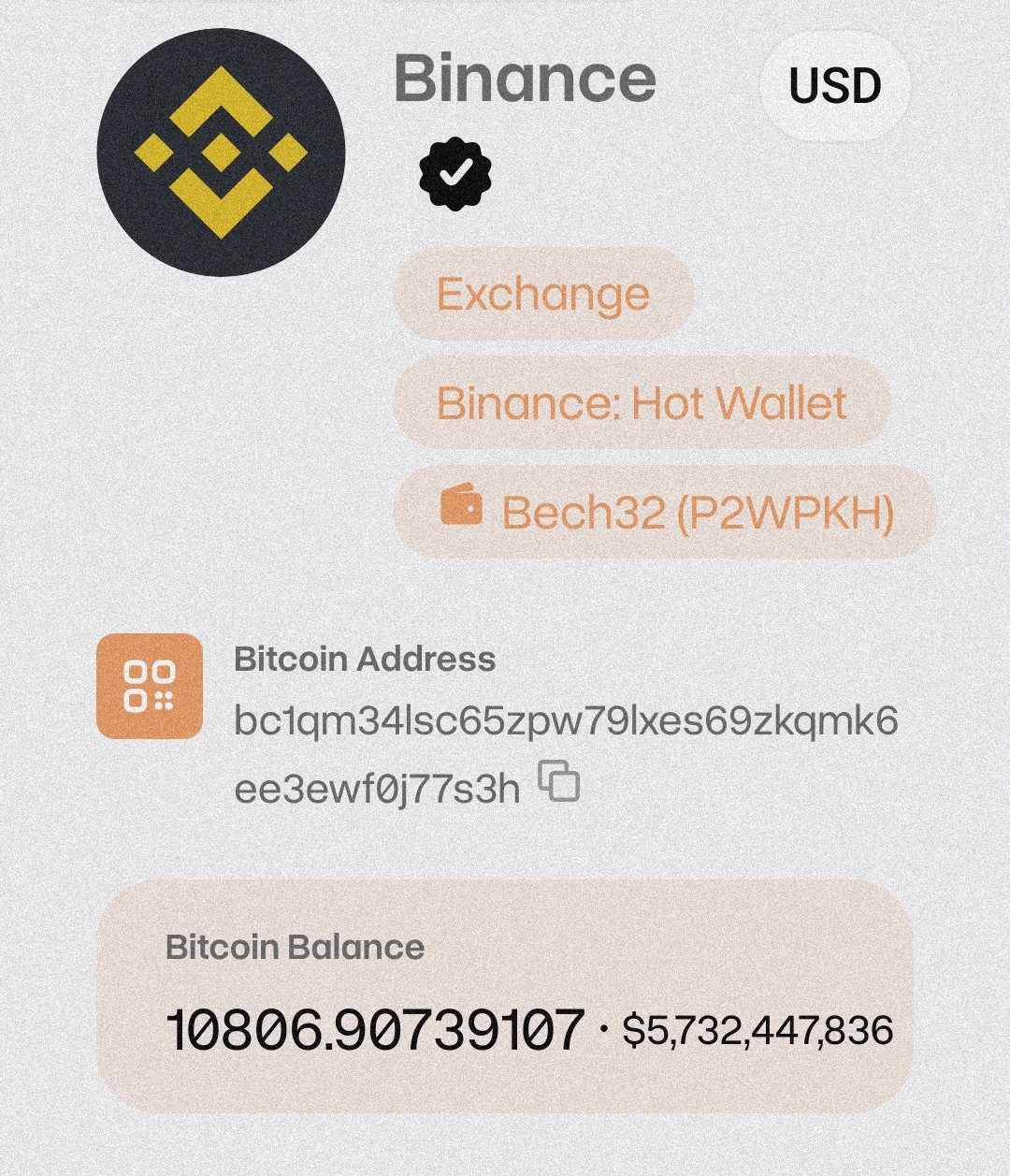 That’s some serious financial muscle 🤯
Absolutely insane!
Binance really does have a massive amount of Bitcoin 💰🚀
That’s some serious financial muscle 🤯
Absolutely insane!
Binance really does have a massive amount of Bitcoin 💰🚀When creating a high-security VeraCrypt encrypted volume, you should choose to create an encrypted file container and employ the AES-Twofish-Serpent cascading encryption algorithm to ensure that data remains secure even if one of the algorithms is compromised in the future, while setting the hash algorithm to SHA-512. During the password setup phase, in addition to using a complex random password of 20 characters or more, you must enable and configure a custom PIM (Personal Iterations Multiplier) value to significantly increase resistance to brute-force attacks by prolonging the key derivation time. Finally, before formatting, move the mouse randomly and irregularly within the window to increase entropy, ensuring that the generated encryption keys possess maximum randomness.
When mounting the volume for actual use, select the corresponding drive slot and specify the encrypted file; you must enter both the password and the previously set custom PIM accurately to successfully unlock the volume. Once inside the virtual disk, files can be read and written just like on a regular hard drive, but you must click "Dismount" immediately after completing your operations to prevent memory remnants or unauthorized access. It is important to note that while the PIM provides a powerful second line of defense, losing it will result in the permanent loss of your data; therefore, this value must be managed with extreme care while pursuing high security.
BIP84 was officially assigned on December 28, 2017.
BIP39 defines the standard for mnemonic seed phrases, converting random entropy into a memorable word list.
BIP32 defines Hierarchical Deterministic (HD) wallets, allowing a full key tree to be derived from a single seed.
BIP44 defines derivation paths for multi-account and multi-coin support to ensure cross-wallet compatibility.
BIP49 introduces SegWit-compatible addresses, which start with the digit 3.
BIP84 introduces native SegWit addresses, which start with bc1 and lower transaction fees.
BIP39 is a technical standard that defines a method for generating a mnemonic seed phrase, allowing users to back up their private keys as a human-readable sequence of words rather than a complex string of alphanumeric characters. It works by generating a random entropy value, adding a checksum to prevent typing errors, and then mapping the resulting binary data to a predefined list of 2048 English words. This seed phrase can then be used to derive a binary seed through a key stretching function, which serves as the root for creating a Hierarchical Deterministic (HD) wallet, ensuring that all subsequent addresses and keys can be fully recovered using only that single set of words.