The Bybit hack has revived long-standing debates about the security trade-offs built into the Ethereum protocol. We cover its reliance on complex, stateful smart contracts, the systemic challenges in its design—and how Bitcoin avoids these pitfalls. 🧵
Blockstream
The Risks of Expressive Smart Contracts: Lessons from the Latest Ethereum Hack
The fresh Bybit exploit in an Ethereum smart contract has revived long-standing debates about the security trade-offs built into the Ethereum proto...

Multisig serves as a fundamental security layer by requiring more than one signer to move funds. On Bitcoin and the
@Liquid Network , implementing this is simple thanks to native opcodes (e.g., OP_CHECKMULTISIG) or Schnorr-based interactivity, keeping the code surface small and secure.
On Ethereum, however, developers must create custom code to emulate multisig—leading to complexity, increased computational demands, and potentially flawed interfaces.

Ethereum contracts must manage on-chain state, handle reentrancy (where an attacker calls a contract in the middle of its own execution), and ensure that the logic for multiple signers is correctly enforced.
Ethereum also uses an account-based model with a universal state tree, meaning each contract update can influence or interact with data used by other contracts.

Mistakes in these areas can introduce critical vulnerabilities, as we have seen with high-profile incidents like the Ethereum Parity wallet hack in 2017 and now with Bybit.

Cointelegraph
Parity Multisig Wallet Hacked, or How Come?post.title.seo-tail
A vulnerability found in the Parity multi-sig wallet contract, let’s dive into what happened there.
In contrast, Bitcoin's UTXO model localizes state changes to individual transactions, reducing the risk that one contract's flaw will leak into another's operation.

While Ethereum contends with repeated contract exploits, Bitcoin and its sidechains are evolving toward more robust multisig approaches. For example, cryptographic schemes like MuSig aggregate multiple signatures into one, making multisig transactions look like standard singlesig. This benefits both privacy and efficiency.
Looking further ahead, the proposed Simplicity language on the
@Liquid Network aims to provide the flexibility of a higher-level scripting language while retaining Bitcoin's careful approach to security.
Blockstream
Simplicity Arrives on Liquid Testnet
Back in 2017, when we first published the Simplicity whitepaper, our mission was to build a smart contracting language that outperforms Bitcoin Sc...
Rather than offering Turing-complete smart contracts, Simplicity focuses on formally verifiable scripts (easier to audit and prove correct) and advanced features like covenants and custom sighash types, all designed to avoid the pitfalls seen with the EVM's unbounded computations.
As the blockchain industry matures, it's increasingly evident that security must be a top-level design choice—not a feature layered on after the fact. This is why we firmly believe that Bitcoin offers the best foundation for capital markets and finance.

Blockstream
Why Bitcoin Offers the Best Foundation For Blockchain-Based Finance
One thing even the harshest Bitcoin critics concede is the revolutionary, world-changing potential of blockchain technology. Despite the recent bea...
For a more comprehensive analysis of the Bybit hack and the underlying flaws in Ethereum's design, read our full report:
Blockstream
The Risks of Expressive Smart Contracts: Lessons from the Latest Ethereum Hack
The fresh Bybit exploit in an Ethereum smart contract has revived long-standing debates about the security trade-offs built into the Ethereum proto...


 Signup for the Live Premiere of this conversation March 4th at 13:00 UTC. ⬇️

 Opportunity details:
🌊 CHF 10,000 sponsorship for a founder or small startup team to live in Lugano.
⚡️ Work closely alongside the Blockstream team on-site for technical expertise and guidance.
🌊 Take your idea to market with a dedicated workspace for designing, prototyping, and launching your product in record time.
Direct application link -->
Opportunity details:
🌊 CHF 10,000 sponsorship for a founder or small startup team to live in Lugano.
⚡️ Work closely alongside the Blockstream team on-site for technical expertise and guidance.
🌊 Take your idea to market with a dedicated workspace for designing, prototyping, and launching your product in record time.
Direct application link --> 
 The new Blockstream Explorer API is designed for developers and businesses needing high-performance, real-time access to Bitcoin and
 Self-custody requires responsibility. Learn more. ⬇️


 Sign up for the Live Premiere February 6th @ 13:00 UTC.
 Pair a Blockstream Metal backup with the new Jade Plus for ultimate Bitcoin security. 🔥🔒
 More ways to transact. More ways to stay secure. Explore now.
 In 2024, we paid out over 2 million sats to 6 contributors for various bounties.
The tasks completed include GitHub Actions improvements, bug fixes, API enhancements, documentation, CI workflow improvements, and database operations.
In 2024, we paid out over 2 million sats to 6 contributors for various bounties.
The tasks completed include GitHub Actions improvements, bug fixes, API enhancements, documentation, CI workflow improvements, and database operations.


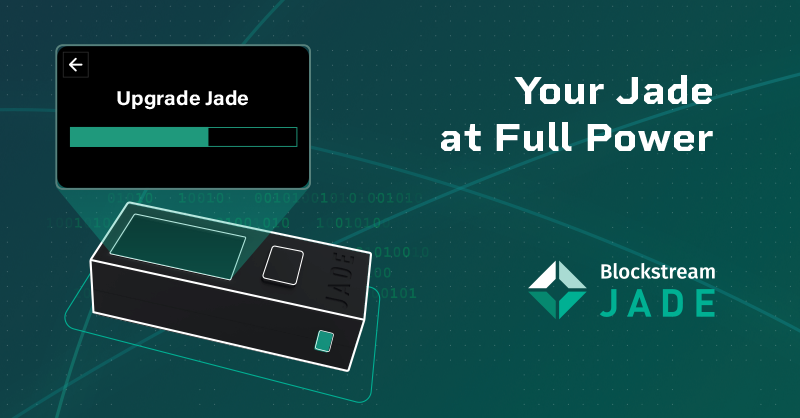
 Learn how to get the most out of this new and improved Bitcoin hardware wallet by Blockstream.
