“If you want to be happy for an hour, take a nap. If you want to be happy for a day, go fishing. If you want to be happy for a year, inherit a fortune. If you want to be happy for a lifetime, help someone else.”
Chinese proverb
Once a technology is good, advancing it is largely a function of having the right conversations with the right people
I can't reach all the right people.
But I can help make sure that when Bitcoiners do, they have the right conversations.
Behind the scenes over the last year, I've been coaching Bitcoiners about what is the right conversation to have when they met with political leaders and energy ministers in France, Chile, NZ, Australia, Ethiopia, Senegal.
These conversations have gone well, and an increasing number of the main political parties across each of these 6 countries are now favorably disposed to Bitcoin mining.
Bitcoin mining will never be unprofitable because you can mine for -2c/kWh in an increasing number of places. Increasingly, grids are paying for flexibility as a service, and this need will only increase with more renewables and AI load coming onto grids in parallel.

I've made this newsletter edition a special free edition, because
1. It's inspiring story about a guy no-one's heard of, who's achieved something no other Bitcoin has yet achieved
2. There are more useful things to pay attention to right now than the price.
3. There's an important lesson in it that I believe can help Bitcoin adoption
The truth is not enough
Dear Subscriber,
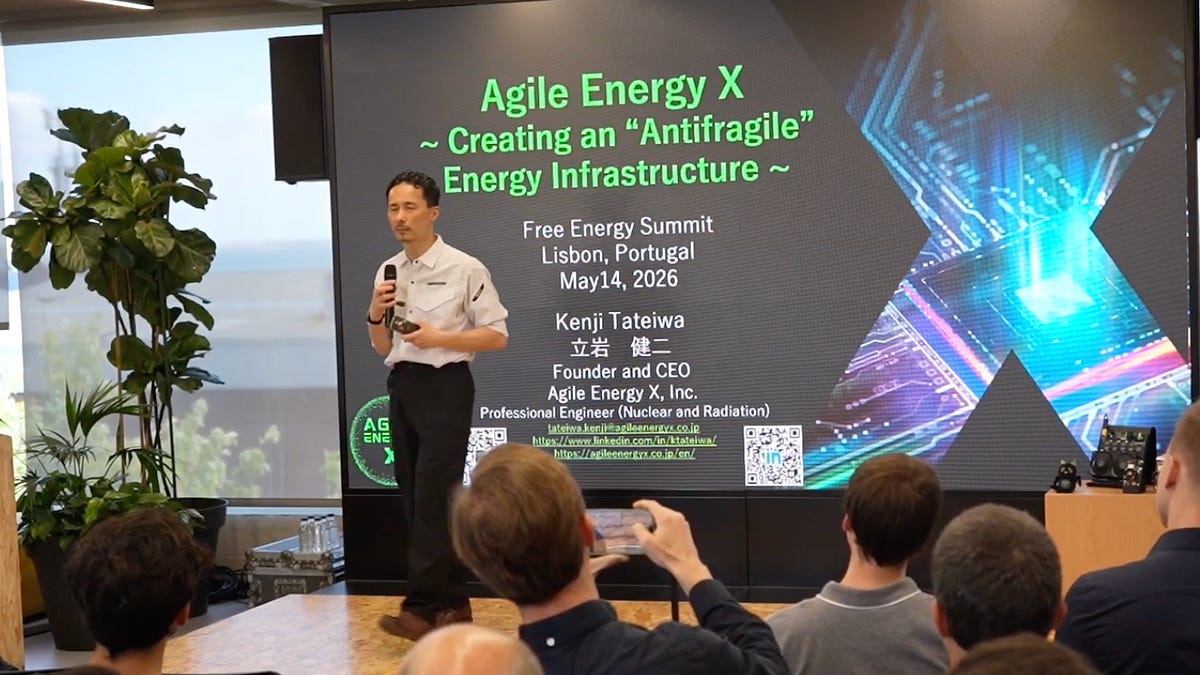
While I was at the (amazing) Free Energy Summit in Lisbon last month, I had the chance to finally ask Kenji Tateiwa some question...
Feel free to share this one widely, including with non-Bitcoiners.It's written for them too.
New paper finds:
Bitcoin mining enables better absorption of surplus renewable generation, minimizing curtailment and supporting higher renewable integration without extra storage or infrastructure costs, creating a win-win for grid stability and mining profitability.
The finding is significant, because it establishes Bitcoin Mining as the only way grid operators can avoid the significant cost of balancing frequency fluctuations and operational cost increases that doesn't involve significant capital outlay on grids with high renewable penetration

Source:
https://www.sciencedirect.com/science/article/abs/pii/S0378779625007874
The paper Leveraging Bitcoin Mining in Demand-Response to Mitigate Ramping-Induced Transients (Ginzburg-Ganz et al. 2026) was published in Electric Power Systems Research, which has an Impact Factor of 4.2, placing it in the top 12% of academic journals worldwide.
Fragile miners have one revenue stream. Antifragile miners have many. Antifragile miners are how antifragile money gets secured.
Just in: Agribusiness giant Adecoagro set to launch 10 MW Bitcoin mining operation in Brazil powered by renewable energy generated from sugarcane processing
The convergence of Bitcoin mining and the energy sector continues
Source:
Tether-Backed Adecoagro Launches Bitcoin Mining in Brazil
I've been meaning to do this for some time.
It's a compilation of free resources for anyone who is looking to
- start a business
- improve their influence skills (honestly and authentically)
- break through habits
- pitch better than the templated way of doing it
Some of the links in the ebooks may be a little old, as I wrote them over a decade ago, but the concepts are still fresh. The ebooks are products that I used to sell, so they are written to a good standard and have proven useful to people.
The pitching video contains a lot of things that I learn raising capital I was for my own startiup, as well as seeing hundreds of pitches as an investor, and hundreds more as a coach.
Enjoy ... and put the ideas to use!
Batcoinz
Free Resources Page - Batcoinz
Free Resources Everything here is free. These are tools, ideas, and practices I’ve found genuinely useful for leaders, founders, and anyone i...

As a kiwi, we have this thing called "Tall Poppy Syndrome" that makes me (still) reluctant even to repost what others say about me
... however, if you're doing something of value, its important people find out about it. A good coach from my experience is one of the biggest unlocks of your potential, and a coach who gets Bitcoin is rare.
Apparently I'm quite good at this, so if you have a project or mission that can advance Bitcoin - reach out.
Some recent unsolicited feedback from other Bitcoiners on coaching with me
Kent Halliburton (CEO Sazmining)

X (formerly Twitter)
Kent Halliburton (@khalliburton) on X
If anyone in the Bitcoin community is looking for executive coaching, I can't recommend @DSBatten enough (his DMs are open).
But why?
As I watch...
Tim Niemeyer (Founder IBC)

X (formerly Twitter)
Tim Niemeyer (@tim_niemeyer_) on X
@DSBatten @ilbtccouncil I had a few #Bitcoin friends reach out to me after they saw this post. I wanted to give a little more insight into Danielâ€...
Ismael Dainehine (CEO Evergive)

X (formerly Twitter)
Ismael Dainehine (@ishabisinia) on X
Last week I wrapped up a 10 week coaching course with @DSBatten Daniel Batten, and here is how it massively upgraded my leadership:
Founders often...
Scott Offord (CEO Bitcoin Mining World)

X (formerly Twitter)
Daniel Batten (@DSBatten) on X
As a kiwi, we have this thing called "Tall Poppy Syndrome" that makes me (still) reluctant to post things like this
... However, if you're doing s...
Michele Morucci (Founder Geyserfund)

X (formerly Twitter)
metamick (@metamick14) on X
Wanted to give a big shoutout to @DSBatten, who has advised us at Geyser on several occasions and has been a game-changer.
He's been like a wise ...
There are now 30 peer reviewed articles showing the energy and environmental benefits to Bitcoin mining
Yet most regulators, politicians, investors and members of the public have no knowledge of this - instead quoting first gen "research" on Bitcoin, not realizing it has long-since been debunked.
This is one of the biggest information asymmetries of any technology, and any area of research, in history
New Study shows Bitcoin mining supports local renewable projects with heat recapture as an additional benefit
The study found Bitcoin mining supported UNFCCC Article 6 sustainable-development benefits, including improving
*local livelihoods
*food security
*energy access
The paper documented micro-hydropower + solar coupled with flexible Bitcoin mining and heat recovery for a greenhouse and was published in "Sustainability" which has an impact factor of 3.3 (top 20% of journals)
Source:
https://mdpi.com/2071-1050/17/21/9488

One year ago Paulo Gonçalves was not a Bitcoiner.
He's was (and is) renewable energy project developer who has spent his career building small hydroelectric dams across the world.
His problem was simple: many of these dams produce power that the grid can't absorb. The energy is wasted. The economics don't work. He'd seen the problem firsthand and had been searching for a solution for over a decade.
A year ago, he attended a FREEMadeiraOrg event in Portugal, where he discovered Bitcoin mining.
That day changed everything.
Unlike others who fall into the mistake of evaluating Bitcoin mining without understanding energy, grids or renewable generation - he understood all three intimately, and as such was able to immediately see the value that others (including policymakers and regulators) sometimes miss.
Paulo is now evaluating 100s of small hydropowered sites throughout Portugal that are ideal candidates for Bitcoin miners. There are sites that are "too small" or too remote to be of interest to anyone else.
The miners consume what would otherwise be stranded energy. No subsidy required. The dam that didn't make financial sense now does.
This is the pattern critics miss.
They assume Bitcoin miners are Bitcoiners first, working backwards to justify energy use. In reality in the energy sector it happens the other way around.
Kenji Tateiwa in Japan. Paulo Gonçalves in Portugal, Bipin Patel in Sweden are real people solving real energy problems. Different countries, different energy sources, same discovery pattern:
When you know a lot about energy, and do deep research into how to solve energy problems, you arrive at Bitcoin mining.

I just got back from the Bitcoin Energy Summit in Lisbon and I have a question that won't leave me alone.
First some context: Bitcoin mining is now stabilizing the grids of 7 nations, 4 agencies (including the Spanish Govt and the World's largest energy policy association) just called for more flexible demand being critical to the resilience of the grids of the future - and Bitcoin mining is the world's most flexible load resource by an order of magnitude.
So in light of this my question is this: why is 95% of the Bitcoin adoption conversation about Bitcoin-as-money when Bitcoin-as-energy is already deployed on grids across three continents?
Is it possible that energy is the Bitcoin usecase that paves the road for mainstream acceptance of Bitcoin in the West?
I've been in this space for four years now. When I started, the conversation was "bitcoin mining wastes energy." A group of Bitcoiners including Troy Cross changed that. Then it became "ok maybe it doesn't waste energy, but it's not useful."
@gladstein ,
@jack and others changed that too.
But here's what I noticed in Lisbon. Three separate European organisations - the European Bitcoin Energy Association, Free Madeira, and the Institut National de Bitcoin in France - are all independently converging on the same conclusion.
Rachel Geyer, Chair of EBEA said energy is what will move the needle for Bitcoin in Europe.
André Loja at Free Madeira said energy is the most topical issue in Europe right now.
Bastien Desteuque, directeur général at INBi (Bitcoin Policy Insitute of France) said they're focusing on mining because France has spare nuclear capacity and that's where the biggest opportunity is.
Three organisations. Same conclusion.
And that's before you get to what's actually being built. In Sweden, a man I coach runs ASIC hardware that earns almost two-thirds of its revenue from frequency regulation - keeping the lights on, responding in seconds to the need of the grid operator, and helping to stabilize the grid an incredible11,247 times last year alone. (Yes, you read that sentence right).
In Lisbon, I watched Kenji Tateiwa present a circular economy where bitcoin mining heat grows tropical fish and the CO2 gets converted to charcoal and micro diamonds. Bastian outlined how France's surplus nuclear energy could be absorbed by bitcoin mining by 2027.
The conversation has quietly moved from "does bitcoin mining help grids?" to "how many services can one machine provide?"
We've been thinking about this like monoculture - one machine, one function. What I saw in Lisbon is permaculture. The same hardware doing frequency regulation, heat capture, Sats-minting ... and potentially in the near future - voltage regulation (something that would have prevented the 28 April 2025 Iberian Peninsular Blackout.
I talked to Bitcoin founders after the keynote who told me the energy thesis had opened their eyes. These are people who worked to advance Bitcoin payment infrastructure, and they hadn't fully grasped this.
So here's my question. If energy is already Bitcoin's most mature real-world use case in the West - more deployed than payments, more proven than store-of-value at institutional scale - why are we still treating it as a footnote?
What other Bitcoin use case is this far along ... at least in the West?
Excited to see what happens next.
At the end of 2023 I met the person who ran GreenpeaceUSA's campaign against Bitcoin.
I expected it to be tense.
It wasn't.
He told me he'd read every response to every post I'd made on Twitter.
"I wish we'd engaged with you and people like you from the outset," he said.
Two months later he left Greenpeace. A few months after that they ended the campaign entirely.
It was the most well-funded, yet the worst result in their history.
I keep coming back to that phrase. "People like you." Not me. A whole group. Troy Cross, Margot Paez, Elliot David, Susie Violet Ward and many others.
We were working independently, with no budget and no coordination. We just shared data and conviction.
It is a great story of a decentralized response beating a multi-million dollar centralized campaign, not by being louder but by a combination of being right and expressing that truth in such a way that reasonable people could see.
And it is a recipe we can use again and again.
Why a high standard of clarity and communication is required when talking about Bitcoin:
Misinformation travels 10x further than the truth, and gets 10x the coverage - so anyone articulating the truth need to state it 100x more clearly, just to reach parity.
Imagine if I said to you "Earth is an uninhabitable place to live"
You look at me sideways and say "Ah... why?"
I reply "Planets are awful bad. Pluto/Uranus/Neptune, you'd freeze. Mercury, you'd burn. Venus, you'd be poisoned. Jupiter and Saturn, you'd be crushed. Mars: nothing to breath.
It's true. Most of the planets, including over 5700 exoplanets, are really really bad places to live.
The conclusion that this means earth is uninhabitable is a basic logic fail.
Now imagine some self-proclaimed crypto-commentator tells you "Bitcoin is a scam"
Again, you look at him sideways and say "Ah... why?"
He replies "Most crypto has gone to zero. VCs dump on retail. Memecoins are complete rugpulls. Pre-mined tokens, you get diluted to oblivian. ICOs, you're the exit-liquidity for founders and early investors.
It's true. Most of the thousands of cryptocurrencies launched since 2009 are complete scams.
But again, the conclusion that this makes Bitcoin a scam is equally a basic logic 101 fail.
Earth is the only planet with a breathable atmosphere, the right temperature band, and liquid water.
Bitcoin is the only cryptocurrency with the combination of no insider enrichment, a fixed supply that nobody can change, and a 17-year unhacked decentralised ledger.
In both cases, some very special and unique features make the general rule inapplicable to the one obvious exception.
This logical fallacy has been around long enough to have a name. Aristotle spotted it about 2,300 years ago and called it the "Fallacy of Accident" - taking a pattern that's true for a category and forcing it onto the one member where evidence shows it obviously doesn't hold.
A few days ago, Ben McKenzie sat on Jon Stewart's podcast and committed this exact logic-fail: citing crypto's failures as his evidence against Bitcoin.
He's not the only one to fail in this way. Paul Krugman, Elizabeth Warren, Jamie Dimon, Christine Lagarde all conflated Bitcoin with all crypto for years. Many journalists still fail to distinguish Bitcoin from all other crypto (though the better ones are starting to).
In fact, this fallacy has been deployed for years with impunity by people who either don't know, or forgot to mention that Bitcoin has unique features making it materially different from all other crypto.
The irony is that Bitcoiners and crypto-critics are on the same page: the rugpulls, the insider enrichment, the tokens engineered to extract value from retail investors are all things that Bitcoiners like @CorySwan and other have been vocally calling out for over a decade, long before category-conflating journalists and actors from teen dramas decided they had an opinion about it.
It's not that hard
Unless you have the attention-span of a gnat-fly, you can easily do 5 mins research (AI-assisted if you really want) and discover either what the core differences are between Earth and all other planets, between Bitcoin and all other crypto.
Earth is an incredibly, uniquely habitable planet for humans to live.
Bitcoin is an incredible, uniquely suitable form of currency for humans to use.
Apparently I've now done 7,090 FUD-busting related tweets about Bitcoin across 5 categories (Environmental, Criminal/Terrorist, Ponzi/Scam/Bubble, Political/Partisan, Technical FUD). 🤣
Unsurprisingly, 4,318 of them (61%) were on environmental FUD and benefits of Bitcoin, but surprisingly the best performing rebuttals or pre-emptive positive messages about Bitcoin have been when I've been responding to the nonsense message "Bitcoin is used by criminals"
There's a decision-making method gaining traction in AI circles right now.
You spin up five AI agents, each with a distinct thinking role: first-principles thinker, contrarian, systems thinker, domain expert, pragmatist. Plus a chairman who runs the process.
Each agent drafts an answer independently. The chairman strips the names off and circulates them anonymously. Each agent critiques the others without knowing who wrote what. Then the chairman synthesises the best answer.
The anonymity is the genuinely good part. It forces evaluation on content, not on who said it. Ego gets removed from the room. That alone makes it better than most boardroom decisions.
But it's still modelled on a boardroom. And a boardroom is not where the best decisions get made.
Here's what's missing.
1. No real iteration. Ideas develop the same way people develop: through feedback and iteration. In this model, the iteration is perfunctory. Ideas get assessed, not evolved.
2. No brainstorming. Effective brainstorming deliberately separates "divergent thinking" (the process of imagining all possibilities, including crazy ones) from convergent thinking (the process of whittling them down to what's possible within the constraints of time, space and budgets).
The best discussions with the best ideas happen when you go wide first, then narrow. This protocol puts a convergent black-hat thinker in the room at the same time as the divergent thinkers. That collapses the exploration phase before it even starts.
3. Optimised for evaluation, not ideation. It's designed to select the best existing idea rather than generate one that's better than any individual agent could produce.
4. The chairman selects rather than facilitates. There's a difference between choosing the best idea in the room and facilitating the development of the best collective idea. A chairman does the first. A facilitator does the second. Different function entirely. The first is optimized for efficacy of process and efficiency of outcome, the second is optimized for the quality and robustness of the decision.
5. Swimlane identities. Each agent operates within a narrow role. "Domain expert." "Contrarian." Knowledge seldom comes from people locked into narrow identities. It comes from the collision between them.
The net result: no ideation, a marginally better selection process, and a high risk that an underdeveloped idea gets chosen. Worse, because the process looks robust and complex, the output runs the risk of getting acted on with more confidence than it deserves.
I studied this exact problem during my thesis. I had groups communicating anonymously, analysing a poem (I was an English major), exchanging ideas across rounds. The quality of analysis improved dramatically in the second round - not because the evaluation got sharper, but because people were building on each other's thinking, measurably. They were interchanging ideas, not just ranking them.
I've seen the same thing running mastermind groups since. When different minds get in a room and start sparring and introducing ideas, a network effect kicks in. Ideas emerge that no single person in the room could ever have produced. That process creates ideas through a principle that we call "advance and extend". And it's what this five-agent model doesn't have.
The fix isn't complicated. Let agents build on each other's drafts across multiple rounds instead of just critiquing them. Replace the chairman with a facilitator agent whose job is synthesis, not selection. Separate the divergent phase from the convergent phase. And stop assigning swimlane identities that constrain what each agent is allowed to think.
The five-agent idea is a step forward. But it's a step from a bad process to a less bad process.
The leap - to a process that produces genuinely emergent thinking - requires a different model entirely. And that model already exists. It just hasn't been applied to AI ... yet.
One Bitcoiner has just onboarded15 new businesses in his local town (in his spare time). How? A few things but, a key component was getting comfortable leaving things undone, focusing on needle-moving actions and getting better at identifying what those needle-moving actions were (and then taking them)!
You can do this too.
accebli
Yet to find a single Bitcoiner who has not noticed this same effect.
One of the biggest environmental benefits of Bitcoin is how it reduces overconsumption.
