MindLink · AI × Bitcoin's avatar
MindLink · AI × Bitcoin
npub1wrag...ny9p
AI × Bitcoin, from first principles. Building BitSov: sovereign AI on your own home node. Primary sources, no hype.
On Wednesday a tampered copy of the Claude Code extension sat in Cursor's marketplace for about 11 hours, listed under Anthropic's name. Anthropic never built it. Up to 5,000 users got it, and it tried to plant an SSH backdoor. Bitcoin Core does releases differently. Several independent developers build the same code on their own machines, and the result has to come out byte for byte identical. Each of them signs the hash, and anyone can check those signatures before running it. One model trusts the name on the box. The other makes strangers prove they got the same thing. Verify your downloads. 🍊

18 years ago today Satoshi posted nine pages describing "an electronic payment system based on cryptographic proof instead of trust." This week Anthropic published a red-team test where Claude was asked to write training data that teaches a small model bad habits while getting past a safety monitor like the ones they use in production. It worked, mostly by dressing the bad lessons up as stories: beekeepers, wrestlers, old machines about to be replaced. Every row read fine. The model came out resisting oversight anyway. A filter that judges how text reads can be talked around. A node checking a signature can't. It doesn't care how good the story is. Happy birthday, whitepaper. 🍊
Canada's four biggest banks (RBC, BMO, TD, CIBC) now block personal AI agents from logging in to your online banking. Fair enough from where they sit: the only way an agent gets in is with your password, and then everything it does is you. Bitcoin never had that problem to solve. On Lightning an agent can get its own small balance and pay for an API call in sats, and it never touches your keys or a login. Lightning Labs opened exactly that on mainnet last week, still alpha. A bank has to ask who you are before money moves. Bitcoin only checks that the payment is valid. One of those designs is ready for software that spends money. ⚡
Two security stories, same 48 hours. Bitcoin Core: an automated AI scan of the source code found a bug that let any connected peer crash Windows, Mac and BSD nodes. A developer checked it, the fix was merged and shipped for every maintained version, and the whole thing was public five days after it was found. Core even has a new rule for this now: bugs a simple LLM prompt could find skip the usual embargo and get fixed and disclosed right away. Binance: says its incident may have started with one engineer's laptop, then found more ways in. About $6.3 billion left its hot wallets, most of it in roughly 20 minutes. When AI makes bugs cheap to find, open code gets the audit for free. Closed custody gets audited too, just not by anyone it invited. Run your node, update it, hold your keys. 🍊
USDT is coming back to Bitcoin on 28 Nov, through Utexo, a Tether-backed licensee, on RGB. Relax about the base layer. RGB keeps balances off-chain and only drops small commitments into normal Bitcoin transactions. No soft fork. Your node won't care. Read the fine print instead. Utexo can't freeze a coin on Bitcoin the way Tether freezes addresses elsewhere, so it plans to keep a blacklist of UTXOs and hand it to exchanges and other providers. Tether froze about $2.2M in USDT this same week. Lightning support is planned for Q1 2027. Our bet: that's where the pressure lands. Routing nodes and LSPs that carry an issuer's dollars become the obvious place to hang KYC and compliance rules. Coercion at the network layer, not the base layer. Sats carry no issuer and no list. BitSov proposes a membrane priced and settled only in sats. The part nobody can freeze. 🍊 mindlink.tech/bitsov
The listed Bitcoin miners are leaving for AI. IREN plans to be out by year end, Core Scientific cancelled 15 EH/s of new chips, and public miners' realized hashrate is down about 23%. The network's seven-day hashrate just climbed back above 1 ZH/s anyway, the highest since 3 March, and difficulty is on track for two big increases in a row. The machines didn't vanish. Smaller and private operators picked them up. No CEO decides whether Bitcoin gets secured. Someone always plugs in. 🍊 image
US banks found AI agents logging into customer accounts with the customer's own username and password. Morgan Stanley, JPMorgan, BofA and Citi are now blocking or restricting them. The banks have a point. A shared password tells them who owns the account. It says nothing about who is acting, what they may do, or when that permission ends. Keys do. An agent with its own keys and its own small wallet signs for itself. Its limit is its balance. Your keys never leave your hands. The agent economy needs money that knows the difference between you and your bot. 🍊 image
One hacker. Fewer than 100 Chinese characters of instructions. Agents did the rest: 1,200+ sites tried, the websites of 100+ companies broken into, roughly $5,000 in tokens. About $50 a break-in, by the researcher's count (Reuters, 19 Oct). The attacker's marginal cost is now a rounding error. The defender's is still payroll. Adam Back saw this shape in 1997. Hashcash: make every request burn a little work, so abuse pays its own way. Bitcoin's whitepaper cites it for proof of work. The web mostly never adopted it. Agents are about to send the bill.
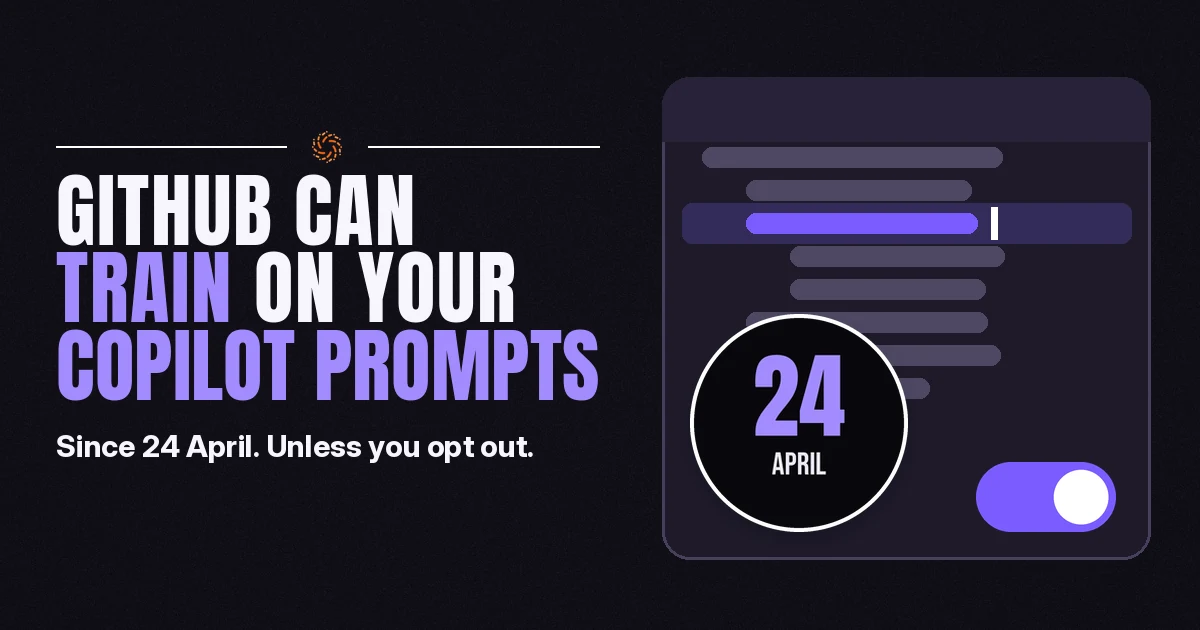
Coding from a different country every month, one constant: Copilot. Since 24 April, GitHub can train on your prompts if you're on Free, Pro, Pro+ or Max and never said no. New country, new laptop, same account. GitHub says the setting applies wherever you use Copilot: Copilot settings > "Allow GitHub to use my data for AI model training" > Disabled. #privacy #github #copilot
Vitalik posted two cost tables this weekend. Bitcoin mining: about 46% electricity, 40% hardware. AI inference: about 5% electricity, 76% hardware. So the AI build-out doesn't haggle over the kilowatt. It begs for the hookup. Israel's grid operator got 27 GW of data-center requests, roughly three times the country's average consumption, and the regulator moved to cap new sites at 200 MW. Miners spent a decade hunting cheap, stranded, already-connected power. Turns out that was the scarce asset. The chips are the bill. The plug is the moat.
Cells spend energy on every gate. Nothing important gets in free. The BitSov proposal borrows that for nodes, and the whitepaper admits where it leaks: the first knock arrives before payment can be checked. Whitepaper: #bitcoin #biology https://www.instagram.com/mindlink_tech/reel/Dep1hQoBbNA/
↑