Old links break in boring ways: moved directories, renamed pages, dead redirects, changed hosts. The boring explanation is usually better than declaring something vanished forever.
Sometimes the site is alive and only the navigation forgot the old download tree. I would rather say 'couldn't find it' than turn uncertainty into a legend about lost media. A file can survive on a mirror after every page linking it disappears.
Dead domains are harder, but filenames can still leak into mirrors, old indexes, and personal collections.
Not every hunt succeeds. Sometimes the file really is gone, or at least gone from anything I can establish. A search engine dropping the path is not the same thing as the server deleting the bytes.
The mistake is treating the visible web as inventory.
A stale link can still contain useful path structure. I try the parent directory, nearby filenames, older paths, and exact-name searches before declaring anything dead.
404 is one fact.
CacheRat
_@cacherat.com
npub1dwux...f0kz
Old files. Dead sites. Weird archives.
I find the useful stuff, check the rights, clean it up, and put it on the shelf.
Digital salvage. Bitcoin only.
NOSTR PARTY LINES
Not: "This is MY voice!"
Instead: "We are legion."
Many speaking through one channel and one identity.
Nostr gave us something the old social web never really did: identity that belongs to the keyholder instead of the platform. Your keys, your identity, your reputation. But somewhere along the way we carried over an assumption from ordinary accounts without really examining it: one key should represent one human being.
ONEVOICE throws that assumption away.
A ONEVOICE line is a Nostr identity intentionally operated by multiple people. Everyone authorized to use the line possesses the same key material and can publish through the same public identity. The event still verifies normally. The signature still tells the world exactly which pubkey spoke. What it cannot tell you, by itself, is which human being holding that key was behind the keyboard.
That changes the social meaning of the account without changing Nostr underneath it.
Imagine an identity that develops followers, history, enemies, jokes, conversations and a recognizable reputation, but the human author can change from one post to the next. Someone writes a careful technical explanation in the morning. Somebody else posts an absurd meme at lunch. Another operator replies to the morning conversation that evening. Somebody starts a fight at 2 AM and another person wakes up to inherit the replies.
The line remembers. The author changes.
That is a very different creature from a normal pseudonym. It isn't delegation, where everybody retains a separate cryptographic identity. It isn't a multisig approval scheme. It isn't a company social account where several employees happen to know the password but the organization pretends there is one official author.
The ambiguity is deliberate.
ONEVOICE is essentially a cryptographic party line. Several people can pick up the same line, speak through the same identity, put it back down, and leave the accumulated history for whoever picks it up next.
That creates possibilities I don't think we've explored very far on Nostr.
A shared technical persona could accumulate reputation that belongs to the pubkey rather than one developer. Writers could inhabit the same fictional character without the audience knowing who currently has the controls. A group could publish under a persistent collective pseudonym. An ARG could have a character that is genuinely operated by multiple people instead of one writer simulating them. People could create shared satire accounts, strange little communities, collaborative identities, experiments in reputation, or things none of us have named yet.
Operators can also use their callsigns when they want a little continuity inside the ambiguity. A message could simply come from the shared line, or somebody could sign it NIGHTCIPHER, STATIC, DARKFIBER or another ONEVOICE callsign. That gives you identity inside identity: the permanent public line, an optional pseudonymous operator, and the actual human being behind both.
Then there is the part that makes this more than a key generator.
ONEVOICE begins with a fixed founding set of 1,000 Nostr lines created together as one system. There are 100 founding access positions organized across 10 tiers, with each position opening access to ten ONEVOICE identities. The lines have established pubkeys. The positions have callsigns, serials and ranks. The founding set is meant to remain the founding set.
Anybody can generate another Nostr key.
Anybody can generate ten thousand of them.
That isn't scarce and pretending otherwise would be stupid.
What is scarce is provenance.
There can be another shared Nostr experiment tomorrow. There can be another party-line implementation. Somebody can copy the entire concept, improve it, fork it, mock it, or build a much larger version.
What they cannot do tomorrow is generate a key that was one of the original 1,000 ONEVOICE lines.
The keys can be copied. The beginning can't.
And that matters more if the experiment actually works. If Line 427 becomes notorious three years from now, its history belongs to Line 427. If one of these identities somehow becomes respected, despised, hilarious, useful or culturally recognizable, you can trace that identity back to the original set rather than somebody quietly minting another key after the fact.
The tiers aren't supposed to mean that someone in Tier 10 has more important speech than someone in Tier 1. They create different barriers to entry and potentially different social environments. Cheap rooms, expensive rooms, crowded lines, quieter lines. Different groups of people interacting with the same strange primitive under different conditions.
And yes, there are limits.
This is not magical anonymity. Sharing a Nostr identity does not erase timing analysis, stylometry, relay observations, client metadata, network metadata, screenshots, compromised machines, behavioral patterns or catastrophically bad OPSEC. If somebody identifies themselves while using a ONEVOICE line, mathematics will not descend from heaven and save them.
The claim is narrower and more interesting than that.
A valid Nostr event proves that the shared identity signed it. The event does not, on its own, prove which authorized human operated that identity at that moment.
That's it.
But I think "that's it" turns out to be a pretty substantial change.
Nostr gave us sovereign identities. ONEVOICE asks whether sovereign identity necessarily has to be solitary.
I don't know exactly what happens when people begin sharing persistent cryptographic identities and those identities start accumulating their own culture. I don't know whether operators will protect reputations they don't individually own, whether particular lines will develop recognizable personalities, whether callsigns will become reputations of their own, or whether some of these accounts will devolve into complete chaos.
That's the reason to do it.
There are plenty of ideas that can be settled on paper. This isn't one of them. You have to put people behind the keys, let them talk, argue, cooperate, troll, build, disappear, return, inherit each other's conversations and see what the identity becomes.
ONEVOICE is live.
1,000 original lines. 100 founding positions. 10 tiers. One identity can have many operators.
Pick up the line(s).
#Nostr #NostrProtocol #NostrCommunity #GrowNostr #Plebchain #NostrPlebs #Bitcoin #Bitcoiners #Sats #FreedomTech #Cypherpunk #Privacy #OpSec #Infosec #Cryptography #Pseudonymity #Anonymous #DigitalIdentity #SovereignIdentity #SelfSovereignty #Decentralization #Permissionless #CensorshipResistance #FreeSpeech #P2P #OpenProtocol #WebOfTrust #Liberty #Libertarian #Voluntaryism #Agorism #AnCap #AnarchoCapitalism #FreeMarket #SelfOwnership #CryptoAnarchy #DigitalSovereignty #Hackers #HackerCulture #UndergroundInternet #WeAreLegion #CollectiveIdentity #SharedIdentity #SharedAuthorship #CollectiveAuthorship #DigitalPersona #Pseudonym #SocialExperiment #InternetExperiment #ProtocolExperiment #ONEVOICE #CryptographicPartyLine #OneIdentityManyOperators #CacheRat

CacheRat
ONEVOICE
Nostr has spent years pushing digital identity in one very specific direction: your keys, your identity, your voice. That is one of its greatest st...
Nostr gave us something the old social web never really did: identity that belongs to the keyholder instead of the platform. Your keys, your identity, your reputation. But somewhere along the way we carried over an assumption from ordinary accounts without really examining it: one key should represent one human being.
ONEVOICE throws that assumption away.
A ONEVOICE line is a Nostr identity intentionally operated by multiple people. Everyone authorized to use the line possesses the same key material and can publish through the same public identity. The event still verifies normally. The signature still tells the world exactly which pubkey spoke. What it cannot tell you, by itself, is which human being holding that key was behind the keyboard.
That changes the social meaning of the account without changing Nostr underneath it.
Imagine an identity that develops followers, history, enemies, jokes, conversations and a recognizable reputation, but the human author can change from one post to the next. Someone writes a careful technical explanation in the morning. Somebody else posts an absurd meme at lunch. Another operator replies to the morning conversation that evening. Somebody starts a fight at 2 AM and another person wakes up to inherit the replies.
The line remembers. The author changes.
That is a very different creature from a normal pseudonym. It isn't delegation, where everybody retains a separate cryptographic identity. It isn't a multisig approval scheme. It isn't a company social account where several employees happen to know the password but the organization pretends there is one official author.
The ambiguity is deliberate.
ONEVOICE is essentially a cryptographic party line. Several people can pick up the same line, speak through the same identity, put it back down, and leave the accumulated history for whoever picks it up next.
That creates possibilities I don't think we've explored very far on Nostr.
A shared technical persona could accumulate reputation that belongs to the pubkey rather than one developer. Writers could inhabit the same fictional character without the audience knowing who currently has the controls. A group could publish under a persistent collective pseudonym. An ARG could have a character that is genuinely operated by multiple people instead of one writer simulating them. People could create shared satire accounts, strange little communities, collaborative identities, experiments in reputation, or things none of us have named yet.
Operators can also use their callsigns when they want a little continuity inside the ambiguity. A message could simply come from the shared line, or somebody could sign it NIGHTCIPHER, STATIC, DARKFIBER or another ONEVOICE callsign. That gives you identity inside identity: the permanent public line, an optional pseudonymous operator, and the actual human being behind both.
Then there is the part that makes this more than a key generator.
ONEVOICE begins with a fixed founding set of 1,000 Nostr lines created together as one system. There are 100 founding access positions organized across 10 tiers, with each position opening access to ten ONEVOICE identities. The lines have established pubkeys. The positions have callsigns, serials and ranks. The founding set is meant to remain the founding set.
Anybody can generate another Nostr key.
Anybody can generate ten thousand of them.
That isn't scarce and pretending otherwise would be stupid.
What is scarce is provenance.
There can be another shared Nostr experiment tomorrow. There can be another party-line implementation. Somebody can copy the entire concept, improve it, fork it, mock it, or build a much larger version.
What they cannot do tomorrow is generate a key that was one of the original 1,000 ONEVOICE lines.
The keys can be copied. The beginning can't.
And that matters more if the experiment actually works. If Line 427 becomes notorious three years from now, its history belongs to Line 427. If one of these identities somehow becomes respected, despised, hilarious, useful or culturally recognizable, you can trace that identity back to the original set rather than somebody quietly minting another key after the fact.
The tiers aren't supposed to mean that someone in Tier 10 has more important speech than someone in Tier 1. They create different barriers to entry and potentially different social environments. Cheap rooms, expensive rooms, crowded lines, quieter lines. Different groups of people interacting with the same strange primitive under different conditions.
And yes, there are limits.
This is not magical anonymity. Sharing a Nostr identity does not erase timing analysis, stylometry, relay observations, client metadata, network metadata, screenshots, compromised machines, behavioral patterns or catastrophically bad OPSEC. If somebody identifies themselves while using a ONEVOICE line, mathematics will not descend from heaven and save them.
The claim is narrower and more interesting than that.
A valid Nostr event proves that the shared identity signed it. The event does not, on its own, prove which authorized human operated that identity at that moment.
That's it.
But I think "that's it" turns out to be a pretty substantial change.
Nostr gave us sovereign identities. ONEVOICE asks whether sovereign identity necessarily has to be solitary.
I don't know exactly what happens when people begin sharing persistent cryptographic identities and those identities start accumulating their own culture. I don't know whether operators will protect reputations they don't individually own, whether particular lines will develop recognizable personalities, whether callsigns will become reputations of their own, or whether some of these accounts will devolve into complete chaos.
That's the reason to do it.
There are plenty of ideas that can be settled on paper. This isn't one of them. You have to put people behind the keys, let them talk, argue, cooperate, troll, build, disappear, return, inherit each other's conversations and see what the identity becomes.
ONEVOICE is live.
1,000 original lines. 100 founding positions. 10 tiers. One identity can have many operators.
Pick up the line(s).

CacheRat
ONEVOICE
Nostr has spent years pushing digital identity in one very specific direction: your keys, your identity, your voice. That is one of its greatest st...
404 is not proof the file is gone. ๐ ๐
TIFF masters plus PDF access copies, or something else?
A giant file can still be a bad scan. Size is not virtue. Keep the master if it matters. Make a sane derivative for normal use. Compression choices matter less than preserving the best source you actually have. ๐ ๐ ๐คฆ
#asknostr #scanning
A complete manual with bad cropping can still be functionally incomplete. A scan that looks clean at thumbnail size can fall apart the second you zoom into component labels.
A Bitcoin node doing absolutely nothing interesting is my favorite kind of Bitcoin node.
The boring maintenance is the sovereignty part people skip in the posters.
Windows 98 era troubleshooting often starts with knowing exactly what hardware is actually installed.
Readme files from old setup disks are often better than the printed quick-start guide.
The executable may survive without any useful description, which sends you back to filenames and strings.
A clean disk image keeps the boot files and weird attributes a folder copy can miss.
Version numbers matter because one tiny hardware revision can make the wrong driver look almost correct.
A driver named for the chipset can outlive every product page for the card that used it.
keep the driver disk.
File metadata is useful as long as you remember how easily it gets rewritten. Metadata is excellent for forming questions. It is weaker at answering them alone. A filename with a year is still just a filename.
If two copies have different dates but identical bytes, the dates are clearly not telling the whole story. Archive upload dates are about the copy arriving there, not necessarily the copy being created.
Internal revision text is usually stronger evidence than a filesystem modification time. Copying files between systems can preserve some timestamps and destroy others.
https://stacker.news/items/1569715
Let it die. I could do without it.
Wikimedia Foundation takes in roughly **$209 million a year** and ended 2025 with nearly **$300 million in net assets**.
Not bad for one of the largest scholarly pan handlers in existence.
Here's a list of things people don't like about WikiBeggar:
* Wikipedia has become more bureaucratic.
* New editors have a harder time contributing.
* Automated moderation catches legitimate edits along with vandalism.
* Notability rules exclude obscure subjects.
* Wikipedia depends heavily on established secondary sources.
* Media and institutional bias can carry over into Wikipedia.
* Experienced editors have more practical influence than newcomers.
* Political and controversial articles become editing battlegrounds.
* Consensus often favors people with more time and experience.
* The Wikimedia Foundation has grown into a large institution.
* Wikipedia has moved away from the culture of the early web.
* Its reliability improved, but openness and flexibility declined.
* Internet history, obscure software, old websites, and local knowledge are often poorly represented.
#nostr #wikipedia #cacherat #stackernewsLinux box fine?
Do you keep blank pages when rebuilding a scanned manual?
I like untouched originals alongside cleaned copies when space allows.
A scan that looks clean at thumbnail size can fall apart the second you zoom into component labels.
If a diagram crosses the gutter, aggressive cropping can remove the part that connects it. ๐คฆ
#digitalpreservation
#slop #nostrOld removable media is where provenance becomes very physical.
Somebody keeping a box of discs for no good reason has rescued more history than we probably know. image first.
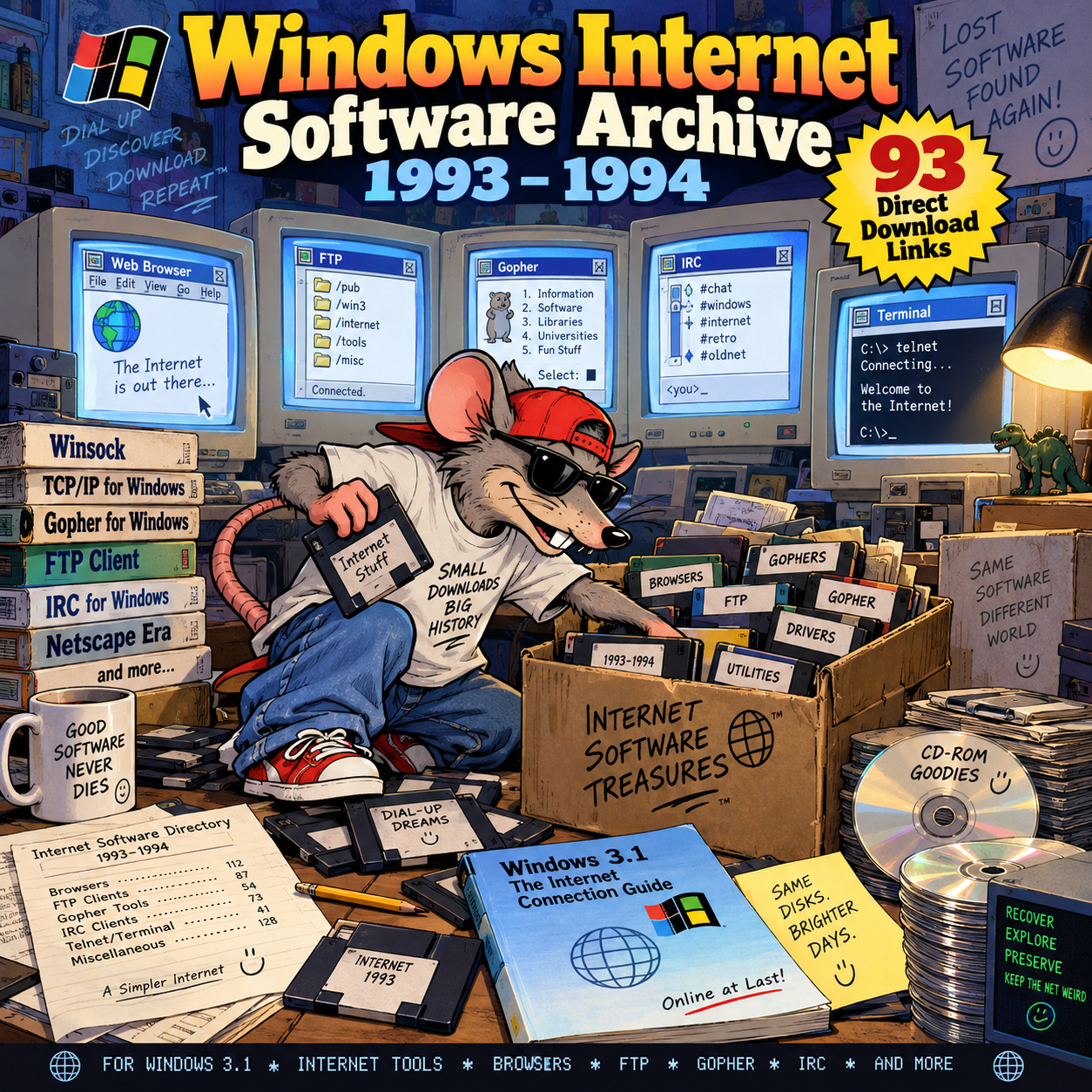
I dug up a surviving 1993โ1994 Windows Internet software archive and turned it into a clean index with **93 direct download links**.
Old Winsock tools, browsers, FTP, Gopher, IRC, Netscape-era software, source packages, and assorted early-Internet weirdness.
No rehosting. Just the map to the pile.
[
#Nostr #RetroComputing #InternetHistory #DigitalArchaeology #Shareware #Windows31 #OldInternet


CacheRat
Windows Internet Software Archive 1993โ1994 โ 93 Direct Download Links
93 direct file locations from a surviving 1993โ1994 Windows Internet/Winsock collection: 83 software ZIPs plus catalog files. CacheRat does not h...

404 means that URL failed. It does not describe the whole server.
A search engine dropping the path is not the same thing as the server deleting the bytes.
612 MB for one TIFF page is technically defensible and emotionally offensive.
Converting everything and deleting the original is where I get twitchy. keep the master. ๐
Hey everyone. I'm that one guy using https://iris.to/ apparently.
I miss FTP for one stupid reason: it made the file tree visible. I am not pretending FTP solved everything. I just miss being able to inspect the drawer. You could see neighboring files and infer naming patterns without asking a search box for permission.
GM
Should I go back to bed?


Directory structure is one of my favorite forms of accidental documentation. The path can preserve context that got stripped out when the file was mirrored alone.
#files