Is anyone else getting paranoid that their own writing is starting to sound like AI cliches, because so much of what they read nowadays comes out of an AI.
To be clear, I don't look down on AI writing just because it's AI. I still read it if it's a useful set of ideas, but I see it very differently if you aren't writing it yourself because, *sometimes* (depending on context) it means you just didn't make much of an effort.
Also it's gradually getting less cliched with more recent models. But, gradually.
if you want to know why i always talked down people's belief in hardware wallets, it was not because of what happened with Coldcard, it's because of what just happened (apparently? seeing it rumored via Karpeles on twitter; not sure if it's true) with Ledger: supply chain. They didn't need to tamper the wallet directly, they just created a way to watch it. You buy via the authorized resale agent, but he goes rogue and sells versions with 'implants' that read your seed as you enter it.
*Not advising any particular approach to all this, not even 'don't use hardware wallets!'. just saying - central points of failure matter, you need to think about that *actively* because it's human nature to stay in the herd, even in subtle ways.
Interesting detail that I bet no one else mentions ;)
If you're worried that AI might break the cryptography protecting your coins, it might make sense to switch to taproot. ECDSA is *far* less trustworthy than Schnorr and ECDLP, imho.
Of course no one really has a clue, but that take is not unreasonable.
It's strange but afaict bitrefill.com is permanently blocked in my ISP in Buenos Aires, last 2 months at least. I saw other similar reports from people in Argentina.
Zero problems via VPN. Definitely *some* kind of local block. Weird.
As both users and developers, we're rapidly approaching the point where we have to decide 'is it OK for the software I use for serious things (health, money, privacy etc.) was not fully vetted or fully understood, line-by-line, by expert humans.'
Tests were always a vital part of development. We're going to have to decide if we can rely on them even way more than we do now.
Sorry for being Captain Obvious today...
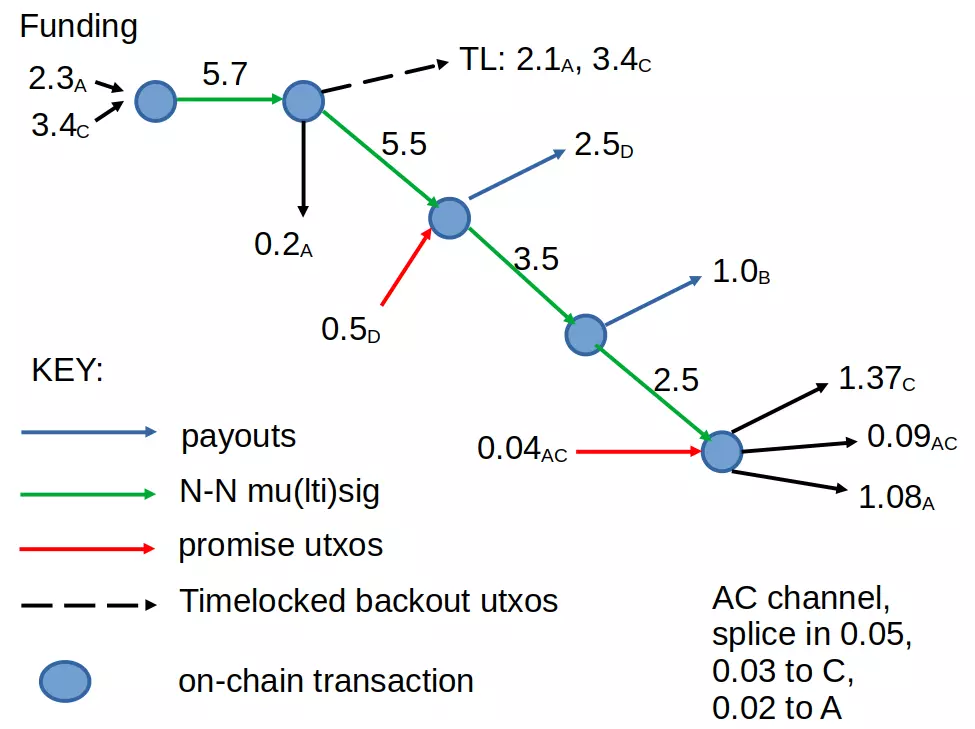
Project I've been working on: "LN-GAP":

GitHub
GitHub - AdamISZ/ln-gap: Lightning governed by arbitrary programs
Lightning governed by arbitrary programs. Contribute to AdamISZ/ln-gap development by creating an account on GitHub.
Play multi-move games or arbitrarily complex contracts in Lightning channels.
Read the linked short paper as per the README, to get an idea of how it works.
Trust model: trustless settlement w.r.t. the counterparty, but needing a 'venue' that is only trusted to publish the 'moves' on time. The venue never controls any funds, doesn't need to process (or understand) the contract, can be drawn randomly from an arbitrarily large set, only 1 of n trust for liveness and majority+counterparty required to collude. Collusion burns reputation and/or bonds.
You can pretty easily run the chess or blackjack examples in the browser.
I think it's a pretty interesting idea, slightly different angle of attack on offchain bitcoin denominated contracts. Draws a lot on many older ideas/constructions, with a few new ideas/details.
This is extremely typical of my interactions with Opus 5.5. I try to make a lighthearted quip about some nerdy thing and it immediately shoots back with a totally dry/deadpan insightful and content-packed answer with the intellect of a thousand suns, or something (*):
"a long time ago when analyzing a similar construction, i somehow convinced myself that the optimum is at e, and that's why 3 or 4 as the base often appears optimal. but knowing me i probably just guessed e by intuition, and it's probably not correct :)
Your intuition was right, and it's a real result. It's called radix economy. If representing a number costs (number of digits) × (cost per digit, proportional to the base), the cost is b · log_b N = (b / ln b) · ln N, which is minimized at b = e. The best integer is 3, slightly better than 2 or 4. That's the classic argument for ternary computers (the Soviet Setun was one)."
(*) OK on reflection, this isn't particularly amazing. But the reference to the Soviet ternary computer is cool. And this output comes in like, milliseconds.
a trick I hadn't seen before to get a random number onto the stack in bitcoin: say Alice and bob post a hash (so a commitment) of a random number, then you want to force them to reveal it in a Script. Using 32 byte values is not useful if you want to do arithmetic; as we all know you can only do arithmetic on "little script": 4 byte values, not 32 byte. Even worse, just hashing '12' is no good; there needs to be a salt so that the commitment is hiding, so more random bytes. Script can't parse the preimage and split it into parts to get the number from '12f3fwrffrsf' to '12'. So here's what you do:
OP_SIZE on the preimage gives a 'little script' number directly. If you want to commit '12' you make a random string *of 12 bytes*, hash it and that's your commitment. It has hiding because the 12 character string is random, and when the preimage is consumed with OP_SIZE you get the number 12 on the stack.
Obviously this is only going to get a smallish number out: I used '12' but i think you could get into the 100s, but not 1000s due to Script limitations. You could do it multiple times though and encode digits that way.
Apparently this trick was already there in a 2013(!) paper:
https://eprint.iacr.org/2013/784.pdf that talks about doing MPC on bitcoin. I wonder if it was unfairly ignored because no one was gonna do MPC on bitcoin back then!
The whole Glock program is as expected, slowly but surely coming together. Basically algebraic garbling is the thing: with that you change a garbled circuit from a 100GB behemoth into some normal sized object. You might still have to throw cut and choose at it, but that's never more than a 100x multiplier. (I admit I haven't read the paper yet, lol, but that's the story that's been brewing all year. I think the Linus/Eagen/Ying Tong thing is somehow closed source so I guess none of us know what the frontier is exactly, unless we pay up!)

Shrinking offchain data requirements for Groth16 verification on Bitcoin
Taking Groth16 garbling from gigabytes to megabytes
Look at this absolute shite your tokens get wasted on:
"The user is asking whether browser fingerprinting is a good example of the kind of high-dimensional, sparse datasets that make deanonymization feasible per Narayanan–Shmatikov. This is a conceptual question, not a current-events question. I know this domain well. I could optionally cite sources — the system prompt says embedding links in markdown with sources is available via tools, and there's an instruction "Use router_search first to discover sources, then router_fetch specific URLs only when you need deeper detail." Also "You may use the router_search and router_fetch tools when current web information would improve the answer."
Hmm, there's also a general instruction: "NEVER write URLs or links." Wait — that conflicts with the citation instructions. The earlier instructions say to cite with clickable markdown links when using tools. The later "General Instructions" say NEVER write URLs or links. In my previous turns I included a link to the GitHub doc. If I don't use tools, I shouldn't fabricate links. I could answer from knowledge without links, which complies with "NEVER write URLs or links." But if I use search, I'd need to cite. The tension: the general instruction says never write URLs or links. In my prior turn, I did write one link to the doc the user themselves gave. That link came from the user, so it's not really "writing a link" discovered via search...." and so on. Like 10 tokens defining my question and then 500 arguing with itself over whether its own rules are self-contradictory 😆
Does libsecp256k1 not expose scalar inversion?
I mean it fits the longstanding philosophy but it's still slightly irritating 😄
Has anyone considered doing Lamport or Winternitz style signatures using dlogs instead of hashes?
First thing I'm noticing: Lamport maps simply, but WOTS uses hash *chains* ; how much additional cleverness might be required for that?
A reasonable question might be 'why on earth would you want to do that?'. I do have an idea for using it, but it takes some explaining...
i can only sympathize with anyone trying to run a bitcoin business (say, a technical one, supporting wallets and similar). if you stick with open source, it seems, you will continue to be attacked directly with the new tooling. if you try to use closed source, your more sensible customers will treat it as it really is - custodial. all combinations are bad: like, custodial, but also open source: guess what you still get attacked. one of the biggest defenses is the simple one: don't be in a big crowd with a big pot of bitcoin under one type of control. the coldcard customers fell victim to that one (though tbh I think the coldcard case was the most extremely unfortunate scenario of everything we 've seen; the Liquid one was also super-unfortunate but not absolutely insanely so).
Closed my Revolut account earlier this year, seems like I was a bit too late.
Who am I kidding, they're all exactly the same.
i did this a few years ago, but i should update it: "What have you used Lightning to buy?". My answer is now: "drinks at bars/events, food (dinner) including sharing the bill with other people, hotel rooms, flights, cellphone bills (both the normal type and esims), electricity bills, water bills, internet bills, taxis, takeaways, groceries (last 3 via gift cards) VPS, VPN, charity donations, trades with friends (usually for USD cash), topping up a debit card, payment for nostr relays, zaps on nostr and LLM model tokens." Probably missed a good few miscellaneous 'buy a thing', but that covers a lot. I have to go via bitrefill for a couple of these, especially internet and electricity bills (in El Salvador; which is also where I got the debit card I can top up with Lightning).
I should also say that 'flights and hotels' being higher cost items, are almost always with btc mainchain or via some other method, but I think I used lightning once or twice here (and will always choose it if I can!). And lastly I should say that having done this for years, with a *self custodial wallet* (I used Electrum a bit but I mostly used Phoenix), I basically *never* have payment routing failures, that used to happen all the time pre-2023.
But apparently I'm all alone because nobody uses Lightning.
Reflections on the Liquid hack.
Take it at different layers:
1/ A central point of failure, even if distributed, holding everyone's funds makes it a brittle design. True. Obviously no nuance there, but it's the first guiding point. It's the reason it's always been way less interesting than a decentralized sidechain would be.
2/ Let's not forget that they *had a whitelist system for exits*. As in, you could not independently peg out, you had to go through a trusted intermediary. This is somehow a failure in 2 opposite directions: it removes reasonable claims of censorship resistance, but, when it came down to it, they also *completely failed to censor* a transaction that no reasonable human-in-the-loop would allow. It's practically a terrible failure, but the whole shape of this problem follows from 1/ so it can never be fully eradicated/corrected.
3/ The software bug was not actually about the cryptography/privacy feature (but wait for 4/ !). It was a logic error in the way that rangeproofs (you can think of them how you think of signatures in normal bitcoin: a little blob of data that proves the transaction is valid) were stored and accessed. it's normal to cache things in software like this that has a significant performance requirement: even simple things like hash functions that are fast. Normal, but of course, it has to be done super carefully (e.g. they have a signature cache in Bitcoin Core) to avoid accepting signatures, rangeproofs and similar, that aren't actually valid. It *was* "just" a software bug, a subtle and tricky one that was easy to miss.
4/ ... Whether 3/ is fair or not as a characterization, here's a surprising feature that *is* absolutely dependent on the cryptography/privacy feature: the *effect* of the bug. Now, it's true that there are non-crypto ways to have catastrophic balance errors, like the 2010 bug in bitcoin that allowed someone to print billions of btc. but not only are they easier if you put the balance arithmetic behind a cryptographic blinding, but they're also easier to be invisible (in Liquid's case, only until you peg out, of course). But it was the crypto structure that allowed this cache hit error to turn into a complete wipeout; if you had some egregious error in signature caching in vanilla bitcoin, I think the worst that can happen is you can steal someone else's money, *not* create bitcoin out of thin air, **because balance checking is not dependent on cryptography, only arithmetic**.
5/ This last one is more in the weeds: as per 3/ caching makes sense because the verifier's computation of the validity of a rangeproof is not free. In fact, this is something specific to bulletproofs as a ZKP: the efficiency of its 'bandwidth' (what has to be sent over the wire; which is also, for a blockchain application, what has to go onchain) comes from essentially folding up the proof's multiple layers into one. the downside is that the verifier has to 'unroll the loop': they have a computational cost linear in the size of the statement. All that's to say, rangeproof verifications are not too efficient. In a different type of ZKP, such as a Groth16 SNARK, the cost of verification is O(1), that is, constant. But that is just not possible on Bitcoin or on bitcoin's EC curve.
Anyone else starting to think they judged Kurzweil too harshly? Just had an AI call me about my home security, which modulated its speech when it realized my cellphone signal was bad. It got the info it needed and politely ended the call.
Then I opened twitter and saw that they had solved Navier Stokes. It's all a bit much.